


Conversational AI insurance revolutionizes trust by optimizing 10 critical micro-journeys in insurance CX. Convin’s advanced tools empower insurers to reduce hidden costs, automate workflows, and enhance customer experience without a major transformation. This strategic adoption addresses fragile trust moments, driving retention and operational excellence in competitive markets.
Conversational AI insurance is an AI technology enabling natural, human-like text or voice interactions with customers. It automates insurance inquiries, claims updates, renewals, and fraud detection efficiently, improving trust and CX.
Let Convin make your CX smarter, not just louder.
Why Conversational AI Insurance Is The Lens Shaping Trust In Insurance CX
Insurance CX leaders are facing a crisis of confidence. Customers don't just want service, they want clarity, immediacy, and consistency. Every misstep erodes trust, and most insurers aren’t even tracking the moments where this happens.
Conversational AI insurance steps in here, not as a silver bullet, but as the lens that reveals these trust-breaking micro-moments. It helps CX and product heads identify where churn starts and where rework happens. It doesn’t demand a full transformation but offers an iterative toolkit to fix what matters first.
- With conversational AI insurance, insurers no longer have to guess where customer experience breaks.
- They can map real conversations, use sentiment analysis in insurance conversations to detect risk, and apply conversational AI intent recognition to guide responses.
- The benefits? Fewer hand-offs, less miscommunication, and measurable improvement in customer satisfaction.
Compliance gaps, rework loops, and operational inefficiencies cost millions, but go unseen. Conversational AI insurance makes these costs visible. From AI chatbot insurance use cases in support of real-time agent assist insurance workflows, the toolset isn’t theoretical; it’s revenue-protecting.
Your competitors are already using conversational AI insurance to map these moments. They’re fixing them in real-time. If you're still relying on legacy scripts and static CX flows, you're losing trust without even realizing it.
The future of insurance trust is agile, data-driven, and responsive. Conversational AI insurance is the lens, and it’s already being used. The only question is: are you looking through it yet?
Micro‑Journey 1: First‑Contact Clarity With Conversational AI Insurance
The very first moment a prospect or customer engages sets the tone for trust.
AI Chatbot Insurance Use Cases For On‑Boarding Clarity
- Automating initial greeting and policy‑eligibility queries.
- Guiding customers to the right product without manual hand‑offs.
- Ensuring uniform disclosure of terms and conditions.
These use cases help convert the “moment of truth” into a consistent experience.
Conversational AI Insurance Benefits: Reducing Confusion And Hand‑Offs
- Faster response results in fewer drop‑outs at first contact.
- Clear, consistent messaging results in lower mis‑selling risk.
- Fewer hand‑offs give better first‑contact resolution.
The benefits of this micro‑journey include improved onboarding KPIs and lower waste.
Voice Recognition Insurance Chatbot Ensuring Identity And Security
- Authenticate voice and speech‑biometrics in real‑time.
- Prevent fraud at first mention and establish trust early.
- Seamlessly route to a live agent only when needed.
Using a voice recognition insurance chatbot early builds a foundation of trust and security.
Once the first contact is nailed, the next micro‑journey kicks in at quoting and comparisons.
Less noise, more insight. Convin filters fast.
This blog is just the start.
Unlock the power of Convin’s AI with a live demo.

Micro‑Journey 2: Quoting And Comparisons Powered By Conversational AI Insurance
When customers request quotes, speed, clarity, and accuracy matter more than ever.
Insurance Customer Experience Uplift Through AI Voice Assistant Insurance
- Instant voice‑bot responses to quote requests.
- Natural‑language dialogue replaces form‑fills.
- 24/7 availability for comparison‑shopping.
This uplifts insurance customer experience by meeting modern expectations of immediacy.

Natural Language Processing Insurance Enabling Rapid Quote Responses
- NLP interprets customer intent (“I need a motor policy for Delhi”).
- Automatically pulls relevant coverage options.
- Reduces manual processing and time to quote.
NLP in insurance is a key enabler of fast, automated responses for quoting.
Conversational AI Intent Recognition Guiding Customers Accurately
- Recognises customer intent (“just checking” vs “ready to buy”).
- Routes flow accordingly: sales vs info.
- Minimises the risk of mis‑handling the quote moment.
Intent recognition makes the quoting journey smarter and more responsive.
Once a quote is accepted, the next micro‑journey is issuing the policy and documentation.
Micro‑Journey 3: Policy Issuance And Documentation With Conversational AI Insurance
The hand‑off from quote to policy issuance is a critical trust moment that insurers often mishandle.
Multilingual Insurance Chatbot Support For Diverse Customer Segments
- Chatbot handles many languages for inbound issuance flows.
- Ensures clear communication for non‑English speakers.
- Reduces errors in documentation due to language misunderstandings.
Multilingual chatbot support removes friction and shows respect for diverse policyholders.
Real‑Time Agent Assist Insurance In Handling Documentation Queries
- Live‑agent assisted by AI prompts during document review.
- Instant retrieval of policy details while on call.
- Ensures agents don’t send wrong documents, reducing re‑work.
- Data point: According to Convin, real‑time agent assist can cut average call processing time by up to 25%.
This micro‑journey converts error‑prone issuance into a streamlined, validated process.
Conversational AI Insurance Benefits: Minimizing Manual Re‑Work
- Fewer incorrect forms, fewer customer follow‑ups.
- Less compliance risk due to missing disclosures.
- Lower operational cost per issuance.
The benefits show up directly in lower costs and improved customer satisfaction.
With the policy issued, you now move into the claims notification micro‑journey where trust is really tested.
Micro‑Journey 4: Claims Notification Via Conversational AI Insurance
When a claim is lodged, every second counts; the customer expects smooth, empathetic service.
AI Chatbot Insurance Use Cases For Immediate Claims Capture
- Chatbot captures the first notice of loss (FNOL) anytime.
- Guides the customer through required fields at the moment of the event.
- Reduces error‑filled reports, delaying processing.
Immediate claims capture by a chatbot means faster acknowledgement and lower frustration.
Sentiment Analysis Insurance Conversations To Detect Stress And Urgency
- AI detects frustration, urgency in customer voice/chat.
- Escalates automatically to a human when the risk of churn is high.
- Prevents call‑backs and long holds.
- Data point: Sentiment analysis in insurance enables proactive escalation and higher retention.
Applying sentiment analysis in insurance elevates emotional intelligence and trust.
Insurance Customer Experience Improved By Conversational AI Insurance Speed
- Faster acknowledgement gives higher CSAT.
- Transparent next‑step prompts provide fewer “where is my claim” calls.
- Consistent messaging equals lower churn in claim flows.
Speed and clarity during claims notification are core benefits of conversational AI insurance.
After notification comes triage and updates, another micro‑journey that needs to be optimized.
Use Convin to skip the churn postmortem.
Micro‑Journey 5: Claims Triage And Updates Through Conversational AI Insurance
The hand‑off from notification to triage is where errors and delays sneak in, and trust erodes.
AI Voice Assistant Insurance Guiding Customers Through Next‑Steps
- Voice assistant explains next steps (“an adjuster will call you within 24 hours”).
- Reduces uncertainty and idle waiting.
- Keeps customers informed and reduces inbound status calls.
A voice assistant in triage lowers anxiety and shows you’re in control.

Natural Language Processing Insurance To Summarise Customer Input
- NLP parses free‑text customer descriptions of damage.
- Auto‑categorises claim severity and required resources.
- Reduces manual triage errors and hand‑offs.
- Data point: According to Convin, document automation and real‑time insights in claims handling can yield up to a 65% reduction in operational costs.
NLP in insurance triage elevates speed and accuracy significantly.
Conversational AI Intent Recognition Applied To Triage Routing
- System recognizes high risk (“total loss”, “injury involved”) vs standard.
- Routes to senior adjusters or fast‑track accordingly.
- Minimises risk of misclassification and compliance gaps.
Intent recognition ensures the right level of triage and builds customer confidence.
Next up: processing payment, renewal alerts, and the related micro‑journey.
Micro‑Journey 6: Payment Processing And Renewal Alerts Via Conversational AI Insurance
Payment and renewal are recurring trust moments: missing them threatens churn and revenue.
Multilingual Insurance Chatbot Support Reminding Customers Proactively
- Chatbot reminds policy‑holders in their preferred language about the upcoming premium.
- Enables payment directly via chat or voice.
- Reduces lapses and attrition.
Multilingual proactive reminders show you value the customer and reduce churn.
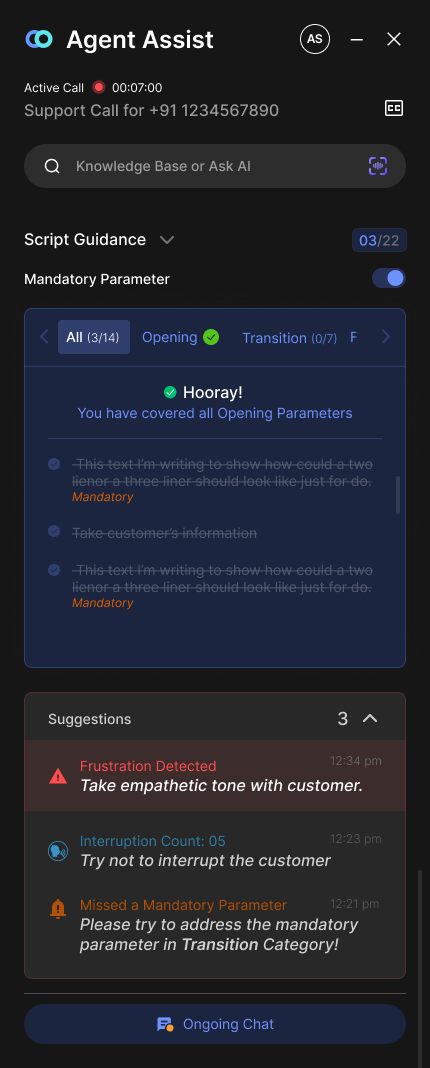
Real‑Time Agent Assist Insurance: Helping Unresolved Payment Issues
- An agent assisted by AI prompts resolves failed payments or disputes on the spot.
- Cuts manual callbacks and improves resolution.
- Maintains continuity.
Real‑time agent assist in the payment micro‑journey ensures issues don’t blow up later.
Conversational AI Insurance Benefits: Lowering Churn At Renewal
- Customers feel engaged and supported, not forgotten.
- Renewals convert higher, and attrition drops.
- Operational costs for manual renewal outreach have reduced.
- Data point: Use case stats show renewal automation via conversational AI insurance can cut operational costs by ~50%.
The benefits of conversational AI insurance in renewals show up in both retention and cost savings.
After keeping a policy active comes the cross‑sell/upsell micro‑journey, a chance to deepen the relationship.
See the gaps your team misses with Convin.
Micro‑Journey 7: Cross‑Sell And Upsell In Conversational AI Insurance Conversations
When the customer is already engaged, using conversational AI insurance to deepen the relationship adds strategic value.

Insurance Customer Experience Improved By AI Chatbot Insurance Use Cases
- Chatbot identifies relevant add‑ons or bundling opportunities during interactions.
- Delivers recommendations in line with context (“you just had your car accident claim, consider cover X”).
- No hard‑sell, just a value‑based suggestion.
These use cases elevate insurance customer experience and strengthen trust.
AI Voice Assistant Insurance Offering Contextual Suggestions
- Voice bot listens to conversation, identifies upsell opportunity, prompts agent or auto‑offer.
- Seamless experience, minimal interruption.
- Higher conversion rates vs manual outreach.
- Data point: Personalized upsell campaigns via conversational AI insurance see ~20% higher conversion rates.
Voice assistant in insurance upselling makes the offer feel helpful, not invasive.
Natural Language Processing Insurance Parsing Customer Needs
- NLP captures signals like “I’m thinking of buying a home next year”.
- System surfaces relevant products at the right time.
- Reduces missed sales and improves relevance.
NLP in insurance enables smart cross‑sell/upsell: turning micro‑journeys into revenue moments.
When things go wrong, service recovery is the next micro‑journey where conversational AI insurance really matters.
Micro‑Journey 8: Service Recovery And Support Via Conversational AI Insurance
Service breakdowns are inevitable. How you recover defines trust more than how you perform when all’s well.
Sentiment Analysis Insurance Conversations Flag Dissatisfaction Early
- AI monitors customer tone and sentiment in real time.
- Flags interaction for the supervisor if sentiment drops below the threshold.
- Enables proactive intervention.
Early flagging via sentiment analysis in insurance avoids escalation and loss of trust.
Real‑Time Agent Assist Insurance Stepping In When Chatbot Hits Limits
- Bot delegates to a live agent seamlessly when complexity or customer stress is detected.
- An agent assisted by AI to handle the situation properly.
- Reduces frustration and re‑work.
Real‑time agent assist during recovery ensures the human touch when needed, supported by AI.
Conversational AI Insurance Benefits: Turning Risk Into Trust
- Quick, effective recovery resets trust.
- Less manual fuss, fewer complaints.
- Supports loyalty and retention.
The benefits of conversational AI insurance here manifest in stronger relationships and lower attrition.
Once you’ve resolved issues, you can turn to advocacy and feedback, the next micro‑journey.
Micro-journeys are leaking revenue. Convin plugs them.
Micro‑Journey 9: Customer Advocacy And Feedback Loops With Conversational AI Insurance
Empowering your customers to advocate for you and capturing feedback creates lasting trust and insights.
Multilingual Insurance Chatbot Support Gathering Feedback Proactively
- Chatbot asks for feedback right after the interaction in the preferred language.
- Simple, quick, real‑time.
- Higher response rates.
Multilingual chatbot feedback support converts insurance customer experience into usable data.

Natural Language Processing Insurance Analysing Free‑Text Responses
- NLP processes open‑ended feedback (“Agent didn’t explain…”).
- Identifies themes, root causes.
- Feeds continuous improvement.
- Data point: Insurers using conversational AI insurance feedback loops saw CSAT improve by ~27%.
NLP in insurance feedback loops converts the voice of the customer into actionable intelligence.
Conversational AI Intent Recognition, Spotting NPS Or Churn Signals
- AI identifies signals of risk or advocacy (“Would you recommend us?”).
- Triggers follow‑up offers or retention measures proactively.
- Turns micro‑journey feedback into targeted action.
Intent recognition in insurance ensures feedback isn’t just collected, it drives decisions.
And finally, one of the most overlooked micro‑journeys: compliance and audit readiness in conversational AI insurance.
Micro‑Journey 10: Regulatory Compliance And Audit Readiness Through Conversational AI Insurance
Compliance in insurance is non‑negotiable. Every conversation can be audited using conversational AI insurance, as the toolkit ensures readiness.

Insurance Customer Experience Improved By AI Chatbot Insurance Use Cases In Compliance
- Chatbot ensures required disclosures are given during interaction.
- Agent prompts via AI guide compliant conversation flows.
- Reduces fines, errors.
These use cases embed compliance into the customer journey rather than add it later.
Natural Language Processing Insurance Tracking Conversation Logs For Audit
- NLP transcribes and analyses all conversation streams.
- Flags missing disclosures or script deviations.
- Audit‑ready records are generated automatically.
- Data point: Intelligent automation in insurance claims and service can reduce processing time by up to 70% and improve CSAT by 28%.
NLP in insurance audit tracking removes much of the manual compliance burden.
Conversational AI Insurance Benefits: Reducing Compliance Risk And Cost
- Lower risk of regulatory penalties.
- Less manual audit effort.
- Faster response to regulators.
The benefits here directly impact the balance sheet and reputational risk.
Want fewer drop-offs? Connect with Convin!
Making The Shift: How To Embed Conversational AI Insurance Without Massive Transformation
You don’t need a multi‑year project to start winning with conversational AI insurance.
- Map your highest‑impact micro‑journeys from the list above.
- Pilot with targeted use‑cases (e.g., quoting bot + agent assist) to demonstrate ROI.
- Use platforms like Convin that offer real‑time agent assist and contact centre conversation intelligence modules.
- Measure invisible costs: re‑work, compliance risk, churn, and include these when building a business case.
- Scale gradually, using data from the pilot to justify full rollout.
By embedding conversational AI insurance step‑by‑step, you turn a toolkit into a transformation without the disruption.
Book your Convin demo today!
What Happens If You Delay Conversational AI Insurance Adoption
In a market where competitors are already mapping micro‑journeys with conversational AI insurance, delay means falling behind. Customers expect seamless, intelligent journeys and will switch if you don’t deliver. Act now to harness this lens and toolkit or risk giving your competition the advantage.
Ultimately, conversational AI insurance reshapes trust by turning every customer interaction into a measurable, improvable moment. It gives you, the CX or product head, the power to see what was previously invisible, fix what was previously unpredictable, and deliver experiences your competitors can’t replicate without years of catch‑up. The insurers adopting conversational AI insurance today aren’t just improving CX; they’re rewriting the baseline for what modern policyholders expect.
FAQs
- How does a voice recognition insurance chatbot improve first-contact resolution?
Voice recognition insurance chatbot instantly identifies customer intent and routes inquiries accurately. It provides agents with real-time data access, reducing transfers and wait times, thereby increasing first-contact resolution and overall customer satisfaction.
- What ROI can insurers expect from conversational AI insurance implementation?
Insurers typically see 30-40% cost reduction, 25-35% higher customer satisfaction, 15-20% faster claims processing, and 10-15% improved retention within 6-12 months after implementing conversational AI insurance.
- Can conversational AI insurance integrate with existing insurance systems?
Conversational AI insurance easily integrates with legacy policy management, CRM, and claims platforms via APIs. This seamless integration enables real-time data access without requiring costly or disruptive system replacements.
- How does conversational AI insurance handle multilingual customer support?
Conversational AI insurance supports 50+ languages with real-time translation and cultural nuance. It enables insurers to deliver empathetic, localized, and efficient support to diverse global customer bases around the clock.
- What training is required for insurance teams using conversational AI insurance?
Training includes AI escalation protocols, conversation monitoring, data interpretation, and collaborative practices to optimize human-AI interactions, ensuring insurance teams maximize conversational AI insurance effectiveness and enrich customer experiences.


%20BLOG10%20examples%20of%20artificial%20intelligence%20in%202024.webp)



.avif)