


Upsell and cross-sell are supposed to be natural extensions of good customer conversations. Yet for many insurance contact centers, the numbers stay stubbornly flat quarter after quarter. Leaders invest in training, scripts, and QA, but contact center upsell performance barely moves. The reason isn’t agent intent or effort; it’s how support teams are set up during the moments that actually matter.
Contact center upsell performance refers to how effectively contact centers identify, prompt, and convert upsell or cross-sell opportunities during customer interactions across live calls and post-call reviews.
See where upsell opportunities are missed on live calls.
What’s Limiting Contact Center Upsell Performance in Insurance Support
Insurance contact centers operate under unique pressure. Every call must balance empathy, accuracy, and compliance, often within tight handle-time targets. In this environment, upsell becomes secondary, even when opportunities clearly exist. Over time, this creates a structural ceiling on contact center upsell performance that training alone can’t fix.
The challenge isn’t that agents don’t want to upsell. It’s that the system around them doesn’t support it in the flow of real conversations. Without timely guidance, even skilled agents default to safe resolutions instead of value-expanding conversations.
Why Real-Time Agent Guidance for Upselling Rarely Exists on Live Calls
Most insurance agents enter calls focused on resolution and compliance. They listen for coverage issues, policy details, and claims questions, not subtle buying signals. Without real-time agent guidance for upselling, agents must rely on memory and judgment in high-pressure moments.
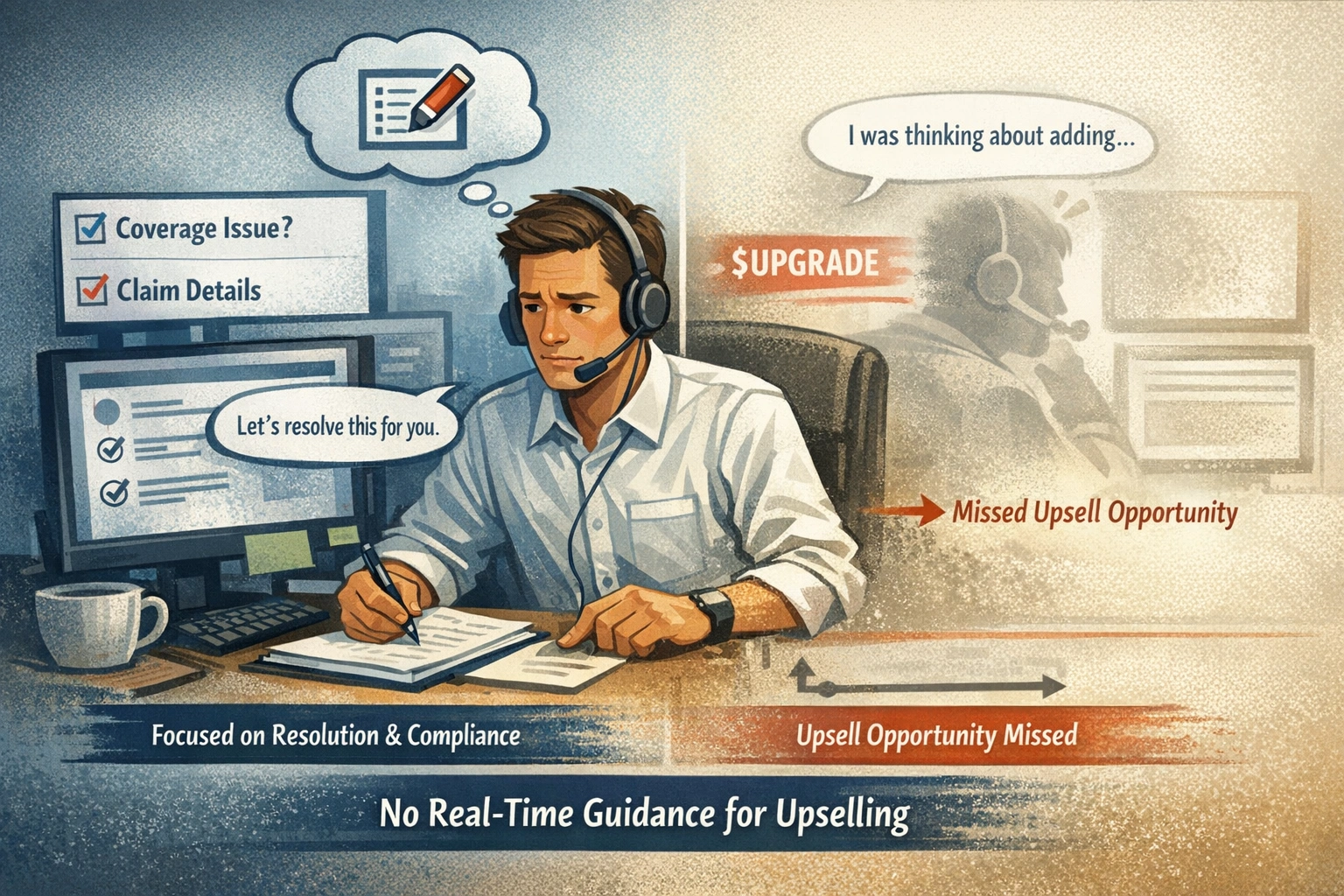
As a result, upsell cues are often recognized too late or not at all. By the time the call ends, the opportunity has passed, and the contact center upsell performance takes another quiet hit.
In practice, the absence of real-time agent guidance for upselling forces agents to choose safety over growth. Over thousands of calls, this compounds into consistently flat outcomes.
Without real-time agent guidance for upselling, insurance agents are asked to multitask at an unrealistic level. The gap between intent and execution becomes a systemic drag on contact center upsell performance.
Once these missed cues become routine, they stop feeling like exceptions and start shaping overall performance.
Help agents act on upsell cues in real time.
How Missed Moments Quietly Drag Contact Center Upsell Performance Down
Missed upsell moments rarely show up as red flags. They appear as “normal” calls that resolved the issue but left value on the table. Over time, these invisible misses quietly cap contact center upsell performance, even when call quality looks strong.
In insurance, upselling often hinges on timing, policy renewals, coverage gaps, or life events mentioned in passing. When these moments slip by, they don’t just affect revenue; they weaken customer lifetime value.
The Cost of Missing Real-Time Prompts for Call Center Agents
Without real-time prompts for call center agents, even obvious opportunities fade in the moment. Agents may recognize a cue seconds after it passes or only during QA review days later. At that point, there’s no chance to act.

These missed real-time prompts for call center agents force teams to rely on post-mortems instead of prevention. The result is predictable: agents hear what they should have done, but not when it would have mattered.
Over time, the lack of real-time prompts for call center agents normalizes missed opportunities and suppresses contact center upsell performance across the floor.
When agents don’t receive real-time prompts for call center agents, upsell becomes reactive instead of natural. That delay quietly erodes contact center upsell performance call after call.
To move the needle, insurance leaders must redefine what “good” upsell execution actually looks like today.
See how real-time guidance changes upsell outcomes.
This blog is just the start.
Unlock the power of Convin’s AI with a live demo.

What High Contact Center Upsell Performance Looks Like Today
High-performing insurance contact centers don’t treat upsell as an add-on. They embed it into conversations in a way that feels timely, relevant, and compliant. This shift is what separates stagnant teams from those improving contact center upsell performance consistently.
The difference lies in enabling agents during the call, not just evaluating them after it. When guidance arrives in the moment, upsell becomes part of the service, not a script.
How To Improve Cross-Sell in Customer Support Calls Without Being Pushy
Learning how to improve cross-sell in customer support calls starts with relevance. Customers respond when offers align with their immediate concern, not when they feel generic or forced. Agents need contextual nudges that support, not interrupt, the conversation.
Understanding how to improve cross-sell in customer support calls also means respecting tone. Insurance conversations are emotional and trust-driven. Well-timed cues help agents frame offers as protection, not sales.
Teams that master how to improve cross-sell in customer support calls see steadier gains in contact center upsell performance, without increasing call friction.
Knowing how to improve cross-sell in customer support calls isn’t about better scripts. It’s about better timing and systems that support agents when it counts.
Even with better in-call support, improvement stalls if learning stops once the call ends.
Close the gap between intent and upsell action.
Fixing Contact Center Upsell Performance With Feedback
Live guidance solves the moment, but sustainable improvement requires reflection. Insurance teams need feedback loops that show agents where opportunities were missed and how to recognize them next time. This is where contact center upsell performance either compounds or plateaus.
Post-call insights turn individual misses into repeatable learning. They transform QA from a scorecard into a growth engine.
Using Post-Call Analysis for Upsell Opportunities in Insurance Teams
Post-call analysis for upsell opportunities helps teams identify patterns agents can’t see on their own. One missed offer is noise; fifty similar misses reveal a systemic gap. This visibility is critical for improving contact center upsell performance.
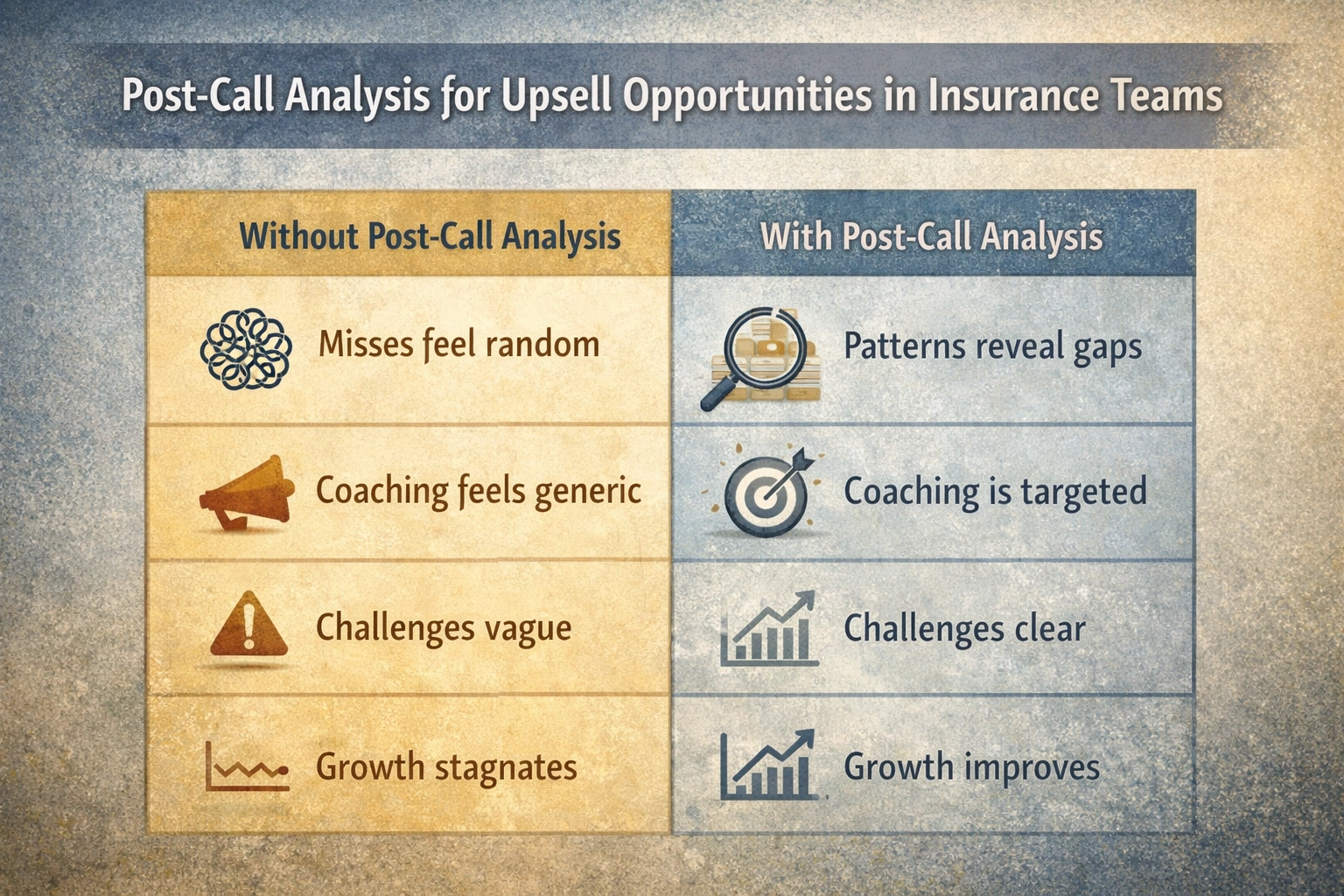
With post-call analysis for upsell opportunities, leaders can spot which policy types, call reasons, or agent behaviors consistently block growth. Coaching becomes targeted instead of generic.
Over time, post-call analysis for upsell opportunities creates shared clarity on what “good” actually looks like.
Without post-call analysis for upsell opportunities, insurance teams repeat the same mistakes. With it, the contact center upsell performance improves through informed coaching.
Agent Coaching to Increase Upsell and Cross-Sell Over Time
Effective agent coaching to increase upsell and cross-sell focuses on behaviors, not just outcomes. Agents need examples, not admonitions. Coaching tied to real calls builds confidence and consistency.

When agent coaching to increase upsell and cross-sell is grounded in real conversations, learning sticks. Agents begin recognizing cues independently, strengthening contact center upsell performance over time.
Sustained agent coaching to increase upsell and cross-sell closes the loop between live guidance and long-term improvement.
Strong agent coaching to increase upsell and cross-sell turns isolated wins into repeatable habits, and lifts contact center upsell performance across the team.
At this point, the pattern is clear: upsell success isn’t about individual effort, but system design.
Rethink upsell performance beyond agent skill.
How Convin Improves Contact Center Upsell Performance in Insurance Teams
Insurance agents don’t struggle with intent; they struggle with timing and clarity. This is where Convin fits into the workflow without disrupting conversations. By supporting agents both during and after calls, Convin helps teams systematically improve contact center upsell performance rather than relying on individual skill.
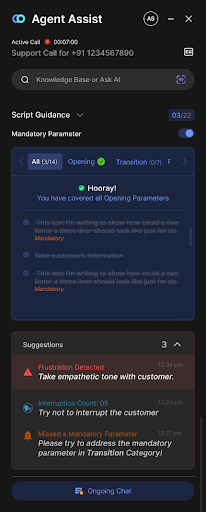
Convin’s Real-Time Assist listens to live insurance conversations and nudges agents with relevant offers, compliance-safe prompts, and next-best actions. This ensures agents don’t miss subtle coverage or upgrade cues while staying focused on resolution.
Over time, these in-the-moment signals directly lift contact center upsell performance by turning intent into action.
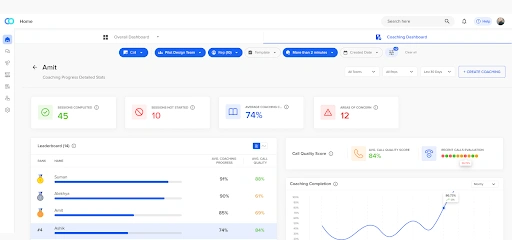
After the call, Automated Coaching analyzes conversations to surface missed upsell moments and behavioral gaps. Managers can coach agents using real examples instead of abstract feedback, reinforcing what good upsell timing sounds like in insurance calls.
Together, real-time guidance and post-call learning create a closed loop that steadily improves contact center upsell performance, without adding pressure or scripts.
Schedule a Convin demo now!
Rethinking Contact Center Upsell Performance as a System, Not a Skill
Flat results often lead leaders to push harder on training. But contact center upsell performance improves fastest when guidance, prompts, and coaching work together as one system. In insurance, complexity demands support at every stage of the call lifecycle.
When real-time assistance, feedback, and coaching reinforce each other, agents don’t just sell more, they serve better. Upsell becomes a byproduct of strong conversations, not an awkward interruption.
The most effective next step isn’t another script. It’s examining whether your agents are supported during and after the moments that shape contact center upsell performance.
FAQs
- What are the 5 key performance indicators of a call center?
The five key call center KPIs typically include average handle time, first call resolution, customer satisfaction score, service level, and contact center upsell performance to measure efficiency and revenue impact.
- What is the 80/20 rule in call centers?
The 80/20 rule in call centers means 80% of customer issues or revenue often come from 20% of call types, customers, or agents, guiding prioritization and resource focus.
- What is upselling in call centers?
Upselling in call centers is the practice of offering customers a higher-value product, add-on, or upgraded service during a support interaction when it aligns with their needs.
- What is the 25% rule of thumb for cross-selling?
The 25% cross-selling rule suggests that increasing customer retention by 5% can boost profits by up to 25%, highlighting the revenue impact of effective cross-sell strategies.


%20BLOG10%20examples%20of%20artificial%20intelligence%20in%202024.webp)



.avif)