


Insurance teams miss true contact center productivity gains because averages hide real conversational behaviors, workflow friction, and coaching gaps. Unlocking call-level and pattern-level visibility reveals what truly slows agents down and what improves customer trust. Modern intelligence finally shows where to intervene, leaving one question: how will you rethink productivity next?
But before we dive into the “how” of productivity, let’s define contact center productivity.
Contact center productivity means or stands for how efficiently a contact center handles customer interactions, resolves issues, and improves service quality by optimizing agent behavior, workflows, and conversation effectiveness.
Uncover hidden productivity blockers.
Why Contact Center Productivity Is Misleading Insurance Leaders
Insurance leaders have spent years chasing higher contact center productivity, only to find that gains rarely stick. That’s because most dashboards still measure productivity in averages: average handle time, average resolution time, average CSAT, all while ignoring what actually happens inside real conversations. When the industry relies on incomplete views, real issues stay buried.
Insurance Operations Efficiency
On the surface, insurers invest heavily in tools, scripts, and workflows to improve insurance operations efficiency. But these efforts often assume that productivity gaps come from slow processes, not from unseen behavioral patterns in calls. Without understanding the interplay between agent actions and customer friction, efficiency remains theoretical.
True insurance operations efficiency requires shifting from broad process metrics to call-level insights that reveal how decisions, hesitations, transfers, and escalations shape outcomes. And that shift starts with seeing beyond averages.
Productivity Blockers In Call Centers
Every insurance operation faces hidden productivity blockers in call centers, rework, repeated clarifications, compliance pauses, or slow system navigation. Yet leaders rarely spot them because they don’t show up in high-level productivity reporting.
Surfacing and resolving productivity blockers in call centers demands a granular lens into how conversations unfold. Averages can’t provide that, but behavioral data can.
This gap between what leaders see and what actually drives contact center productivity becomes even more obvious when we examine how traditional call center metrics distort the full picture.
Transform coaching with evidence.
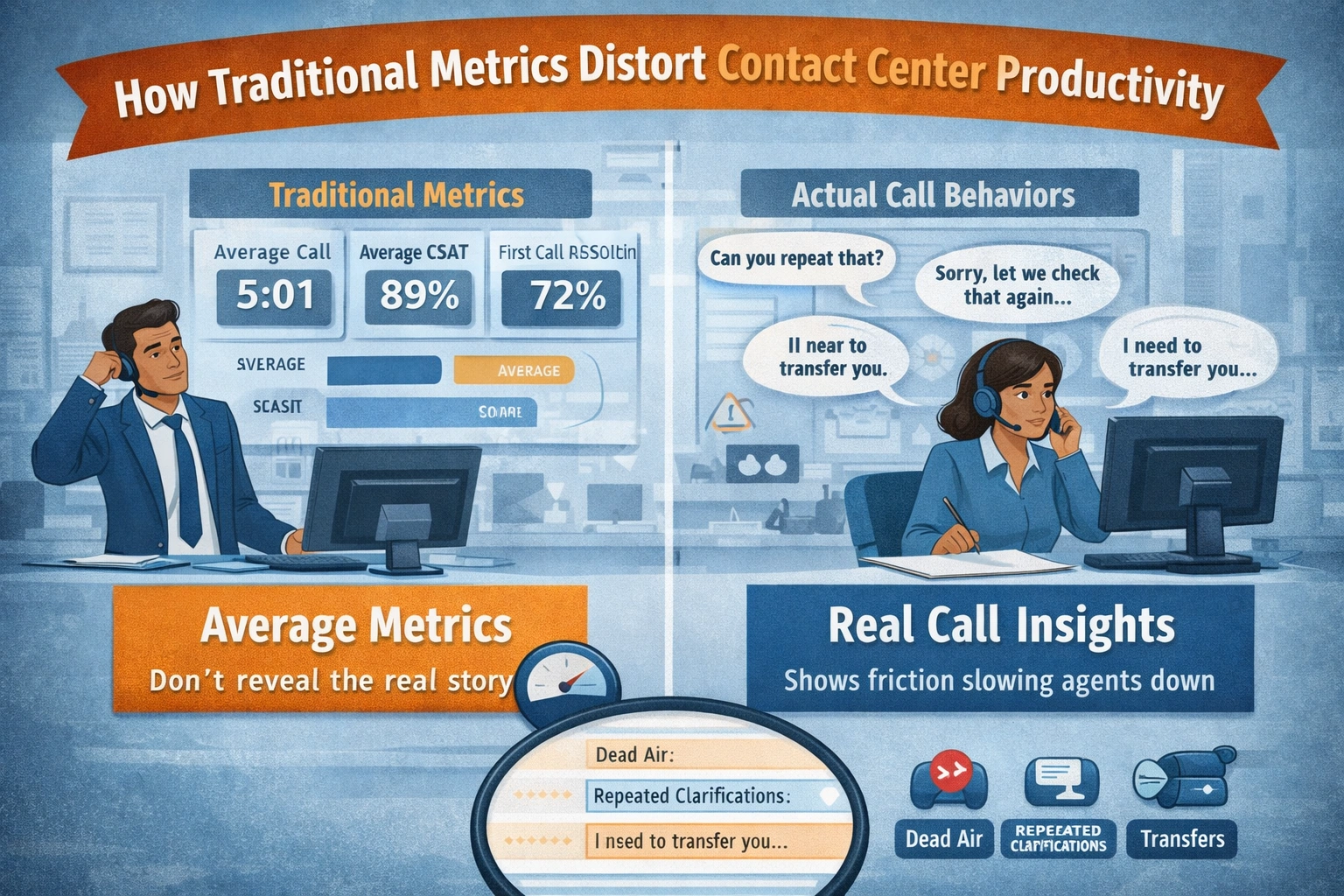
How Traditional Metrics Distort Contact Center Productivity
For years, insurance teams have used familiar KPIs to measure contact center productivity, but these KPIs were built for volume-based operations, not complex risk conversations. As a result, leaders often optimize for speed, not clarity, accuracy, or customer trust.
Insurance CX Metrics
Many insurers lean on insurance CX metrics to determine team health. But CX scores often lag weeks behind the actual issues causing poor customer experiences. The surface-level ratings miss the behavioral roots.
To truly elevate insurance CX metrics, insurers need insights into moments that hurt customer confidence, silences, repeated information requests, compliance missteps, not just post-call feedback.
Call Pattern Analysis
Traditional metrics overlook the gold mine hidden in call pattern analysis. Patterns like frequent holds, long explanations, or backtracking reveal why certain calls take longer or fail to resolve.
Embedding call pattern analysis into daily operations helps leaders move from reactive to proactive decision-making, ultimately improving contact center productivity across the board.
Once insurers see how conventional metrics fall short, the next question becomes obvious: What exactly is happening in conversations that leaders can’t see today?
Elevate agent performance quickly.
This blog is just the start.
Unlock the power of Convin’s AI with a live demo.

What Hidden Behavior Reveals About Contact Center Productivity
The biggest breakthroughs in contact center productivity come from understanding agent behavior at a call-by-call level. Behavioral data uncovers friction moments that dashboards can’t detect, unnecessary transfers, repeated disclosures, off-script detours, or unclear explanations.
Contact Center Workflow Bottlenecks
Often, agents aren’t the issue; the process is. In insurance, contact center workflow bottlenecks surface when agents must navigate slow policy systems, jump between legacy tools, wait for underwriting approvals, or follow scripts that don’t align with real customer intent. These friction points compound under pressure: longer holds, repeated clarifications, and unnecessary transfers that eat away at both customer patience and operational efficiency.
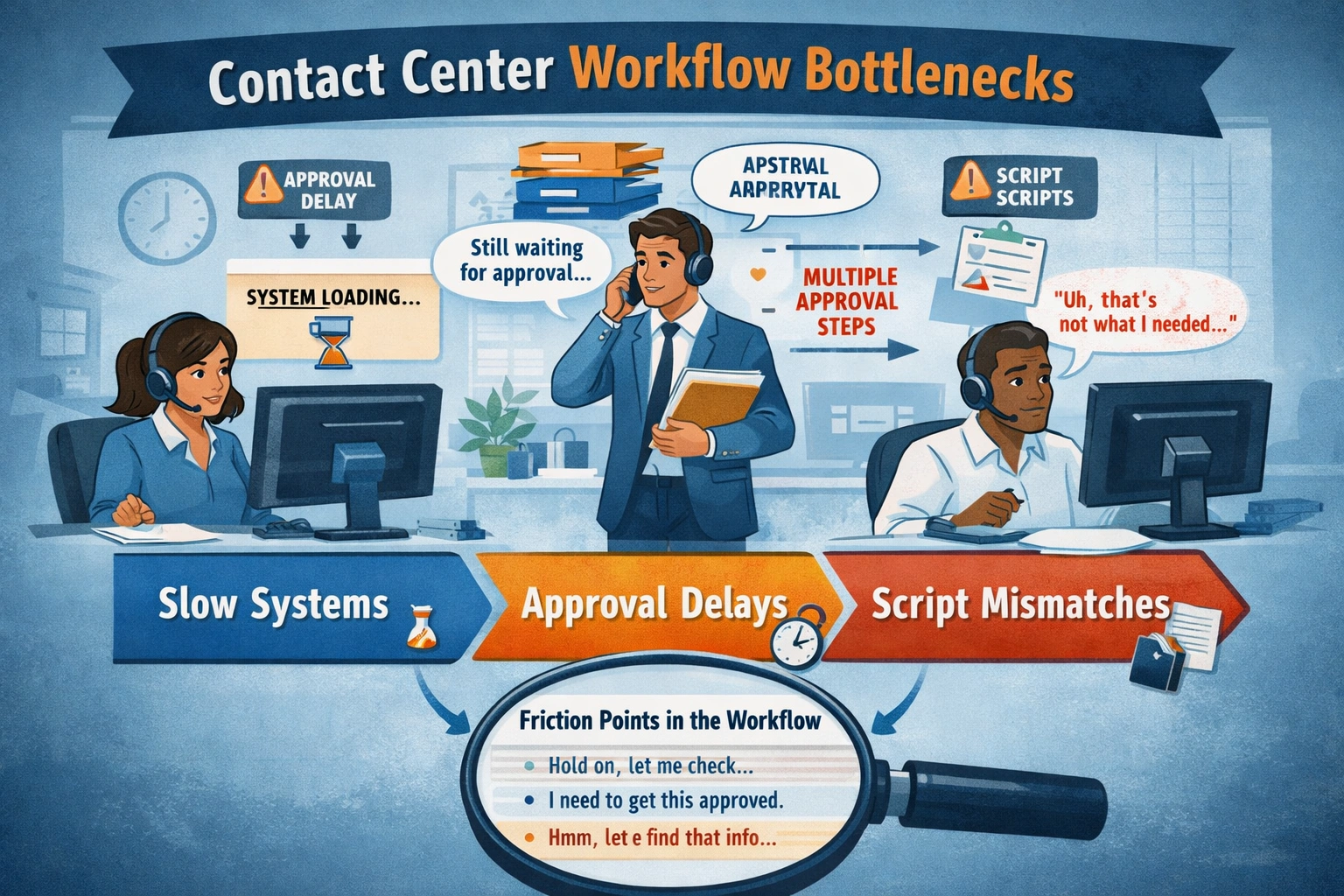
Because these bottlenecks are buried inside conversations, not dashboards, leaders often misdiagnose the problem. Volume metrics suggest agents need to “work faster,” when the real culprit is workflow drag.
By exposing contact center workflow bottlenecks inside actual call transcripts and interaction patterns, insurers finally see where approvals break down, where documentation takes too long, and where customers consistently need more explanation.
This allows teams to redesign workflows exactly where they slow agents down, not based on assumptions or incomplete averages.
By spotting contact center workflow bottlenecks within conversations, insurers can rebuild processes around real behavior, not outdated metrics; removing friction at the root instead of coaching agents around broken systems.
Agent Coaching Insights
Unspoken habits shape outcomes more than most leaders realize. Tone, confidence, pacing, clarity, empathy, and compliance quietly determine how smoothly a conversation unfolds.
Agent coaching insights uncover these patterns at scale, showing leaders what top performers consistently do well and where others struggle. Instead of relying on gut feel or limited QA samples, leaders finally get objective, repeatable visibility into what actually drives strong calls.
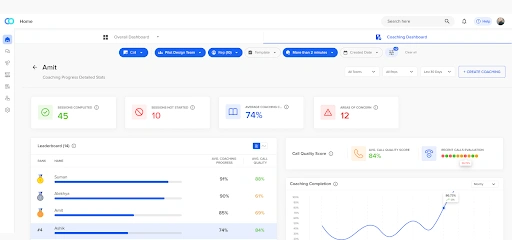
With deeper agent coaching insights, coaching becomes strategic rather than generic. Instead of blanket reminders like “improve soft skills” or “stick to the script,” managers can pinpoint the exact behaviors causing escalations, long resolutions, or customer frustration. Agents receive targeted feedback that feels actionable, fair, and personalized, fueling faster improvement and stronger confidence.
When agent coaching insights become routine, coaching transforms from sporadic and subjective to precise and continuous, elevating agent capability, enhancing customer experience, and steadily strengthening overall contact center productivity.
Seeing these patterns is only half the story. The real transformation begins when modern tools make these insights accessible and actionable for insurance teams.
Power decisions with call-level data.
Modern Tools That Transform Contact Center Productivity In Insurance
AI-driven platforms have redefined how insurers improve contact center productivity. Convin’s Automated Coaching and Conversation Intelligence work quietly in the background, analyzing every call, surfacing blockers, and delivering insights leaders previously had no way to access.
Agent Performance Analytics
Modern agent performance analytics go far beyond traditional output metrics like AHT or resolution rate. In insurance, where conversations carry financial, regulatory, and emotional weight, leaders need to understand how agents communicate, not just how fast.
Advanced analytics illuminate the behaviors that make or break call outcomes: who explains risk with clarity, who pauses too long when navigating systems, who confidently handles objections, and who instinctively de-escalates sensitive situations.
These insights matter because they expose the difference between agents who are merely completing tasks and those who are building trust. When leaders can isolate behaviors such as overlong explanations, repeated verification loops, or missed cues for proactive guidance, coaching becomes evidence-based rather than intuitive.
Agents know exactly which habits to reinforce and which to adjust, and managers can support them without guesswork or subjective interpretation.
With precise agent performance analytics, insurers can create targeted coaching loops that consistently strengthen agent confidence, boost customer trust, and reliably improve overall contact center productivity.
Call Center Quality Assurance In Insurance
Insurance is a high-stakes industry: claims conversations, policy upgrades, disclosures, and regulatory scripts all require accuracy and consistency. Yet most QA teams still review less than 2% of calls, leaving blind spots in compliance, clarity, and customer experience.
Modern call center quality assurance in insurance eliminates these gaps by automating QA across every conversation, every day.
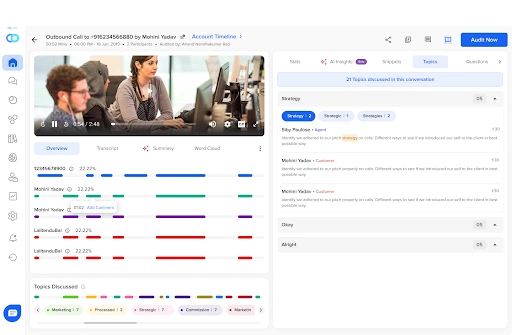
Instead of sampling, insurers gain full visibility into issues such as missed disclosures, unclear explanations, inconsistent verification steps, or documentation errors.
Automated QA highlights exactly where compliance deviations occur, where customers show repeated confusion, and where agents struggle with complex workflows. This gives leaders a real-time pulse on operational risk, coaching needs, and customer friction points.
And because automated call center quality assurance in insurance scales effortlessly, it creates a fairer, data-backed environment for agents. Feedback becomes consistent, timely, and grounded in complete evidence rather than limited reviews.
Automated, scalable call center quality assurance in insurance removes guesswork, strengthens compliance, and ensures productive, high-quality conversations become the standard, not the exception.
With visibility and coaching aligned, teams can adopt a structured framework to elevate contact center productivity sustainably.
Capture insights from every call.
A Practical Framework For Improving Contact Center Productivity
Improving contact center productivity isn’t about adding more dashboards. It’s about building a repeatable framework that ties behavior, coaching, workflows, and intelligence together.
Insurance Operations Efficiency
A practical framework strengthens insurance operations efficiency by focusing on clarity, process, and agent capability, and not just speed.
As organizations embed insurance operations efficiency into their daily rhythms, productivity gains stop being temporary and start becoming predictable.
Agent Coaching Insights
A strong framework relies on continuous improvement powered by agent coaching insights. These insights guide leaders on where to intervene and how to shape agent confidence.
When agent coaching insights fuel every improvement cycle, insurers create a self-correcting system that steadily enhances contact center productivity.
Make productivity gains sustainable.
Step-By-Step: A Practical Framework For Improving Contact Center Productivity
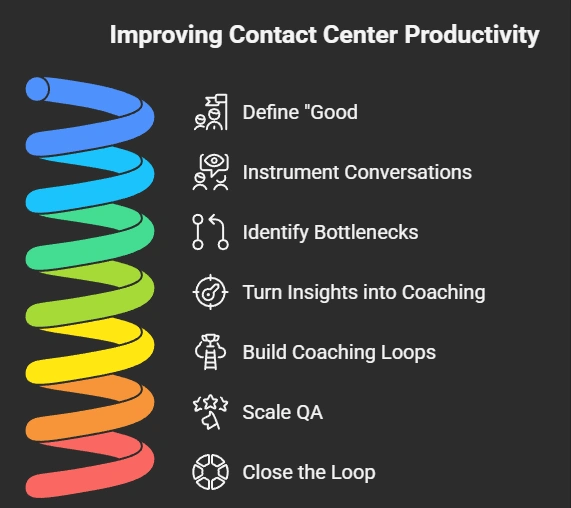
Step 1: Define What “Good” Looks Like For Your Insurance Operation
Before changing anything, align on outcomes.
- Clarify what contact center productivity means for your org: not just speed, but accuracy, first-call resolution, and compliant conversations.
- Tie it to insurance operations efficiency: fewer repeat calls, cleaner documentation, faster resolution on claims and policy changes.
- Set 3–5 core success metrics (e.g., FCR, complaint rate, QA score, average premium per call).
Output: A one-page “Productive Conversation in Our Insurance Contact Center” definition that everyone can reference.
Step 2: Instrument Conversations, Not Just Dashboards
You can’t fix what you can’t see.
- Use a conversation intelligence platform (like Convin) to capture and analyze 100% of calls.
- Go beyond averages, start looking at behaviors: holds, silences, transfers, interruptions, missed disclosures, upsell attempts.
- Map these patterns to insurance CX metrics (NPS, CSAT, complaints, churn) and see where the real damage is happening.
Output: A set of the top 5 behavioral patterns correlated with poor contact center productivity or weak CX.
Step 3: Identify Contact Center Workflow Bottlenecks
Separate people issues from process issues.
- Pull out patterns where agents repeatedly:
- Put customers on hold to check systems.
- Switch between multiple tools or screens.
- Wait for approval/underwriting/exceptions.
- Mark these as contact center workflow bottlenecks, not individual performance problems.
- Prioritize the bottlenecks that affect the highest volume call types (claims status, policy changes, renewals, etc.).
Output: A prioritized list of 3–7 contact center workflow bottlenecks with example call snippets.
Step 4: Turn Insights Into Agent Coaching Insights
Now move from “what’s broken” to “how to help.”
- Use agent coaching insights from conversation analytics to see:
- Who explains coverage and risk clearly?
- Who struggles with objections or difficult conversations.
- Who adheres to scripts and disclosures consistently.
- Group agents into coaching cohorts (e.g., “great empathy, weak structure” or “strong compliance, weak clarity”).
- Define 1–2 focus behaviors per cohort: keep it tight and practical.
Output: A coaching plan per cohort using real calls, not generic talk tracks.
Step 5: Build Targeted Coaching Loops With Agent Performance Analytics
Make coaching repeatable and data-backed.
- Use agent performance analytics to track behavior changes over time, not just outcomes.
- For each coaching loop, define:
- A baseline (e.g., average hold time, number of clarifying questions, missed upsell moments).
- The target behavior change (e.g., “reduce holds by using on-screen prompts,” “use this objection-handling pattern”).
- A review cadence (weekly / bi-weekly).
- Review calls together using actual clips flagged by analytics; reinforce the changes visibly.
Output: A living dashboard that links coaching activities to improvements in contact center productivity.
Step 6: Scale QA With Call Center Quality Assurance In Insurance
Stop sampling, start seeing.
- Move to automated call center quality assurance in insurance, so 100% of calls are evaluated for:
- Compliance adherence.
- Clarity of explanation.
- Documentation completeness.
- Use QA outputs to:
- Identify systemic training gaps.
- Spot new productivity blockers in call centers early.
- Feed new patterns into your coaching loops and process fixes.
Output: A QA-to-coaching pipeline where findings directly trigger coaching themes and process improvements.
Step 7: Close The Loop With Continuous Improvement Rituals
Make this a system, not a one-time project.
- Run a monthly “Productivity Review” with ops, QA, training, and product/underwriting:
- Review contact center productivity trends.
- Look at the top call drivers and friction themes.
- Decide on 1–2 process or script changes.
- Share wins: highlight agents and teams whose behavior changes moved key metrics.
- Refresh your definition of “good” as your business and customer expectations evolve.
Output: A continuous improvement rhythm where behavior insights, coaching, and process changes feed each other.
Mock Coaching Script (From Manager to Agent, Using Analytics & Coaching Insights)
Context:
An insurance contact center manager is using conversation intelligence and agent performance analytics to coach an agent who struggles with long claims calls and repeated clarifications.
Manager: “Hey Sarah, thanks for taking the time today. I’ve pulled a couple of your recent claims calls that the system flagged. Not because they’re ‘bad’, but because they show where we can boost your contact center productivity without adding pressure!”
Agent: “Sure, sounds good. I know some of those calls are running long.”
Manager: “Exactly. Now, here’s what the agent performance analytics are telling us. On average, your claims calls are about 90 seconds longer than the team average, mostly due to extra clarifying questions and time spent in the policy system. But your empathy scores and customer tone are strong; that’s a real positive.”
Agent: “Okay, so the extra time is the main issue?”
Manager: “Right. When we listened to this call together, did you notice how many times you had to go back and re-ask the claim date and incident details? That’s where agent coaching insights show a pattern: you’re being careful, but the flow is forcing you to double-handle information.”
Agent: “Yeah, I didn’t realize I was repeating that much until I heard it back.”
Manager: “Here’s the good news: this isn’t just on you. We’ve seen similar patterns in other calls; that’s a contact center workflow bottleneck. The system layout makes it easy to miss a field and go back. We’re feeding that to ops so they can fix it.
In the meantime, I want to give you a simple structure to reduce repeats:
- Confirm all key claim details upfront.
- Repeat them back once, clearly.
- Use that confirmation as your ‘single source of truth’ for the rest of the call.”
Agent: “That sounds manageable. So I just need to be more deliberate in that early part?”
Manager: “Exactly. Let’s listen to this clip where you handled a similar call really well. See how you summarized in one go before moving on? That’s the behavior we want to standardize. Our call center quality assurance in insurance is already picking up fewer repeats in calls where you use that pattern.”
Agent: “Got it. I can focus on that in my next few calls.”
Manager: “Perfect. Here’s the plan: over the next week, I’ll ask Convin to flag 5 of your claims calls where you used this structure. We’ll review them quickly next Friday to see how your handle time and customer clarity changed. If the metrics move, it’ll be a direct win for your contact center productivity and the team’s overall efficiency.”
Agent: “Sounds good. I like having something specific to try and then review.”
Manager: “Exactly the goal: specific, measurable, and fair. You’re already strong on empathy; this is about tightening structure so both you and your customers feel more in control.”
At this point, the industry’s shift becomes clear: productivity can no longer be measured through averages; it must be built through understanding behavior at scale.
Book your Convin demo now!
The New Reality Of Contact Center Productivity In Insurance
The insurance industry is entering a new era where contact center productivity depends on visibility into every interaction, not just aggregated numbers. Leaders who embrace behavioral insights gain a competitive edge in speed, accuracy, and customer trust.
Elevating performance means elevating insurance CX metrics with deeper, behavior-led context, not just surveys. When insurance CX metrics connect directly to real call behaviors, insurers can finally close the gap between customer expectation and experience.
The path forward requires exposing productivity blockers in call centers, those friction points that slow agents, frustrate customers, and increase operational costs. Removing productivity blockers in call centers unlocks scalable improvements in contact center productivity, making every call smoother, faster, and more compliant.
FAQs
1. What skills improve contact center productivity in insurance?
Key skills include clear policy explanation, confident objection handling, accurate documentation, and efficient system navigation. Insurance agents who demonstrate these competencies typically deliver faster, more reliable resolutions and higher customer trust.
2. How does agent morale affect contact center productivity?
Low morale increases handle times, escalations, and errors. Motivated agents perform better, adapt faster to workflow changes, and contribute to more consistent customer outcomes.
3. Why do insurance contact centers struggle with high variation in call quality?
Variability often stems from inconsistent training, uneven process adherence, and differences in how agents interpret scripts or handle complex customer scenarios.
4. What role does technology fatigue play in contact center productivity?
Frequent switching between outdated or poorly integrated systems slows agents, increases cognitive load, and leads to more operational errors or compliance risks.
5. How can insurance leaders reduce repeat calls without increasing pressure on agents?
Leaders can reduce repeat calls by improving knowledge bases, refining call flows, simplifying verification steps, and ensuring agents have real-time guidance during complex conversations.


.avif)

.avif)