


As insurance teams grow, inconsistency rises fast, especially without strong insurance regulatory compliance. Calls drift, scripts splinter, and performance gaps widen, creating avoidable chaos. This blog breaks down why growth triggers disorder and how modern compliance restores stability. The real question: how will your team tackle these scaling cracks next?
Insurance regulatory compliance refers to the standards, controls, and oversight insurers must follow to ensure accurate, consistent, and lawful customer interactions across growing teams, reducing risk and operational chaos.
Audit your team’s call consistency now.
The Growth-Chaos Loop In Insurance Teams
As insurance teams expand, leaders often assume experience and headcount will naturally improve consistency. But the opposite usually happens. Every new agent, workflow, and line of business introduces fresh variation, and those gaps widen quickly without strong insurance regulatory compliance in place. Before long, leaders find themselves fighting fires across quality, scripts, and performance while struggling to understand what changed.
Insurance Call Center Quality
Strong insurance call center quality is the first casualty when teams grow fast. In the early stages, everyone follows the same handful of scripts, tribal knowledge, and coaching cues.
As the team scales, however, variations appear: two agents handle the same query differently, disclosures get skipped, and customer explanations drift away from the approved script. Without a firm insurance regulatory compliance structure, these inconsistencies multiply.
For insurance leaders, this leads to widening QA gaps, uneven experiences across customer segments, and a higher risk of regulatory misses. The challenge isn’t bad intentions; it’s the absence of a unified lens that scales with the team.
When insurance call center quality becomes impossible to benchmark across locations or teams, leaders lose the ability to control outcomes.
In short, insurance call center quality can only scale when insurance regulatory compliance scales with it.
Insurance Agent Performance
As headcount rises, insurance agent performance naturally diversifies. Top agents find workarounds, new agents improvise, and mid-level performers follow their own version of the playbook, often unintentionally. Without a central system capturing what “good” looks like, there’s no reliable reference point for enforcing insurance regulatory compliance.
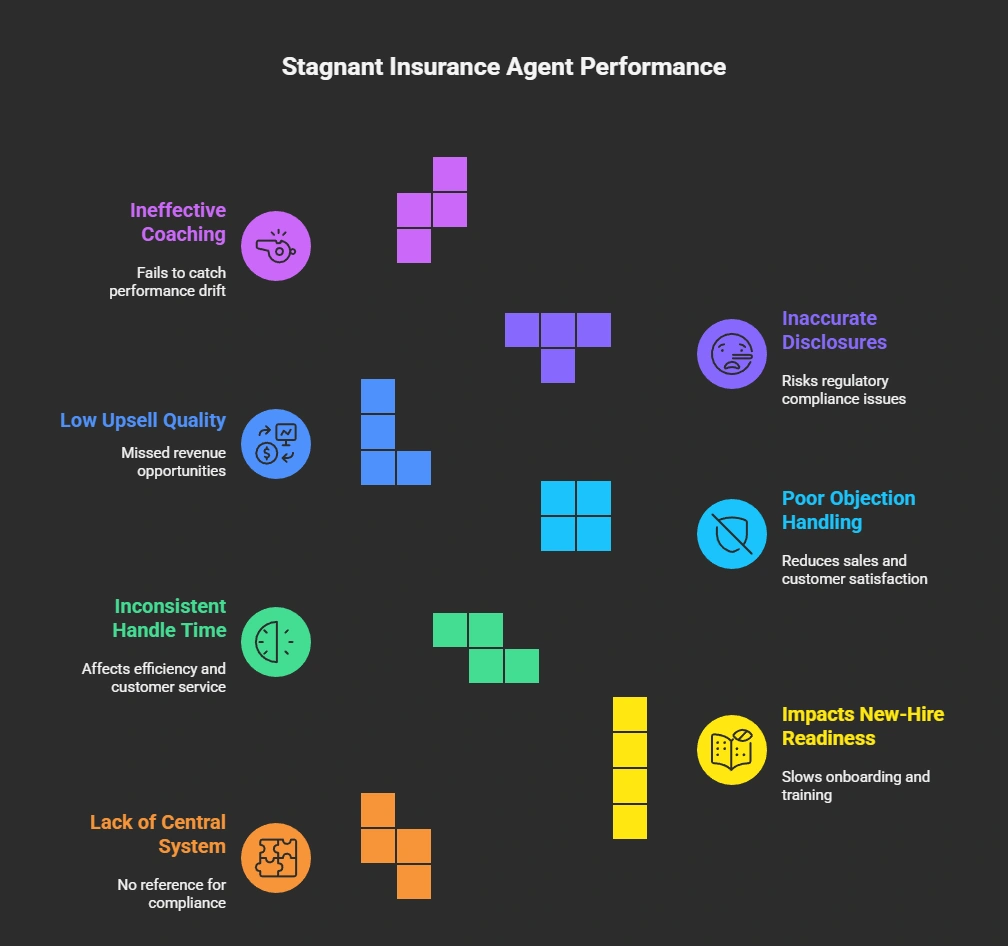
This impacts new-hire readiness, average handle time, objection handling, upsell quality, and disclosure accuracy. Leaders may try manual coaching or sampling calls, but those efforts rarely catch drift at scale. As a result, insurance agent performance becomes harder to manage and even harder to improve consistently.
Ultimately, insurance agent performance stays predictable only when teams anchor to strong insurance regulatory compliance frameworks supported by real, unified insights.
Growing teams produce richer data but also more chaos. To understand what’s breaking, we need to look at where gaps show up first.
Find chaos triggers in your workflows.
What Breaks First When Insurance Regulatory Compliance Can’t Keep Up
When insurance regulatory compliance fails to scale with team size, cracks appear in everyday workflows. These gaps don’t start loud; they start subtle, like a script line skipped, a disclosure phrased loosely, or a claim explanation missing its required structure. Over time, small cracks widen into operational risks.
Call Consistency In Insurance Teams
Leading teams struggle most with call consistency in insurance teams. Different mentors train with different styles, agents inherit variations, and without centralized QA data, leaders rely on anecdotes. When frameworks for insurance regulatory compliance rely on manual tracking, consistency becomes impossible.
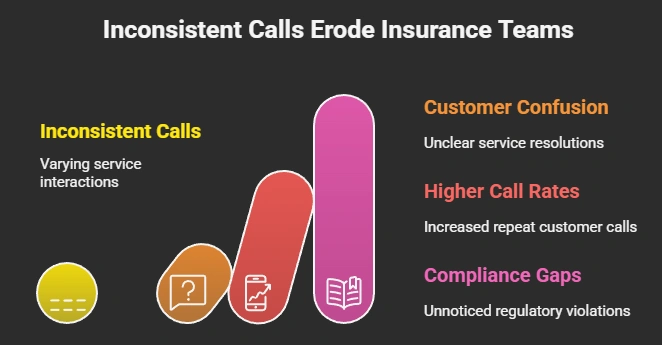
Inconsistent calls lead directly to customer confusion, unpredictable service resolutions, and higher repeat call rates. Worse, compliance gaps sneak in unnoticed. With no unified repository for scripts, workflows, or scorecards, call consistency in insurance teams slowly erodes.
Ultimately, restoring call consistency in insurance teams starts by rebuilding insurance regulatory compliance as an always-on guardrail, not an after-the-fact audit.
Insurance Operations Scalability
As demand grows, insurance operations' scalability becomes a limiting factor. Processes built for 30 agents don’t survive at 300. Leaders report bottlenecks in monitoring, reviewing, training, and updating scripts, all signs of fragile insurance regulatory compliance foundations.
Without scalable QA workflows, teams struggle to keep disclosures accurate, recommendations compliant, and customer interactions aligned with policy requirements. These issues directly affect cost-to-serve, customer experience, and complaint ratios. And because technology sprawl adds noise, insurance operations' scalability deteriorates even faster.
In the end, true insurance operations scalability depends on embedding insurance regulatory compliance into every workflow, so teams grow without multiplying risks.
When cracks appear across consistency and operations, leaders start looking for a system of control, not more manpower. That’s where a modern approach comes in.
Scan calls for hidden compliance drift.
This blog is just the start.
Unlock the power of Convin’s AI with a live demo.

How Strong Insurance Regulatory Compliance Restores Order
A modern approach to insurance regulatory compliance stabilizes fast-growing teams by giving leaders a single source of truth. Instead of relying on subjective reviews, reactive coaching, or partial call sampling, teams can build compliance into the workflow through automation, insights, and standardized scorecards.
QA Automation For Insurance
QA automation for insurance is one of the fastest ways to enforce consistency at scale. Automated scoring, disclosure tracking, and script adherence checks ensure agents follow the right structure every time. These guardrails dramatically reduce the time leaders spend chasing errors or digging through calls to find compliance misses.

When paired with insurance regulatory compliance, QA automation for insurance transforms reactive reviews into proactive prevention. Instead of discovering issues weeks later, leaders can detect non-compliant patterns within hours.
The result is simple: QA automation for insurance keeps teams aligned, consistent, and fully anchored to insurance regulatory compliance even during hypergrowth.
Insurance Contact Center Insights
Clear insurance contact center insights help leaders understand where inconsistency begins and how to correct it. With centralized transcripts, scorecards, and reporting dashboards, leaders can see exactly which teams drift from standards, which scripts fail in the field, and which workflows introduce compliance risk.
Without these insights, scaling becomes a guessing game. With them, insurance regulatory compliance becomes a strategic advantage, not a regulatory burden. And when paired with automated monitoring, insurance contact center insights help leaders prevent issues long before they escalate.
Ultimately, insurance contact center insights reinforce insurance regulatory compliance by giving teams a unified view of performance and risk.
Modern tools make all this achievable. Platforms like Convin bring together automated quality management, centralized insights, and compliance workflows, all elements that allow insurance teams to scale safely. But the path always starts with rethinking how compliance should work in today’s fast-moving environment.
Identify early-stage chaos patterns.
A Practical Path To Modern Insurance Regulatory Compliance
Strong insurance regulatory compliance isn't just about preventing violations; it's about building a scalable operating foundation. Most insurance leaders begin by standardizing scripts, scorecards, and disclosure rules. Then they add automated QA layers to ensure enforcement. Finally, they establish dashboards for continuous insight.
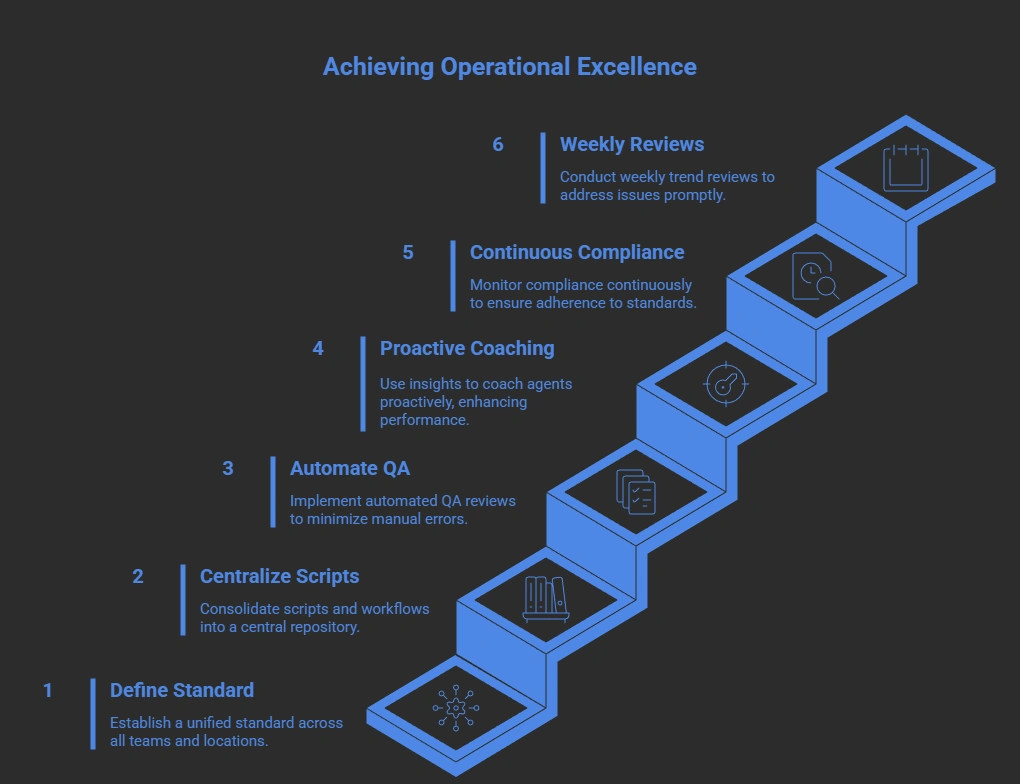
A modern path may include:
- Defining one shared standard across all teams and locations
- Centralizing scripts and workflows
- Automating QA reviews to reduce manual gaps
- Using insights to coach agents proactively
- Implementing continuous compliance monitoring
- Reviewing trends weekly instead of firefighting monthly
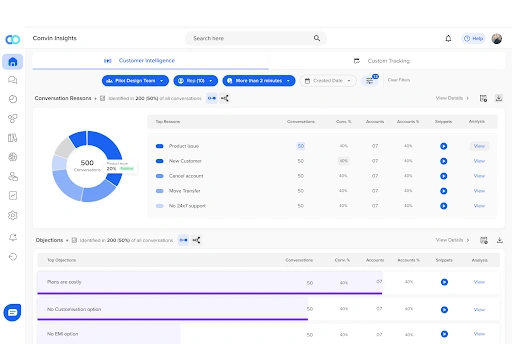
Tools like Convin’s automated quality management, Convin Insights, and compliance workflows support this approach, subtly enabling leaders to anchor operations around one unified framework.
When leaders align their teams to scalable insurance regulatory compliance, they create stability that compounds with growth instead of cracking under it.
As teams implement modern compliance practices, they often notice something surprising: growth starts to feel manageable again.
Schedule your Convin demo now!
Scaling Without Losing Control Of Insurance Regulatory Compliance
As insurance teams grow, chaos isn’t inevitable; it’s preventable. The difference lies in how well insurance regulatory compliance evolves with the organization. When compliance stays static, inconsistency spreads. When compliance becomes dynamic, automated, and insight-driven, growth becomes an opportunity instead of a risk.
By reinforcing consistency, tightening quality, and creating a unified operational backbone, strong insurance regulatory compliance helps teams scale with confidence. And with the right frameworks and tools, leaders can finally replace firefighting with predictable, repeatable performance.
FAQs
- How does insurance regulatory compliance impact the accuracy of customer disclosures in large insurance teams?
Insurance regulatory compliance ensures agents deliver mandatory disclosures consistently, even as teams grow and variations naturally increase. Clear compliance standards reduce improvisation, prevent missed statements, and create uniform communication across teams, directly protecting customers and reducing regulatory risk.
- What tools help insurance leaders detect early compliance drift before it affects call quality?
Leaders use automated QA systems, real-time monitoring tools, unified scorecards, and transcript-level insights to spot early drift. These tools surface missed disclosures, script deviations, and performance anomalies before they turn into widespread call quality issues.
- Why do growing insurance teams struggle to maintain script consistency even with regular training?
As teams scale, agents learn from different trainers, adopt personal phrasing, and rely on informal knowledge sharing. Without centralized scripts, automated reviews, or unified insights, consistency fades quickly, no matter how frequent the training sessions.
- How can insurance regulatory compliance reduce the operational cost of handling repeat customer calls?
When insurance regulatory compliance is strong, agents follow accurate scripts, give complete explanations, and avoid errors that force customers to call back. Better compliance reduces repeat contacts, lowers workload, and improves first-call resolution, cutting cost-to-serve.
- What are common warning signs that insurance teams are outgrowing their existing compliance workflows?
Early signs include rising QA backlogs, inconsistent disclosures, uneven agent performance, increasing customer complaints, mismatched scripts across teams, and delayed regulatory updates. These indicators show that manual or outdated workflows can’t support the team’s growth.


%20BLOG10%20examples%20of%20artificial%20intelligence%20in%202024.webp)



.avif)