


Pricing enterprise-grade AI calling can feel like a moving target, especially in AI agent insurance, where risk sensitivity, workflow complexity, and regulatory demands shape every buying decision. Enterprise teams don’t just want automation; they want predictability, transparency, and confidence that value matches cost. This guide unpacks how aligning value drivers to pricing tiers gives insurance RevOps and Sales leaders a stable, scalable framework for evaluating and packaging AI calling.
AI agent insurance refers to automated AI-driven calling and workflow systems built for insurance sales, service, and outreach designed to improve efficiency, compliance, and customer experience across policy lifecycles.
Review your insurance automation gaps.
Why Pricing Confidence Matters In AI Agent Insurance
Enterprise buyers in AI agent insurance operate in an environment defined by compliance pressure, intricate claims and sales workflows, and high-stakes customer interactions. AI calling must prove not only capability but reliability across real-world insurance scenarios. Pricing confidence emerges when value is explicit, measurable, and mapped to recognizable insurance outcomes.
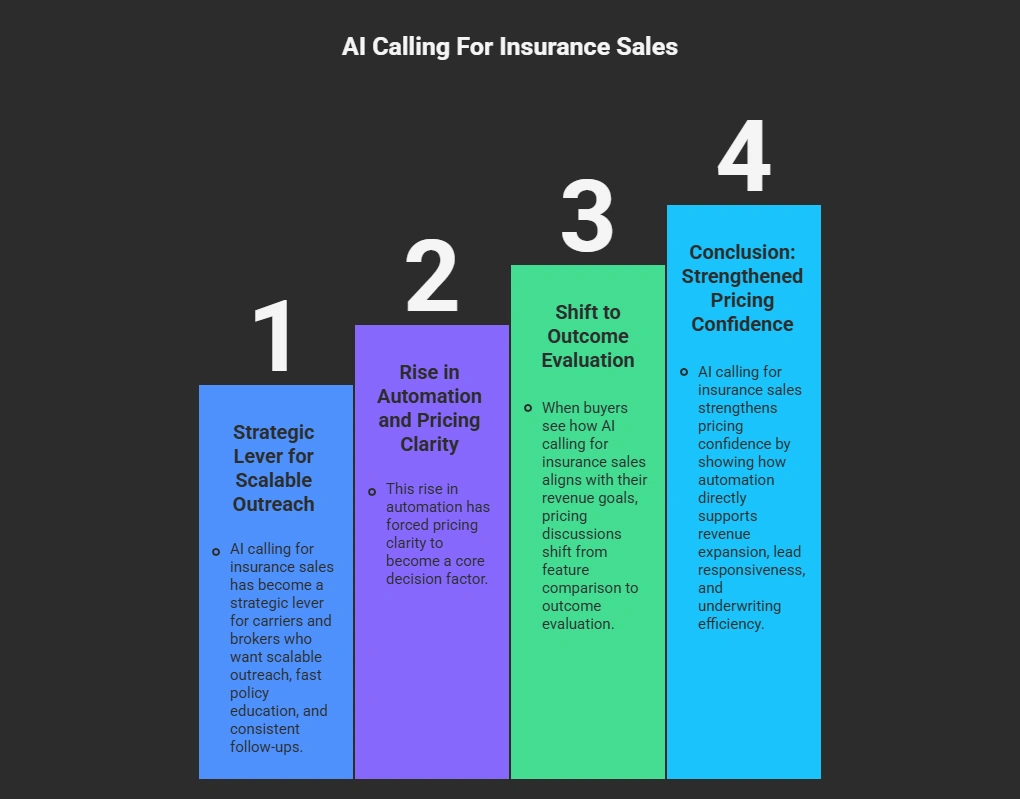
AI Calling For Insurance Sales
AI calling for insurance sales has become a strategic lever for carriers and brokers who want scalable outreach, fast policy education, and consistent follow-ups. This rise in automation has forced pricing clarity to become a core decision factor. When buyers see how AI calling for insurance sales aligns with their revenue goals, pricing discussions shift from feature comparison to outcome evaluation.
In conclusion, AI calling for insurance sales strengthens pricing confidence by showing how automation directly supports revenue expansion, lead responsiveness, and underwriting efficiency.
Insurance AI Voice Agent
An insurance AI voice agent can manage quoting, pre-screening, renewals, and customer qualification, but enterprise buyers want proof that each workflow adds measurable value. Clear packaging and transparent tiering help map the insurance AI voice agent’s capabilities to operational complexity, from basic outbound reminders to fully automated multi-step policy advisory.
Ultimately, an insurance AI voice agent builds trust when its capabilities are framed within value-aligned tiers that match insurance workflow depth and customer experience expectations.
With clear reasons for pricing confidence established, the next step is understanding what enterprise buyers specifically look for when evaluating AI agent insurance platforms.
Restructure your AI calling bundles.
What Enterprise Buyers Expect From AI Agent Insurance Platforms
Enterprise purchasing teams want more than generic automation. They expect AI agent insurance solutions to integrate seamlessly into legacy systems, meet compliance standards, and provide measurable ROI, especially in large contact centers and agent networks. Packaging must reflect these enterprise realities.
AI Agents For Insurance Contact Centers
AI agents for insurance contact centers are increasingly evaluated on scalability, regulatory adherence, and consistency across thousands of calls. Enterprise buyers want transparency: how costs scale, how performance is measured, and how escalation works. Packaging these expectations into pricing tiers helps convert complexity into clarity.
In the end, AI agents for insurance contact centers earn buyer confidence when pricing shows how automation scales responsibly and predictably across call volumes and customer journeys.
AI-Powered Insurance Outreach
For growth-focused insurance teams, AI-powered insurance outreach promises precision and personalization at scale. But enterprise leaders require assurance that each outreach capability, lead scoring, callback automation, renewal nudges, maps clearly to a pricing tier. This removes ambiguity and allows Sales/RevOps to match spend to expected uplift.
Therefore, AI-powered insurance outreach gains enterprise traction when packaged transparently, making ROI easier to forecast and justify.
With expectations clarified, we can look at why pricing is often difficult to structure and why AI agent insurance requires a different approach.
Improve your tier packaging instantly.
This blog is just the start.
Unlock the power of Convin’s AI with a live demo.

The Pricing Challenge In AI Agent Insurance
Most pricing issues in AI agent insurance stem from misalignment: enterprises buy workflows and outcomes, while vendors often price based on usage or generic features. Insurance workflows differ dramatically from claims follow-ups to FNOL calls to policy renewals, and pricing must reflect this variability.
Automated Insurance Sales Workflows
Automated insurance sales workflows vary in complexity depending on scripting depth, regulatory disclosures, and handoff paths. Because no two carriers operate identically, pricing based solely on call minutes or conversation counts creates uncertainty. Tying automated insurance sales workflows to defined workflow tiers helps procurement teams understand exactly what they’re paying for.
Ultimately, automated insurance sales workflows drive pricing confidence when packaged by complexity and outcome, not just usage.
AI Pricing Strategy For Insurance
A strong AI pricing strategy for insurance acknowledges factors like regulatory nuance, multi-language support, verification processes, and real-time analytics. Enterprise buyers appreciate pricing frameworks that show how these advanced capabilities ladder into higher tiers. This strategy minimizes surprises and reinforces trust.
In conclusion, an AI pricing strategy for insurance succeeds when it connects capability investment with predictable, outcome-indexed pricing.
Below is a mock call script that depicts frontline sales agents uncovering the pricing challenge in AI agent insurance.”
It’s written as a realistic agent enterprise buyer dialogue, highlighting the friction points, uncertainty drivers, and misalignment between usage-based pricing and insurance workflow complexity.
Context:
A Sales/RevOps rep is speaking with a Director of Operations at a large insurance carrier, evaluating AI calling for underwriting and renewals. This script helps illustrate how pricing confusion shows up in real enterprise discussions.
Scene 1: Opening: Buyer Signals Pricing Confusion
Buyer:
“Before we go deeper into workflows… we’re stuck on pricing. Every vendor gives us a per-minute or per-call model. But our insurance calls aren’t uniform. Some are disclosures, some are verifications, some are advisory. How do we budget for that?”
Agent:
“Totally understood. That’s actually the number one challenge we hear in ai agent insurance. Usage-based pricing doesn’t reflect workflow complexity, and insurance workflows rarely follow a straight path.”
Scene 2: Probing: Agent Surfaces Root Causes
Agent:
“Can you walk me through where the pricing uncertainty comes from internally? Is it the variability of calls, compliance steps, or something else?”
Buyer:
“All of it. A ‘simple’ renewal call can turn into a ten-minute conversation because of KYC checks, policy clarifications, and upsell prompts. A per-minute model makes our cost unpredictable. And we can’t forecast spend across 12 months this way.”
Agent:
“Makes sense. Insurance teams often tell us that the pricing challenge in ai agent insurance is directly tied to branching logic. One customer might complete in 30 seconds. Another needs five disclosures, a premium explanation, and verification. Same workflow name totally different conversation cost.”
Scene 3: Clarifying: Buyer Acknowledges Misalignment
Buyer:
“Exactly. And when procurement asks us why a ‘renewal workflow’ is 3x more expensive on certain days, we have no answer. Nothing changed except customer behavior.”
Agent:
“Right. Because usage pricing assumes consistency, but ai agent insurance conversations aren’t consistent. Policies differ, risk profiles differ, underwriting rules differ, and compliance disclosures differ. Pricing doesn’t reflect reality; it reflects call length.”
Scene 4: Reality Check: Buyer Reveals Financial Friction
Buyer:
“And honestly… it’s hard to take something to the CFO when I can’t defend the variability. We need a pricing model that aligns cost to value and outcomes—not random conversation durations.”
Agent:
“This is why so many enterprise teams say the biggest pricing challenge in ai agent insurance isn’t the technology—it’s predictability. If pricing doesn’t map to workflow complexity, spend becomes unforecastable.”
Scene 5: Insight Pivot: Agent Frames Value Drivers
Agent:
*“Let me check: would it help if pricing tiers were tied to your workflow categories? For example:
- simple outbound nudges,
- multi-step advisory,
- compliance-heavy journeys
…each with predictable rates?”*
Buyer:
“That would help. Our concern is that we’re buying outcomes such as completed renewals, completed screenings, not minutes. Pricing needs to match that.”
Agent:
“Exactly. Once pricing reflects complexity and insurance-specific value drivers such as disclosures, verification, and branching logic; it becomes defensible internally.”
Scene 6: Confirmation: Buyer Connects the Dots
Buyer:
“So the issue isn’t the AI. It’s that the traditional pricing model wasn’t built for insurance workflows.”
Agent:
“Correct. The ai agent insurance space evolved faster than its pricing frameworks. And that’s why so many teams report the same pain: unpredictable monthly bills, confused stakeholders, and difficulty scaling.”
Scene 7: Wrap-Up: Agent Summarizes the Pricing Challenge
Agent:
*“To summarize what you’ve shared:
- Usage-based pricing breaks when workflows vary in complexity.
- Compliance steps, disclosures, and branching inflate call time unpredictably.
- Procurement can’t justify variability to finance.
- Pricing needs to align with insurance outcomes, not minutes.”*
Buyer:
“That’s exactly it. If you can show us a tiered model based on workflow complexity, we can move forward faster.”
This is the moment enterprise buyers realize the real pricing challenge in AI agent insurance isn’t cost; it's unpredictability caused by misaligned pricing models.
Once challenges are clear, the solution becomes obvious: align value drivers directly to pricing tiers, core to building confidence in AI agent insurance deals.
Assess compliance steps in your workflows.
Aligning Value Drivers To Pricing Tiers In AI Agent Insurance
This is the heart of the AI agent insurance pricing conversation. Enterprise buyers want tiers that reflect meaningful insurance value drivers, risk reduction, call accuracy, automation depth, analytics insights, not superficial feature counts. When value drivers are clearly structured, procurement teams can confidently justify spend.
Key value drivers that map naturally to pricing tiers:
- Workflow depth and branching complexity
- Verification and compliance automation
- Language and dialect coverage
- AI reasoning sophistication and error tolerance
- Integration density (CRM, policy admin, claims systems)
- Outcome analytics and insights
Convin’s Insurance solution and Automated Virtual AI Agents align with several of the above drivers, but the narrative remains vendor-agnostic.
With value-aligned tiers clarified, it’s time to turn the framework into real packaging models for enterprise-scale AI agent insurance buyers.
Run a pricing confidence check today.
Packaging AI Calling For Enterprise-Scale AI Agent Insurance
In enterprise AI agent insurance, packaging AI calling isn’t about feature bundles; it’s about mapping insurance outcomes to predictable tiers. RevOps leaders need pricing structures that reflect effort, value, and risk. Packaging should ensure insurance teams clearly understand how each tier supports their unique workflows.
AI Calling For Insurance Sales
Revisiting AI calling for insurance sales, packaging can follow workflow maturity:
Tier 1: Basic Outbound Notifications
At this foundational tier, AI calling for insurance sales focuses on simple, time-saving automations: reminders for renewals, payment nudges, scheduled follow-ups, and basic status notifications.
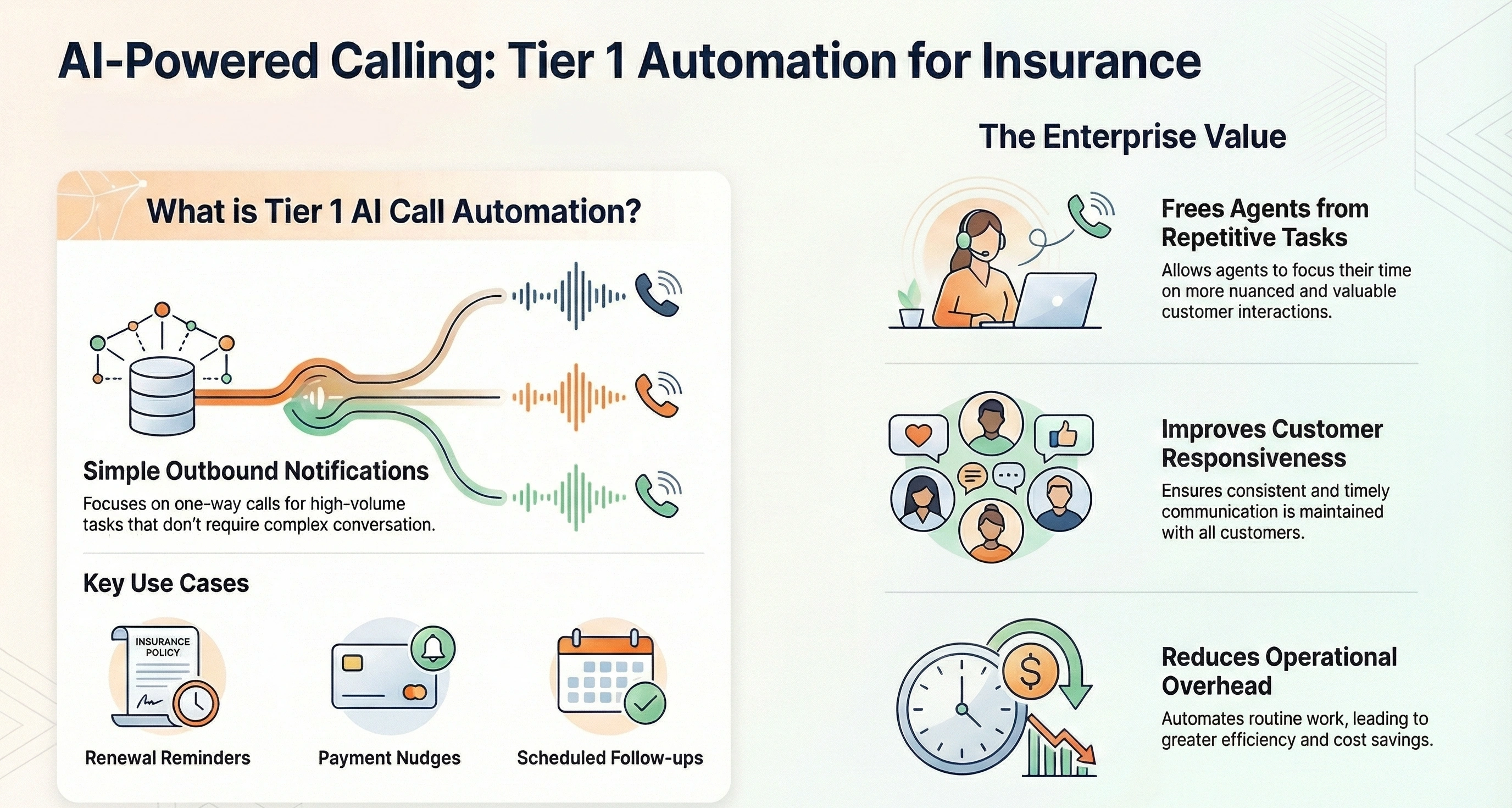
These are often one-way calls with minimal branching, ideal for high-volume tasks that absorb human agent bandwidth but don’t require nuanced conversation.
Enterprise value:
- Frees agents from repetitive tasks
- Improves customer responsiveness
- Reduces operational overhead
How Convin helps:
Convin’s Automated Virtual AI Agents can execute these notification workflows with consistent delivery, audit-friendly call logs, and smooth scheduling integrations, helping ops teams maintain predictable outreach without overhauling existing processes.
Tier 2: Qualified Outreach with Script Branching
Tier 2 introduces qualified outreach, where AI determines intent, eligibility, or interest, while navigating light branching logic.
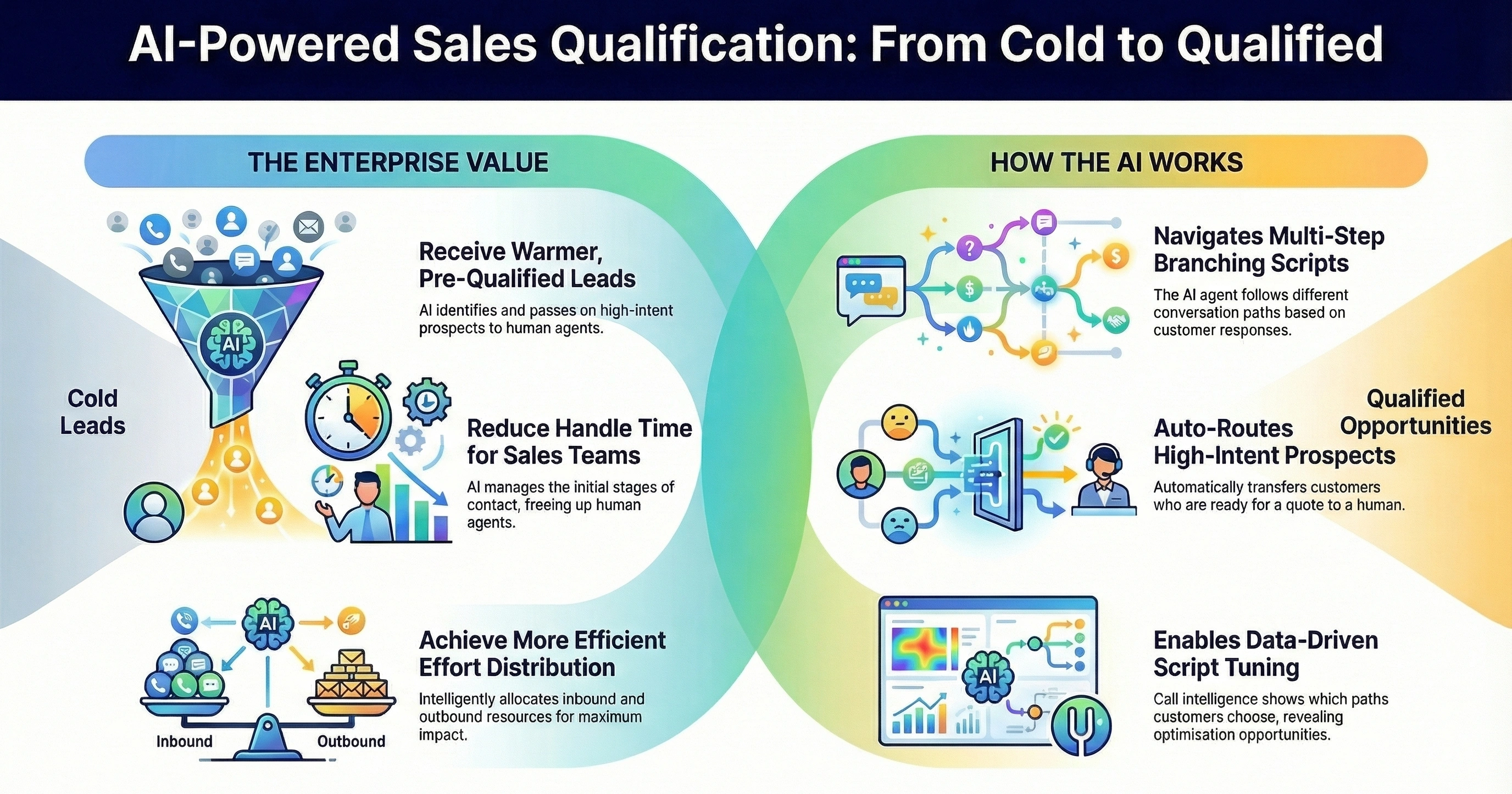
The system identifies whether a customer is ready for a quote discussion, requires additional information, or should be transferred to a human agent.
Enterprise value:
- Warmer, pre-qualified leads for human agents
- Reduced handle time for sales teams
- More efficient distribution of inbound/outbound effort
How Convin helps:
Convin’s AI agents handle multi-step branching scripts, auto-route high-intent prospects, and flag compliance-sensitive responses for review. The platform’s call intelligence provides visibility into what paths customers choose, allowing RevOps to fine-tune scripts without guesswork.
Tier 3: Advisory Conversations with Compliance-Aligned Disclosures
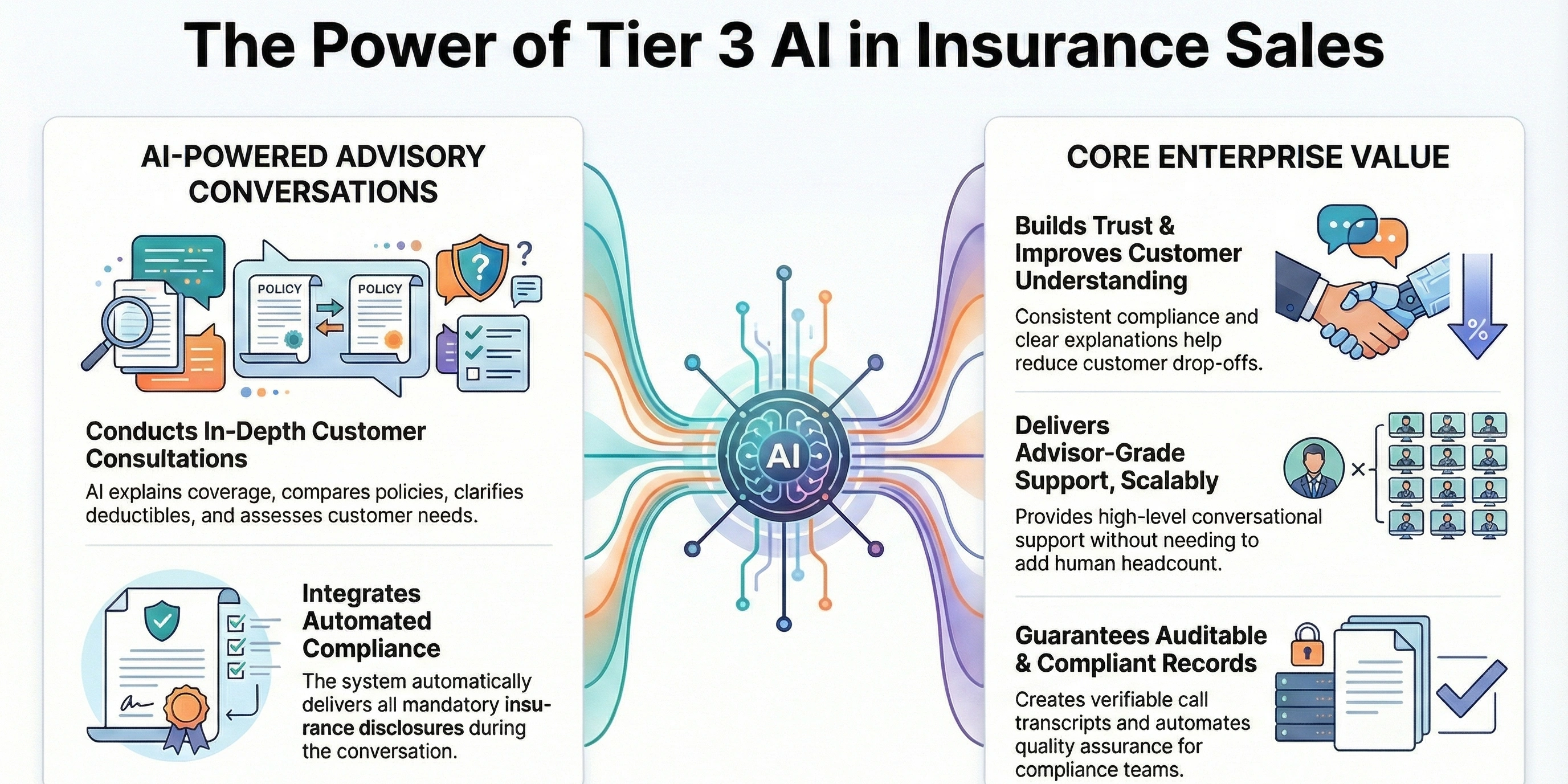
At this stage, AI calling for insurance sales becomes conversationally rich. The AI walks customers through coverage explanations, policy comparisons, renewal benefits, deductible clarifications, and needs assessment questions while automatically delivering mandatory insurance disclosures.
Enterprise value:
- Increased trust due to consistent compliance delivery
- Improved customer understanding and reduced drop-offs
- Advisor-grade support without adding headcount
How Convin helps:
Convin’s Automated Virtual AI Agents can deliver insurer-specific disclosures, verify information, and document call outcomes in auditable transcripts. The system’s QA automation ensures disclosures are always delivered correctly, important for compliance teams that must defend every conversation.
Tier 4: Fully Automated Multi-Journey Orchestration and Cross-Sell
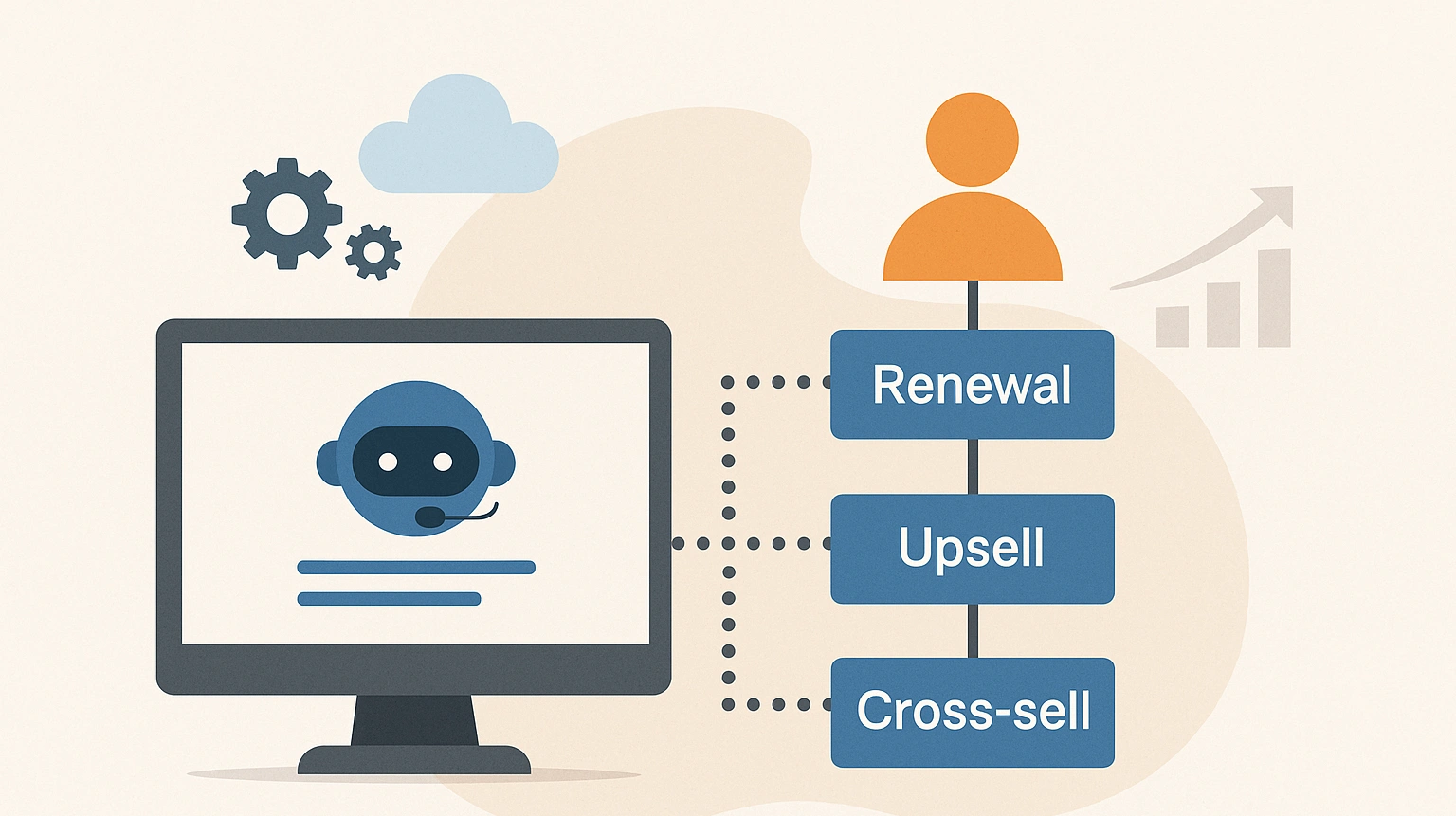
Here, AI calling for insurance sales operates as a fully dynamic sales engine. The AI navigates complex,
- Multi-step journeys
- Renewal
- Upsell
- Cross-sell
while adjusting conversational paths based on customer profile, product fit, and regulatory considerations. These workflows may span multiple days or touchpoints.
Enterprise value:
- Automated end-to-end sales cycles
- Increased policy attachment rates
- Personalized journeys at scale
- Predictable, repeatable revenue lift
How Convin helps:
Convin’s AI agents integrate fully with policy admin and CRM systems, enabling multi-touch orchestration. They adapt conversations in real time using contextual data, and hand off seamlessly when human expertise is required. The layered analytics help RevOps understand which journey flows convert and where optimizations drive ROI.
Why These Tiers Build Pricing Confidence
As capabilities mature from simple notifications to orchestrated advisory journeys, enterprise buyers finally see why higher tiers command higher pricing:
- Complexity: higher reasoning & branching
- Compliance: deeper automation safeguards
- Personalization: more data clubbed with integration layers
- Revenue impact: measurable uplift in conversion and retention
This is the structure that helps insurance buyers say:
“Yes, I understand what we’re paying for and why.”
This structure helps enterprise buyers see how increasing capability aligns with increasing value.
In conclusion, AI calling for insurance sales gains enterprise momentum when packaging highlights revenue impact, operational savings, and workflow intelligence.
AI Agents For Insurance Contact Centers
For large carriers and TPAs, AI agents for insurance contact centers often anchor enterprise ROI. Packaging can reflect:
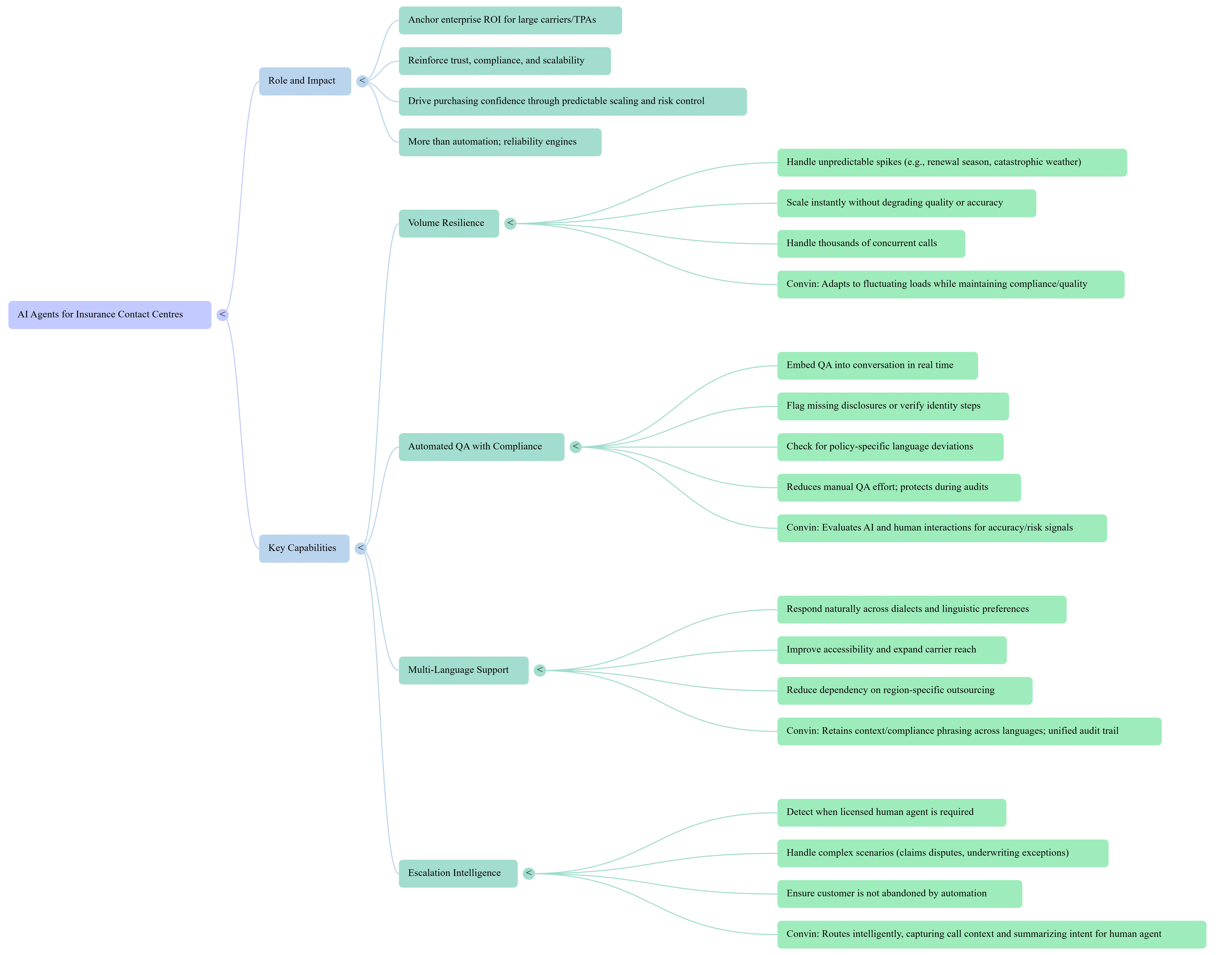
- Volume Resilience
Insurance contact centers experience unpredictable spikes, renewal seasons, rate-change cycles, catastrophic weather events, or regulatory deadlines. AI agents for insurance contact centers need the ability to scale instantly without degrading call quality or response accuracy. Volume resilience means the AI must handle thousands of concurrent calls without slowing down, dropping context, or misrouting high-priority interactions.
Convin’s AI agents adapt to fluctuating inbound or outbound loads while maintaining consistent conversation quality, auto-logging calls, and preserving compliance integrity even at peak volumes.
- Automated QA with Compliance
Insurance communications require strict, auditable adherence to disclosures, consent checks, eligibility questions, and regulated scripts. AI agents for insurance contact centers can embed QA into the conversation itself, flagging missing disclosures, verifying identity steps, or checking for policy-specific language deviations in real time. This reduces manual QA effort and protects the organization during audits.
Convin’s conversational intelligence automatically evaluates AI along with human agent interactions for accuracy, compliance coverage, and risk signals, giving compliance teams evidence, not anecdotes.
- Multi-Language Support
Insurance customer bases span multiple regions and linguistic preferences. AI agents for insurance contact centers must respond naturally across dialects, languages, and culturally specific communication styles. Multi-language capability helps carriers expand reach, improve accessibility, and reduce dependency on region-specific outsourcing teams.
Convin’s AI agents can be configured for multilingual insurance workflows, retaining context, intent, and compliance phrasing across languages while maintaining a unified audit trail.
- Escalation Intelligence
Even the most advanced AI cannot (and should not) handle every case. Insurance customers often present complex scenarios such as claims disputes, underwriting exceptions, or emotional, sensitive situations. AI agents for insurance contact centers need escalation intelligence to detect when a call requires a licensed human agent. Good escalation logic ensures the customer never feels abandoned or looped by automation.
Convin’s AI agents route escalations intelligently, capturing call context, summarizing intent, and handing off a clean, structured brief to human agents so customers don’t repeat information.
The clearer these elements appear inside pricing tiers, the easier procurement becomes.
Together, these capabilities make AI agents for insurance contact centers more than automation; they become reliability engines that reinforce trust, compliance, and scalability in every customer touchpoint.
Ultimately, AI agents for insurance contact centers drive purchasing confidence when packaging proves they scale predictably with quality and risk controls.
With all major sections covered, we can now wrap up the full narrative on pricing confidence for AI agent insurance.
Book your Convin demo today!
The Path To Pricing Confidence In AI Agent Insurance
Pricing confidence in AI agent insurance comes from clarity, not complexity. Enterprise buyers want pricing structures that reflect real workflow value, predictable scaling, and transparent ROI. By aligning value drivers to pricing tiers, insurance organizations gain a framework that’s easier to justify internally and simpler to operationalize.
RevOps and Sales teams can use this model to structure conversations around outcomes instead of features, accelerating deal velocity and reducing pricing friction.
FAQs
1. How do AI agents improve lead qualification accuracy in insurance sales?
AI agents analyze customer intent, eligibility, and response patterns to automatically qualify leads, reducing manual screening time and improving conversion predictability.
2. What data security standards should insurance teams check before deploying AI calling?
Insurance teams should validate compliance with SOC 2, ISO 27001, PCI considerations, and region-specific privacy laws to ensure safe handling of customer and policy data.
3. Can AI agents integrate with legacy policy administration systems used by insurers?
Yes. Modern AI agents can connect with policy admin systems via APIs or middleware, enabling real-time updates, customer verification, and workflow automation.
4. How do insurers measure ROI from AI calling and virtual agents?
Teams typically track call deflection, faster policy renewals, improved upsell rates, reduced handle time, and enhanced compliance accuracy to calculate ROI.
5. What types of insurance workflows are easiest to automate with AI calling?
Routine workflows such as renewal reminders, payment verifications, lead outreach, FNOL intake, and document follow-ups are usually the most automation-ready.


%20BLOG10%20examples%20of%20artificial%20intelligence%20in%202024.webp)



.avif)