


In insurance, repeated policy status inquiry calls signal deeper communication and workflow gaps: unclear updates, inconsistent scripts, and rising customer friction. These issues drain teams and weaken trust. Strengthening proactive communication and real-time agent support reduces the loop. The question now is: which gaps in your process are creating your next policy status inquiry?
A policy status inquiry is a customer request checking the current stage or progress of their insurance policy, often triggered by unclear updates, communication delays, or inconsistent agent guidance.
Fix repeated “Where’s my policy?” calls today.
Why Policy Status Inquiry Calls Keep Repeating
If your team keeps fielding the same policy status inquiry call every day, it’s rarely a customer problem; it’s almost always a system problem. Sales heads and policy agents often feel the heat, but the root cause usually sits deeper in communication workflows. When customers repeatedly ask, “Where is my policy?”, they’re really telling you something’s broken long before renewal time. This is where the hidden costs begin to pile up.
Customer Experience Gaps
Most repeat policy status inquiry calls stem from overlooked customer experience gaps. When updates don’t arrive at the right time or in the right channel, uncertainty becomes the default experience.
Customers expect clarity on policy issuance, processing times, and approvals. When they don’t get consistent updates, inbound calls spike and customer patience dips. These customer experience gaps frustrate buyers and overwhelm teams who now spend time clarifying instead of closing.
Without timely communication, each policy status inquiry becomes another sign of a widening trust deficit.
Close the customer experience gaps, and you immediately cut down the volume of repeated policy status inquiry calls that drain efficiency and satisfaction.
Unclear Policy Updates
Even when teams try their best, unclear policy updates can leave customers guessing. Ambiguous language or missing steps generate confusion that inevitably leads to more policy status inquiry calls.

A policy update that says “in process” isn’t enough for customers who want certainty. Vague stages, inconsistent wording, and delayed notifications only deepen frustration. These unclear policy updates don’t just cause repeat calls; they undermine confidence in the entire customer journey. Suddenly, your agents become the only reliable “source of truth,” creating unnecessary workload.
Fixing unclear policy updates eliminates one of the most chronic drivers of repeated policy status inquiry calls.
Once repeated policy status inquiry calls become part of your daily call volume, the costs start compounding quietly, across time, productivity, and customer trust.
Cut customer confusion before it starts.
The Real Cost Of Every Policy Status Inquiry
A repeat policy status inquiry call rarely feels catastrophic in the moment, but multiplied across days, weeks, and seasons, it quietly reshapes your team’s productivity curve. Sales heads lose time preparing teams for new business because they’re tied up solving old frustrations.
Policy agents get caught in cycles of clarifying the same status repeatedly. The real cost isn’t the 2-minute call; it’s the momentum it steals from every critical workflow around it.
Call Center Workflow Issues
Many recurring policy status inquiry calls come from entrenched call center workflow issues. These are inefficiencies too small to notice day-to-day but too costly to ignore long-term.
When agents rely on multiple disconnected systems, policy portals, CRM, and internal approval trackers, they lose valuable seconds on every lookup. Over time, these micro-delays stack into hours of wasted effort. These call center workflow issues become even sharper during peak seasons like renewals or regulatory updates.

Customers waiting on policy confirmation don’t understand internal delays; they only know they haven’t heard back. That silence becomes a prompt for yet another policy status inquiry, pushing call queues higher and stretching SLAs further. The system becomes reactive, and leaders struggle to break the cycle.
Fixing the call center workflow issues doesn’t just streamline operations; it meaningfully reduces the number of policy status inquiry calls that drain your team’s time and attention every week.
Inconsistent Agent Scripts
Another hidden driver of repeated policy status inquiry calls is the presence of inconsistent agent scripts across the team. Variability in talk tracks makes customers question accuracy.
Even small differences: “Your policy should be ready soon” vs. “It will be issued within 48–72 hours”, change customer expectations dramatically. These inconsistent agent scripts not only confuse customers but also lead to internal misalignment: supervisors, QA analysts, and agents all interpret guidelines differently.
And when customers receive conflicting answers, they call again to “just double-check,” triggering yet another policy status inquiry that could have been prevented. Reps also experience stress when they feel responsible for misleading customers unintentionally.
Eliminating inconsistent agent scripts ensures clarity and builds trust, reducing the callbacks and repeat policy status inquiry loops rooted in agent-to-agent variation.
Once these hidden operational and communication gaps become visible, the path to improvement becomes clearer. The next step is understanding what high-performing teams do differently to prevent repeated policy status inquiry calls in the first place.
Detect repeated intent patterns quickly.
This blog is just the start.
Unlock the power of Convin’s AI with a live demo.

What Does Better Look Like For Policy Status Inquiry Reduction
Top insurance teams don’t just manage policy status inquiry calls; they anticipate and prevent them. They build processes that keep customers informed, agents aligned, and workflows predictable. When customers never feel lost, they never feel the need to repeatedly check on their policy.
Insurance Policy Communication
Strong insurance policy communication is the foundation of a low-friction customer experience. It’s the first line of defense against unnecessary inbound calls.
Great insurance policy communication involves clear milestones: policy submission received, verification complete, underwriting in progress, approval successful, issuance completed, and any exceptions flagged with precise steps.

Insurance policy communication
Customers understand where they are in the journey, so they never feel unsure. The most successful teams use multi-channel updates, SMS, email, and app notifications to meet customers where they already are. When updates are timely and specific, the number of policy status inquiry calls drops dramatically.
Invest in richer insurance policy communication, and you prevent the uncertainty that drives customers to make repeat policy status inquiry calls in the first place.
AI Agent Assist
While better communication helps proactively, an AI agent assist strengthens the reactive moments, when customers call in with concerns or clarification needs.

With AI agent assist, agents get real-time cues that ensure every policy detail is explained consistently. The tool reminds them of the correct steps, helps avoid outdated phrasing, and guides them toward accurate timelines.
These improvements reduce accidental miscommunication, a major driver of repeat policy status inquiry calls. Instead of improvising answers, agents deliver clarity with confidence, even during peak volume periods.
When teams adopt AI agent assist, they dramatically decrease the likelihood of customers calling back with another policy status inquiry rooted in confusion or incomplete guidance.
Once communication strengthens both proactively and reactively, modern insurance teams add a final layer, smart automation and real-time intelligence, to eliminate the last mile of repeat policy status inquiry calls.
Prevent avoidable support call spikes.
How Teams Fix Policy Status Inquiry Issues With Modern Tools
Modern teams use a blend of automation and real-time intelligence to reduce the burden of repeated policy status inquiry calls. Instead of reacting to customer confusion, they build a system where updates flow automatically, and agent accuracy is consistently supported.
Policy Status Automation
The most powerful intervention is policy status automation, which turns manual, delayed updates into seamless, instant communication.
Imagine every customer automatically receiving a message the moment their policy moves from one stage to another. No more waiting. No more confusion. With policy status automation, updates are triggered by workflow events, ensuring customers stay in the loop without ever needing to place a policy status inquiry call. Automation also helps agents by reducing status-check workloads and freeing them to focus on revenue-generating conversations.
Implementing policy status automation directly cuts down the number of repeat policy status inquiry calls by keeping customers consistently informed.
AI Agent Assist + Conversation Intelligence
Layering an AI agent to assist with conversation intelligence creates a proactive, self-correcting communication engine.
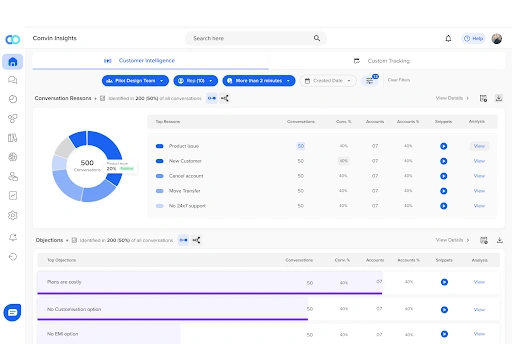
Conversation intelligence identifies trends, like rising policy status inquiry calls, and pinpoints their root causes. Maybe certain agents are deviating from scripts. Maybe certain products generate the most confusion.
Maybe certain customer segments aren’t receiving updates. Coupled with real-time AI agent assist, teams can fix issues instantly, ensuring consistent talk tracks and closing gaps such as customer experience gaps, unclear policy updates, and inconsistent agent scripts. This tight loop reduces callbacks dramatically.
By combining AI agent assist with conversation intelligence, teams prevent miscommunication and stop the recurring policy status inquiry cycle before it begins.
Schedule a Convin demo now!
Rethink The Policy Status Inquiry Loop
Repeated policy status inquiry calls aren’t just a signal; they’re a warning. They highlight missing clarity, inconsistent talk tracks, and communication gaps that quietly erode customer trust.
Strong insurance policy communication is the foundation of trust in a high-volume, high-stakes industry.
Teams that invest in clearer updates, better messaging, and consistent guidance quickly reduce friction. Customers appreciate transparency, and agents reclaim hours lost to repetitive calls. When you eliminate confusion, the policy status inquiry loop naturally fades.
Reinforce insurance policy communication, and you transform every policy status inquiry from a reactive burden into a proactive opportunity.
FAQs
- What triggers a policy status inquiry before a customer receives their policy documents?
A policy status inquiry is usually triggered when customers sense a communication gap, no confirmation messages, unclear timelines, or unexpected delays in document issuance. Even small lags between payment, verification, and final approval can prompt customers to check on their policy status.
- How can insurers predict a policy status inquiry using behavioral or intent signals?
Insurers can predict a policy status inquiry by analyzing early signals like repeated portal logins, stalled document submissions, customers rereading previous emails, or rising frustration in earlier conversations. Conversation intelligence tools can spot these intent patterns before the customer makes the call.
- Why do policy status inquiry calls increase during underwriting or verification delays?
Underwriting and verification involve multiple checkpoints, and delays often occur when additional documents, medical checks, or internal approvals are needed. If customers aren’t informed proactively, uncertainty grows—leading to more policy status inquiry calls as they try to understand what’s holding things up.
- How does proactive communication reduce the likelihood of a policy status inquiry?
Proactive communication keeps customers updated at every milestone, submission, verification, underwriting, approval, and issuance. When customers know exactly where their policy stands, they don’t feel the need to check repeatedly, significantly reducing policy status inquiry calls.
- What role does automation play in shortening the policy status inquiry cycle time?
Automation shortens the policy status inquiry cycle by sending instant alerts when a policy moves stages, flagging delays, and reminding customers of pending actions. This eliminates guesswork, reduces inbound calls, and keeps policyholders informed without manual follow-ups from agents.


%20BLOG10%20examples%20of%20artificial%20intelligence%20in%202024.webp)



.avif)