


Insurance sales compliance isn’t just a regulatory checkbox. It’s a high-risk area that can quietly bleed revenue, invite penalties, and damage brand trust. Yet, many insurers continue to rely on legacy processes and incomplete visibility to manage what should be one of their most tightly controlled functions.
Agents are expected to follow scripts, disclose accurate information, and maintain consistency across all customer interactions.
But when deviations occur, as they inevitably do, the blame often lands squarely on the agent. Missed disclosures, incomplete pitches, or non-standard language are viewed as negligence.
The truth is more complex and far more concerning.
Behind every script deviation or inconsistent sales pitch is often a broken system. One that fails to monitor adherence, lacks feedback loops, and doesn’t give leaders the granular visibility they need. It’s not a people problem. It’s a systems problem.
And the longer this goes unaddressed, the higher the compliance risk.
Discover what’s really causing non-compliance with Convin!
The Real Problem Behind Insurance Sales Compliance Failures
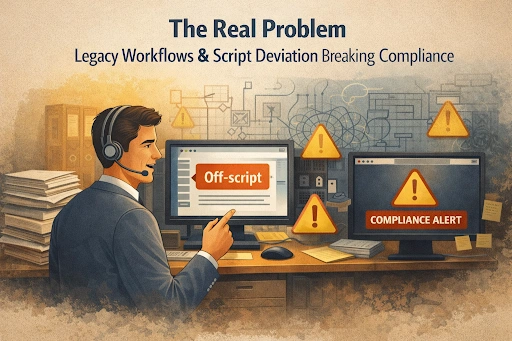
For most insurance leaders, compliance issues first appear as simple human error. An agent forgets a disclosure. Another uses improvised language during a pitch. A third submits incomplete documentation.
These incidents get logged as disciplinary issues or coaching opportunities, but the pattern keeps repeating. Over time, this pattern begins to cost money, reputation, and regulatory goodwill.
The first hard truth is that compliance failures are never just about individuals. They reflect deeper structural gaps in how organizations equip, monitor, and guide their agents. Regulatory expectations in insurance are strict, covering licensing, transparency, disclosures, and suitability.
Failure to meet these expectations can carry real penalties and business disruption. For example, missing a required disclosure can trigger regulatory fines or trigger investigations during a market conduct exam.
This is not hypothetical. Regulators increasingly focus on sales communications and consumer protection to ensure transparency for policyholders.
Despite these risks, many carriers and large agencies still rely on manual compliance checks or periodic audits that happen well after the fact. This creates two problems:
- Delayed detection of deviations from required scripts, which means agents can continue repeating the same mistakes for weeks or months before anyone notices.
- Surface-level coaching, which targets the symptoms rather than the underlying cause of deviation.
Consider common missteps documented across the industry. Agents frequently miss providing required replacement forms or suitability questionnaires in life insurance transactions when selling complex products. Regulators treat missing disclosures as a gap in consumer protection, not a simple oversight.
Another example is inconsistent messaging during sales pitches. Script deviation often reflects uncertainty about complex product details or an absence of real-time guidance.
When agents encounter a customer question they have not practiced answering, they improvise. This can lead to incomplete or non‑standard explanations that fail to satisfy regulatory standards for transparency. Over time, these patterns can accumulate into audit flags and even formal complaints from policyholders.
These issues also affect internal operational costs. Compliance teams spend countless hours reviewing records, chasing down missing disclosures, and remediating bad practices. This effort is expensive and rarely proactive.
Many agencies still use checklists that are updated infrequently and may not reflect the latest regulatory changes across states or products.
The result is a compliance function that feels reactive. Broken systems make compliance harder to enforce, harder to measure, and harder to improve. Every deviation, inconsistent pitch, or missed disclosure then becomes a symptom of something larger.
Up next, we will dive into why these problems are often rooted in the compliance systems themselves rather than in agent behavior.
Script Deviation Is Not Your Agents’ Fault
Script deviation in insurance sales is often framed as a discipline issue. Agents are seen as choosing speed over accuracy or personalization over compliance. This framing is convenient, but it is inaccurate. In most organizations, deviation is not driven by intent. It is driven by structural and system-level gaps.
Agents operate in high-pressure environments. They manage complex products, evolving regulations, and aggressive targets while trying to keep conversations natural. When systems fail to support this reality, deviation becomes inevitable.
The Myth of Agent Non-Compliance
The assumption that agents willingly ignore scripts does not hold up under scrutiny. Most agents understand the consequences of non-compliance. Regulatory action, chargebacks, customer complaints, and even license risk are very real concerns.
Regulatory reviews support this view. The National Association of Insurance Commissioners has repeatedly noted that the majority of sales practice violations stem from process gaps, outdated guidance, or unclear expectations rather than deliberate misconduct.
In many cases, agents were following instructions that had not been updated to reflect current regulatory requirements or product changes
This creates a dangerous disconnect. Leadership believes scripts are clear and enforced. Agents believe they are following acceptable guidance. Compliance teams only discover the gap when an audit or complaint surfaces.
At that point, the damage is already done.
Systemic Flaws That Encourage Script Deviation
Script deviation is rarely random. It follows predictable patterns created by flawed systems and workflows.
Common systemic issues include:
- Scripts that are too rigid to handle real customer objections
- Sales playbooks that do not differentiate between products, states, or customer profiles
- Poor version control, where outdated or non-compliant scripts remain in circulation
- No real-time reinforcement or feedback during live sales interactions
In life and annuity sales, these issues are especially pronounced. LIMRA research shows that inconsistent product explanations and suitability discussions are among the top compliance risks cited by carriers. These risks increase when agents lack contextual guidance during live conversations
When agents face uncertainty mid-call, they improvise. They simplify language, skip steps, or paraphrase disclosures. Not because they want to cut corners, but because the system gives them no better alternative at the moment.
Over time, these small deviations compound. They create wide variability in sales pitches, uneven disclosure adherence, and a growing compliance exposure that is difficult to quantify or control.
Script deviation, then, is not a frontline failure. It is a predictable outcome of systems that were never designed to support compliant behavior at scale.
Next, we will examine how inconsistent sales pitches amplify these risks and make insurance sales compliance even harder to enforce.
Learn why agents deviate and how systems cause it.
Inconsistent Sales Pitches and the Compliance Impact
Let’s be honest. No two agents pitch the same way. One leads with product benefits, another leans into pricing. Some follow the script closely; others tweak it to sound more natural. On the surface, it feels harmless, maybe even helpful.
But in insurance sales, where compliance is critical, these differences can quickly turn into serious problems.
When agents adjust the script on the fly, even with good intentions, you end up with a wide range of sales conversations. These are harder to track, harder to audit, and much harder to correct once patterns form.
Why Consistency Actually Matters
Sales scripts are not just onboarding tools. They exist to protect both the customer and the business. Every line in a script is there for a reason, often tied to a regulatory requirement. So when parts are skipped, simplified, or over-personalized, you lose the guardrails.
Here's what typically slips through:
- Mandatory disclosures are shortened or skipped
- Product risks are underplayed or missed entirely
- Key features are misrepresented or not explained at all
- Suitability is only discussed in some cases, not all
These aren’t just coaching opportunities. They’re compliance gaps. And if no one is watching closely, they become standard practice across teams.
What This Looks Like in Reality
Most leaders assume agents are following the process. But once you listen to a batch of calls or review transcripts, the inconsistencies become clear. One agent focuses on cash value. Another barely mentions it. One explains the policy charges upfront. Another brings it up only when asked.
Regulators don’t leave much room for interpretation. Consistency in what’s said, when it’s said, and how it’s framed matters just as much as following procedures. According to LIMRA research, insurers who actively monitor pitch consistency report fewer audit issues and better retention metrics.
This isn’t just about ticking boxes. It’s also about brand trust. Customers who hear conflicting details from different agents start to lose confidence in what they’re buying. Even if compliance rules aren’t technically broken, credibility suffers.
Where the Real Fix Starts
Inconsistency is not a training flaw. It is a visibility and process flaw.
If agents are all saying different things, the root cause is usually a lack of real-time guidance and accountability. Fixing this means integrating scripts into the actual workflow, using tools that highlight when key messaging is missed, and providing feedback that goes beyond generic coaching.
Without a system that enforces alignment, you can’t expect consistency. And without consistency, compliance becomes a guessing game.
Next, we will dig into poor disclosure adherence and why it continues to be one of the most persistent and overlooked risks in insurance sales.
Poor Disclosure Adherence Is a Symptom, Not the Disease
When agents miss key disclosures, it’s easy to point to training gaps or individual error. But in most cases, the issue runs deeper. Disclosure failures are usually a sign that the system itself is not built to support consistent compliance.
Why Disclosures Get Missed
In the middle of a complex conversation, agents often lose track of when and how to deliver mandatory disclosures. Common reasons include:
- Poorly structured scripts
- Lack of real-time prompts
- Disclosures hidden in static documents
- No visibility into what was said during the call
In this setup, adherence depends entirely on memory. That’s a high-risk strategy in a regulated space.
What the Real Problem Looks Like
Training alone won’t fix it. If disclosures aren’t embedded into workflows or monitored in real time, gaps will continue. Most teams only catch issues during random audits, long after the fact. By then, it's too late.
What Needs to Change
Your system should:
- Surface the right disclosures at the right time
- Confirm they were delivered
- Flag any gaps immediately
- Provide data-backed feedback
Disclosure misses are not an agent problem. They are a system design problem. Fix the design, and the compliance will follow.
Next, we’ll explore how insurance sales analytics can bring the missing visibility and control back into your compliance process.
The Role of Insurance Sales Analytics in Identifying Compliance Gaps
Most compliance gaps aren’t discovered in real time. They show up in audits, after complaints, or when a pattern becomes too obvious to ignore. That delay is the real problem. Insurance sales analytics can change that.
What Analytics Makes Possible
Modern analytics can track and surface patterns that humans miss. With the right setup, you can:
- Detect script deviations at scale
- Flag missed disclosures automatically
- Identify agents with recurring compliance gaps
- Analyze how messaging varies across regions or teams
Instead of relying on spot checks or manual QA, analytics allows you to see the full picture.
Why Traditional Monitoring Falls Short
Manual reviews can’t keep up with call volume or account for pitch variability. They’re time-consuming and reactive. More importantly, they often surface issues after the fact, when the risk has already materialized.
Analytics flips that. It shifts compliance from reactive to proactive.
How This Shifts Compliance Strategy
With analytics in place, compliance leaders can:
- Catch deviations early
- Focus training where it’s needed most
- Build accountability into sales workflows
- Provide leadership with data, not assumptions
Instead of chasing problems, you start preventing them. The insights from analytics become the foundation for continuous improvement.
In the next section, we’ll look at what strong systems actually look like when they’re built to support agent compliance from the ground up.
Uncover the process flaws behind missed disclosures.
This blog is just the start.
Unlock the power of Convin’s AI with a live demo.

Building Compliance Through Better Systems, Not Blame
Fixing compliance issues doesn’t start with agents. It starts with systems that remove ambiguity, enforce standards, and surface gaps early. Too often, sales compliance is treated as a people issue when it is actually a process and technology problem.
When built right, your systems should prevent deviation before it starts, not just flag it after the fact.
Tools and Technologies That Drive Script Discipline
Compliance cannot depend on static PDFs or memory-based adherence. It requires integrated tools that guide agents in real time. This includes:
- Contextual script delivery during calls
- Automated prompts for required disclosures
- Smart checklists that adapt to product and customer type
- Real-time transcription and deviation detection
These tools give agents the support they need to stay on track while reducing compliance risk without slowing down the sale.
Continuous Monitoring for Long-Term Compliance
One-time audits don’t scale. Long-term compliance depends on continuous monitoring that catches patterns, not just isolated mistakes.
With automated monitoring in place, compliance teams can:
- Flag recurring issues instantly
- Track performance across agents and teams
- Focus coaching efforts on actual data
- Create audit trails that stand up to regulatory scrutiny
This is how compliance becomes predictable, not reactive.
Actionable Steps
Technology and compliance cannot live in separate silos. Senior leadership must drive integration between tools, processes, and risk frameworks to create a system that scales.
Aligning Tech, Process, and Compliance Objectives
Start by mapping where compliance lives across the sales process. Identify the gaps where disclosures are missed, scripts are ignored, or reviews are delayed. Then ask:
- Does our tech stack actively support real-time script adherence?
- Can we monitor every conversation without relying on manual checks?
- Are compliance metrics tied into business reporting?
If the response is negative, the risk is only being delayed rather than managed.
KPIs That Matter for Insurance Agent Compliance
Move beyond completion rates and QA scores. The real indicators of compliance maturity include:
- Percentage of calls with full disclosure adherence
- Rate of script deviation across agents or regions
- Time to identify and resolve a flagged compliance event
- Number of repeat violations per agent or team
These metrics provide more than just information. They provide authority.
Final Thoughts
Compliance failures are not the result of bad intent. They are usually the result of outdated systems that haven’t kept up with the complexity of modern insurance sales.
For leaders ready to shift from reactive fixes to proactive control, it starts with visibility, automation, and accountability built into the sales process.
Are you curious to see how that works? Book a quick walkthrough of how top insurers are using real-time sales intelligence to close compliance gaps before they become liabilities.
Frequently Asked Questions
1. What is insurance agent compliance monitoring?
Insurance agent compliance monitoring involves tracking and evaluating agent behavior to ensure they follow sales scripts, adhere to disclosures, and comply with regulatory standards in every customer interaction.
2. How does script deviation affect customer trust in insurance sales?
Script deviation can lead to inconsistent information, missed disclosures, and misaligned expectations, which can reduce customer trust and lead to complaints or policy cancellations.
3. Why are insurance sales analytics critical for audit readiness?
Insurance sales analytics provide data-backed evidence of agent compliance, helping insurers prepare for regulatory audits and reduce the risk of penalties from undetected violations.
4. How can insurers reduce inconsistent sales pitches across teams?
Insurers can minimize inconsistent sales pitches by integrating guided scripts, automating call quality checks, and using analytics to enforce messaging consistency across all agents.


.avif)


.avif)