


In the high-pressure world of an insurance call center, agent performance isn’t just a service metric; it’s a business differentiator. Customers expect answers on the first call. Regulators expect flawless compliance.
And leaders expect agents to not only resolve queries but retain, upsell, and reassure, often all in one interaction.
Yet most organizations lack the systems to coach agents effectively, at the moment. According to McKinsey, only 15% of customer experience leaders are fully satisfied with how their company measures and manages CX performance, a clear gap in operational visibility and impact.
This blog explores how real-time coaching, live feedback, roleplay scenarios, and agent assist tools are helping insurance call centers outperform competitors.
You'll discover why traditional coaching falls short, how to integrate compliance and product training into every call, and how platforms like Convin are enabling insurers to reduce escalations, boost FCR, and drive measurable policyholder satisfaction.
Transform agent performance, see how Convin powers insurance call centers.
Why Real‑Time Coaching Matters In an Insurance Call Center
An insurance call center faces layers of complexity, from handling sensitive policyholder data to adhering to strict regulatory compliance and driving renewals and conversions.
Traditional coaching models, based on after‑the‑fact reviews, struggle to keep pace with these demands.
By contrast, real‑time coaching can intervene during live interactions, helping agents steer conversations more effectively, reduce errors, and elevate policyholder satisfaction.
In a market where first‑call resolution and retention are key differentiators, real‑time coaching becomes a strategic capability.
1. The Unique Pressures On Insurance Call Center Agents
Insurance agents often deal with emotional policy‑holders, moment‑of‑truth disclosures, and upsell opportunities simultaneously.
These pressures can increase error rates and compliance risk. According to Convin, 50 % of US support calls face escalations, pushing down first‑contact resolution and increasing AHT.
When coaching only happens post‑call, the damage may already be done: an agent may appear confident but still miss disclosure language or mishandle an objection.
Through real‑time coaching, managers equip agents with situational prompts and feedback as the call unfolds. This helps the agent pivot, recover smoothly, and build consistent habits. It shifts coaching from reactive to proactive.
2. Key Metrics Insurers Care About: First‑Call‑Resolution, Policyholder Satisfaction, Compliance
In the insurance context, typical success metrics include first‑call resolution (FCR), policyholder satisfaction (PSAT), retention rates, compliance adherence, and operational cost per interaction. Improving these metrics requires agents to follow complex script flows and regulatory disclosures, not just deliver service.
For instance, Convin’s real‑time agent‑assist solution claims to boost FCR and lower handle time, supporting the KPI focus of insurance operations.
When agents receive coaching in the moment, the alignment with these metrics becomes tighter: errors drop, call handling becomes smoother, and the policyholder walks away satisfied.
It’s not just about speed, but about quality and risk management.
3. How Real‑Time Coaching Improves Response Accuracy And Consistency
Standard post‑call coaching leaves a gap between behaviour and feedback; habits may have already formed. Real‑time coaching reduces that gap to zero.
Featuring tools like live prompts, dynamic battlecards, and context‑aware guidance (all of which Convin offers), agents are held to a live standard that drives consistency.
Consistency is critical in insurance: whether it’s compliance statements, upsell opportunities, or customer retention, variation in agent behaviour = risk. Real‑time coaching anchors the standard.
With these pressures, metrics, and consistency demands, real‑time coaching is no longer optional; it’s foundational for the modern insurance call center.
Beyond coaching frameworks, the immediacy of live‑feedback tools takes performance to the next level, letting agents adjust on the fly rather than later.
Elevate agent consistency, deploy real-time coaching with Convin.
Power of Live Feedback In Real‑Time Coaching
When agents receive feedback during an interaction rather than hours or days later, the learning sticks, behaviours change faster, and outcomes improve. Live feedback is a critical element of effective insurance agent coaching and drives measurable performance gains.
1. Real‑Time Feedback Insurance Calls Enable Immediate Course Correction
Real‑time feedback means agents receive guidance during the call or immediately after, not days later. This can include prompts during the call, visual alerts for compliance slip‑ups, or suggestions when an objection arises. For example, Convin reports that their Real‑Time Agent Assist solution helps issue resolution 25 % faster.
In an insurance setting, this might look like: the agent begins explaining a premium increase, a live system prompts them with a regulatory disclosure, or a supervisor sees negative sentiment and triggers a live micro‑coaching cue. The result: course‑correction in the moment, reducing errors and improving service quality.
Live feedback converts mundane calls into micro‑learning sessions, and every conversation becomes a chance to reinforce success.
2. Live vs Post‑Call Coaching: What Drives Faster Performance Improvement
Post‑call reviews are retrospective, useful, but reactive. Live feedback is instantaneous and proactive. Industry insights show that agents with immediate feedback achieve quicker ramp‑up, higher service scores, and fewer mistakes.
In practical terms for an insurance agent: instead of being told “you missed the underwriting disclosure” five days later, they receive an alert during the call. This immediacy prevents pattern‑forming mistakes and embeds correct behaviour faster.
Live feedback speeds up improvement, shortens mistakes‑to‑correction cycles and helps agents reach peak competence sooner.
3. Boosting Compliance And Reducing Costly Errors Through Instant Feedback
In insurance operations, a compliance violation can cost far more than a missed sale: fines, reputational risk, regulatory investigations. Real‑time live‑feedback mechanisms allow systems like Convin’s to monitor calls for compliance triggers, surface alerts to agents or supervisors and halt the issue before it becomes costly.
For example, Convin’s dashboard allows supervisors to see negative sentiment, script deviation or violation flags in real time and intervene. These capabilities let insurers convert risk into operational control.
Instant feedback not only drives performance, it safeguards compliance, reduces escalation, and protects both the brand and bottom line.
While live feedback keeps agents aligned during real calls, structured roleplay scenarios help them prepare before the interaction ever begins.
Strengthen compliance and CX with live feedback from Convin.
This blog is just the start.
Unlock the power of Convin’s AI with a live demo.

Using Role‑Play Scenarios To Level Up Insurance Agent Coaching
Hands‑on, immersive training through role‑play scenarios gives agents the safe space to rehearse complex interactions, especially relevant in an insurance call center setting where each call may carry high stakes.
1. Simulating Tough Policyholder Interactions To Build Agent Confidence
In insurance calls agents might deal with nervous policyholders, compliance disclosures, upsell pitches or claims disputes. Roleplay allows them to rehearse these conversations: the angry caller, the complex claim, the coverage objection.
That rehearsal builds agent confidence, reducing hesitation and equipping them with practiced responses.
During the scenario, coaches can inject real‑time prompts (via tools like Convin) so the roleplay mirrors live calls. This repetition and contextual preparation speeds ramp up and reduces variability in calls.
Conclusion: Roleplay equips agents with the mindset and muscle of live‑interaction before they face the real thing.
2. Embedding Product and compliance training in everyday coaching
Roleplay scenarios aren’t just about practicing scripts, they’re opportunities to combine product knowledge, regulatory compliance and objection handling in a realistic context.
For example, an agent may roleplay: “policyholder declines premium, cites affordability, wants partial waiver.” The coach uses prompts to ensure the agent explains coverage implications, upsell alternatives and complies with disclosure language.
By embedding these elements into every roleplay, coaching becomes richer and aligned with your insurance call center’s real demands.
Roleplay ensures agents won’t just know the product or rules, they’ll execute them under pressure.
3. Making Coaching Repeatable And Measurable With Scenario‑Driven Practice
The value of roleplay isn’t one‑and‑done, it’s repeatable and measurable. Effective programs track how agents perform across scenarios, note improvement, identify gaps and adapt the next session.
Tools like Convin help by capturing conversation analytics, sentiment, and behaviour metrics during role‑play and live calls.
Agile coaching with repeatable scenarios builds consistency in agent behaviour and allows leadership to benchmark readiness.
When roleplay is structured, repeatable and quantified, it becomes a scalable method for agent readiness in insurance call centres.
With live‑feedback and roleplay practices in place, the next frontier is live agent assist, the technology that powers both real‑time coaching and preparation, especially in regulated insurance workflows.
Scale agent readiness with Convin’s roleplay and analytics tools.
The role of live agent assist in insurance call center operations
Integrating live agent assist tools lets your insurance call center shift from reactive support to proactive guidance, empowering agents in the moment with data, prompts, and context‑aware help.
1. What Is Live Agent Assist: Key Tools And Features
Live agent assist refers to software that monitors live calls, provides AI‑driven prompts, displays knowledge base guidance, and integrates supervisor feedback in real time. For example, Convin’s Real‑Time Agent Assist offers features like live captions, script checklists, battlecards, and compliance alerts.
These tools are designed to support agents during live interactions rather than only after. In insurance, where every phrase matters, these assist tools reduce agent cognitive load and let them focus on the policyholder, not the paperwork.
Conclusion: Live agent assist is the operational backbone for high‑performing insurance call centres of the future.
2. Agent Assist For Compliance, Objection Handling, And Upselling
The strength of agent assist is in complex use‑cases: a policyholder says, “I’m canceling because the premium is too high”; the tool detects keywords, triggers a battlecard with objection handling steps, prompts the agent to explain value, checks compliance language, and surfaces upsell options.
Convin’s blog states: “approximately 64% of consumers prefer businesses capable of addressing their requirements instantly.”
In insurance call centers, this means more than just resolution; it means retention, compliance, and profitability. Assist tools give agents the playbook live, aligning calls with business strategy.
Live agent assist is not simply support; it’s a performance multiplier for critical insurance interactions.
3. Impact On Productivity And Policyholder Satisfaction
When agents are supported in real time, productivity improves and policyholder satisfaction rises.
For example, Convin reports that their agent assist tool enables issue resolution 25% faster than traditional methods. Another data point: Convin claims 21% higher sales performance when agent assist is used.
For insurance call centers: shorter handle times, fewer escalations, higher satisfaction scores, better retention. The business case is clear.
Live agent assist doesn’t just help agents, it drives tangible improvements in call centre outcomes.
Now that the role and benefits of agent assist are clear, let’s look at how Convin specifically enables insurance organizations to implement these tools effectively and measure success.
Drive productivity gains, equip your agents with Convin's live assist.
How to roll out real‑time coaching and assist tools in your insurance call center
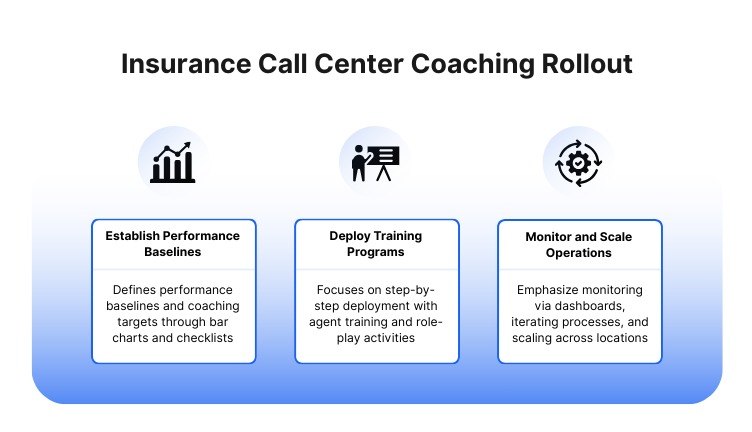
Rolling out new coaching and assist tools effectively in an insurance call center requires a structured change‑management path: set baselines, deploy thoughtfully, and measure rigorously.
1. Start With Performance Baselines And Coaching Goals
Begin by gathering current performance data: FCR, AHT, escalation rates, and compliance breaches. Define target improvements (e.g., reduce escalations by X %, improve CSAT by Y %).
Use conversation intelligence tools to identify frequent pain points or call types. With Convin’s analytics dashboards, leaders gain visibility into where the greatest opportunities for improvement lie.
2. Deploy Tools Like Live Feedback And Agent Assist Step‑By‑Step
Rather than a big‑bang rollout, it’s wise to pilot with a high‑impact call type (e.g., renewal calls, claims follow‑up) and embed role‑play training, live feedback, and agent assist together.
Train agents and supervisors simultaneously, ensure change management is in place, and refine workflows based on early feedback. Make sure compliance use‑cases are built in from day one.
3. Monitor, Iterate, And Scale Based On Performance Data
Track the same metrics you set as baseline. Use automated scoring and dashboards to monitor impact: reduction in escalation rate, improvement in FCR, and reduction in compliance breaches.
Use these insights to iterate coaching workflows, update role-play scenarios, and refine prompts in agent-assist tools. Over time, scale across teams, geographies, and call types.
A structured, data‑driven rollout of real‑time coaching and assist tools ensures your insurance call center doesn’t just adopt new technology, but transforms how agents work and how service is delivered.
Unlock ROI at scale, roll out Convin’s real-time tools with impact.
Real‑Time Coaching Gives Your Insurance Call Center The Edge
Coaching agents once a week or after a bad call isn’t enough anymore. Insurance call centers deal with fast-moving conversations, strict regulations, and policyholders who won’t wait on hold or tolerate errors.
You need systems that guide performance as it happens, not after it’s too late to fix.
That’s where real-time tools come in. With live feedback, structured roleplay, and in-the-moment assist, your agents handle objections better, stick to compliance, and resolve issues faster.
Convin brings these capabilities together in one platform, supporting your frontline with coaching prompts, analytics, and insights that actually move the numbers.
If you're looking to reduce escalations, improve first-call resolution, and give your team the support they need to perform under pressure, this is where it starts.
Book your Convin AI demo today!
FAQ
1. How to improve agent performance in call center?
Agent performance improves when coaching is real-time, targeted, and data-backed. Use tools like live agent assist, real-time feedback, and scenario-based roleplays to guide agents during calls. Platforms like Convin help track performance metrics like FCR and compliance adherence, critical for high-stakes environments like an insurance call center.
2. Why is coaching important in BPO?
Coaching directly impacts service quality, compliance, and customer retention in BPOs. Without timely guidance, agents often repeat mistakes. Real-time coaching addresses issues mid-conversation, reduces errors, and builds agent confidence, especially in industries like insurance where accuracy and regulation are key.
3. How to effectively coach call center agents?
Effective coaching blends live feedback with structured practice. Use real-time prompts, personalized insights, and measurable roleplay scenarios. Convin enables supervisors to coach with context, linking agent behavior to KPIs like handle time, sentiment, and call outcomes.
4. What are the 5 R's of coaching?
The 5 R’s of coaching are: Rapport, Recognition, Review, Reinforce, and Redirect. In call centers, especially insurance call centers, applying these principles in real-time improves agent engagement, reduces compliance risk, and drives consistent service quality. Tools like Convin help automate and support this coaching structure.


%20BLOG10%20examples%20of%20artificial%20intelligence%20in%202024.webp)



.avif)