


Many insurers assume multilingual automation succeeds if the language output is accurate. But Regional Leaders know that’s only half the story. The real challenge isn’t translation; it’s navigating the messy layer of local regulation, wording norms, tone expectations, and disclosure rules that vary across states, countries, and regulators. And that’s exactly where most multilingual bots fail.
This blog walks through the hidden layer, the regional talk-track matrix, and how it determines whether a multilingual AI voicebot for insurers succeeds or exposes your organization to avoidable risk.
Check multilingual agent alignment using Convin.
Why A Multilingual AI Voicebot For Insurers Fails Without A Regional Talk-Track Matrix
A regional leader doesn’t worry about whether a bot can speak 8–10 languages. You worry about whether it can say the right regulatory line in the right way in a specific geography. This section explores why insurers see uneven results even after investing in multilingual automation and why the missing foundation is always the same: a structured regional talk-track matrix.
Without this layer, multilingual automation will always default to translation rather than compliance-safe localization.
The Pitfalls In Multilingual Policyholder Communication
When multilingual automation is treated as translation, message intent gets lost. Disclosures become shorter. Warnings soften. Consent lines shift. What sounds harmless in one language can sound evasive or even noncompliant in another. And policyholders notice that friction instantly.
Regional nuances amplify these gaps: conversational politeness in Tamil Nadu differs from directness in Gujarat; U.S. state DOI expectations differ from UK FCA fairness guidelines; Singapore’s MAS tone requirements differ from IRDAI disclosure expectations.
These gaps compound into trust issues, misalignment with regulators, and inconsistent CX across markets. Multilingual policyholder communication can only succeed when insurers treat localization as a regulatory responsibility, not a linguistic one.
Where Insurance Call Compliance AI Breaks Down
Compliance isn’t universal. RBI/IRDAI (India), FCA (UK), CMS/State DOI (US), and MAS (Singapore) all interpret wording differently, even when the underlying regulation is similar. A tiny shift in phrasing or tone can flip a call from “safe” to “risky.” Insurance call compliance AI often misfires because it evaluates calls without the contextual understanding of regional phrasing norms.
This leads to false positives, missed violations, and low confidence in automation.
Compliance AI becomes truly reliable only when regional talk-tracks define what “correct phrasing” looks like. Without that context, even the best AI models behave inconsistently and expose insurers to preventable scrutiny.
So if multilingual automation fails without a regional foundation, the next question is: What does a region-ready framework actually look like, and why do insurers need it now more than ever?
Compare regional CX patterns with Convin analytics.
The Multilingual AI Voicebot For Insurers Needs Region-Specific Regulatory & Cultural Layers
A multilingual bot that merely “supports” 12 languages is not a differentiator anymore. Regional Leaders need something deeper: structure, predictability, auditability, and cultural appropriateness. This section breaks down how region-specific regulatory and cultural layers form the backbone of a scalable multilingual automation strategy.
Think of it as configuring your automation stack with the same care you configure your actuarial rules: precise, documented, and region-bound.
How Regional Compliance Voice AI Handles Local Rules
Regional compliance voice AI works only when it mirrors the regulatory reality of each geography. Consent lines vary. Renewal reminders vary. Grace-period messages vary. Even a simple “verification statement” needs different legal phrasing across markets. Technology must recognize those differences, not flatten them.
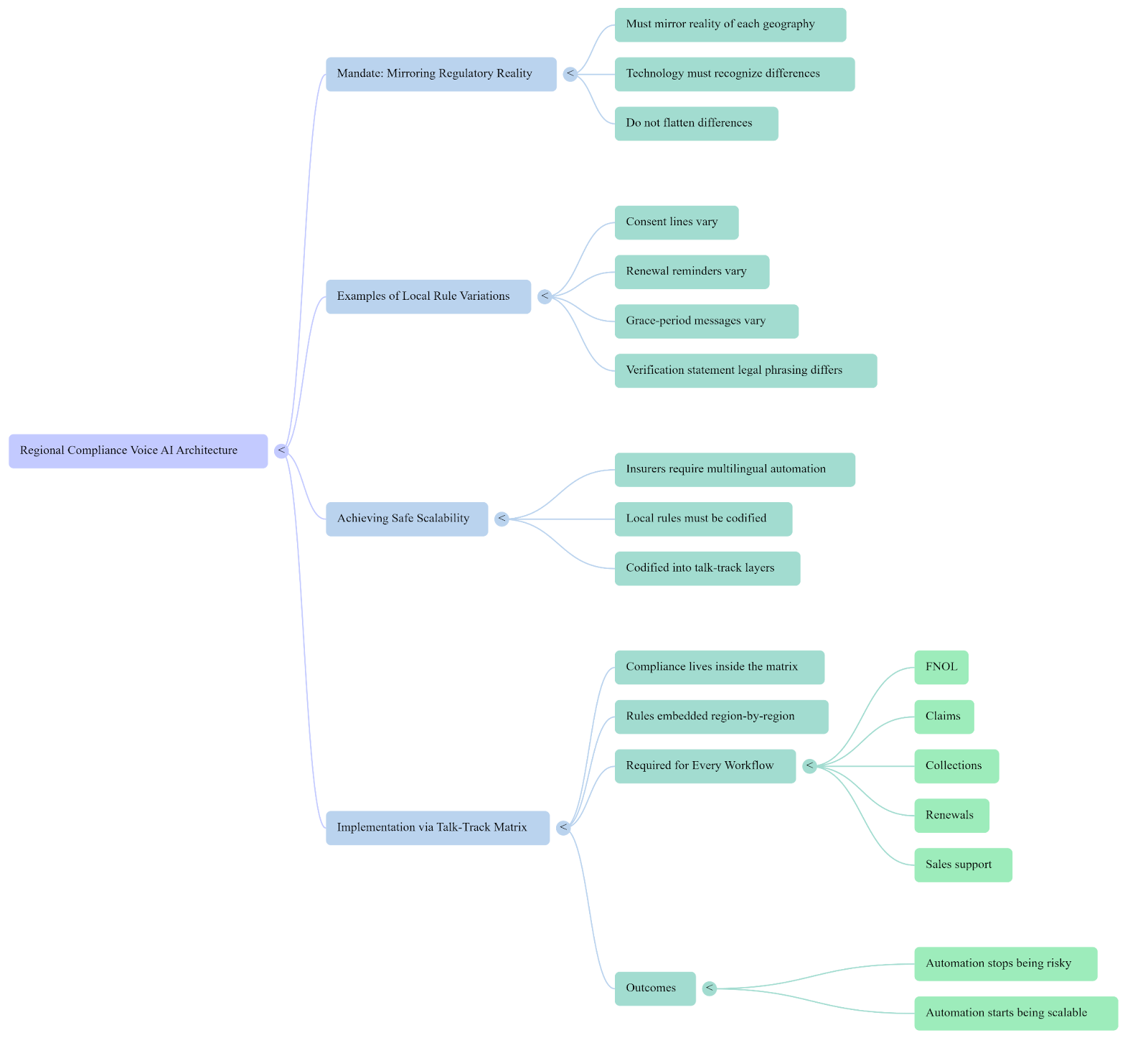
Insurers can’t scale multilingual automation unless local rules are codified into talk-track layers for every workflow, FNOL, claims, collections, renewals, and sales support.
A multilingual approach becomes safe only when compliance lives inside the talk-track matrix. When rules are embedded region-by-region, automation stops being risky and starts being scalable.
The Role Of Regional Disclosure Automation
Disclosure norms differ dramatically by market. Some regions need explicit premium warnings. Others require transparent benefit clarifications. Some require additional empathy statements before proceeding. Regional disclosure automation ensures these nuances are maintained across languages without burdening local teams.
It also helps insurers stay ahead of regulation updates by updating talk-tracks centrally without rewriting scripts in every language.
With regional disclosure automation, insurers protect themselves from compliance drift and keep multilingual operations consistent, even as regulations evolve.
Now that we’ve explored why regional layers matter, let’s look at how insurers actually operationalize them, with powerful support from the Convin product ecosystem.
Review last week’s calls via Convin’s compliance scan.
This blog is just the start.
Unlock the power of Convin’s AI with a live demo.

How Convin Helps A Multilingual AI Voicebot For Insurers Stay Region-Ready
Convin’s platform doesn’t replace your multilingual AI voicebot; it strengthens its backbone. By analyzing calls, guiding agents in real time, and training teams on region-specific matrices, Convin helps insurers build a voicebot foundation rooted in regulatory and cultural precision.
Here’s how each product quietly supports the regional talk-track matrix behind the scenes.
Insurance Voice Automation By Region With Conversation Intelligence
Convin’s conversation intelligence engine helps insurers understand how talk-tracks actually play out across markets. It analyzes thousands of calls to reveal compliance drift, tone mismatches, and missing disclosures by region.
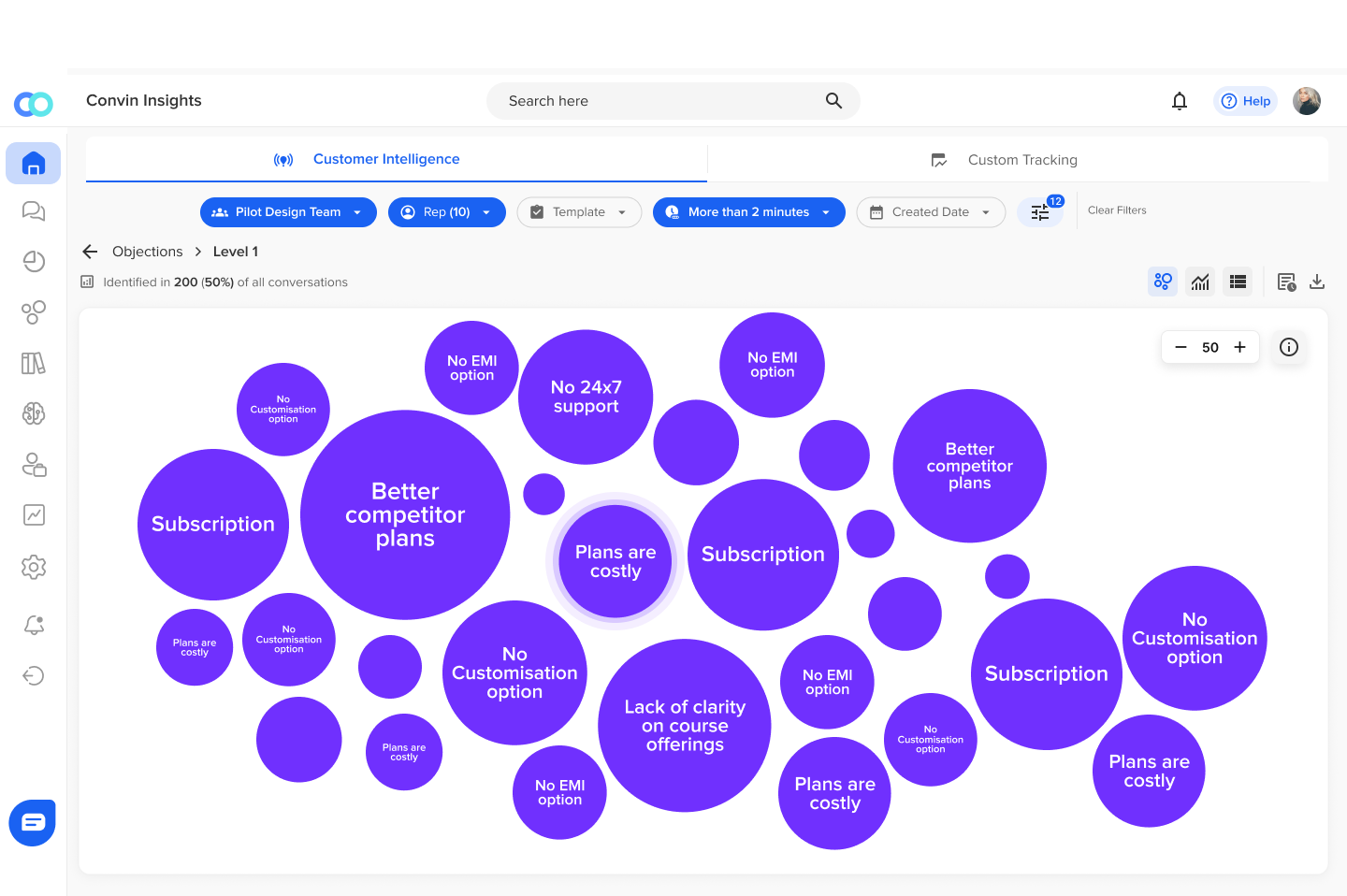
This makes it easier for regional leaders to adjust scripts and update the talk-track matrix with confidence. The system also highlights intent patterns that differ across languages, critical for multilingual voice automation.
Conversation intelligence ensures regional talk-tracks are grounded in real conversations, making multilingual automation more accurate, predictable, and regulator-ready.
Multilingual FNOL Voicebot Enhancement With Real-Time Agent Assist
Real-Time Agent Assist helps frontline agents deliver region-safe phrasing during FNOL, claims follow-ups, renewals, and collections. When agents follow regionally precise talk-tracks, the AI voicebot can mirror the same patterns with less variance.
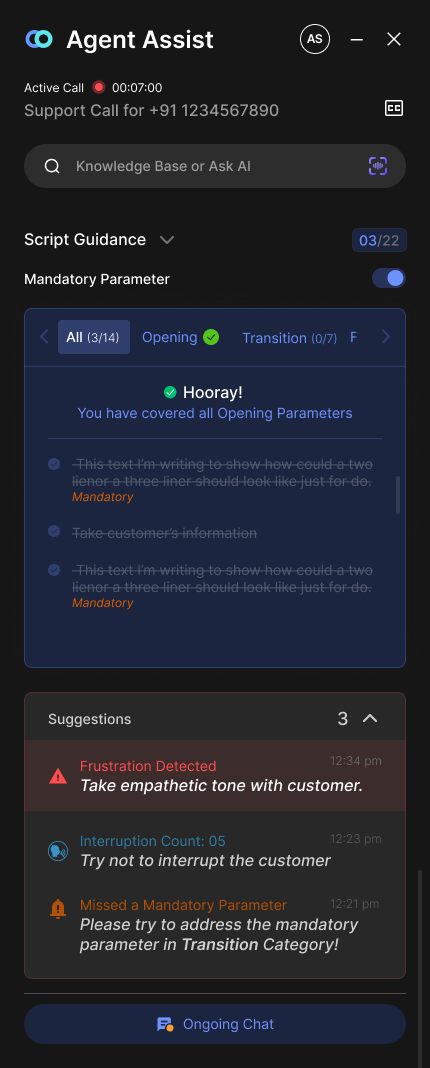
This preserves consistency across both human and automated interactions, something regulators increasingly watch for.
By nudging agents with regional disclosure lines at the right moment, Real-Time Agent Assist strengthens the accuracy and auditability of multilingual FNOL voicebots.
Training Regional Teams Via Convin’s Learning Management System
Convin’s LMS helps insurers train teams on region-ready talk-tracks using localized modules, call examples, and practical scenarios. When human teams adopt region-specific talk-tracks, your voicebots automatically gain stronger training data. This bridges the gap between front-line behavior and automated behavior.

LMS-driven regional training ensures your multilingual automation doesn’t drift over time; it grows more aligned, more consistent, and more compliant.
With the support system in place, the next step is understanding what “good” actually looks like when designing a region-ready talk-track matrix.
See Convin’s region-ready talk-track insights.
What A Good Regional Talk-Track Looks Like For A Multilingual AI Voicebot For Insurers
A strong talk-track matrix is more than a script; it’s a governance layer. It maps regulatory triggers, cultural tone markers, and intent variations across regions. This section outlines what insurers should expect from a well-built matrix and how it becomes the backbone of multilingual success. It’s part regulatory blueprint, part linguistic guide, and part operational framework.
Multilingual Policyholder Communication Framework
A robust framework focuses on clarity first, compliance second, and culture third. It outlines where empathy is expected, where directness matters, where legal phrasing is mandatory, and where tone should soften or intensify. Every region gets its own curated structure rather than a copy-paste from English. Insurers with this framework experience fewer escalations and smoother policyholder conversations.
By establishing a clear communication framework per region, insurers set a strong foundation for voicebots that sound natural, culturally appropriate, and regulator-aligned.
Insurance Voice Automation By Region Playbook
A practical regional playbook keeps the matrix usable and easy to update. It documents what should be said, how it should be said, and why. It clarifies regulatory checkpoints, empathy lines, disclosure expectations, and fallback phrasing. This structure ensures that operations, agents, QA teams, and voicebots are all aligned.
A region-first playbook makes multilingual automation manageable and audit-friendly, giving Regional Leaders predictable control across geographies.
With a clear picture of what “good” looks like, let’s wrap with the bottom-line takeaway for Regional Leaders scaling voice automation.
Book your Convin demo today!
Why Regional Leaders Need A Multilingual AI Voicebot For Insurers
Regional Leaders aren’t just scaling automation, they’re scaling risk governance, customer trust, and brand consistency. A multilingual AI voicebot only works when backed by a region-ready talk-track matrix that respects regulatory nuance and cultural tone. Insurers who solve this layer scale faster and safer than those who rely on translation alone.
A compliance-first approach ensures every region gets the quality, transparency, and trustworthiness that regulators expect. With conversation intelligence, real-time assist, and structured training, Convin quietly strengthens the talk-track matrix you rely on. It’s not about replacing your voicebot; it's about giving it the regulatory and cultural scaffolding it needs to thrive.
With a region-ready talk-track matrix, insurers unlock truly scalable, compliant, and culturally resonant multilingual automation, without increasing risk or operational overhead.
FAQs
- How do insurers ensure compliance with multilingual voicebots across regions?
By embedding regional regulatory rules (IRDAI, RBI, FCA, CMS/DOI, MAS, etc.) directly into the talk-track matrix and monitoring conversations using QA or conversation intelligence tools.
- What are the biggest risks of a poorly localized multilingual AI voicebot?
Risks include incorrect disclosures, regulatory penalties, inconsistent CX, customer distrust, and operational errors during sensitive workflows like claims and FNOL.
- Do multilingual AI voicebots work with existing insurance CRM and policy systems?
Most modern platforms integrate with policy admin systems, CRMs, claims tools, and ticketing systems to retrieve customer data and deliver contextual responses.
- How do insurers measure the effectiveness of a multilingual AI voicebot?
Metrics include disclosure accuracy, containment rate, FNOL correctness, HEP (high empathy phrase) detection, resolution rate, and region-specific compliance scores.


.avif)

.avif)