

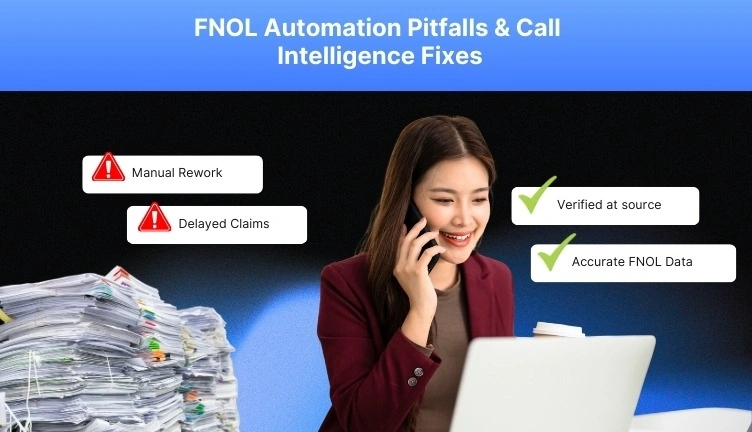
Insurance leaders invest heavily in FNOL automation to speed claims and improve customer satisfaction. On paper, automation of intake forms, routing, and workflows gives the impression that claims are set in motion without friction.
In reality, the first notice of loss remains a major bottleneck because current automation often stops upstream of the live conversation, where most data is created.
Research shows the global FNOL automation market reached USD 1.54 billion in 2024 and is growing rapidly at approximately 14 percent annually, underlining how critical carriers view this capability. However, there are still important gaps in the regulation and verification of the first contact.
Industry analysts also estimate that by 2025, around 60 percent of insurance claims will be triaged with automation tools, reflecting how much carriers depend on automated processes to reduce error and delay.
Despite this adoption, complaints related to claims handling are consistently among the top drivers of customer dissatisfaction when resolution is slow or unclear, showing that automation without intelligence still leaves policyholder expectations unmet.
This paradox means many insurers think their FNOL automation works, while the actual data quality, completeness, and compliance outcomes remain uncontrolled.
The first call still determines whether claims proceed smoothly or get stuck in correction loops, manual follow-ups, and customer frustration. That is why leaders must focus not just on digitizing FNOL but on ensuring it captures accurate, verified information at the source.
Fix FNOL automation by tackling the hidden call-level gaps.
Why Insurance FNOL Automation Is Not Effective
Most FNOL automation initiatives in insurance focus on digitizing intake forms and routing work to the right queue. That helps, but it does not fix the highest-variance part of the FNOL process flow, which is the customer conversation.
McKinsey’s “Claims 2030” view of the future assumes FNOL can happen through many channels and remain consistent, but in reality, voice remains a dominant channel, and it is where data quality and customer trust are won or lost.
FNOL automation software automates workflow, not truth
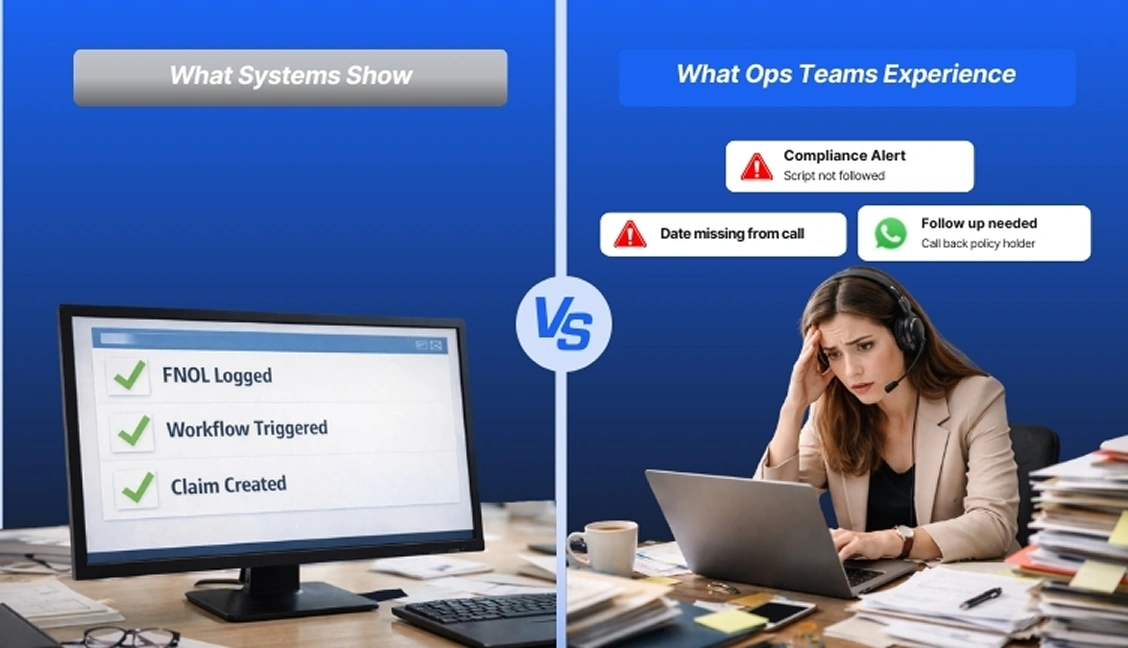
A typical FNOL automation software stack can log a claim, attach documents, and trigger tasks. It cannot reliably ensure the caller’s narrative becomes complete, structured, and verified data.
If the agent skips a confirmation, paraphrases a key detail, or misses a required disclosure, the system still records “FNOL completed” and pushes bad inputs downstream.
That is why many teams experience a painful pattern: automation increases throughput but also increases the speed at which errors travel.
Deloitte’s claims transformation work repeatedly emphasizes that claims is a “clock starts ticking” moment where experience and operational exposure move together, and early friction compounds across the journey.
The call is the failure point in the FNOL process flow
In the real FNOL process flow, the call creates three common failure modes:
- Unstructured capture: free-form storytelling does not map cleanly into FNOL fields.
- Agent variability: two agents interpret the “same incident” differently, creating inconsistent FNOL data.
- Missed compliance moments: disclosures, consent, and grievance-sensitive language may not be delivered consistently.
Once those gaps exist, claims teams are forced into manual verification and follow-ups. That is the opposite of what FNOL automation was supposed to achieve.
Why this is amplified in India: audit readiness and grievance risk
In India, the bar is higher because audit readiness and grievance handling expectations are not optional.
IRDAI maintains a formal grievance redressal mechanism, and insurers also align grievance policies to IRDAI regulations and master circulars on protection of policyholders and operations.
The practical ops implication is simple. If you cannot prove what was communicated during FNOL calls, a documentation gap will be revealed during audits, escalations, and grievances.
This is where speech analytics in Indian insurance becomes less about “insights” and more about defensible evidence and consistent execution.
Sampled QA cannot govern FNOL at scale
Most contact centers still rely on manual sampling. Even well-run QA teams review only a small portion of total calls, which means compliance and accuracy issues can often be hidden in the majority of FNOL interactions.
A speech analytics case study from RDI highlights the throughput constraint of manual review, where analysts can only review a tiny fraction of the total call volume due to time-intensive processes.
That dynamic is exactly why automated QA for contact centers and contact center QA automation India are becoming board-level discussions in regulated operations.
What changes when you add call intelligence
This is where call center speech analytics for claims and conversation intelligence for insurance become the missing layer. Listening to more calls is not the objective. The goal is to make FNOL measurable and controllable:
- Convert call narratives into structured FNOL fields
- Verify agent adherence to mandatory steps
- Flag risk moments for compliance and grievance prevention
- Enable real-time call analytics for claims automation so issues are caught early, not post-facto
Once you do that, FNOL automation stops being a workflow that moves tickets. It becomes a controlled intake system that improves data reliability and reduces compliance blind spots.
Learn why FNOL automation fails without accurate call data.
Where Does FNOL Automation Fail in the FNOL Process Flow?
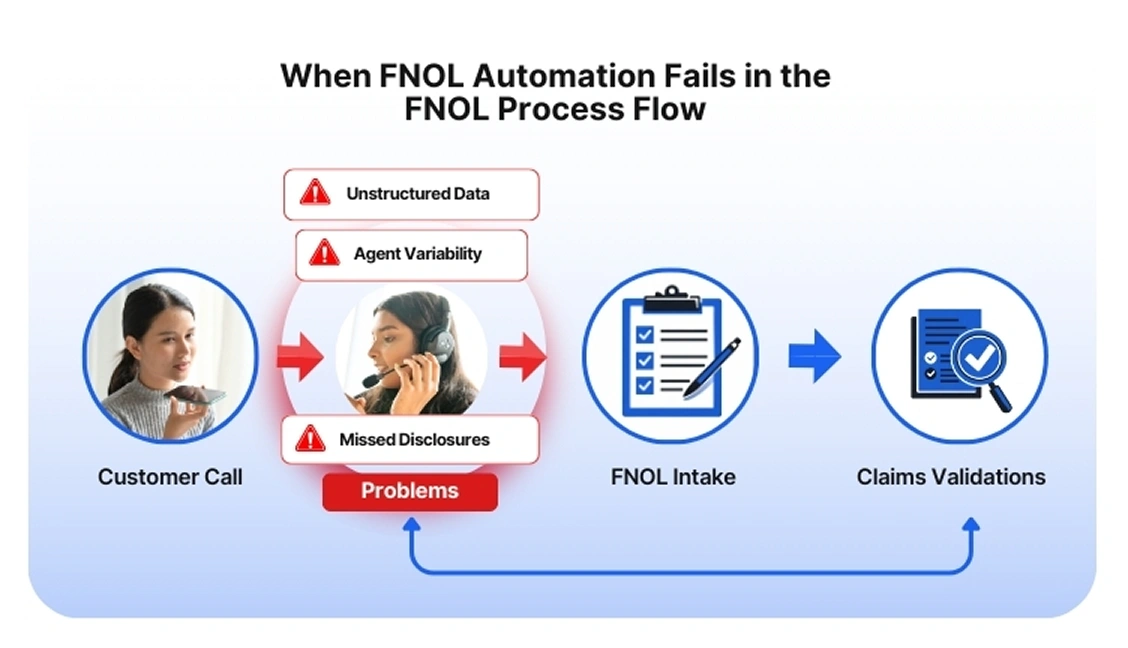
In FNOL in insurance, the FNOL process flow is often drawn as a clean sequence: capture FNOL, validate policy, assign adjuster, and progress to settlement. The problem is that most FNOL automation stacks assume the intake data is already structured and reliable.
In reality, the highest-variance step is the very first customer interaction, often a voice call, where the story is messy, and the details arrive out of order. When that first capture is wrong or incomplete, the rest of the flow becomes a rework factory.
Here is where FNOL automation typically breaks in the FNOL process flow:
- Customer call and first capture
- What fails: agents miss confirmations, interpret details differently, or skip mandatory statements under time pressure.
- What it causes: inconsistent FNOL fields, missing loss timelines, incorrect contact details, and avoidable follow-up calls.
- What fails: agents miss confirmations, interpret details differently, or skip mandatory statements under time pressure.
- FNOL intake and triage
- What fails: automation routes the case, but it cannot validate whether the core narrative is complete.
- What it causes: wrong triage, extra validation steps, and early delays before the claim even stabilizes.
- What fails: automation routes the case, but it cannot validate whether the core narrative is complete.
- Compliance and audit readiness
- What fails: required disclosures and grievance-sensitive moments live inside calls, but most operations cannot evidence them at scale.
- What it causes: audit surprises and grievance escalation risk, especially when the “proof” is buried in recordings with limited review capacity. IRDAI’s grievance redressal expectations make this exposure operationally real, not theoretical.
- What fails: required disclosures and grievance-sensitive moments live inside calls, but most operations cannot evidence them at scale.
The uncomfortable pattern is that FNOL automation often improves the speed of downstream workflow while leaving the upstream truth unchecked.
McKinsey’s view of “Claims 2030” reinforces that claims journeys are increasingly omnichannel and digital, which makes consistent intake quality even more critical, because small intake gaps compound across the lifecycle.
What changes the game is treating the call as a governed step in the FNOL process flow, not just a channel that feeds it.
That is the bridge to conversation intelligence for insurance, call center speech analytics for claims, and automated QA for contact centers, because they make the call measurable, searchable, and coachable at scale.
Why FNOL Automation Software Misses Call-Level Risk
Most FNOL automation software is great at what it was built for: routing, ticket creation, document collection, task orchestration, and system-to-system handoffs.
What it is not built for is governing human conversations where risk shows up as phrasing, omissions, tone, and missed confirmations.
That is why many teams feel like FNOL automation is “working,” yet claims still slow down and compliance issues still surface late.
Call-level risk gets missed for three structural reasons:
- Workflows can validate fields, not intent
- A form can require a date, but it cannot confirm whether the caller’s story actually matches that date of loss.
- A dropdown can standardize categories, but it cannot catch contradictions that emerge in natural speech.
- Sampling-based QA leaves gaps
- Most contact centers cannot review more than a slice of total calls, which means high-impact FNOL errors can hide in plain sight.
- COPC’s QA benchmarking materials emphasize that QA programs are foundational, but practical capacity limits make it hard to rely on manual review for full coverage.
- Compliance requirements live inside conversations
- Disclosures, consent language, and grievance triggers are often spoken, not clicked.
- Speech analytics is widely used for compliance monitoring because it can automatically analyze large volumes of calls and score them for required elements.
The integration of compliance monitoring AI call software with real-time call analytics into claims automation in the Indian insurance industry enhances the First Notice of Loss (FNOL) process.
By incorporating speech analytics, it improves audit readiness and ensures accuracy by detecting missing mandatory statements, flagging risky moments, and automating quality assurance in contact centers beyond traditional sampling, resulting in fewer corrections.
Find out why FNOL software misses critical call-level details.
This blog is just the start.
Unlock the power of Convin’s AI with a live demo.

How Convin Strengthens FNOL Automation at the Call Layer

Most FNOL automation programs in insurance get judged on what happens after intake: claim creation, routing, document collection, and workflow triggers.
That is the part your FNOL automation software does well. The weak link is earlier in the FNOL process flow, when the customer describes the incident on a call, and the agent translates that story into structured fields.
Convin strengthens FNOL automation by governing that call layer so the data entering your systems is consistent, complete, and audit-ready.
1) Convin turns FNOL conversations into structured, usable FNOL data
In practice, FNOL capture is not “form filling.” It is storytelling, interruptions, language variability, and partial facts.
Convin’s conversation intelligence for insurance helps convert those unstructured calls into structured FNOL elements so downstream systems receive cleaner inputs.
What this fixes in fnol automation
- Missing or inconsistent FNOL fields that cause downstream rework
- Conflicting incident narratives that force adjuster validation
- Agent-to-agent variability that breaks standardization across centers
2) Convin enforces adherence to the FNOL process flow
Scripts exist, but adherence is inconsistent because agents optimize for speed and call pressure.
Convin strengthens FNOL automation by making adherence measurable across the FNOL steps that matter most.
Instead of hoping critical questions were asked, you can verify whether they happened and where they broke.
Examples of adherence moments Convin can govern
- Mandatory incident and policy confirmations
- “Next steps” expectations setting to reduce repeat calls
- Required statements that ops and compliance teams expect in the FNOL journey
This is effectively automated QA for contact centers applied specifically to FNOL, aligned to outcomes ops and claims care about. It also supports contact center QA automation in India by shifting from sampled reviews to broader coverage.
3) Convin adds compliance monitoring to FNOL automation, not after it
In India, compliance risk frequently lives inside spoken disclosures and the way agents handle objections, disputes, or grievances.
Traditional FNOL automation software does not “see” those moments because they are not captured as structured events.
Convin strengthens FNOL automation with compliance monitoring AI call software that can detect missed mandatory statements and flag risky moments that require intervention.
What changes operationally
- Fewer compliance surprises are found late in audits
- Clear evidence trails tied to the call layer, not just CRM fields
- Faster closure on potential grievance triggers because they are identified earlier
This is particularly relevant for speech analytics in Indian insurance, where multilingual calls and high volume make manual compliance review unrealistic at scale.
4) Convin enables real-time call analytics that prevent FNOL errors from becoming claims delays
Most claims leakage and delay patterns start as small intake mistakes. Fixing them two days later costs far more than preventing them during or immediately after the call.
Convin strengthens FNOL automation by enabling real-time call analytics for claims automation, so you catch gaps early enough to correct them before they cascade through the rest of the claim.
Where real-time or near-real-time signals help most
- Missing critical FNOL details that block triage
- Incomplete confirmations that lead to follow-up calls
- High-risk language that suggests disputes, fraud concerns, or grievance escalation
This is where AI call analytics software India becomes a practical operating lever. You are not adding more monitoring. You are reducing preventable rework and making the FNOL entry point reliable.
5) What “strong FNOL automation” looks like when Convin sits at the call layer
When Convin strengthens your FNOL call layer, the FNOL process flow becomes more predictable end-to-end. Claims teams spend less time revalidating basics and more time progressing cases.
Ops and compliance teams move from sampled visibility to consistent governance across the interactions that actually create risk and cost.
Net effect
- FNOL data accuracy improves because intake is verified at the source
- Compliance posture strengthens because call-level obligations are measurable
- Agent adherence improves because coaching is tied to specific FNOL moments, not generic QA
See how call intelligence enhances FNOL automation and reduces errors.
How FNOL Automation Improves With Accurate Call Data
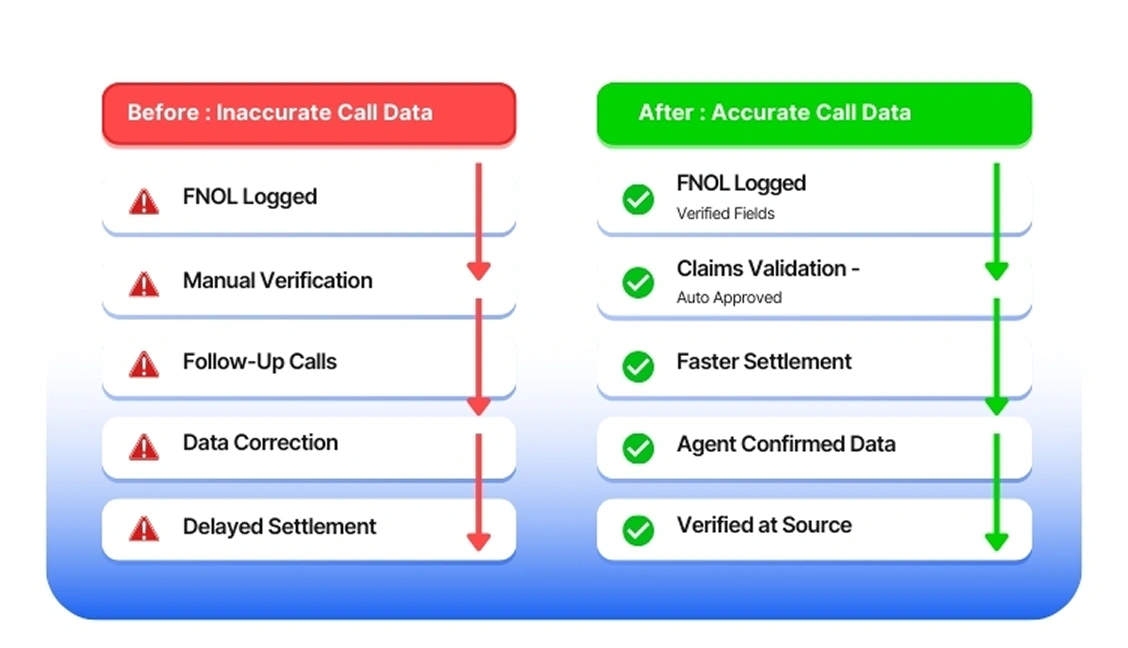
In FNOL in insurance, automation outcomes are only as strong as the data that enters the system at the first notice of loss. Most FNOL automation programs assume that once a claim is logged, the hard part is done.
In reality, the quality of the FNOL call determines whether the rest of the FNOL process flow moves smoothly or collapses into rework.
This is where many FNOL automation software implementations fall short. They can enforce mandatory fields and route tickets, but they cannot judge whether the information captured during the call is complete, consistent, and correctly confirmed.
When call data is inaccurate, automation does not eliminate effort. It simply shifts effort downstream to claims validation, customer callbacks, and manual corrections.
Accurate call data changes this dynamic completely.
With conversation intelligence for insurance and call center speech analytics for claims, the FNOL call becomes a structured data source rather than an unverified narrative.
Key incident details, confirmations, and next steps can be consistently captured and validated at the source. This reduces the most common FNOL friction points, such as repeated customer follow-ups, inconsistent loss descriptions, and delayed triage decisions.
Operationally, accurate call data improves fnol automation in four concrete ways:
- Cleaner intake for the FNOL process flow: Claims teams receive FNOL records that are coherent and complete, reducing the need for early-stage validation. Automation can then do what it was designed to do, which is move the claim forward instead of flagging exceptions.
- Lower rework and faster claims progression: When FNOL details are right the first time, adjusters spend less time reconciling narratives and more time progressing cases. This is where real-time call analytics for claims automation creates value by catching gaps early rather than days later.
- Stronger QA coverage without scaling headcount: Accurate call data enables Automated QA for contact centers, replacing limited manual sampling with broader coverage across FNOL interactions. This is especially important for contact center QA automation India, where call volumes make traditional QA models impractical.
- More effective agent coaching: Instead of generic QA scores, supervisors can coach agents on specific FNOL moments that impact data quality. Over time, this reduces variability across agents and centers, which is one of the biggest hidden drains on FNOL automation performance.
When call data is accurate, FNOL automation stops behaving like a fast routing engine and starts behaving like a reliable intake system that downstream teams can trust.
Why FNOL Automation Needs Compliance Monitoring AI in India
In India, the effectiveness of FNOL automation cannot be separated from compliance. The first notice of loss is not just an operational step. It is a regulated interaction where disclosures, consent, and grievance-sensitive language often occur verbally.
Traditional FNOL automation software does not see these moments because they live inside conversations, not forms.
This creates a structural risk in insurance. An FNOL record can look complete in the system while still being non-compliant at the call level.
Missed disclosures, unclear explanations, or poorly handled objections may only surface during audits, disputes, or grievance escalations. By then, the cost is no longer just operational. It becomes reputational and regulatory.
With speech analytics in India insurance, compliance can be monitored at scale across FNOL calls, not just through small audit samples. Mandatory statements, consent language, and grievance indicators can be automatically detected and tracked.
This gives compliance teams evidence, not assumptions, about what actually happened during the FNOL interaction.
From an operations perspective, this strengthens FNOL automation in several ways:
- Audit readiness is built into the FNOL process flow: Instead of reconstructing evidence after the fact, insurers can show that required disclosures were delivered during the FNOL call itself. This reduces audit stress and late-stage remediation.
- Early identification of grievance risk: AI call analytics software India can surface language patterns that signal dissatisfaction or dispute during FNOL. Addressing these early prevents escalation and repeat contact, which directly affects claims cost and CX.
- Scalable compliance without slowing agents down: Manual compliance checks often slow operations or create fear-driven behavior among agents. Automated monitoring allows compliance to scale quietly in the background, supporting speed without sacrificing control.
- Alignment between QA, ops, and compliance: With contact center QA automation India, the same call data can serve multiple functions. Ops looks at efficiency, QA looks at adherence, and compliance looks at regulatory risk, all from a shared source of truth.
In short, FNOL automation in India cannot succeed on workflow alone. Without compliance monitoring at the call layer, insurers are left with blind spots that undermine both efficiency and trust. When compliance intelligence is embedded into FNOL calls, automation becomes not just faster but also defensible and sustainable at scale.
Discover how AI-powered compliance monitoring strengthens FNOL automation.
FNOL Automation Is Incomplete Without Call Intelligence
FNOL automation often focuses on streamlining workflows and reducing manual steps. The first notice of loss (FNOL) process starts with a phone call.
Without accurately capturing the details from that call, FNOL automation remains incomplete, pushing incomplete or inconsistent data downstream, which leads to rework, delays, and compliance risks.
As we’ve discussed, conversation intelligence for insurance is the missing piece that ensures FNOL data is captured correctly, structured properly, and compliant from the very first interaction.
Integrating call center speech analytics for claims, AI call analytics software India, and real-time call analytics for claims automation ensures that automation is not only faster but also more reliable and defensible.
This integration enhances operational efficiency and compliance, minimizes manual follow-ups, and mitigates audit risks. Additionally, it increases customer satisfaction by streamlining the claims process and reducing the need for rework and follow-up calls.
Ultimately, FNOL automation is incomplete without call intelligence. By embedding AI-driven conversation insights into the FNOL process, insurers can transform their automation from a simple workflow tool into a fully optimized, compliant, and data-driven claims solution.
If you’re looking to enhance your FNOL process and make automation truly effective, integrating call intelligence is the next crucial step.
Experience how call intelligence streamlines FNOL automation and ensures compliance in real time. Schedule a demo for optimized FNOL automation
Frequently Asked Questions
1) What is FNOL automation?
FNOL automation refers to the use of digital tools to automate the intake and processing of the First Notice of Loss (FNOL), speeding up claims and improving data accuracy.
2) How does FNOL automation improve customer experience?
By automating the FNOL process, insurance companies can reduce wait times, ensure faster claim initiation, and provide a seamless experience without requiring customers to repeat information multiple times.
3) Can FNOL automation reduce operational costs?
FNOL automation reduces manual effort, minimizes errors, and shortens claim processing times, leading to lower operational costs and improved efficiency for insurers.
4) What challenges does FNOL automation address in insurance?
FNOL automation helps eliminate data inconsistency, manual errors, claims delays, and compliance risks by standardizing and verifying information during the FNOL call, ultimately improving claims processing speed.
5) How can FNOL automation handle multiple communication channels?
FNOL automation can integrate multiple channels like phone calls, emails, and web forms, ensuring all data is captured, structured, and routed accurately, regardless of how the customer initiates the claim.

.avif)