

.avif)
Onboarding automation transforms how HR teams welcome and train new hires—making the process faster, more consistent, and scalable. From smarter tools to reduced HR workload, it’s redefining onboarding in contact centers. While there are challenges, the benefits far outweigh the risks. Is your team ready to embrace the future of onboarding with automation at its core?
What Is Onboarding Automation and Why Does It Matter
The hiring process doesn’t end when an offer letter is sent. Onboarding is where productivity begins. And in contact centers, onboarding determines how quickly new hires can confidently talk to customers.
Onboarding automation makes that process smarter, faster, and repeatable.
What is Onboarding Automation?
Onboarding automation is the use of artificial intelligence to automate the integration of new employees into a company.
It includes:
- Automating documentation, training, and compliance tasks
- Using chatbots or virtual agents to answer new hire queries
- Delivering customized onboarding based on the employee’s role
- Tracking onboarding completion and performance in real-time
Convin’s Virtual AI Agents simulate real-life customer conversations in contact centers to help new hires practice handling diverse scenarios. These simulations include objections, escalations, and compliance checks.
By interacting with lifelike AI-driven calls, reps build confidence, improve communication skills, and avoid early-stage errors—long before they ever speak to a real customer on the phone.
Onboarding automation doesn’t just replace manual tasks—it enhances them by using data to adapt in real time.
Why is everyone talking about onboarding automation?
Because traditional onboarding is too slow and inconsistent, HR leaders are facing:
- High-volume hiring is common, especially in contact centers.
These centers onboard dozens or even hundreds of employees simultaneously, requiring scalable, efficient systems to deliver consistent training and support without overwhelming HR teams. - Geographically distributed and remote teams.
With teams spread across cities or countries, traditional in-person onboarding becomes impractical. Onboarding automation ensures every employee receives standardized, engaging training regardless of their physical location or time zone. - Rising employee expectations for seamless digital experiences.
Modern employees expect intuitive, tech-enabled onboarding that mirrors the digital convenience they use daily. Outdated systems often frustrate and disengage them before productivity begins. - HR and operations teams are under pressure to reduce time-to-productivity and quickly get new hires customer-ready.
Onboarding automation shortens learning curves, helping employees contribute faster without compromising training quality or compliance.
Onboarding automation solves these problems. Here’s what’s driving the buzz:
- 62% of organizations say AI has improved onboarding efficiency
- 41% report better employee retention within the first 90 days
- HR teams report saving 25+ hours per new hire
With platforms like Convin, onboarding extends far beyond basic automation. You gain access to AI-driven coaching that guides agents through real-world scenarios, detailed performance analysis highlighting strengths and weaknesses, and personalized call simulations that reflect your team’s workflows.
This comprehensive approach ensures new hires are better prepared, more confident, and aligned with business goals from day one.
Launch smarter onboarding with automation.
How Onboarding Automation Is Used in HR Teams
HR is no longer just paperwork and policy. Today’s HR leaders must act as experience designers, creating seamless journeys for new hires. And that’s where onboarding automation comes in.
Onboarding automation supports HR teams by simplifying complexity and ensuring consistency, especially in high-churn environments like customer service and collections.
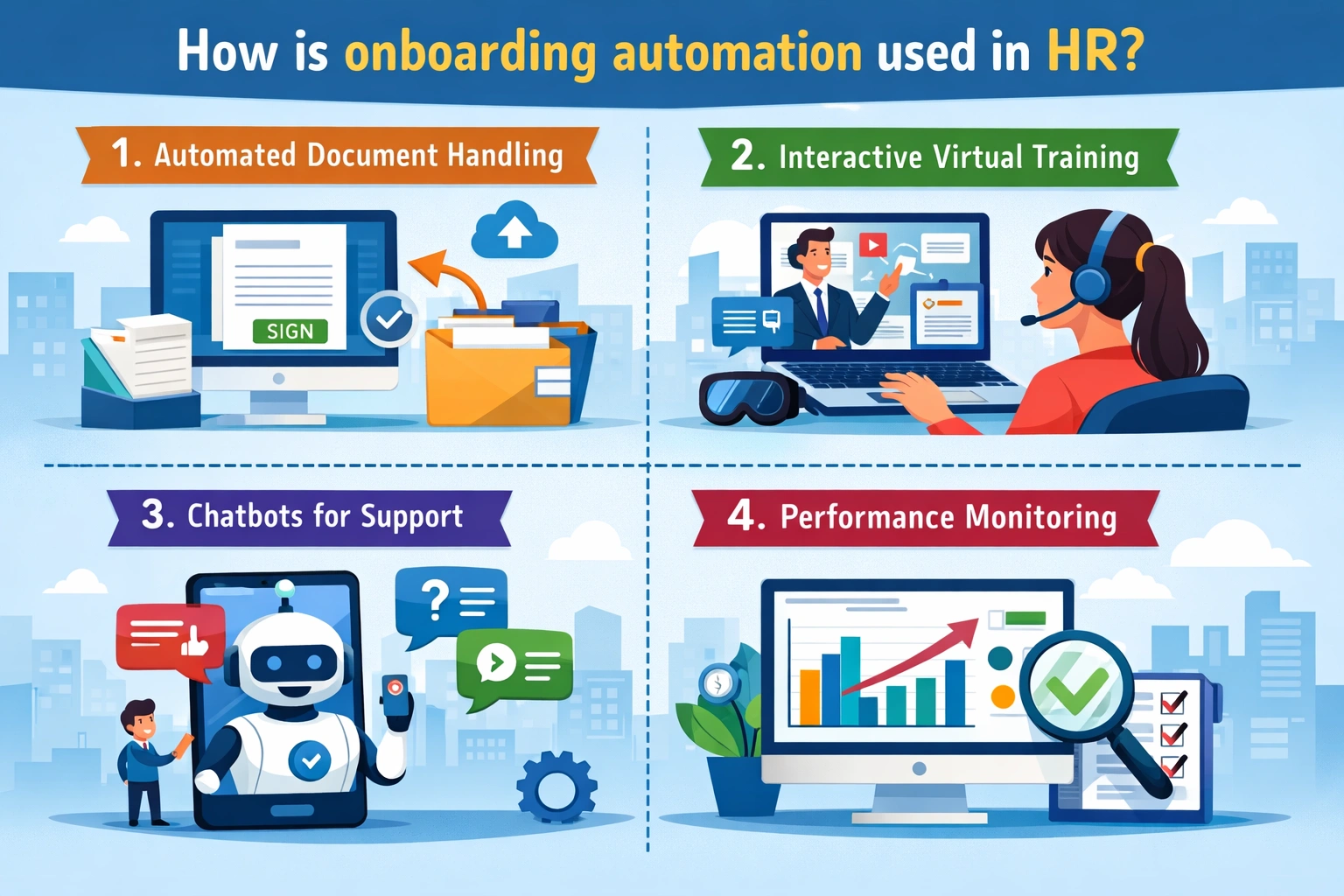
How is onboarding automation used in HR?
Let’s break it down:
- Automated Document Handling:
Onboarding automation uses AI bots to collect and verify documents. These bots streamline document collection by automatically requesting, receiving, and validating identity proofs, certifications, and onboarding forms.
This eliminates delays, ensures accuracy, and reduces manual HR involvement, allowing teams to focus more on engagement and less on administrative paperwork during onboarding.
- Interactive Virtual Training:
AI guides employees through SOPs, tools, and expectations. Onboarding automation delivers step-by-step walkthroughs of standard operating procedures, platform tutorials, and job-specific expectations.
These virtual modules adapt based on employee role and pace, ensuring new hires fully understand their responsibilities, tools, and workflows before interacting with customers or handling live tasks.
- Chatbots for Support:
New hires ask questions and get instant answers. 24/7 AI chatbots act as round-the-clock onboarding assistants, answering queries related to policies, tools, workflows, or HR contacts.
This immediate support prevents confusion, reduces first-week drop-offs, and provides a consistent source of help—especially useful for remote or international employees in different time zones.
- Performance Monitoring:
AI tracks early engagement and alerts HR when support is needed. Onboarding automation systems monitor onboarding progress by tracking module completion, interaction quality, and engagement levels.
If a new hire falls behind or struggles with specific tasks, alerts are sent to HR or managers, allowing timely interventions and customized coaching to support their success.
Convin’s Voicebot is being used in HR teams for:
- Delivering day-one training simulations
Convin’s AI Agents provide immersive, role-specific call simulations on the first day, allowing new hires to experience real customer scenarios and practice responses before handling actual client interactions. - Answering FAQs about policies, tools, and benefits
AI chatbots instantly respond to new hire questions about workplace policies, software tools, company culture, and benefits, ensuring clarity and reducing dependency on HR teams for basic onboarding support. - Guiding new hires through role expectations based on call data
By analyzing historical call performance, Convin’s AI outlines specific expectations for new hires, helping them understand objective communication standards, behavioral benchmarks, and typical customer challenges relevant to their role.
Onboarding Automation for Remote Employees
Remote teams pose new challenges. Managers can’t "walk over" to check progress or provide help.
Here’s where onboarding automation for remote employees becomes critical:
- On-demand training modules are accessible from anywhere
New hires can access interactive training content from any device or location.
This flexibility supports remote and hybrid workforces, ensuring employees progress through onboarding without scheduling conflicts or dependency on live trainers. This makes learning more efficient and self-paced.
- Role-based simulations that mirror real-world call scenarios
AI-powered simulations recreate customer calls based on actual contact center data.
These exercises train new hires to handle objections, compliance, tone, and urgency—tailored specifically to their job function. They improve retention, reduce live-call anxiety, and enhance readiness for real-time interactions.
- Daily nudges and task reminders using conversational bots
AI chatbots proactively send reminders, track task completion, and encourage module progress through friendly daily nudges.
These bots maintain engagement, reduce dropout rates, and guide new hires through a structured onboarding timeline, without HR constantly following up or micromanaging progress.
- Progress dashboards for HR and team leads
Centralized dashboards give HR and managers a real-time view of each employee’s onboarding status.
These insights highlight who’s excelling, who needs support, and where content adjustments may be required—enabling data-driven coaching and timely interventions before performance gaps grow wider.
With Convin’s Automated Virtual Agents, remote reps can:
- Practice handling demanding customers
New hires use AI-driven simulations replicating tough customer interactions, including objections, complaints, and escalations.
This builds confidence and prepares them to respond calmly and effectively during high-pressure real-world calls.
- Receive feedback through automated quality assurance
Convin’s automated QA tools evaluate every training and simulation call, providing objective, real-time feedback.
This helps new agents understand their mistakes, improve compliance, and meet performance standards before taking live customer calls.
- Get coached by AI based on behavior insights
AI analyzes tone, speech patterns, and call behavior to offer personalized coaching tips.
New hires receive targeted guidance to improve soft skills, empathy, and communication style—all tailored to their unique learning needs.
Onboarding automation makes onboarding location-agnostic, ensuring a consistent experience whether in-office or remote.
Boost HR efficiency with onboarding automation.
This blog is just the start.
Unlock the power of Convin’s AI with a live demo.

Key Benefits and Risks of Onboarding Automation in Contact Centers
Like any innovation, onboarding automation has its advantages and challenges. However, when implemented with the right strategy and tools, the pros significantly outweigh the cons.
Benefits and Risks of Onboarding Automation
Let’s evaluate the key takeaways.
Top Benefits of Onboarding Automation
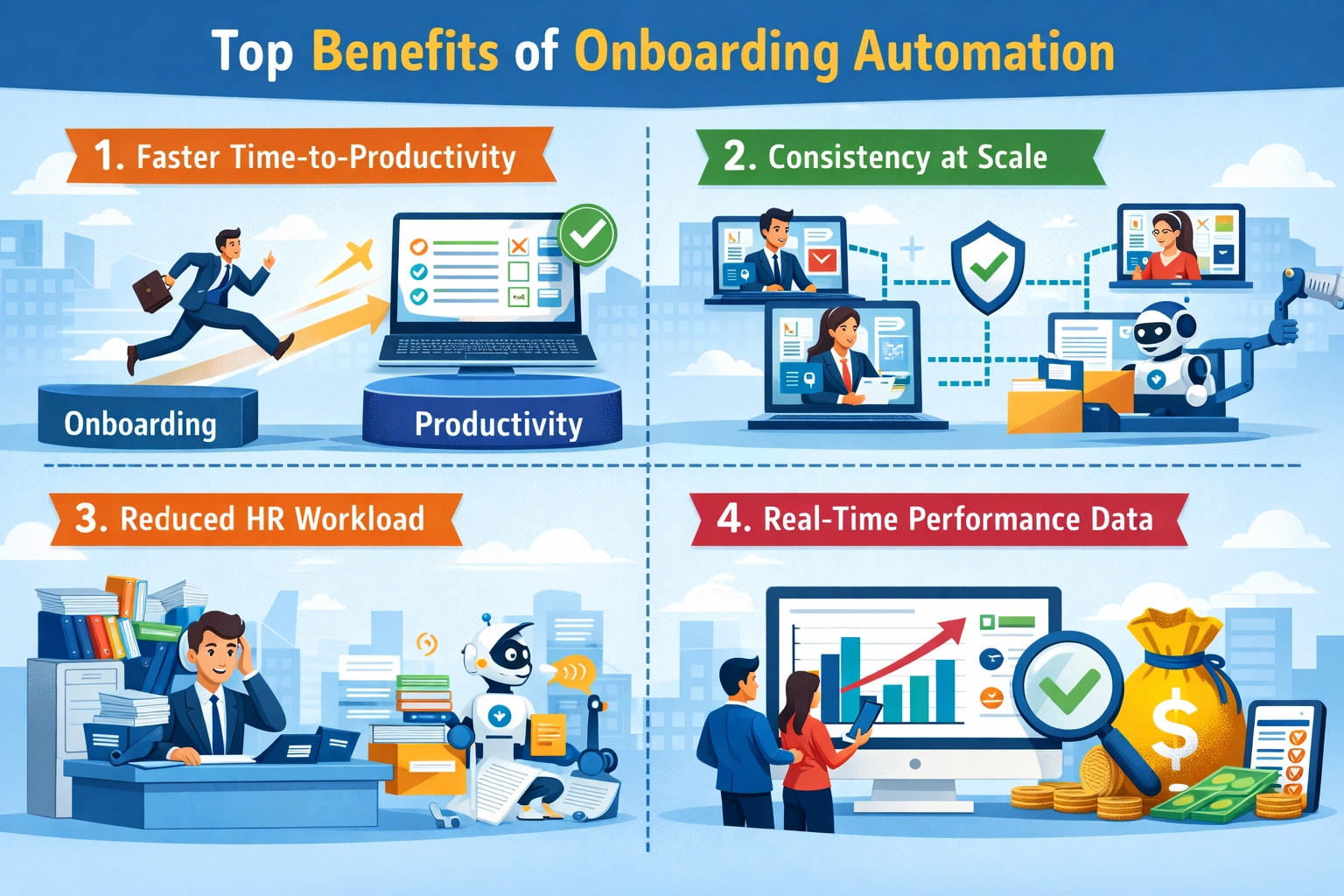
- Faster Time-to-Productivity:
Onboarding automation reduces training time by up to 50%. It accelerates learning by instantly delivering role-specific training.
New hires get productive sooner, shortening ramp-up time by up to 50% while maintaining quality, engagement, and compliance across every phase of the onboarding process.
- Consistency at Scale:
Every new employee gets the same high-quality experience. Onboarding automation ensures each employee receives a structured, uniform onboarding journey.
Regardless of location, role, or team size, the training, tools, and expectations remain consistent—eliminating human error and variation in onboarding delivery across the organization.
- Reduced HR Workload:
Onboarding automation eliminates repetitive admin tasks, including time-consuming document collection, task tracking, FAQ responses, and compliance confirmations.
This allows HR teams to shift focus from manual processing to high-value initiatives like employee engagement, culture-building, and strategic development.
- Real-Time Performance Data:
Instantly identify struggling employees. Onboarding automation tracks onboarding progress and training interactions in real time.
It flags patterns like incomplete modules or poor call performance early, enabling managers and HR to step in with personalized coaching before frustration builds or gaps widen.
- Cost Efficiency:
One-time content creation, infinite delivery. Once training modules, call simulations, and AI workflows are built, they can be used repeatedly without extra cost.
This drastically cuts per-hire training expenses while maintaining high-quality delivery—especially important for large-scale contact center hiring.
Convin’s automated Quality Assurance platform evaluates every onboarding and training call against predefined benchmarks.
It ensures even the newest agents meet performance, compliance, and communication standards from day one. This eliminates manual reviews and enables instant, data-driven feedback that helps accelerate readiness and reduce early-stage errors.
Risks of Onboarding Automation
- Too Much Automation:
Overuse of AI can reduce the human touch and emotional connection during onboarding. - Data Privacy:
Monitoring conversations and performance must align with strict data protection and compliance regulations. - Generic Content:
Poorly designed onboarding automation workflows may feel robotic or irrelevant to new hires.
Solution? Adopt a hybrid onboarding model, where automation manages scale and consistency, and humans deliver empathy and emotional intelligence.
Convin’s QA, combined with the Human Coach approach, combines automation with personalized human guidance to balance efficiency and connection.
Scale onboarding without scaling your team.
Top Tools and Step-by-Step Guide for Onboarding Automation
You’ve seen why onboarding automation works. But what does it look like in action? Here’s a complete implementation plan backed by the tools that contact centers trust.
Step-by-Step Guide for Onboarding Automation
- Pre-Onboarding Setup:
Onboarding automation collects essential documents, validates identification, and configures user systems automatically.
Personalized welcome messages are sent to create a warm, engaging first impression—ensuring new hires are fully prepared before their official start date with zero manual HR intervention.
- Day-One Virtual Training:
Convin’s AI agents use interactive tutorials to guide new employees through essential tools and systems.
They explain role-specific SOPs in a clear, easy-to-follow format, ensuring day-one clarity on responsibilities, platform usage, and communication protocols specific to contact center roles.
- Simulated Practice Sessions:
New hires interact with AI-generated customer scenarios that simulate real contact center conversations.
Convin’s AI evaluates tone, pitch, response accuracy, and compliance—offering hands-on practice that builds confidence before employees handle actual customer calls.
- Live Call Monitoring:
Trainees listen in on calls by top-performing agents to understand best practices in real time.
Meanwhile, Convin Call Behavior Analysis collects insights on speech patterns, resolution strategies, and customer sentiment to shape tailored learning recommendations.
- Real-Time QA:
Convin’s automated QA platform instantly reviews new hire call performance.
It flags compliance issues and performance gaps while suggesting personalized micro-lessons to fix errors—reducing manual QA load and accelerating learning through targeted reinforcement.
- Manager Coaching:
AI-generated dashboards summarize onboarding progress and behavior trends.
Managers and HR teams use this data to deliver personalized coaching sessions, improve agent readiness, boost morale, and ensure new hires align with quality expectations.
Top Tools Related to Onboarding Automation
These are the best-in-class tools that enable intelligent, automated onboarding:
- Convin’s AI Agents – Practice and train new reps on voice workflows
Convin’s AI Agents deliver role-specific, voice-based training simulations.
Reps practice handling real-life customer scenarios, objections, and compliance steps in a controlled environment, enabling faster learning and better preparedness before taking live calls.
- Convin’s QA – Evaluate onboarding progress with automated quality checks
Convin’s automated Quality Assurance system continuously monitors and scores onboarding interactions.
It evaluates voice tone, scripting accuracy, and regulatory compliance to ensure every new rep meets training standards.
- Convin’s Call Behavior Analysis – Tailor onboarding to individual learning styles
Call Behavior Analysis from Convin identifies speech patterns, engagement levels, and performance tendencies.
AI personalizes the onboarding automation journey based on how each rep learns and communicates best, resulting in more effective coaching, faster skill development, and stronger long-term performance outcomes.
- AI Chatbots – Provide help and task reminders
Conversational AI bots offer instant responses to onboarding-related questions and send reminders for training deadlines.
Available 24/7, they reduce HR dependency, keep new hires engaged, and ensure task completion without follow-ups.
- HR Platforms (Zoho, SAP, BambooHR) – Integration for seamless workflows
Onboarding automation tools integrate easily with popular HR platforms like Zoho, SAP, and BambooHR.
This ensures seamless synchronization of employee data, training progress, document verification, and onboarding checklists, enabling HR teams to manage everything from one central system without duplicating tasks.
Pairing Convin with your existing HR tech stack gives a 360° onboarding automation solution, from hiring to high performance.
Schedule your Convin demo today!
The Future of HR: Onboarding Automation
Onboarding automation isn’t just a modern HR trend—it’s a strategic shift that empowers teams to scale faster, train smarter, and reduce early attrition. In fast-moving environments like contact centers, it replaces guesswork with data, inconsistency with standardization, and inefficiencies with automation.
Convin stands at the forefront of this evolution, offering AI Agents, automated QA, and behavior-driven coaching to turn onboarding into a performance advantage. Whether simulating real customer calls, tracking learning progress, or tailoring coaching to individual reps, Convin makes onboarding intelligent and impactful.
FAQs
What are the four pillars of onboarding?
The four pillars of onboarding are Compliance, Clarification, Culture, and Connection. These foundational elements ensure new hires understand company policies, role expectations, workplace culture, and team dynamics, setting them up for long-term success and faster integration.
What are the three most essential elements of successful onboarding?
Precise role alignment and expectations, structured, engaging training content, early feedback, and support are essential for successful onboarding.
What is pre-boarding?
Pre-boarding is the process between a job offer acceptance and the employee's first day. It includes paperwork, system setup, welcome messages, and early learning materials, ensuring a smooth transition and stronger engagement before official onboarding begins.
How to apply AI for offboarding?
AI can support offboarding by automating exit interviews, collecting feedback, revoking system access, and generating compliance reports. It ensures a structured, consistent offboarding process while capturing insights that help reduce future attrition and improve employee experience.


.avif)


.avif)