


Insurance contact centers sit on mountains of customer data, yet agents rarely benefit from it when it matters most during live calls. Policies, claims history, endorsements, renewals, and past conversations all live inside CRMs, but agents still rely on memory and guesswork. That disconnect is exactly why real-time agent assist has become critical, but also why it often underdelivers.
The truth is simple: real-time agent assist needs CRM insights to be effective. Without live access to context, even the smartest assist tools become passive dashboards. Let’s break down why this gap exists, how it hurts insurance teams, and what actually fixes it.
See a real-time agent assist in a live insurance call.
Why Real-time Agent Assist Breaks Without CRM Insights
Insurance leaders often invest in real-time agent assist, expecting immediate gains in accuracy, productivity, and consistency. But when those gains don’t show up, the issue isn’t the idea; it’s the missing data flow.
At the heart of the problem is how CRM systems are designed versus how agents actually work on live calls.
Before addressing the “why” of the issue, let’s understand what real-time agent assist is.
Real-time agent assist is a live call support capability that guides agents using CRM insights and conversation context, helping reduce guesswork, improve accuracy, and boost productivity during customer interactions.
CRM Adoption In Contact Centers Remains Superficial
CRM adoption in contact centers looks strong on paper but weak in practice. Agents log interactions, update fields, and close tickets, but mostly after the call ends. During live conversations, CRM screens feel dense, slow, and disconnected from the moment.
This gap directly limits real-time agent assist because the assist layer depends on usable CRM insights. If the data isn’t surfaced proactively, agents won’t hunt for it mid-call. As a result, CRM adoption in contact centers becomes compliance-driven, not performance-driven.
When CRM insights stay buried, real-time agent assist loses relevance. Agents revert to memory, intuition, or scripts, even when better answers already exist in the system.
Until CRM adoption in contact centers moves from passive storage to active guidance, real-time agent assist will continue to fall short of its promise.
Agent Assist Solutions Miss Context Agents Actually Need
Most agent assist solutions focus on prompts, scripts, or keyword detection. What they miss is situational context: policy type, claim status, tenure, past disputes, or previous agent notes.
Without CRM insights, real-time agent assist can’t differentiate between a first-time policyholder and a high-risk renewal call. That lack of nuance leads to generic guidance that agents quickly ignore.
In insurance, context changes everything. Agent assist solutions that don’t adapt to CRM data end up increasing cognitive load instead of reducing it.
Agent assist solutions only work when they understand who the customer is, and that understanding must come directly from CRM insights in real time.
If missing CRM context weakens real-time guidance, the next question is obvious: how does this gap actually show up inside everyday insurance call flows?
Fix CRM adoption with real-time agent assist.
How Real-time Agent Assist Falls Short Inside Insurance Call Flows
Insurance conversations are rarely linear. They jump between policies, claims, exclusions, and edge cases. That complexity exposes the cracks in most real-time agent assist implementations.
Without live CRM integration, assist tools struggle to keep up with how agents actually work.
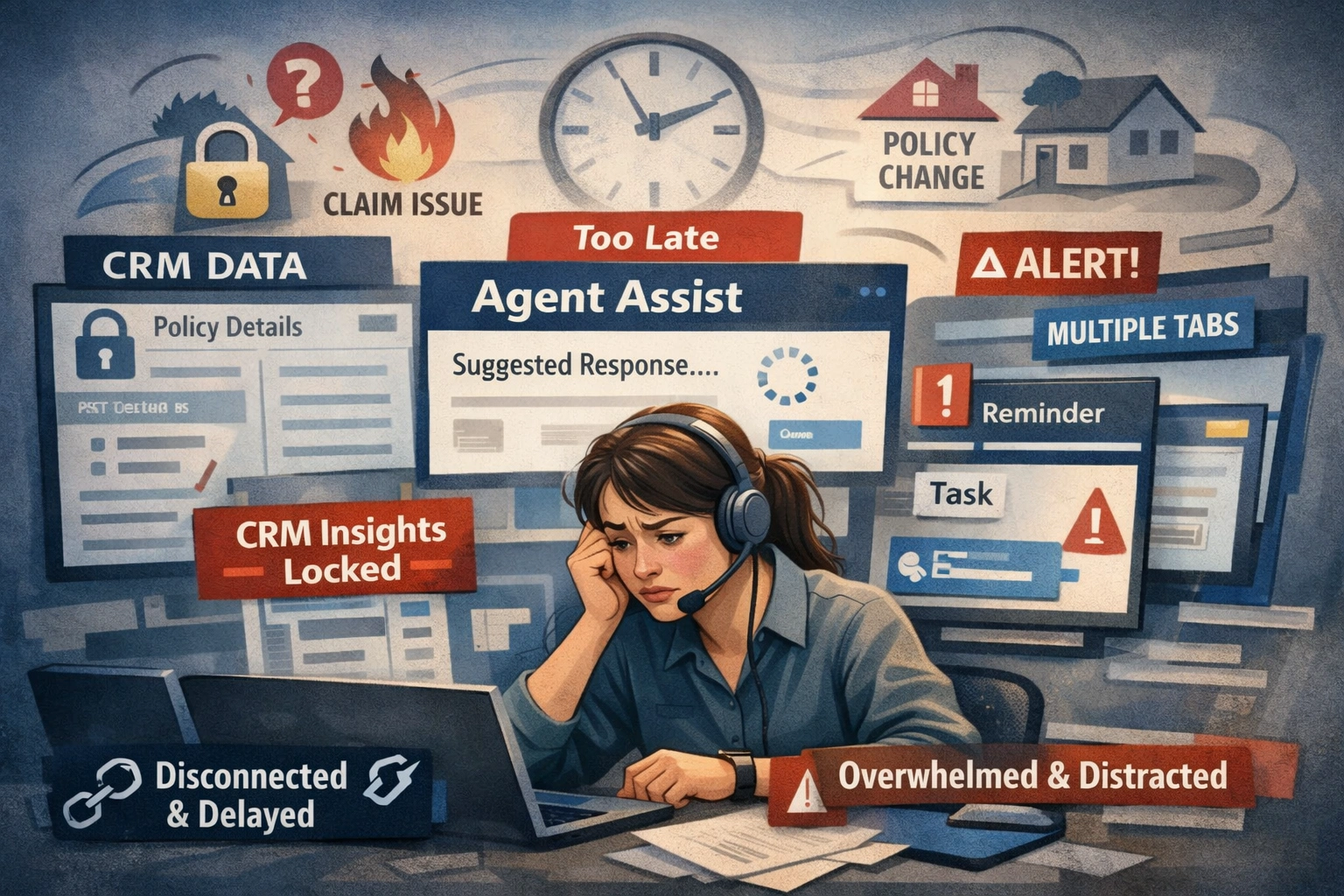
CRM Insights Stay Locked Outside Live Conversations
CRM insights often live one click too far away. Agents may know the data exists, but switching screens mid-call breaks focus and flow.
This is where real-time agent assist should shine, but without direct CRM insights, it can’t surface what matters at the right moment. Instead of guiding the conversation, it reacts too late or not at all.
Over time, agents learn that checking CRM data during calls isn’t worth the effort. CRM adoption in contact centers becomes administrative, and real-time agent assist loses trust.
When CRM insights don’t enter live conversations automatically, real-time guidance becomes delayed, diluted, and easy to ignore.
Call Center Agent Productivity Tools Add Friction, Not Flow
Many call center agent productivity tools promise efficiency but add layers of alerts, tabs, and notifications. Agents end up managing tools instead of conversations.
Without CRM insights, real-time agent assist becomes just another screen. Instead of reducing effort, it competes for attention during high-stakes insurance calls.
True productivity tools should remove decisions, not add them. And that only happens when CRM context drives what agents see and hear.
Call center agent productivity tools only improve outcomes when they work invisibly, powered by CRM insights and delivered through Real-time agent assist.
So what does “good” actually look like? To answer that, we need to define what real-time agent assist truly needs from CRM insights to work inside insurance environments.
Reduce call errors with live agent assist.
This blog is just the start.
Unlock the power of Convin’s AI with a live demo.

What Real-time Agent Assist Needs From CRM Insights To Work
Before looking at any platform, it’s important to understand the baseline capabilities that make real-time agent assist effective.
In insurance, the bar is higher because errors are costly and context is everything.
Agent Assist Solutions Require Policy, Claim, And History Context
Effective agent assist solutions must understand the customer’s full insurance journey. That includes active policies, claim timelines, past escalations, and previous agent commitments.
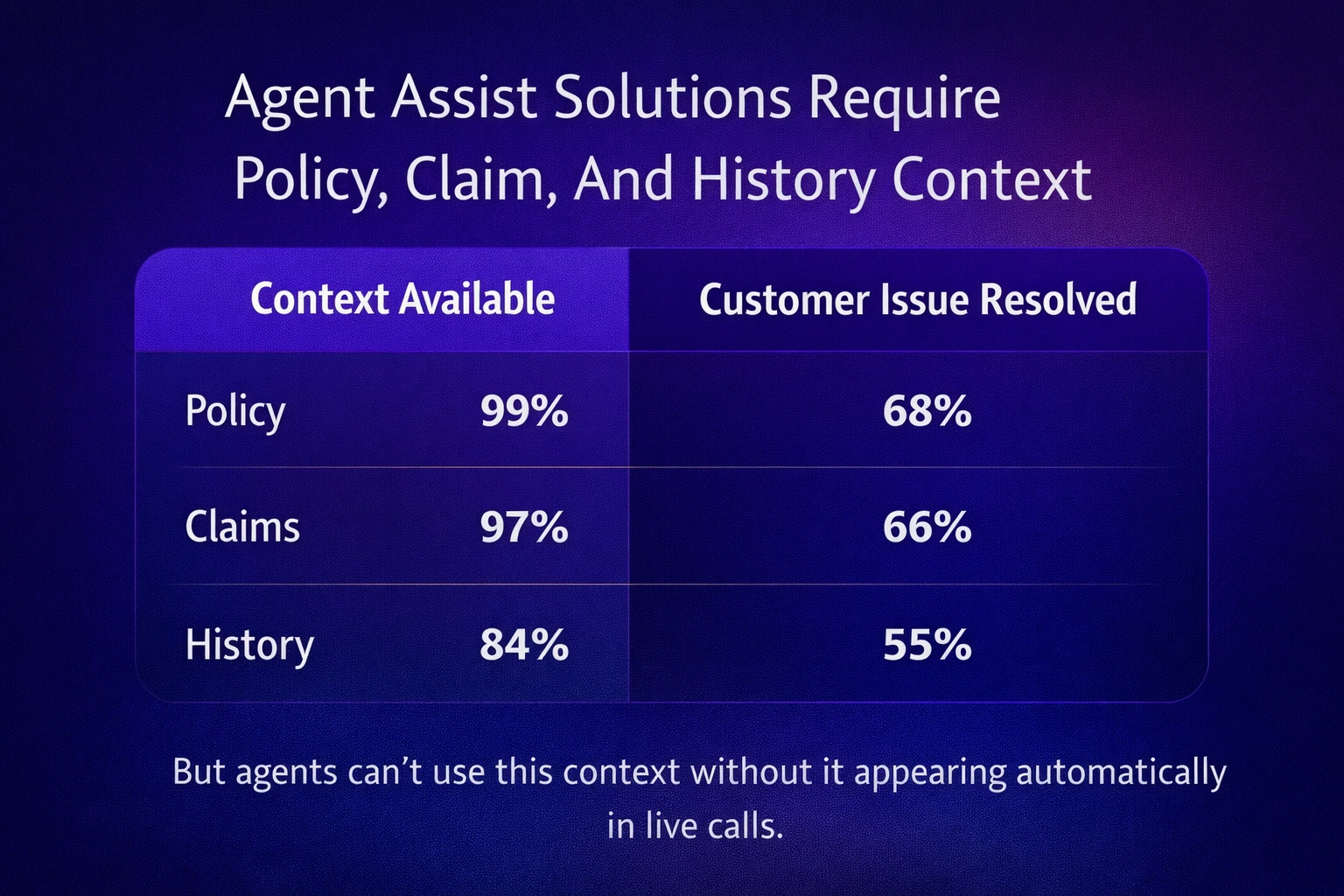
When real-time agent assist pulls this context from CRM insights automatically, guidance becomes precise. Agents don’t just hear what to say; they understand why it applies to this customer.
Without this depth, agent-assist solutions stay generic and fail to influence real outcomes.
Policy and claim context transform real-time agent assist from a script reader into a decision support system.
CRM Adoption In Contact Centers Depends On Zero Effort Access
Agents won’t adopt tools that require manual searching. CRM adoption in contact centers improves only when insights appear without effort.
Real-time agent assist must act as the delivery layer surfacing CRM insights at the exact moment they’re needed. When that happens, agents stop seeing CRM as a database and start seeing it as support.
This shift is what turns CRM adoption in contact centers from an obligation to an advantage.
Zero-effort access to CRM insights is the foundation for scalable real-time agent assist.
With these requirements in mind, let’s look at how real-time guidance actually comes together when CRM insights are embedded directly into live calls.
Upgrade agent assists with real CRM insights.
Where Real-time Agent Assist Meets CRM Insights In Practice
This is where execution truly matters. In insurance contact centers, workflows move fast, and agents don’t have time to chase information across systems. Tools must adapt in real time, without disrupting the conversation.
This is exactly where Convin’s Real-time agent assist changes the experience. By overlaying CRM insights directly onto live calls, Convin ensures agents get support in the moment it matters, not after the call ends.
.webp)
Agent Assist Solutions That Pull CRM Insights Mid-Call
Modern agent-assist solutions need to work while the customer is speaking, not between screens or after pauses. Convin’s Real-time agent assist listens to live conversations and dynamically pulls relevant CRM insights as the call unfolds. Policy details, claim status, prior interactions, and key customer context surface automatically, without agent effort.
For agents, this feels less like “using a tool” and more like having a silent co-pilot. Real-time agent assist becomes an extension of the agent’s thinking, guiding responses without interrupting flow.
Because Convin surfaces value instantly, agents naturally engage with the CRM data they enter. Over time, this reinforces CRM adoption in contact centers not through enforcement, but through everyday usefulness.
When CRM insights appear mid-call through Convin, real-time agent assist becomes timely, relevant, and trusted.
7 Top Voice AI Tools: What To Look For Instead Of Just Who To Pick
As interest grows around the 7 Top voice AI tools, many insurance leaders jump straight into vendor comparisons. But at the MOFU stage, the smarter move is to first understand what actually differentiates effective voice AI in live insurance calls, before names and logos enter the picture.
Instead of asking “Which tool is best?”, high-performing teams ask “Which capabilities matter for our call complexity?”
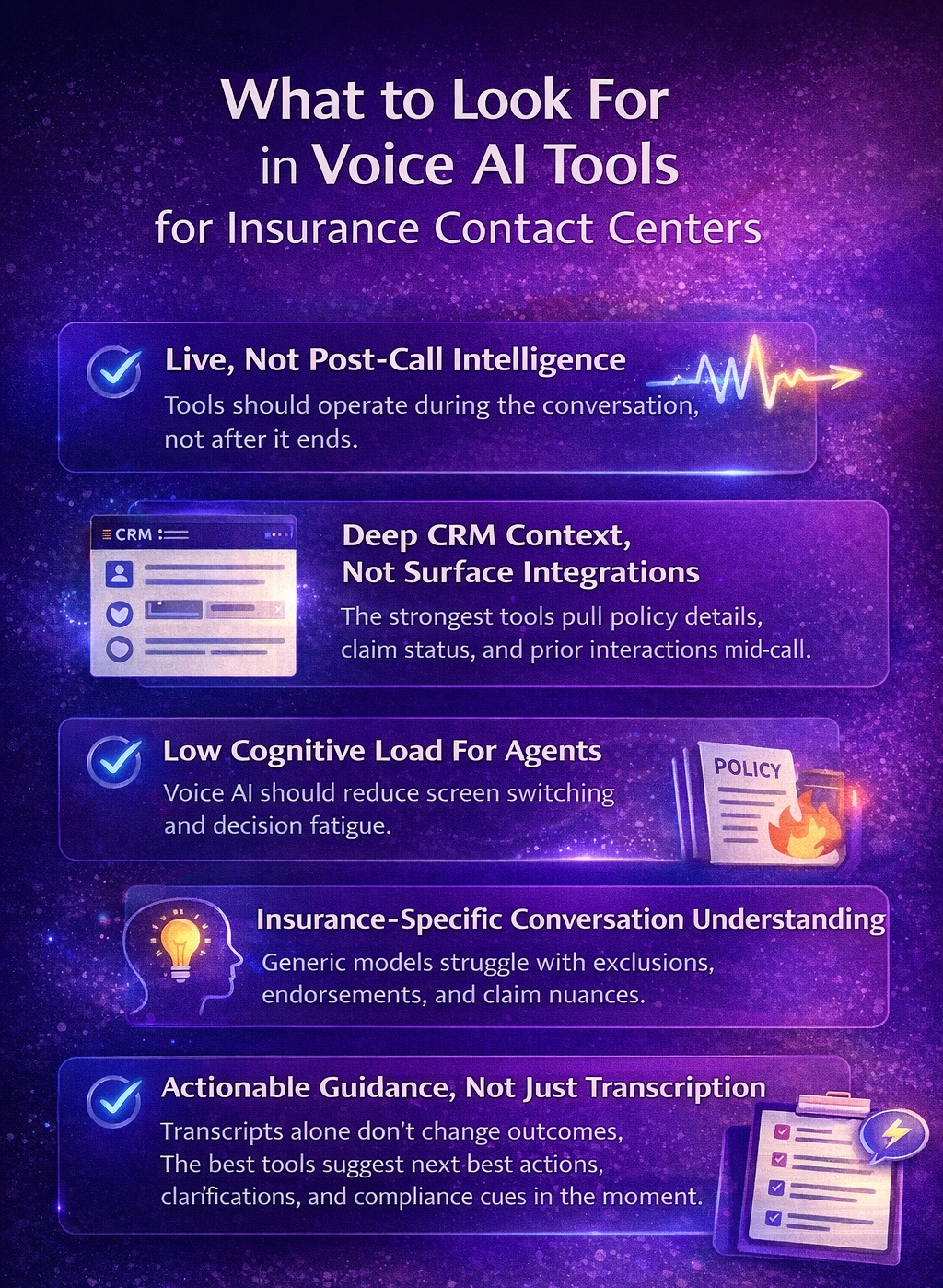
What to look for in voice AI tools for insurance contact centers:
- Live, Not Post-Call Intelligence
Tools should operate during the conversation, not after it ends. Real-time guidance matters far more than post-call analytics in high-stakes insurance interactions. - Deep CRM Context, Not Surface Integrations
The strongest tools pull policy details, claim status, and prior interactions mid-call. Shallow CRM links won’t support real-time agent assist effectively. - Low Cognitive Load For Agents
Voice AI should reduce screen switching and decision fatigue. If agents must click, search, or interpret alerts, adoption will stall. - Insurance-Specific Conversation Understanding
Generic models struggle with exclusions, endorsements, and claim nuances. Look for tools built to handle regulated, context-heavy conversations. - Actionable Guidance, Not Just Transcription
Transcripts alone don’t change outcomes. The best tools suggest next best actions, clarifications, and compliance cues in the moment.
This lens helps teams evaluate the 7 Top voice AI tools more objectively. Once these criteria are clear, vendor comparisons become simpler and more meaningful because the focus stays on outcomes, not feature checklists.
The real differentiator isn’t the number of tools available. It’s how well a tool fits the reality of life insurance conversations.
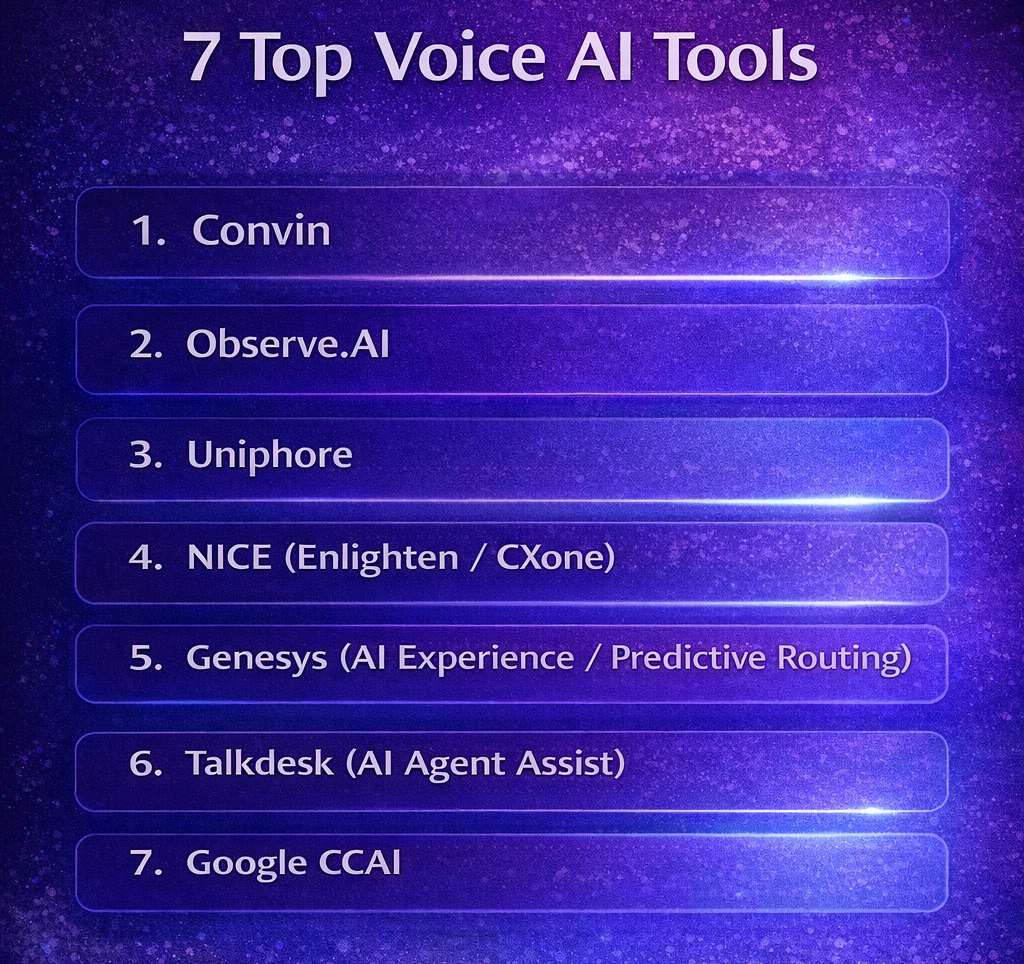
How Leading Vendors Compare
Once teams understand what to look for, the next natural step is to see how the 7 Top voice AI tools stack up against those criteria. The goal here isn’t to crown a winner, but to highlight strengths, gaps, and best-fit use cases, especially for insurance contact centers.
Below is a capability-led comparison, not a feature checklist.
What To Look For vs How Top Voice AI Tools Compare
1. Convin
- Best fit: Insurance and regulated contact centers
- Strength: Real-time agent assist with deep CRM insights mid-call
- Why it stands out: Built for live guidance, not just analytics; strong on compliance, coaching, and agent adoption
- Trade-off: Purpose-built focus means less emphasis on generic speech analytics use cases
2. Observe.AI
- Best fit: QA and post-call analytics teams
- Strength: Conversation intelligence and performance insights
- Limitation: Primarily post-call; real-time agent assist capabilities are more limited for live decision support
3. Uniphore
- Best fit: Large enterprises with complex CX stacks
- Strength: Broad voice AI platform with analytics and automation
- Limitation: Real-time CRM-driven guidance can feel heavy to deploy and slower to operationalize
4. NICE (Enlighten / CXone)
- Best fit: Enterprises already deep in NICE ecosystems
- Strength: Scale, compliance, and workforce management integration
- Limitation: Real-time agent assist often feels rules-driven rather than context-aware
5. Genesys (AI Experience / Predictive Routing)
- Best fit: Contact centers using Genesys Cloud
- Strength: Native platform integration and routing intelligence
- Limitation: Agent guidance relies heavily on workflows, not live CRM insights
6. Talkdesk (AI Agent Assist)
- Best fit: Mid-market contact centers modernizing fast
- Strength: Quick deployment and UI simplicity
- Limitation: CRM context depth during live calls is still evolving
7. Google CCAI
- Best fit: Teams with strong internal AI and engineering resources
- Strength: Speech recognition and language models
- Limitation: Requires significant customization to deliver insurance-ready real-time agent assist
How To Use This Comparison
For insurance leaders evaluating the 7 Top voice AI tools, the key distinction is live usefulness vs analytical insight. Many platforms analyze conversations well after they end. Far fewer actively support agents during the call, using CRM insights to guide decisions in real time.
That’s why comparisons should always anchor back to one question:
Does this tool help my agent while the customer is still on the line?
When viewed through that lens, real-time agent assist powered by CRM insights becomes the defining factor, not brand size or feature breadth.

Call Center Agent Productivity Tools Powered By Live Context
The most effective call center agent productivity tools don’t demand clicks or attention; they anticipate needs. Powered by CRM insights, Convin’s Real-time agent assist delivers next best actions, compliance nudges, and clarification prompts exactly when they’re needed.
For insurance teams, this directly reduces rework, escalations, and compliance risk. Productivity improves not because agents rush, but because they make better decisions with full context.
With live CRM context embedded into conversations, Convin turns Real-time agent assist into one of the most impactful call center agent productivity tools insurance teams can deploy.
All of this sounds promising, but what does it actually change for insurance contact centers on the ground?
Improve agent confidence in real time.
The Insurance Impact Of Real-time Agent Assist Using CRM Insights
When CRM insights finally meet live conversations, the effects compound quickly across teams, metrics, and customer experience.
This is where real-time agent assist moves from feature to force multiplier.
CRM Adoption In Contact Centers Improves Resolution And Trust
When agents see CRM insights helping them resolve issues faster, CRM adoption in contact centers improves naturally. Data quality goes up because agents trust the system.
Customers notice the difference too. Conversations feel informed, personalized, and consistent, especially in sensitive insurance scenarios.
Real-time agent assist becomes a driver of both operational discipline and customer trust.
Better resolution and trust are downstream effects of CRM insights flowing through Real-time agent assist.
Agent Assist Solutions Reduce Guesswork In High-Stakes Calls
Insurance calls often involve stress, urgency, and financial risk. Guesswork has real consequences.
Agent-assist solutions that rely on CRM insights reduce uncertainty for agents. Real-time agent assist helps them navigate exclusions, coverage limits, and next steps with confidence.
This consistency is what leadership teams look for when evaluating the long-term value of call center agent productivity tools.
Reducing guesswork is where Real-time agent assist delivers its highest ROI in insurance contact centers.
All signs point to one conclusion: real-time guidance without context isn’t enough.
Book your Convin demo now!
Real-time Agent Assist Works Only When CRM Insights Flow
Insurance contact centers don’t have a data problem; they have a delivery problem. CRM insights exist, but they rarely reach agents during live conversations.
That’s why real-time agent assist needs CRM insights to succeed. When context flows into calls automatically, agents stop guessing, CRM adoption in contact centers improves, and productivity tools finally live up to their promise.
For insurance leaders evaluating agent assist solutions, the real question isn’t whether to deploy real-time agent assist; it’s whether CRM insights are truly part of the conversation.
FAQs
- What does agent assist do?
Agent assist provides live guidance during customer interactions, surfacing prompts, knowledge, and compliance cues to help agents respond accurately, faster, and more consistently across calls and chats in real time.
- What is the meaning of real-time assistance?
Real-time assistance means delivering guidance, insights, or actions instantly while a task is happening, enabling immediate decisions and corrections without delays, context switching, or post-event review during live interactions continuously.
- Who are the big 4 AI agents?
The big 4 AI agents commonly referenced are OpenAI, Google, Microsoft, and Amazon, representing leading platforms advancing large language models, enterprise AI agents, and cloud-based intelligent automation capabilities at scale.
- What are level 3 AI agents?
Level 3 AI agents are semi-autonomous systems that execute tasks independently but require human oversight for decisions, exceptions, and risk control, balancing automation with accountability in real-world business environments.


%20BLOG10%20examples%20of%20artificial%20intelligence%20in%202024.webp)



.avif)