

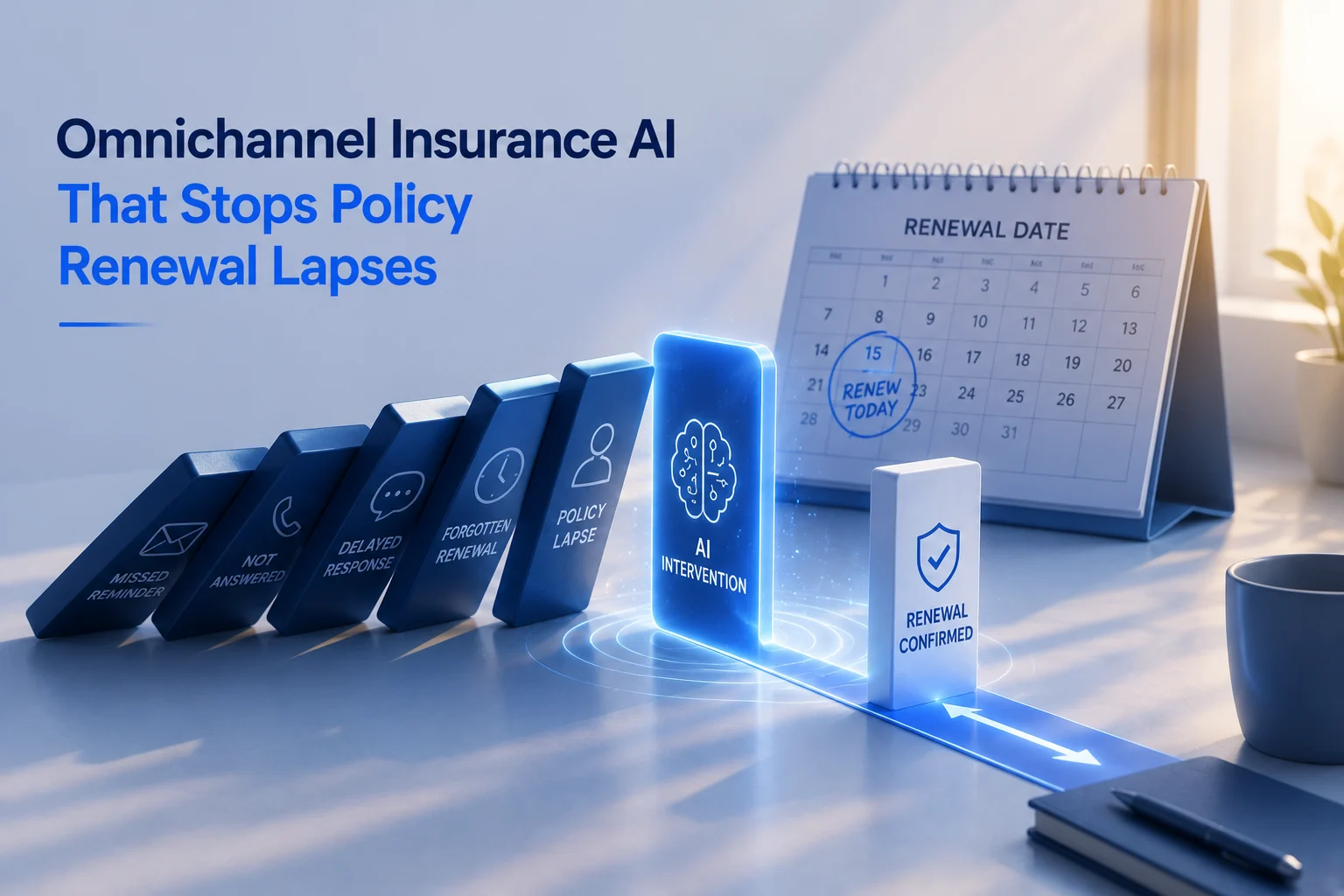
When a renewal book starts to leak, the first sign is often silence. A call is missed, an SMS is ignored, and the policy is assumed lost. But is that really the full picture?
In insurance, silence does not always mean disengagement. The same customer who ignores a call may respond on WhatsApp later or complete payment after a timely reminder. So why do renewals still slip away?
The issue is not lack of outreach, but lack of continuity. Most systems restart every interaction instead of carrying context forward. That is where omnichannel insurance changes things, ensuring every touchpoint stays connected.
In a market like India, where persistence is already under pressure, the real question is simple: are insurers reaching customers, or just reaching out to them?
Fix renewal leakage with omnichannel insurance continuity
How does omnichannel insurance actually reduce lapses?
Omnichannel insurance for renewal means using policy data, lapse-risk scoring, and channel sequencing to reach each policyholder on the most likely channel at the right time, then carrying context across voice, WhatsApp, SMS, email, and human follow-up until payment clears.
That is the difference between a reminder system and a renewal system. A reminder system sends the same message to everyone. A renewal system knows who is at risk, who needs a nudge, and who needs a human callback.
Sources: [IRDAI Handbook of Indian Insurance 2023–24], [Business Standard on surrenders and withdrawals], [Business Standard on IRDAI persistency targets]
Move from siloed renewals to omnichannel insurance system with Convin
What does a renewal workflow look like in practice?
A working renewal engine is sequenced, not random. It starts before expiry, changes channel as intent changes, and escalates only when the customer actually needs help.
Convin fits here by reading due dates, payment history, policy type, and prior interactions from the PAS. If a customer raises price sensitivity on the first call, the next touch opens with a premium explanation, not the same pitch. That is what makes omnichannel insurance feel coherent instead of repetitive.
Lapse-risk scoring: a prioritization layer that ranks policyholders by likelihood to lapse, so the highest-risk accounts get the earliest and richest outreach.
Sources: [Convin AI Voice Bots for Insurance Renewals]
Build structured renewal workflows for higher persistency with Convin
This blog is just the start.
Unlock the power of Convin’s AI with a live demo.

Why WhatsApp is the renewal completion layer in India
Competitor content often treats WhatsApp like just another channel. That misses how India actually behaves during renewal. For many policyholders, WhatsApp is the place where the payment decision gets completed.
India has 550+ million monthly active WhatsApp users, and business messages see about 98% open rates versus 22% for email. That is why WhatsApp beats email and bulk SMS for renewal completion, especially in Tier 2 and Tier 3 markets where mobile-first behavior is standard.
The channel split should look like this:
- Voice for explanation and objection handling.
- WhatsApp for policy summary, due date, and payment link.
- SMS for OTP and final urgency.
- Email for record keeping and formal notices.
Convin’s renewal flows use that split well because they keep context across channels. A customer who said “I will pay tomorrow” on a call should not receive a generic reminder the next morning. They should receive a timely WhatsApp message with the exact policy details and a payment path that is already familiar.
Sources: [Convin AI Voice Bots for Insurance Renewals]
Improve renewal completion using WhatsApp-led orchestration with Convin
How should insurers handle grace period and lapse recovery?
The grace period should not be treated like a last-minute panic window. It should be a separate recovery flow with its own tone, cadence, and escalation logic.
Convin’s revival workflows reportedly recover 14% of lapsed policies in real deployments. That matters because low contactability alone can shrink revival funnels by 30% or more. If the team keeps calling at the wrong time, the policy does not just lapse, it disappears.
For life insurance, the recovery window can extend well beyond the first few days. Convin’s lapsed-to-revival workflow runs for 12 to 18 months post-expiry, which is useful when a customer needs a reminder about underwriting risk, not just a payment link. The point is to restart coverage before the customer starts over somewhere else.
The strongest renewal teams also audit every interaction. Convin says it auto-audits 100% of voice, WhatsApp, SMS, and email interactions, which is a major upgrade over manual QA sampling. In a regulated book, that is not a nice-to-have.
Recover lapses with structured grace period automation with Convin
How do upsell and renewal work together without hurting retention?
Upsell should happen after the renewal is safe, not before. Push too early and the customer feels sold to. Push too late and the opportunity is gone.
A clean rule is to suppress cross-sell for 24 to 72 hours after payment confirmation. Once that window passes, the system can use policy type, premium band, and past conversations to decide whether an add-on is relevant. This is where the AI matters, because the agent should not have to remember the pitch. The system should surface it at the right moment.
That split is one of the biggest gaps in competitor content. Motor is a volume play. Life is a value-protection play. Convin’s auto-QA also reviews 100% of renewal interactions, which helps teams catch missed upsell cues without weakening the renewal conversation.
Sources: [McKinsey on AI in Insurance ], [ Capgemini World Life Insurance Report 2025]
Align upsell timing with renewal journeys using Convin
Why compliance has to be built into omnichannel insurance
Compliance cannot sit outside the workflow, because the workflow itself creates the compliance risk. That is especially true in India, where IRDAI, TRAI, and DPDP all affect renewal communication.
IRDAI’s 2024 and 2025 guidance, plus the DPDP Act 2023, mean insurers need consent tracking, data minimization, disclosure language, DND checks, and audit-ready records. TRAI’s move toward 1600-series service numbers adds another operational constraint. The renewal engine has to follow these rules automatically, not through manual list management.
Convin’s approach is straightforward. The AI identifies itself as an assistant, uses mandatory disclosure language, scrubs against DND, enforces contact caps, and stores transcripts for retrieval. That is the right model for omnichannel insurance because every touchpoint is both a customer moment and a compliance event.
Sources: [Legal 500 on IRDAI Regulatory Sandbox 2025 ], [ Lexology on IRDAI 2024 Regulations ], [ K&S Partners on DPDP and IRDAI overlap]
Ensure compliant omnichannel insurance workflows with Convin
What ROI should leaders expect from omnichannel insurance?
The ROI case works because renewal leakage, labor cost, and complaint volume all move at once.
Convin’s insurance deployments report 30% higher retention, 60% lower operating costs, 27% higher CSAT, 38% better first-call resolution, and 200 to 300% ROI within 18 months. Separately, Capgemini’s 2025 life insurance work shows best-in-class insurers deliver 38% higher NPS, 11% lower expense ratio, and 6% higher revenue growth over three years. Those numbers point in the same direction: renewal excellence compounds.
The market is already moving. ICICI Lombard and Arya.ai reported 98% workflow automation and reduced manual quality checks to 2%. That is the kind of proof that tells you this is no longer experimental. It is becoming the operating model.
Sources: [Capgemini World Life Insurance Report 2025 ], [ Insurance Business on Capgemini findings ], [ PR Newswire on ICICI Lombard and Arya.ai]
See insurance renewal ROI in action with Convin demo
FAQ
Q: How can AI reduce insurance policy lapse rates?
AI reduces lapses by scoring risk early, timing outreach better, and keeping context across channels. Instead of repeating the same reminder, it adapts the next touch based on what the customer already said and did.
Q: What is the best channel for insurance renewal reminders in India?
WhatsApp is usually the strongest channel for completion, while voice is best for explanation and objection handling. SMS works best as a final nudge or OTP layer, not as the main renewal engine.
Q: How do I comply with IRDAI regulations when using AI for renewal communications?
Build compliance into the system. That means disclosure scripts, consent tracking, DND scrubbing, contact caps, and transcripts stored for audit. It should happen automatically on every campaign.
Q: What is the ROI of omnichannel AI for insurance renewals?
The ROI comes from higher retention, lower staffing cost, better contactability, and fewer escalations. In Convin’s reported deployments, that translated into 60% lower operating cost and 200 to 300% ROI within 18 months.
Q: What is the grace period and how should AI communicate it to policyholders?
The grace period is the window after expiry when the customer can still restore coverage. AI should switch tone, explain the reinstatement path clearly, and use the customer’s channel preference rather than blasting the same message everywhere.




.avif)