

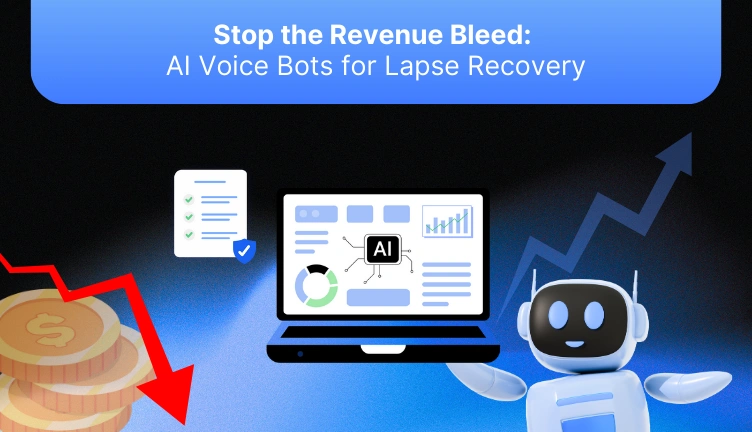
Most insurers don’t lose crores in renewal revenue because customers don’t want to continue. They lose it because outreach happens too late, too inconsistently, or too manually to match the speed at which customers lapse.
And here’s the uncomfortable truth: even your best-performing teams can’t match the precision, timing, and follow-through offered by AI voice bots for insurance renewals. Automation is the only way to stay ahead of the rapidly closing lapse window.
See how AI voice bots for insurance renewals prevent revenue leakage.
Why Manual Renewal Outreach Is Breaking Down
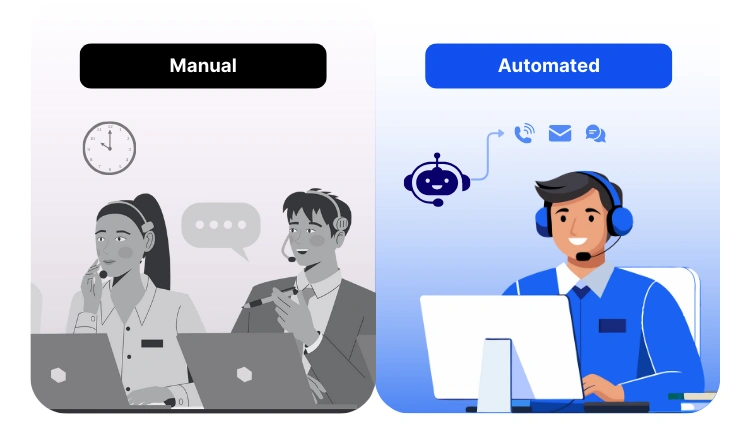
Renewal teams are facing a volume and velocity problem that manual outreach simply can’t keep up with. Outreach models continue to rely on dialers, spreadsheets, and agent follow-through even as policy counts continue to rise, customer expectations continue to change, and revival windows shorten.
Industry data shows how unforgiving the timing gap has become. McKinsey notes that in insurance, conversion rates drop sharply when follow-ups are delayed even by a day, especially in retention and renewal workflows.
Meanwhile, Deloitte highlights that contactability in outbound insurance campaigns rarely crosses 30–40%, largely because most calls happen at suboptimal times or rely on single-channel attempts.
Even the best revival programs are difficult to carry out precisely when you include operational realities like fragmented customer data, inconsistent scripts, compliance overhead, and limited QA coverage.
The result? High lapse rates are not because customers are unwilling, but because insurers can’t reach them with the right message at the right moment. Automation is no longer a productivity story here; it’s a revenue protection imperative.
See why manual renewal outreach fails to scale for insurers.
Problem Deep Dive: Why Lapsed Policies Keep Slipping Away
Most lapsed policies are not the result of a single failure but a chain of small, compounding breakdowns. From missed signals and poor contactability to inconsistent follow-ups and slow handoffs, renewal revenue leaks at multiple points. Understanding these failure patterns is the first step toward fixing them at scale.
- Poor Early Warning & Risk Identification
The majority of insurers continue to function reactively, trying to revive policies only after they have expired. Without predictive signals, teams can’t see which customers are likely to drop off or why.
Industry studies show that early-risk identification can improve retention outcomes by 15–25%, simply because agents intervene before disengagement hardens. But manual teams don’t have the bandwidth to analyze call patterns, sentiment, objections, or prior payment behavior at scale.
Revival success collapses when risk appears late, converting avoidable churn into irreversible revenue loss.
- Low Contactability & Outdated Customer Information
A large portion of policies never even enter a revival conversation because customers can’t be reached. Deloitte reports that 60–70% of outbound calls in insurance miss on the first attempt, driven by wrong timing, outdated numbers, and single-channel dependency.
This becomes a structural barrier: if customers don’t pick up, no script, agent, or offer can revive the policy. Manual teams rarely have data-driven best-time-to-call insights or omnichannel orchestration across SMS, WhatsApp, and email. Low contactability alone can shrink revival funnels by 30% or more.
- Inefficient & Script-Dependent Agent Follow-Up
Even when agents connect, conversations are inconsistent. Some over-explain; others skip key objections; many rely on memory instead of structured talk tracks.
According to Bain, conversation inconsistency is one of the top drivers of failed renewals, particularly when objections like pricing or distrust aren’t handled well. Manual QA captures only 2–5% of calls, leaving leaders blind to what’s truly happening across thousands of conversations.
Inconsistency at scale translates to unpredictable revival outcomes and unscalable training costs.
- Fragmented & Delayed Revival Process
Renewal isn’t a single event; it’s a workflow spanning call centers, underwriting, branch ops, and collections. Without automation, hand-offs break down - agents forget to notify teams, documents get delayed, and interested customers lose momentum.
McKinsey reports that renewal conversions drop by nearly 50% when follow-up actions lag beyond 24–48 hours. Yet most insurers rely on manual task assignments and ad hoc reminders.
Every delay increases the chance that a revivable customer slips through the cracks.
- Low Personalization in Retention Messaging
Broadcast-style renewal messages assume all customers lapse for the same reason. But a price-sensitive lapsed customer and a confused first-year customer need entirely different interventions.
Accenture notes that personalized retention outreach can improve conversion rates by 10–15%, yet most insurers lack segmentation models tied to intent or past interactions. Generic messaging fails to address the emotional or practical barrier behind the lapse.
- No Prioritization of High-Value or High-Risk Policies
Agents often spend equal effort across all customers, even when certain policies carry far higher premiums or lifetime value. Without automated prioritization, leaders can’t ensure the right revival attempts happen first.
Profitability is disproportionately impacted by high-value errors, but manual teams find it difficult to determine which clients need immediate attention.
In insurance, saving a single high-premium policy can outweigh the effort of reviving dozens of low-value ones, making the lack of prioritization a costly blind spot.
- Limited Visibility on Lapsed Drivers & Revival Performance
Most leaders lack real-time clarity on why policies are lapsing, where customers drop off in the funnel, and which agent behaviors correlate with revival success. Traditional reporting is backward-looking and heavily manual.
According to EY, insurers cite data fragmentation as a top-3 barrier to improving retention and revival metrics. Revival strategies are still based on conjecture rather than optimization in the absence of root-cause analytics.
- High Operational Cost of Manual Outreach & QA
Manual dialing, manual follow-ups, manual QA, and manual reporting create a labor-heavy, cost-intensive model. Outbound calling and QA teams scale linearly with policy volume, pushing OPEX higher every year.
Deloitte estimates that manual QA alone consumes 10–15% of contact center costs in regulated industries like insurance. When revival depends solely on human bandwidth, insurers face the worst of both worlds: rising costs and inconsistent outcomes.
What “Good” Looks Like: A Predictive, Always-On Renewal Engine
A high-performing renewal function isn’t defined by larger teams or more aggressive dialing. It is characterized by accuracy, the capacity to identify which customers are most likely to fall behind, when to get in touch with them, how to handle their objections, and what to do next to get them back on track. Leading insurers are shifting from manual revival sprints to an always-on renewal engine powered by automation and intelligence.
In an ideal model, risk scoring continuously flags customers likely to lapse based on behavior, sentiment, and interaction history. Best-time-to-call intelligence ensures every outreach attempt lands when the customer is most reachable, dramatically improving contactability.
Automated reminders across voice, SMS, WhatsApp, and email keep customers engaged throughout the revival window, instead of relying on sporadic agent nudges.
Additionally, the engine uses dynamic scripts and objection guidance to maintain conversation consistency, so regardless of agent variability, customers always hear the correct message.
And a unified revival funnel dashboard presents leaders with real-time visibility from “contacted” to “revived,” eliminating the guesswork that plagues manual review cycles.
Fundamentally, this model allows human agents to handle only the high-value, complex objections where negotiation and empathy are really important.
Everything else happens in the background in a predictable manner, including timing, follow-ups, nudges, and qualification. This is what modern insurance renewal automation looks like when done right.
Identify where your renewal conversations and follow-ups break down.
This blog is just the start.
Unlock the power of Convin’s AI with a live demo.

Convin’s Approach: Automating the First 80% of Revival Conversations with AI Voice Bots
The most common misconception about insurance renewals is that the success of a revival depends on the number of agents who make more calls.
The information-driven, repetitive, and time-sensitive conversations that make up the first 80% of the workflow actually determine whether or not there are any delays, inconsistencies, or leaks. AI voice bots excel at that in particular.
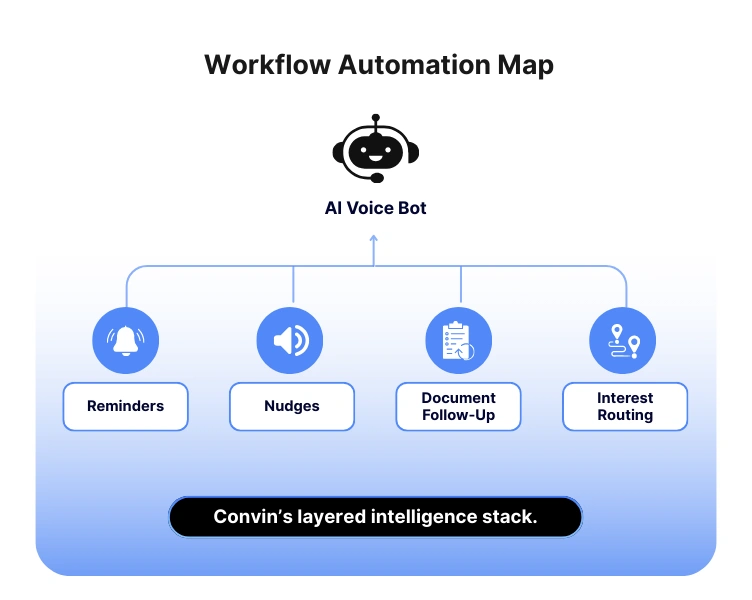
Convin’s AI voice bots handle the high-volume, high-variance steps that traditionally overwhelm teams: premium reminders, due-date nudges, failed-payment follow-ups, document requirement clarifications, and post-interest reminders.
Automation performs these structured conversations with flawless timing and precision each time. For customers, the experience is fast and frictionless. For insurers, the revival funnel widens immediately.
What makes this engine powerful is that the bot doesn’t operate in isolation.
It’s guided by Convin’s intelligence stack risk scoring that highlights who’s likely to lapse; best-time-to-call intelligence that optimizes pickup rates; intent and objection detection that spots hesitation; and automated QA that enforces compliant, accurate conversations. Together, they turn outreach into a precision workflow instead of a volume game.
When the bot detects a complex objection or a high-value policyholder, it hands off to a human agent with full context, conversation summary, risk score, objection cues, and recommended next actions. No cold handovers. No repeated questions. No lost interest.
For insurers, this model does two things at once:
- Recovers more lapsed revenue by engaging every customer, every time, at the right moment
- Reduces OPEX by shrinking the manual load on outbound and QA teams
This is the practical path to modernizing AI voice bots for insurance renewals: not as a gimmick, but as a scalable revenue engine.
Explore what a modern AI-driven renewal engine looks like!
How Insurers Can Start Recovering Lapsed Policies with AI Voice Bots
Once insurers see where revival workflows break, the next question is always the same:
How do we start modernizing without disrupting current operations?
The strategy below helps teams move from manual renewal sprints to a predictable, automated recovery engine.
1. Identify high-value and high-risk lapse segments
Start by mapping policies based on premium value, customer profile, historical engagement, and call sentiment. Focus your first automation pilots on these segments as they deliver the quickest, clearest ROI.
2. Build or activate lapse-risk scoring
Use behavioral patterns, payment history, and interaction signals to predict the probability of lapse. The goal isn’t perfection; it’s prioritization. Even basic risk stratification can improve outreach focus dramatically.
3. Deploy AI Voice Bot journeys for the first 80% of conversations
Let bots handle the repetitive but time-sensitive moments: reminders, clarifications, payment nudges, document follow-up, revival eligibility checks. Human agents intervene only when customers need nuance, reassurance, or negotiation.
4. Activate omnichannel reminders to cover all preferred touchpoints
Combine voice with SMS, WhatsApp, and email for consistent, compliant follow-through. This widens the top of the revival funnel and recovers customers who never answer calls.
5. Use automated QA to fix script gaps and compliance misses
Analyze 100% of bot-led and agent-led calls. Identify which objections derail conversations, which talk tracks work best, and where compliance risks hide. Feed these insights back into scripts and bot logic.
6. Stand up a real-time revival funnel dashboard
Track: Contacted → Connected → Interested → Docs Received → Revived.
Leaders can spot where customers are dropping off in real time—and adjust workflows instantly instead of waiting for month-end MIS.
7. Run a 30-day A/B test: bot-led vs. agent-led outreach
This is where teams see the sharpest contrast. Bots excel in timing, consistency, and volume. Agents excel in empathy and negotiation. Together, they create a hybrid model that is both scalable and high-converting.
A structured playbook like this lets insurers adopt insurance renewal automation without a big-bang transformation. You modernize one workflow, measure uplift, and expand from there.
Learn how insurers start with one workflow and scale renewal recovery.
Wrap-Up: Renewal Revenue Is a Precision Game Now
Lapsed policies are caused by slow outreach, inconsistent conversations, and missed timing in addition to being a sign of customer disinterest. The carriers winning today aren’t the ones with bigger teams. They’re the ones building renewal engines that work with precision: right customer, right moment, right message, zero leakage.
That degree of accuracy is made possible by AI voice bots for insurance renewals. When combined with intelligence, such as risk scoring, best-time-to-call, objection detection, and automated quality assurance, they produce a renewal workflow that consistently moves clients toward renewal. Only in critical situations do human agents intervene.
The shift is already underway across the industry. The only question is whether your renewal engine will keep up with the customers you’re trying to retain. Take a closer look at how AI voice bots support renewal recovery in a short walkthrough.
Frequently Asked Questions
1. How do AI Voice Bots for Insurance Renewals integrate with existing CRMs
AI voice bots for insurance renewals integrate via APIs with CRMs and policy systems to sync customer data, call outcomes, and renewal status in real time.
2. Can AI Voice Bots for Insurance Renewals handle multiple Indian languages
AI voice bots for insurance renewals can support multilingual conversations, enabling insurers to improve contactability across regional language preferences.
3. How secure are AI voice bots for insurance renewals?
AI voice bots for insurance renewals follow enterprise-grade security standards, including data encryption, access controls, and audit logs to protect customer data.
4. What is the typical implementation time for AI voice bots in insurance?
Most insurers can deploy AI voice bots for insurance renewals in weeks, starting with one workflow before scaling across renewal journeys.
5. Do AI Voice Bots for Insurance Renewals work for both life and general insurance
AI voice bots for Insurance Renewals are used across life, health, and general insurance for premium reminders, policy revival, and renewal follow-ups.

%20BLOG10%20examples%20of%20artificial%20intelligence%20in%202024.webp)



.avif)