

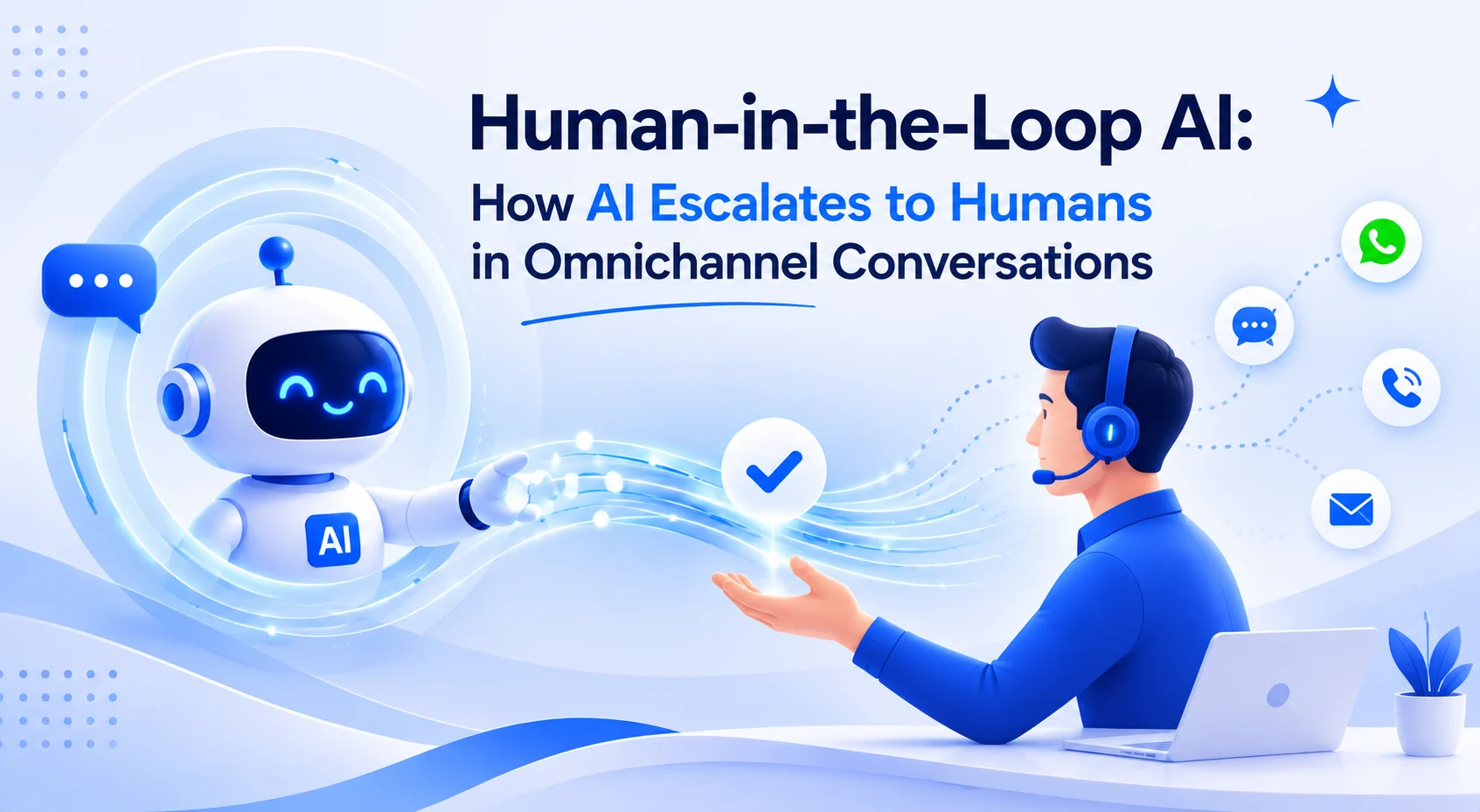
The customer is eight minutes into a conversation, the AI is doing fine, and then the thread suddenly turns. Maybe the buyer asks about a contract clause. Maybe the borrower mentions a complaint. Maybe the lead wants to negotiate. That is the moment where the whole system either earns trust or loses it.
That is why human-in-the-loop AI matters. It is not a rescue plan after the AI gets stuck. It is the architectural decision that defines which conversations the machine should own, which ones should route to a rep, and how that transfer should happen without the customer feeling a seam.
In omnichannel environments, that boundary is now a live-production problem. Voice AI is already carrying a meaningful share of inbound volume, and customers are increasingly comfortable using AI only when they know a human is available if needed.
[Digital Applied Summary Of The Forrester Wave Contact Center AI Report, 2026]
See how Convin handles seamless human-in-the-loop AI handoffs
What Human-in-the-Loop AI Actually Means in Practice
Human-in-the-loop AI means the system is designed to hand a conversation to a human at specific trigger points, on purpose, with context attached. It is not an AI failure. It is the system doing the right thing at the right moment.
The easiest way to think about it is through three operating modes:
- AI-only mode: Handles routine, low-risk interactions like FAQs, lead qualification, and payment reminders.
- AI-assisted mode: A human stays in control while AI provides real-time prompts, summaries, and recommendations.
- Full escalation mode: The system hands over to a human when the customer, deal value, or risk profile requires it.
This distinction matters because the experience changes based on the mode in play. When AI is performing well, the customer should never feel a forced transfer. But when the interaction becomes high-value, emotionally charged, or compliance-sensitive, the human should step in seamlessly—with full context already available, not a blank slate.
Convin’s design philosophy is built around that idea. The company treats handoff as a deliberate routing decision, not a patch for a weak AI. That is the difference between a chatbot and a production-grade omnichannel system.
Experience real-time AI to human escalation with full context in Convin
Which Signals Trigger AI Escalation to Humans
The best escalation systems do not rely on a single keyword. They read a stack of signals.
The first is explicit request. If the customer says they want a person, the system should route immediately. Salesforce’s customer research shows this matters more than teams sometimes admit. People are more willing to use AI when there is a clear path to a person, and many want to know upfront whether they are speaking to AI at all.
The second is sentiment trajectory. A single frustrated phrase is not the same as an AI Escalation Logic in Conversational Systems
AI escalation is no longer a fallback mechanism—it is a core design layer in modern conversational systems. As voice AI already handles a growing share of contact center volume, these triggers ensure automation improves efficiency without compromising experience, accuracy, or compliance.
Reduce drop-offs with intelligent AI escalation powered by Convin
This blog is just the start.
Unlock the power of Convin’s AI with a live demo.

How Convin Executes Seamless AI-to-Human Handoffs
A good handoff is not just a routing event. It is a continuity event.
When Convin’s system escalates a live voice conversation, it should not feel like the AI disappeared and the customer got dumped into a queue. The better pattern is a warm transfer, where the AI keeps the conversation active while the human rep is alerted and the context package is prepared. The customer hears continuity, not silence.
On chat channels, the rep should get the full transcript, a summary, the customer’s sentiment at the moment of transfer, the detected intent, the CRM history, and the action items the AI had already started. That way the human does not begin by asking, “How can I help you?” They begin by continuing the conversation.
That is where Convin’s Agent Assist and Supervisor Assist layers matter. Convin says Supervisor Assist reduced average handle time and improved CSAT in the first six months, because the rep gets live guidance, not a cold handoff.
[Convin Live Agent Support Supervisor Assist, 2024]
Improve CSAT with seamless AI and human collaboration workflows
What the Human Rep Sees During Handoff
A handoff only works if the rep arrives with useful context.
The rep doesn’t arrive blind. They land on a structured context snapshot designed for instant clarity:
1. Conversation Overview
- Full transcript
- Concise AI-generated summary
- Current next step in progress
2. Escalation Context
- Trigger reason (sentiment, confidence drop, compliance, or value threshold)
- Customer sentiment at the exact point of handoff
3. CRM & Account Data
- Linked CRM record and lead history
- Deal value and account priority (for sales threads)
- Open issue details (for support cases)
This structure turns the rep from a reactive responder into an informed closer. It also eliminates repetitive questioning, which is where customer trust typically breaks first.
Convin’s banking compliance data shows that human-in-the-loop systems reduced mis-selling incidents by 31% within three months, as reviewers were able to catch risky claims before deal closure.
Convin’s insurance content says the same design produced a 40% reduction in customer complaints in call center workflows, which is exactly what you would expect when the rep gets the right context at the right moment instead of starting cold.
[Convin Insurance Call Centers, 2025]
Turn every complex conversation into a guided human-assisted resolution
When High-Touch Escalation Becomes Necessary
Not every high escalation rate is a problem.
If you sell high-value products, handle regulated requests, or run a premium customer experience, you may actually want a larger human share. In those cases, AI should qualify, route, and prepare the lead—not close everything on its own. That is not inefficiency. That is selective judgment.
This is where human-in-the-loop AI is often misunderstood. Teams assume the goal is to remove humans as much as possible. In reality, the goal is to place humans only where their judgment creates real value.
Conversation snippet:
AI: “Thanks for your interest in our luxury collection. I’ve noted your preferences and budget range.”
AI: “I’ve also checked availability and shortlisted the best options for you.”
AI (handoff note): “This lead is warm and high-value. Recommend human takeover for final consultation.”
Rep: “Hi, I saw your selections—let me personally guide you through the final options and customization.”
For a luxury D2C brand, the human steps in when the lead is already warm. For an insurance company, AI may handle routine queries, while claims or sensitive questions escalate immediately.
Salesforce’s trust data supports that logic. Buyers are more likely to use AI when there is a clear escalation path to a person, and many want to know upfront when they are talking to AI at all. [Salesforce State Of The AI Connected Customer, 2024]
The performance data also points the same way. Convin’s broader platform claims 10x conversions and 60% lower operational costs in its AI-driven workflows, which is the kind of result you get when the machine handles volume and the human handles the deal-defining moment.
[Convin How AI Reduces Average Handling Time In Call Centers, 2025]
Eliminate broken handoffs with Convin’s context-aware escalation system
How Human-in-the-Loop AI Improves Model Intelligence
Every escalation should teach the system something.
Convin’s architecture should log what triggered the handoff, what the human did with it, and what the final outcome was. That makes escalation part of the learning loop, not a dead end. The AI gets better at recognizing where its boundary should be, and the rep gets better at seeing which cases deserve earlier intervention.
That is why human-in-the-loop systems often improve over time instead of plateauing. The system learns which confidence thresholds are too low, which triggers are too late, and which cases should go to a human immediately. The feedback loop makes the AI sharper and the human more effective.
Convin’s published pages also show why this matters operationally. It says live support and supervised assistance reduced AHT by 25%, improved CSAT by 20%, and in another contact-center workflow improved ramp-up time for new agents.
[Convin Live Agent Support Supervisor Assist, 2024],
[Convin ACPT Analysis Blog, 2025]
That is the real value of human-in-the-loop AI. It is not a compromise between automation and people. It is the mechanism that lets both get better together.
Book a Convin demo to experience human-in-the-loop AI in action
FAQ
Q: How do organizations decide the right escalation threshold in human-in-the-loop AI systems?
The best human-in-the-loop AI systems balance customer experience and efficiency by testing confidence scores, sentiment signals, and business risk levels. Thresholds are usually refined over time using escalation outcomes and performance data.
Q: Can human-in-the-loop AI support multilingual customer conversations?
Yes. Human-in-the-loop AI can manage conversations across multiple languages and escalate to agents with the appropriate language skills when needed. This helps maintain context and service quality across diverse customer bases.
Q: What KPIs should businesses track for human-in-the-loop AI performance?
Common metrics include escalation rate, first-contact resolution, CSAT, average handle time, transfer success rate, and revenue influenced. These KPIs show whether human-in-the-loop AI is improving outcomes without creating unnecessary handoffs.
Q: How does human-in-the-loop AI help prevent customer fatigue from automation?
Human-in-the-loop AI reduces frustration by recognizing when customers need empathy, negotiation, or expert guidance. Timely escalation prevents users from getting trapped in repetitive automated interactions.
Q: What industries benefit most from human-in-the-loop AI implementations?
Industries such as healthcare, banking, insurance, legal services, and enterprise SaaS benefit heavily from human-in-the-loop AI because they frequently handle high-value, regulated, or sensitive customer interactions.


.avif)