

Insurance call centers feel the pain when everyday conversations turn into expensive outcomes.
Customers call back because the first interaction did not fully resolve the issue or because the explanation did not match policy reality.
SQM Group’s benchmarking puts a “good” First Call Resolution rate at 70% to 79%, which still implies 21% to 30% of customers need a repeat contact to get fully resolved.
These repeat calls pile up fast in claims FNOL, coverage clarifications, renewals, and collections, and they often become escalations because the second agent inherits incomplete context.
At the same time, QA and compliance risk are getting harder to manage with manual sampling and after-the-fact reviews.
Payment handling standards like PCI DSS v4.0.1 and tighter expectations around how sensitive data is protected raise the stakes for what ends up in recordings, transcripts, and exports.
Outbound governance is also sharper because the FCC confirmed TCPA restrictions on “artificial or prerecorded voice” include AI-generated human voices, which increases scrutiny on consent and disclosures.
Convin helps you get conversation-level visibility and defensible proof across escalation risk, QA gaps, and compliance exposure, so your evaluation is based on what is actually happening in calls, not what a demo claims.
Get a procurement-ready evaluation plan you can defend internally.
Insurance Call Center Software Checklist and Evaluation Approach
Insurance call centers operate in a high-stakes zone where every conversation can change the outcome of a claim, a renewal decision, or a collections recovery. That is why insurance call center software cannot be evaluated like a generic customer support tool.
- Policy wording is not optional context. It is the product
In insurance, customers do not judge you only on speed. They judge you on whether the agent explained coverage correctly, set expectations clearly, and documented next steps in a way the next agent can trust.
A small misstatement about deductibles, exclusions, waiting periods, or documentation timelines can cause a chain reaction. It triggers repeat calls, escalations, and sometimes formal complaints.
- FNOL rigor is a workflow requirement, not a training issue
Claims calls are uniquely sensitive because the first conversation sets the entire path. In FNOL, missing details do not just reduce call quality.
They create rework for adjusters, delays, customer anxiety, and follow-ups that inflate volume. Your checklist should assume this reality.
A vendor that looks strong in a generic demo may fail when asked to support FNOL completeness and expectation-setting consistency across hundreds of agents.
- Payment handling and consent are operational risks
Renewals and collections often include payment discussions and outbound follow-ups. That means you need governance. Your software must support safe processes around what is recorded, what is transcribed, what is exported, and what is stored.
Consent also becomes critical in outreach workflows, especially where automation is used. If the system cannot show evidence and control, your compliance risk rises even if the front-end experience looks smooth.
- Audit readiness changes what “good” looks like
Insurance teams are not just managing performance. They are managing proof.
When quality or compliance issues occur, leaders need to answer questions quickly: What was said?
When was it said?
Who said it?
What policy rule applies?
What action was taken?
Most tools surface insights. Fewer tools make those insights audit-ready. This is where buyers typically lose deals in practice. Not because the vendor lacks a feature. Because the evaluation did not test what breaks in insurance:
- Coverage misstatements that create liability and escalations
- Rework driven by missing FNOL information
- Repeat calls caused by weak documentation and unclear next steps
- Escalations caused by inconsistent explanations across agents
- Compliance exposure caused by poor evidence trails and weak governance
If your checklist does not force vendors to prove capability across claims, renewals, and collections, your shortlist will be based on the wrong signals.
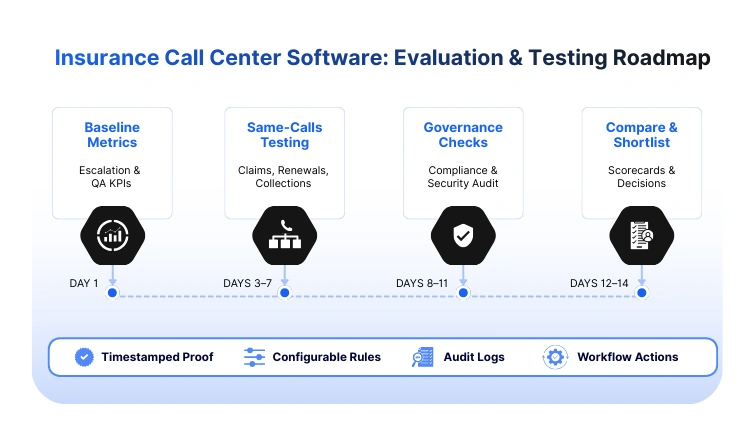
Insurance Call Center Software Evaluation (14-day plan)
An insurance call center software evaluation should be short, structured, and driven by proof. Fourteen days is enough if you test the right workflows and hold every vendor to the same evidence standards.
Step 1: Establish baseline KPIs (Days 1 to 2)
Start with metrics that represent both customer pain and operational risk. These give you a before-and-after benchmark and prevent subjective vendor scoring.
- Escalation rate
- Transfer rate
- Repeat-call rate
- AHT and ACW
- QA variance across reviewers and teams
- Compliance defect rate
Make sure the KPIs are split by queue where possible. Claims and collections behave very differently, and an average can hide failure.
Step 2: Run the same-calls test (Days 3 to 8)
This is the core of your evaluation and the fastest way to run an honest insurance contact center software comparison.
Build a call set of 30 to 50 real calls across:
- Insurance call center solution for claims
- Insurance call center software for renewals
- Insurance collections call center software
Balance your call set deliberately:
- Include both routine and edge cases
- Include at least a few escalations
- Include at least a few “repeat-call” chains if you have them
- Include calls where agents made mistakes, because that is where tools prove value
Every vendor must process the same call set and deliver outputs in a consistent format. This eliminates the demo theater and reveals real differences.
Step 3: Set evidence standards (Days 3 to 10, non-negotiable)
The biggest mistake in a vendor evaluation is accepting outputs that look impressive but cannot be defended. Your checklist should enforce proof.
Require:
- Timestamped proof for every risk flag, QA failure, or compliance exception
- Configurable rules and scorecards so you can match your policies and processes
- Audit logs that show who accessed, edited, or exported sensitive artifacts
- Workflow actions, not just insights, so teams can operationalize findings
If a vendor cannot show evidence and control, it does not belong in a regulated environment shortlist.
Step 4: Score and shortlist (Days 11 to 14)
At this stage, convert your checklist into a scorecard. Keep it simple and procurement-friendly:
- Score escalation control and performance readiness
- Score QA maturity and coaching workflows
- Score compliance monitoring and audit readiness
Decide your minimum thresholds. For example, any vendor that cannot provide evidence-backed compliance exceptions should not move forward, even if it has strong dashboards.
Once you run the same-calls test, Convin should be evaluated on whether it delivers buyer-grade proof that connects conversations to operational accountability.
1) Real-time risk flags and post-call insights with evidence
Convin should show how risk is detected in the moment and how insights are validated after the call. More importantly, every alert should be tied to evidence. You should be able to click into the moment that triggered the flag and understand why it matters.
2) Configurable scorecards, automated QA, and coaching actions
Your QA needs will vary by claims, renewals, and collections. Convin should prove that scorecards can be configured by queue and that QA can be automated without losing defensibility. Coaching should not be an afterthought. It should be a clear next step that turns detected issues into measurable behavior change.
3) Compliance exceptions and audit-ready reporting
In insurance, compliance is not just about catching misses. It is about building proof. Convin should demonstrate that exceptions are captured consistently, reported clearly, and backed by timestamps and logs so compliance and leadership teams can rely on it during audits, escalations, and internal reviews.
If Convin proves these three outcomes using your real calls, you get a shortlist decision you can defend. It becomes less about feature claims and more about what the system can consistently surface, govern, and operationalize across claims, renewals, and collections.
Use the 14-day plan to shortlist with proof, not demos.
Insurance Call Center Software Features Checklist for Escalation Reduction and Performance
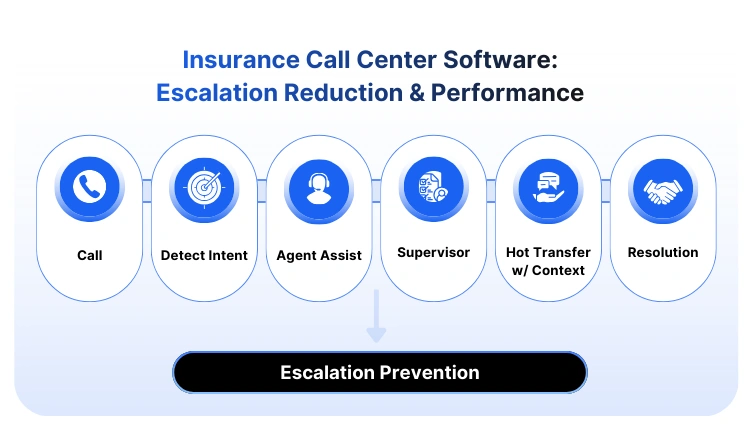
Escalation reduction is where insurance call center software wins or loses in a BOFU shortlist. If your stack cannot prevent avoidable transfers, reduce repeat calls, and keep supervisors from firefighting, it will not matter how good the dashboards look.
This checklist is designed for an insurance call center software evaluation and an apples-to-apples insurance contact center software comparison, especially across claims, renewals, and collections.
Escalation Reduction Checklist (agent + supervisor workflows)
Use this as the core checklist when scoring vendors and deciding what qualifies as the best insurance call center software for your environment.
1) Intent- and skill-based routing
- Confirm the system can route by intent and complexity across claims, renewals, and collections.
- Your evaluation should test routing accuracy using real cases from an insurance call center solution for claims, insurance call center software for renewals, and insurance collections call center software.
- Score whether routing reduces unnecessary transfers, not just whether it exists.
2) Context-rich handoffs that prevent no-repeat transfers
- The critical question is whether a transfer carries usable context for the next agent.
- Evaluate if handoffs retain intent, policy or claim identifiers, last action taken, customer sentiment, and next step commitment.
- In an insurance call center software evaluation, this is one of the fastest ways to predict escalation volume after go-live.
3) Real-time agent assist that prevents escalation moments
- Check for approved knowledge access and next-best-action prompts that keep agents consistent.
- Score whether the assist is aligned to policy language and the workflow stage, not generic guidance.
- This is also where insurance call monitoring and QA software overlap with escalation reduction, because escalation drivers often start as quality misses.
4) Supervisor assist for in-call containment
- Validate escalation triggers that supervisors can trust, like repeated holds, frustration signals, cancellation intent, and coverage disputes.
- Evaluate hot transfers with context and supervisor actions that are possible during the call.
- If supervisors can only review after the fact, escalations will still spike during peak volumes.
5) Root-cause analytics that explain escalation drivers
- Your checklist should demand “why” visibility, not only counts.
- Use insurance call analytics software criteria to score whether the vendor can show top escalation drivers, themes by queue, and ownership mapping across training, process, policy communication, and tooling.
- Add a compliance layer to this scoring by verifying how escalation drivers interact with disclosures and regulated statements through insurance compliance call monitoring.
Performance Checklist by Insurance Workflow
Your evaluation should separate performance requirements by workflow, since the same feature behaves differently in each queue.
Claims
- FNOL completeness checks, since missing details create rework and delayed resolution.
- Expectation-setting guardrails to ensure consistent next steps and timelines.
- Coverage clarity checks focused on deductibles, limits, and exclusions within your insurance call center solution for claims.
Renewals
- Churn-risk detection cues that surface early during renewal conversations.
- Compliant retention playbooks and offer explanations that match policy rules.
- Follow-up workflows that reduce repeat contacts within insurance call center software for renewals.
Collections
- Promise-to-pay capture that is consistent and easy to audit.
- Dispute and hardship detection with safe escalation rules and supervisor involvement.
- This becomes the baseline for evaluating insurance collections call center software.
Across all three, your vendor score should reflect how well the system supports consistent performance while reducing risk.
In short, Convin’s conversation intelligence platform can prove escalation control and performance improvement using conversation evidence.
1) Real-time escalation signals and configurable thresholds
- During your insurance call center software evaluation, require Convin to demonstrate how risk is flagged and how thresholds can be tuned by queue.
2) Actionable workflows that move from detection to action
- Evaluate workflows that route alerts into queues and follow-ups so teams can act consistently, not manually chase issues.
3) Trend insights for repeat calls and escalation clusters
- Use Convin’s analytics to validate escalation patterns by workflow, agent, region, and issue type.
- This is where insurance call analytics software scoring and insurance contact center software comparison scoring should meet, because trends are what procurement teams can defend beyond a demo.
If you run this checklist using the same-calls method, you can compare Convin and alternatives on the same reality and decide which platform is truly the best insurance call center software for claims, renewals, and collections.
Cut escalations by validating routing, handoffs, and supervisor workflows.
This blog is just the start.
Unlock the power of Convin’s AI with a live demo.

Insurance Call Center Software Checklist for QA, Compliance, and Analytics
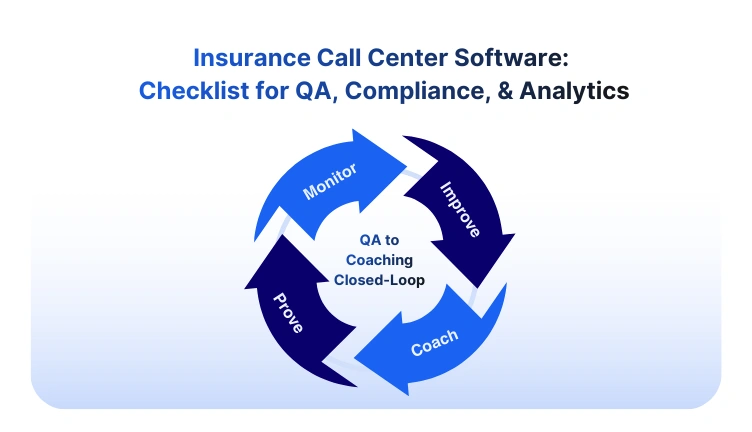
If escalation reduction is the front line, QA, compliance, and analytics are what determine whether your insurance call center software holds up under scale and scrutiny.
A shortlist should test whether the platform can audit, prove, and improve performance across claims, renewals, and collections.
This section is built to support a rigorous insurance call center software evaluation and a fair insurance contact center software comparison, especially when you are selecting the best insurance call center software for regulated insurance workflows.
Insurance Call Monitoring and QA Software Checklist
Your QA checklist should be designed for high-volume operations. The goal is not just to score calls. It is to reduce variance, enforce consistency, and prove improvements over time.
1) High-coverage monitoring and configurable QA scorecards
- Confirm the platform can support high-coverage monitoring across queues and teams.
- Scorecard requirements should differ by workflow, since QA needs vary across an insurance call center solution for claims, insurance call center software for renewals, and insurance collections call center software.
- Evaluate how easily QA categories and weightings can be adapted to your internal QA program.
2) Evidence-first scoring
- Every QA failure must be tied to timestamps and traceable evidence.
- In an evaluation, this is the difference between a “confidence score” and a defensible QA output.
- Evidence-first scoring also supports compliance reviews because QA and compliance failures often overlap in regulated scripts and disclosures.
3) Calibration controls and scorecard versioning
- Calibration is essential if multiple reviewers and leaders use the system.
- Your insurance call monitoring and QA software checklist should include scorecard versioning, change logs, and governance over who can edit criteria.
- This is a key comparison point in an insurance contact center software comparison, since many platforms score but do not control drift.
4) Closed-loop coaching
- Coaching must be operationalized, not presented as an insight.
- Look for clip-based coaching, assignments, completion tracking, and impact reporting that shows whether behavior changed.
- This becomes especially important in claims and collections, where small behavior shifts create measurable outcomes.
Insurance Compliance Call Monitoring Checklist
Compliance needs to be measurable, auditable, and evidence-backed. Your checklist should focus on whether the platform reduces exposure while keeping workflows practical for agents and supervisors.
1) Required disclosure detection and exception reporting with evidence
- The system should detect required statements and flag missed disclosures with proof.
- Exception reports should be filterable by queue, team, and agent, so leaders can act fast.
- This is the core of insurance compliance call monitoring and should be non-negotiable in your evaluation.
2) Audit logs, RBAC/SSO, retention controls, export governance
- Score whether the vendor can support enterprise access control through RBAC and SSO.
- Confirm retention controls and export governance, since call data, transcripts, and summaries are sensitive and often regulated.
- In a BOFU purchase decision, these controls separate “tooling” from platform readiness.
3) Payment protection capabilities
- If you handle payment conversations, you need controls that prevent sensitive data leakage.
- Your checklist should include redaction, DTMF masking, and tokenization options where relevant.
- This is a critical comparison point because it affects recordings, transcripts, and downstream exports.
4) Consent and outreach governance
- Consent ledger support, revocation handling, and DNC controls should be evaluated as part of compliance readiness.
- These matter most in renewals and collections workflows where outbound follow-ups are common.
- This is where insurance call center software for renewals and insurance collections call center software needs stronger governance than generic support queues.
5) Fraud and identity risk cues
- Evaluate whether the platform can surface risk cues for suspicious conversations and support step-up workflows.
- Fraud risk often impacts claims and collections first, and it adds handle-time friction that teams want to manage proactively.
Insurance Call Analytics Software Checklist (ROI and ops impact)
Analytics is only valuable in BOFU buying if it is actionable and provable. Your evaluation should focus on whether analytics explains what to fix, who owns it, and what changed after action.
1) Escalation and repeat-call driver analytics
- The platform should show why escalations happen, not just how many.
- Repeat-call drivers should be identifiable by theme and workflow across claims, renewals, and collections.
- This is core to insurance call analytics software scoring because it links conversations to operational cost.
2) Coaching impact analytics
- The system should show what improved outcomes after coaching.
- Buyers should be able to tie coaching interventions to QA score lifts, lower escalations, and fewer repeats.
- This is the strongest proof during an insurance call center software evaluation because it demonstrates measurable behavior change.
3) Executive dashboards with drill-down to proof calls
- Dashboards should support leadership reporting but must also drill down to evidence calls.
- This matters for audit readiness and for procurement validation in an insurance contact center software comparison.
4) Alerts when thresholds spike
- Evaluate alerting for compliance defects, escalation spikes, and churn intent signals.
- Alerts should be configurable by workflow, since claims volatility and renewal volatility behave differently.
Convin’s conversation intelligence platform closes the loop from insights to outcomes, not as a reporting add-on.
1) One system to connect insights to QA to coaching to outcomes
- Convin should demonstrate how conversation insights feed into scorecards, coaching actions, and measurable improvement.
2) Configurable dashboards and alerts for ops, QA, and compliance leaders
- Confirm that each stakeholder can view what matters to them without custom builds every time.
- This is a practical differentiator when selecting the best insurance call center software for scaled operations.
3) Evidence-backed reporting for procurement and audits
- In a buying cycle, Convin should prove that outputs are evidence-backed and defensible.
- This is what makes the purchase decision safer, especially when evaluating claims, renewals, and collections performance under compliance requirements.
If you use this checklist during your insurance call center software evaluation, you will be able to compare Convin and alternatives on the same reality and make a confident decision for your insurance workflows.
Build audit-ready QA and compliance evidence you can defend.
Insurance Call Center Software Comparison and Purchase Checklist
A purchase decision for insurance call center software should not be based on the best demo. It should be based on the most defensible proof.
This section helps you run a structured insurance call center software evaluation and a fair insurance contact center software comparison across the workflows that matter most: insurance call center solution for claims, insurance call center software for renewals, and insurance collections call center software.
It also ensures you evaluate the supporting layers that influence risk and outcomes, including insurance call monitoring and QA software, insurance compliance call monitoring, and insurance call analytics software. The goal is to shortlist the best insurance call center software for your environment, not for a generic use case.
Insurance Contact Center Software Comparison Scorecard
A scorecard keeps evaluation consistent across stakeholders and prevents subjective decision-making. Use a weighted model so vendors are compared on what actually drives business impact.
1) Suggested weights
- Escalation and performance: 35%
- QA and coaching: 35%
- Compliance and governance: 30%
This weighting works because escalation and QA directly affect cost and customer experience, while compliance and governance reduce operational and regulatory exposure.
2) Standardized vendor output requirements
To keep your insurance contact center software comparison fair, every vendor must run the same call set and deliver results in the same format. Require:
- Same-calls test across claims, renewals, and collections
- Evidence format that ties every flag to timestamps and transcripts
- Latency requirements for real-time alerts and supervisor actions
- Calibration requirements for QA scoring consistency across reviewers
This approach ensures vendors are scored on reality, not presentation. It also makes your evaluation repeatable when leaders ask why a vendor ranked higher.
Best Insurance Call Center Software Shortlisting Criteria
Once you have a scorecard, apply a shortlisting filter. These criteria determine whether a vendor belongs in the final round for the best insurance call center software decision.
1) Proven outcomes on your calls
- Require measurable proof on your call set.
- Validate outputs across the three workflows: insurance call center solution for claims, insurance call center software for renewals, and insurance collections call center software.
- Avoid relying on generic benchmarks or case studies as substitutes for your own evidence.
2) Configurability without vendor dependency
- Score whether your teams can configure scorecards, thresholds, workflows, and alerts without waiting on the vendor.
- This matters because insurance workflows change frequently, and your system must keep up without professional services every time.
- This also links directly to your insurance call monitoring and QA software expectations and your compliance workflows.
3) Integration depth
A vendor should prove integration readiness across the systems that shape insurance outcomes:
- CCaaS and telephony
- CRM
- Claims core and policy administration systems
- Payments systems where relevant
Integration depth affects more than deployment. It affects whether insights can be acted on and whether documentation and follow-ups are accurate.
4) Governance readiness
For BOFU insurance buyers, governance is a deal-breaker, not an add-on:
- Audit trails
- Retention controls
- Access controls and role-based permissions
- Redaction support for sensitive content
These capabilities are foundational to insurance compliance call monitoring and determine whether your platform can be trusted in audits and escalations.
Procurement-ready RFP Questions Plus Pilot Plan
Procurement needs a clear way to validate claims and reduce purchase risk. Use a combined RFP and pilot structure so selection is proof-driven.
1) Copy and paste RFP questions by pillar
Escalation and performance
- How do you detect escalation risk, and how is evidence shown?
- What actions can supervisors take during the call?
- How do you support context-rich transfers and reduce repeat calls?
QA and coaching
- What coverage can you support, and what is your evidence format?
- How do you handle calibration and score drift?
- How do coaching assignments, completion, and impact reporting work?
Compliance and governance
- How do you detect missing disclosures and generate exception reports with evidence?
- What audit logs and retention controls are available?
- How do access controls and export governance work?
These questions help ensure your insurance call analytics software, QA, and compliance requirements are evaluated together, not in isolation.
2) Two-week pilot plan
Use a two-week pilot to validate outputs in realistic conditions:
- Week 1: shadow mode, configure scorecards, run initial monitoring and reporting
- Week 2: enable coaching actions, alerts, and operational workflows, then track results
- End of pilot: ROI readout using your baseline KPIs, plus an evidence pack for leadership
3) Go/no-go checklist
Before you sign, confirm:
- Measurable lift on escalation, repeat calls, QA outcomes, or compliance defect reduction
- Audit readiness, including evidence-backed exceptions and governance controls
- Admin usability, so your team can operate and adapt the platform without heavy vendor involvement
If a platform clears this purchase checklist, it is not just a tool. It is an insurance conversation intelligence platform you can use in procurement reviews, operational audits, and long-term scale decisions.
Compare vendors with a weighted scorecard and a 2-week pilot plan.
Make the Shortlist Defensible with a Proof-Based Convin Pilot
Selecting insurance call center software is a risk decision as much as a performance decision. What you buy shapes what agents say, what gets documented, what escalates, and what you can prove during audits or disputes.
The safest way to choose is not by demos or feature claims, but by evidence from your real calls across claims, renewals, and collections.
Use this checklist to run a same-calls test and score vendors on escalation and performance, QA and coaching, and compliance and governance.
Require timestamped proof, calibration, audit logs, and workflows your team can actually operate. That is how procurement gets a decision it can defend.
Book a Convin demo to see how escalation signals, automated QA, compliance exceptions, and audit-ready evidence show up on real insurance calls.
FAQ
- What’s a defensible sample size for an insurance call center software evaluation?
30–50 of the same calls across claims, renewals, and collections. For the final insurance contact center software comparison, use 100+ if possible.
- How do I validate automated QA accuracy and calibration across vendors?
Use a QA-lead ground truth set, compare vendor agreements, and require calibration and scorecard versioning in your insurance call monitoring and QA software.
- What should insurance compliance call monitoring produce for audits?
Timestamped disclosure evidence, exception reports, and audit logs + RBAC/SSO + retention/export controls from insurance compliance call monitoring.
- Which features matter most for claims vs renewals vs collections?
- Claims: FNOL completeness, coverage clarity
- Renewals: churn-risk cues, compliant retention playbooks
- Collections: promise-to-pay, dispute and hardship detection
- How do I quantify ROI from insurance call analytics software and coaching?
Track before-and-after deltas in repeat calls, escalations, and QA defects, then convert using cost per contact + supervisor time saved from insurance call analytics software.

%20BLOG10%20examples%20of%20artificial%20intelligence%20in%202024.webp)



.avif)