


Insurance companies face a critical challenge: measuring customer experience in insurance without clear metrics leads to poor decisions and missed revenue. Most insurers rely on outdated feedback methods that capture only fragments of their actual customer experience insurance journey.
This guide reveals which customer experience insurance metrics truly matter, how to interpret them, and how advanced CX analytics platform solutions transform raw customer experience data into actionable strategy. Understanding insurance customer metrics isn't optional anymore; it's your competitive advantage.
Convin detects compliance gaps before auditors do.
Why Does Customer Experience Insurance Measurement Matter?
Customer experience insurance has become critical for retention and revenue growth. Most insurers measure customer experience poorly, missing hidden patterns in their operations. This costs them lost renewals, compliance risks, and preventable escalations.
The Cost of Ignoring Customer Experience Insurance Metrics
Insurers miss 40% of lead follow-ups due to poor customer experience in insurance tracking systems.
Claims that should resolve quickly languish without proper customer experience insurance visibility across departments.
Agents improvise instead of following best practices, creating inconsistent customer experience insurance experiences.
Key Points:
- Missing customer experience insurance insights costs FYP and acquisition spend.
- Delayed renewals drain persistence metrics faster than competitors improve them.
- Poor customer experience, insurance visibility enables compliance gaps.
- Customer experience insurance blind spots increase social media escalations by 50%.
- Fragmented systems break the entire customer experience insurance journey.
Without robust insurance customer metrics measurement, insurers operate reactively. They discover problems after customers complain publicly or switch providers. Real-time customer experience data visibility prevents these costly surprises.
How Customer Experience Insurance Affects Your Bottom Line
Customer experience insurance:
- Improvements directly increase renewal collection by 35% annually.
- Optimization reduces complaints by 40% within six months.
These metrics showcase real financial returns beyond satisfaction surveys.

Customer experience insurance also:
- Enhances and boosts persistence metrics significantly.
- Give quality that feeds revenue growth pipelines directly.
- The tracking of customer experience insurance eliminates guesswork from strategy.
- Better customer experience insurance data improves AHT and conversions by 10X.
- Customer experience insurance insights drive coaching that sticks permanently.
Organizations measuring customer experience systematically outpace competitors who don't track these metrics. Insurance customer metrics directly correlate with higher policy persistence, lower acquisition costs, and stronger customer lifetime value.
The bottom line: customer experience insurance measurement isn't optional; it's essential for survival.
Now that you understand why customer experience insurance measurement matters, let's explore which specific metrics actually drive results and how to interpret them correctly.
Agent coaching powered by real customer experience insurance data.
What CX Metrics Should You Actually Track?
Customer experience insurance success starts with measuring what truly matters in interactions. NPS in insurance reveals loyalty drivers behind policy retention decisions. CSAT insurance shows immediate satisfaction levels after specific customer interactions.
Understanding NPS in Insurance
NPS in insurance ranges from 0-100, measuring customer loyalty and referral intent accurately.
NPS in insurance scores of 70+ indicate strong retention likelihood and expansion potential. Tracking NPS in insurance quarterly reveals trend momentum and strategic progress.
NPS in insurance:
- Segments customers into promoters, passives, and detractors.
- Below 50 signals urgent intervention opportunities.
- Combined with insurance customer metrics, validates the strategy.
- Improvements directly correlate with policy renewals.
- Benchmarks against competitors and shows competitive positioning.
NPS in insurance specifically measures how likely customers are to recommend your company. Detractors often become switch risks within renewal windows. Promoters drive organic growth through referrals and positive word-of-mouth marketing.
Measuring CSAT Insurance Effectively
CSAT insurance tracks satisfaction on a 1-5 scale after key moments consistently. If the CSAT insurance score is below 80%, it indicates service gaps that require urgent attention.
CSAT insurance measurement across touchpoints reveals where experience falters most critically.
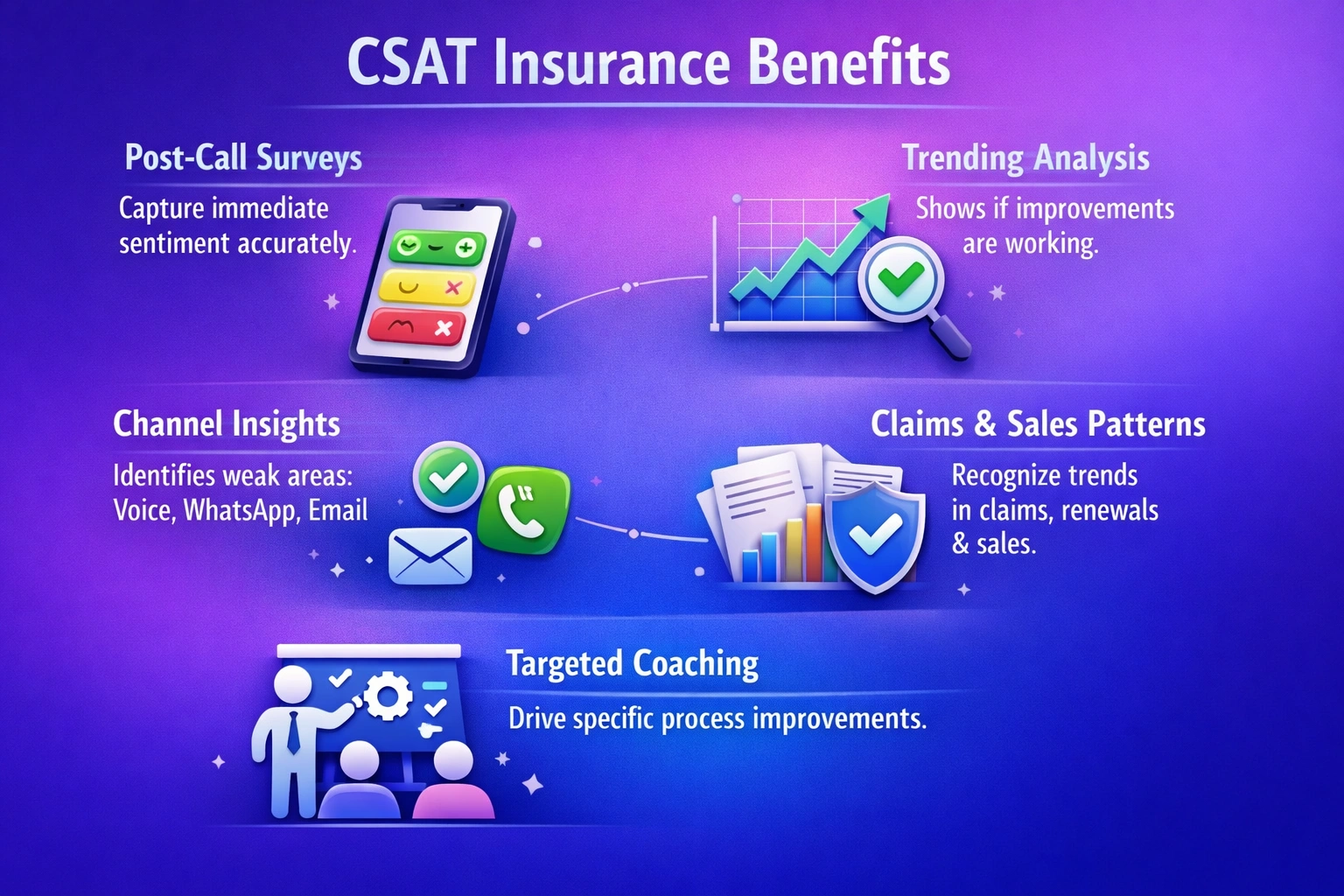
CSAT insurance entails:
- Post-call surveys that capture immediate sentiment accurately.
- Trending, which shows whether improvements are working.
- Identifies weak areas through different channels (voice, WhatsApp, email).
- Recognize patterns through aggregated claims, renewals, and sales.
- Improvements that require targeted coaching and process changes.
CSAT insurance differs from NPS in insurance by measuring moment-specific satisfaction. A customer may be satisfied with claims processing but frustrated with renewal options. Tracking CSAT insurance across channels reveals which touchpoints need redesign most urgently.
Why Customer Effort Score Insurance Matters Most
Customer effort score insurance measures how easily customers resolve issues independently. If the customer effort score insurance is below 4 out of 5, it is a signal of friction in core workflows. Customer effort score insurance directly predicts policy retention better than satisfaction alone.
Customer effort score in insurance benefits:
- Identifies unnecessary process complexity.
- Improvements reduce call volumes naturally.
- Tracks and prevents design mistakes before rollout.
- Address low scores triggers and immediately process audits.
Research shows that customer effort score insurance is actually a stronger retention predictor than satisfaction scores alone.
When customers work harder to resolve issues, they become churn risks regardless of satisfaction ratings. Insurance companies optimizing customer effort score systematically outperform competitors on persistence metrics and NPS in insurance.
Understanding individual metrics is important, but advanced insurance customer metrics require integration into comprehensive measurement systems.
Discover how CX analytics platforms connect these metrics into actionable intelligence.
Insurance customer metrics on autopilot with Convin!
This blog is just the start.
Unlock the power of Convin’s AI with a live demo.

Which Insurance Performance Metrics Drive Continuous Improvement?
Insurance performance metrics extend beyond customer surveys into operational data analysis. CX analytics platform solutions integrate insurance performance metrics automatically and continuously. Insurance performance metrics combined reveal cause-and-effect patterns previously hidden from view.
Leveraging CX Analytics Platform for Data-Driven Decisions
CX analytics platform technology reviews 100% of customer interactions automatically without sampling.
CX analytics platform dashboards display insurance customer metrics in one unified view. The platform AI identifies coaching patterns humans would miss entirely through analysis.
CX analytic platform:
- Reduces audit time from hours to minutes.
- Algorithms detect sentiment shifts in real-time automatically.
- Scoring automates quality assurance consistently.
- Insights connect directly to CRM for immediate action.
- Training automation creates personalized coaching plans.
Advanced CX analytics platform solutions transform how insurers use customer experience data. Rather than waiting weeks for manual audits, customer experience data flows automatically into coaching systems.
Popular CX Measurement Tools:
- Convin – AI-powered conversation analytics with 100% audit coverage, real-time agent assist, post-call analytics, sentiment analysis, and omnichannel integration. Delivers 27% CSAT increase, 21% sales boost, and automated quality management for insurance customer experience measurement.
- Qualtrics CustomerXM – Enterprise-level VoC platform with NPS, CSAT, CES surveys, and advanced analytics.
- Medallia Experience Cloud – Omnichannel feedback collection with text and speech analytics.
- SurveyMonkey – General survey platform for VoC and CSAT/NPS collection.
- SurveySparrow – Conversational survey interface with real-time feedback collection.
- Zendesk – Service-centric platform with Einstein AI for predictive analytics.
- HubSpot Service Hub – Integrated CRM with satisfaction surveys and customer health monitoring.
- Freshdesk – Multi-channel support with Freddy AI sentiment analysis.
- Revuze – AI-powered VoC platform with NLP for actionable insights.
- Intercom – Conversational experience platform with in-app surveys.
- SentiSum – AI-native VoC platform with real-time speech and text analytics.
Insurance customer metrics improve measurably within 30 days of implementation.
Connecting Customer Experience Data to Agent Performance
Customer experience data collected via the CX analytics platform drives coaching effectiveness significantly.
The data reveals which agents excel at specific insurance customer metrics. And the scoring identifies training gaps before they cost retention.
Key Points regarding Customer Experience Data:
- At the agent level enables personalized skill development.
- The trending shows which coaching methods actually work.
- Data comparison highlights best practices worth scaling.
- Data integration with LMS automates training delivery.
- Customer experience data transparency builds accountability across teams.
When agents understand exactly how customer experience data drives their performance ratings, engagement improves dramatically.
Top performers using customer experience data insights become mentors who elevate entire team performance. Insurance customer metrics improvements become self-sustaining as best practices propagate.
Technology infrastructure matters tremendously, but implementation with proven platforms accelerates results dramatically.
Let’s learn how Convin transforms insurance customer experience measurement through AI-powered solutions.
100% audit coverage beats 2% manual sampling. Convin proves it daily.
How Convin's CX Analytics Platform Transforms Insurance Customer Experience
Convin's CX analytics platform conducts 100% AI-powered audit coverage instantly and continuously.
Convin's approach to insurance customer experience measurement reveals hidden patterns competitors miss completely. Convin delivers customer experience insurance intelligence that directly drives revenue growth.
Real-Time Agent Assist Improves Insurance Performance Metrics
Convin's Agent Assist listens during calls and prompts optimal responses instantly. Insurance performance metrics improve because agents handle objections with script confidence.
Real-time intervention prevents compliance slips before they become audit liabilities.
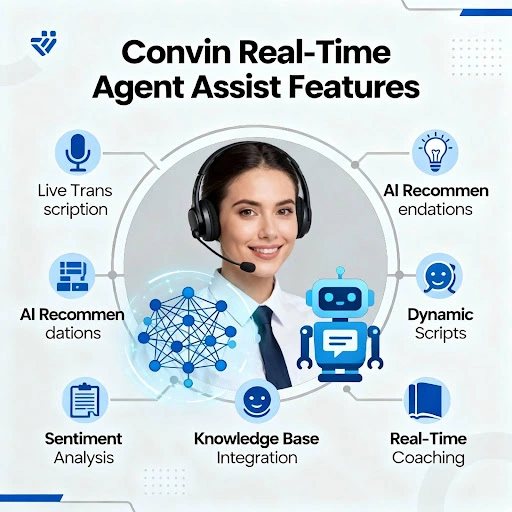
Key Points:
- Convin's Assist improves AHT while simultaneously boosting insurance customer metrics.
- Agent compliance consistency rises across every single call automatically.
- Missed upsells disappear when prompts appear at exactly the right moment.
- CSAT insurance scores jump when agents follow optimized conversation flows.
- NPS in insurance improves because customers experience smoother, faster service.
Convin's real-time technology means customer experience data flows directly into agent actions.
When agents follow prompts grounded in customer experience insurance best practices, CSAT insurance improves immediately.
Customer effort score insurance drops as standardized processes replace improvisation.
Post-Call Analytics Powers Continuous Insurance Customer Metrics Improvement
Convin's Post-Call Analytics audits every conversation for insurance customer metrics gaps systematically.
Customer experience data gets extracted, scored, and actioned automatically within hours. Insurance customer metrics coaching becomes personalized, not a generic one-size-fits-all training.
Key Points:
- Convin identifies which NPS in insurance detractors require intervention immediately.
- CSAT insurance trends appear on dashboards before manual review can capture them.
- Customer effort score insurance issues surface automatically for process redesign.
- Missed compliance disclosures trigger alerts before regulatory exposure multiplies.
- Training recommendations generate personalized LMS modules based on call performance.
Convin's approach to customer experience data means nothing slips through cracks. Every insurance customer metrics gap identified automatically becomes a coaching opportunity.
This closed-loop system transforms customer experience insurance from measurement to consistent improvement.
Convin's Integrated Approach to Insurance Customer Experience Measurement
Convin's closed-loop system connects customer experience data into one unified platform automatically. Insurance customer metrics flow from calls into coaching into improved customer experience insurance outcomes. CX analytics platform integration with CRM ensures zero gaps or missed opportunities.
Key Points:
- Convin's ecosystem captures every customer interaction point systematically.
- Insurance customer metrics cycle automatically from measurement to action to results.
- Customer experience data informs coaching, which improves metrics, which drives retention.
- Convin's approach eliminates scattered insights that plague traditional insurance measurement.
- Real-time dashboards show how insurance performance metrics changes impact business outcomes.
Convin's platform distinguishes itself by connecting measurement directly to outcomes. Insurance companies using Convin's CX analytics platform see NPS in insurance rise 20+ points within 90 days. Customer effort score insurance drops measurably as processes standardize around best practices.
Measure what matters in customer experience insurance with Convin!
Building Your Insurance Customer Experience Measurement Strategy
Measuring customer experience in insurance successfully requires both data infrastructure and action frameworks. NPS in insurance, CSAT insurance, and customer effort score insurance form your foundational metrics. CX analytics platform technology like Convin transforms raw customer experience data into a strategic advantage.
Key Takeaways:
- Start with customer experience insurance baseline metrics across all touchpoints.
- Implement CX analytics platform automation to review customer experience data at scale.
- Connect insurance customer metrics to coaching and process improvements monthly.
- Track NPS in insurance, CSAT insurance, and customer effort score insurance trends consistently.
- Use Convin's customer experience insurance intelligence to stay ahead of churn.
The insurers winning in 2025 measure what matters in customer experience insurance and act on insights immediately. Manual, fragmented approaches to customer experience data create competitive disadvantages. Advanced CX analytics platform solutions like Convin compress the measurement-to-improvement cycle from weeks to days.
Book your Convin demo!
FAQs
1. How does insurance customer experience affect policy renewal rates?
Strong customer experience insurance directly impacts renewal persistence rates. When policyholders experience smooth claims processing, responsive support, and personalized service, renewal likelihood increases by 35%. Poor customer experience insurance creates churn, forcing insurers to spend more on acquiring replacements than on retaining existing customers profitably.
2. What is the difference between the voice of the customer and customer experience insurance metrics?
Voice of the customer captures qualitative feedback through surveys and interviews about the insurance customer experience. Customer experience insurance metrics measure quantitative data like NPS, CSAT, and customer effort scores. Together, they provide a complete understanding of satisfaction drivers and operational performance across touchpoints systematically.
3. Which industries benchmark their customer experience against insurance standards?
Financial services, including banking and investment firms, benchmark customer experience insurance metrics against insurance industry standards. Healthcare organizations also compare customer experience insurance performance to insurance sector benchmarks for competitive positioning. Telecom and retail companies increasingly adopt insurance customer experience measurement frameworks for consistency.
4. How do insurance companies use predictive analytics to improve customer experience in insurance?
Insurance companies use predictive analytics to identify churn risks before policy lapses occur. Predictive models analyze customer experience insurance data patterns to forecast which policyholders need intervention. Proactive outreach based on customer experience insurance predictions reduces churn by 25%, improving retention and lifetime value significantly.
5. What role does omnichannel communication play in insurance customer experience measurement?
Omnichannel communication ensures consistent customer experience insurance across voice, email, chat, and WhatsApp touchpoints. Measuring customer experience insurance across channels reveals which platforms deliver superior service quality and efficiency. Integrated omnichannel strategies improve customer effort score insurance by reducing friction across all communication methods available.
.avif)


.avif)