

Procurement and IT leaders know the pattern: every vendor claims they’re “AI-powered,” yet half of them are still built on dialer logic wrapped in clever marketing. Insurance operations are too complex and too regulated to accept AI on faith. The only reliable filter is forcing vendors to prove orchestration, not pitch it.
This guide equips you with 12 RFP questions that separate dialers from a true insurance voicebot, with the goal of helping you validate depth, transparency, and long-term operational viability.
An insurance voicebot is an AI-driven conversational system designed to handle policyholder inquiries, claims steps, and routine insurance workflows through natural, human-like voice interactions, reducing manual effort and improving customer experience.
Pressure-test your voicebot with complex intents.
Why Insurance Voicebot RFPs Need Power Moves
Insurance teams no longer evaluate automation tools on surface-level features. They’re assessing whether a platform can orchestrate multi-intent, multi-system workflows across underwriting, FNOL, claims, and renewals. That distinction is nearly impossible for dialers to meet, which is why RFPs must force proof, not promises.
For Procurement and IT, the stakes are high: accuracy, compliance, and efficiency are tied directly to architecture quality and conversational intelligence.
AI Voicebot For Insurance Customer Service
Insurance service calls often involve policy verification, eligibility questions, documentation requirements, and next-step guidance, all happening in real time. Dialers struggle because they rely on static scripts that break the moment the customer goes off-path. A true AI voicebot handles the unpredictability baked into service requests.
By assessing how well the vendor’s bot navigates multi-intent journeys, you quickly see whether you’re dealing with AI or a dialer with a facelift.
A vendor that demonstrates robust handling of branching customer needs signals readiness for real operational load. One that can’t is already disqualified, no matter how polished the pitch.
Insurance Telephony Workflow Automation
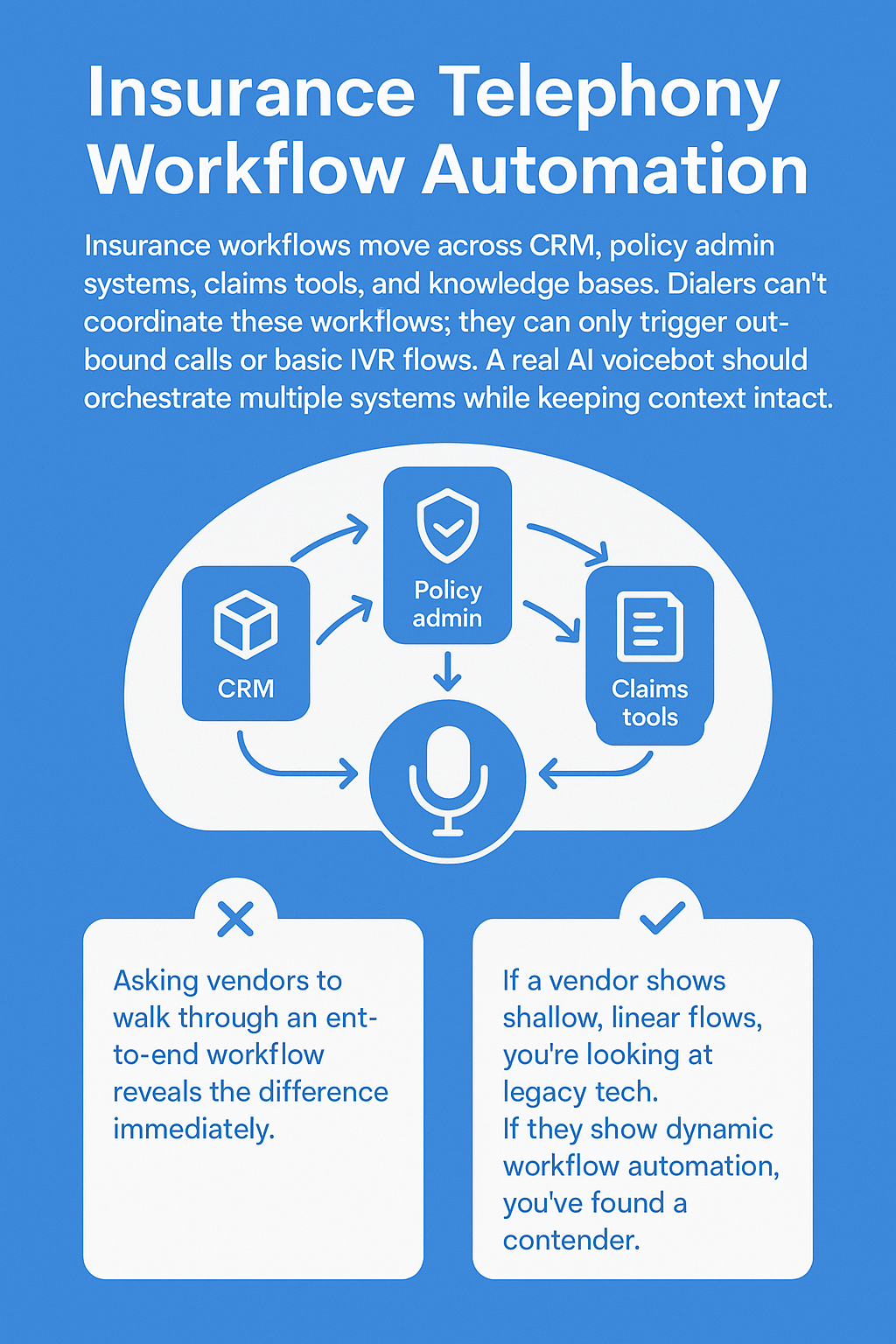
Insurance workflows move across CRM, policy admin systems, claims tools, and knowledge bases. Dialers can’t coordinate these workflows; they can only trigger outbound calls or basic IVR flows. A real AI voicebot should orchestrate multiple systems while keeping context intact.
Asking vendors to walk through an end-to-end workflow reveals the difference immediately.
If a vendor shows shallow, linear flows, you’re looking at legacy tech. If they show dynamic workflow automation, you’ve found a contender.
Now that we understand why strong RFPs matter, let’s break down the 12 questions that reveal whether a platform is a genuine insurance voicebot or just a dialer wearing an AI badge.
Get the 12 RFP questions that expose weak automation!
The 12 RFP Questions That Reveal A Real Insurance Voicebot
Most vendors excel at demos because demos are controlled. RFP evaluations must therefore force vendors into uncontrolled territory, architecture proof, inference tests, and system-orchestration evidence.
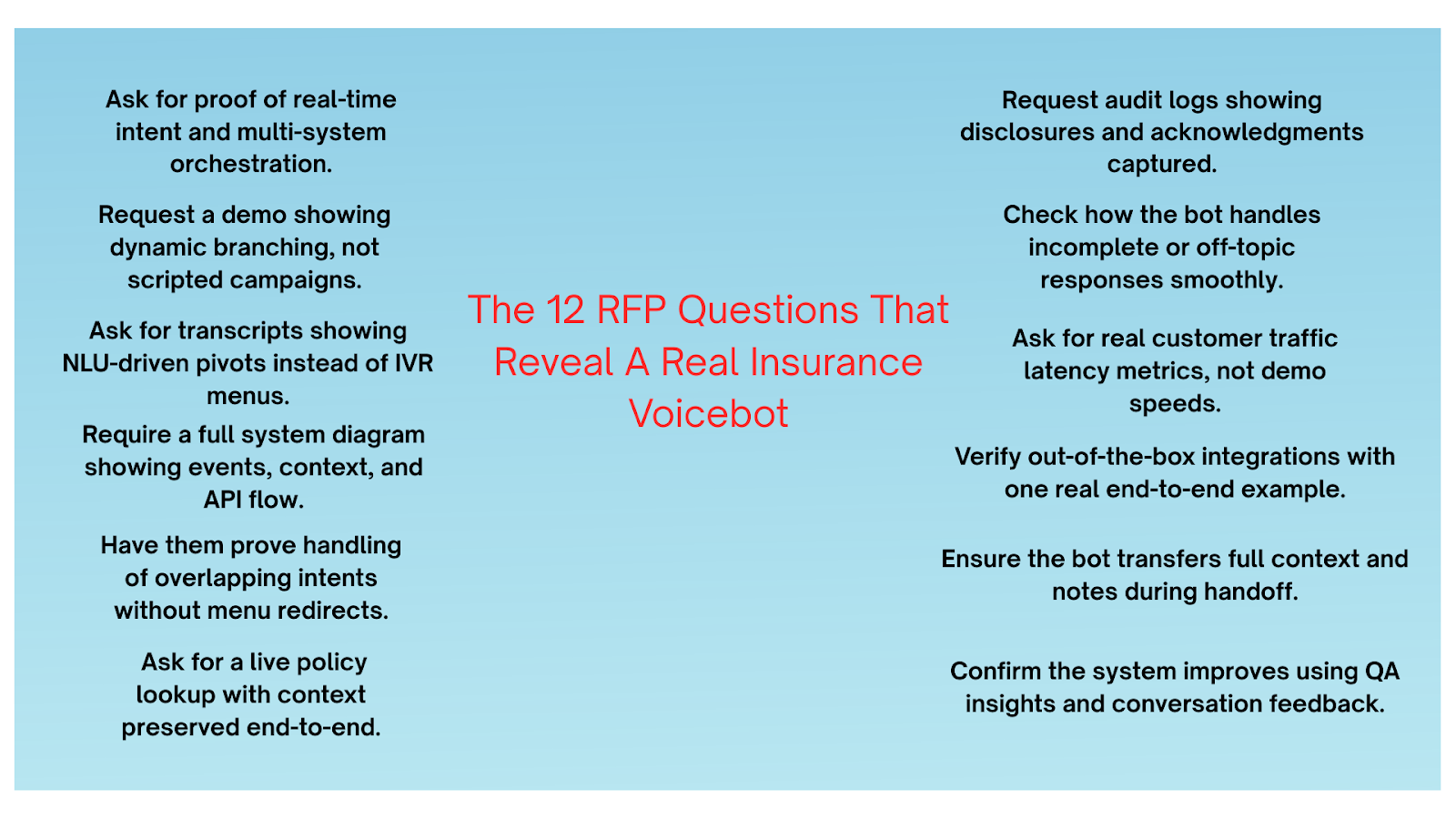
These 12 questions evaluate capability across three areas: architecture, conversation intelligence, and insurance operational fit.
- Insurance Inbound Call Automation
Inbound insurance calls often require quick identity checks, policy lookups, intent recognition, and accurate routing.
Ask vendors: “Show how your system detects intent and orchestrates at least three downstream systems in real time.”
Dialers will show you IVR menus. True voicebots will show event-driven orchestration.
When a vendor can prove real inbound automation, you gain confidence that the platform can scale beyond one or two narrow scripts.
- Insurance Outbound Automation
Outbound insurance workflows, renewal reminders, follow-ups, and payment nudges require dynamic branching based on customer responses.
Your RFP should ask: “Demonstrate how outbound flows adapt mid-call based on customer statements.”
Most dialers collapse here because they depend on predefined scripts.
A vendor that proves dynamic branching demonstrates real understanding, not superficial compliance with your use case.
- AI Dialer Vs Voicebot
This question is the ultimate separator: “Provide real transcripts showing NLU-driven pivots—not IVR menus or keyword trees.”
Dialers can’t produce this because they don’t interpret meaning; they follow rules.
Transcripts showing contextual interpretation are your best evidence that AI is genuinely doing the work.
- Architecture Transparency & Data Flow Validation
Insurance workflows break when vendors hide architectural limits.
Ask: “Provide a system diagram showing how your voicebot handles events, context handoff, and API calls during a live conversation.”
Vendors that can’t show this are signaling a dialer-style backend, where orchestration is bolted on, not native.
- Multi-Intent Handling Under Pressure
Most dialers collapse when policyholders ask two or more unrelated questions.
Ask: “Demonstrate how your system handles three overlapping intents in a single turn, without menu redirects.”
If the vendor switches to an IVR or transfers to an agent, the architecture isn’t truly conversational.
- Real-Time Policy Lookup & Verification
Insurance requires live access to policy data to avoid compliance misses.
Ask: “Show how your voicebot queries policy systems in real time and keeps context across the lookup and response.”
A vendor that only simulates data access is masking workflow limitations.
- Evidence Of Compliance Handling
Insurance compliance demands precise disclosures and auditability.
Ask: “Provide compliance audit logs from real calls, showing how your system tracks mandatory disclosures and customer acknowledgments.”
Dialers rarely have this granularity, exposing gaps in regulated environments.
- Error Recovery & Unexpected Response Handling
Real customers don’t speak in clean, structured phrases.
Ask: “Demonstrate how your voicebot recovers when customers give incomplete, contradictory, or off-topic responses.”
A true bot adapts gracefully; a dialer restarts the script or transfers immediately.
- Latency & Response Benchmarking
High latency kills insurance CX and breaks trust.
Ask: “Share live-call latency benchmarks across recognition, NLU, and orchestration, measured on real customer traffic not demos.”
A vendor unwilling to share latency numbers is likely dependent on slow, brittle workflows.
- Integration Maturity With Insurance Systems
Insurance ecosystems are notoriously fragmented.
Ask: “List out-of-the-box integrations with CRM, policy admin, claims, billing, and content systems, plus show one real example end-to-end.”
Dialers may claim “API-ready,” but only mature vendors can demonstrate working integrations.
- Real-Time Escalation & Handoff Quality
Bad handoff experiences, wrong context, missing notes, and drive up cost-to-serve.
Ask: “Show a live example of bot-to-agent handoff with preserved context, summarized notes, and next best action suggestions.”
A vendor that can’t preserve context is not built for insurance-grade journeys.
- Continuous Learning & QA Evidence
Bots improve only when they learn from real conversations.
Ask: “Explain how your system identifies misclassifications, corrections, and coaching opportunities using full-call QA.”
Dialers that lack feedback loops plateau quickly, leaving teams to manually patch gaps.
Once you’ve asked these tough questions, the next step is understanding what good actually looks like, so you know whether the vendor’s answers meet the mark.
Compare dialer vs insurance voicebot performance.
This blog is just the start.
Unlock the power of Convin’s AI with a live demo.

What “Good” Looks Like In An Insurance Voicebot
Insurance AI success isn’t about showy demos; it’s about predictable outcomes. Procurement and IT teams should expect clarity around workflow orchestration, accuracy, compliance readiness, and operational lift.
“Good” bots prove their intelligence consistently, not occasionally.
Underwriting Voicebot Tools
Underwriting relies heavily on structured data gathering, risk clarification, and eligibility checks. A capable voicebot should guide applicants through this process, validate information, and hand off to an underwriter only when necessary. If vendors can’t demonstrate underwriting-ready flows, they’re not enterprise-grade.
Voicebots that accelerate underwriting provide clear downstream impact, reduced manual effort, faster decisions, and fewer NIGO (Not-In-Good-Order) submissions.
.webp)
Insurance Telephony Workflow Automation
Complex workflows such as FNOL require consistent context handoff across multiple systems. A strong voicebot demonstrates that it can coordinate lookups, validations, notes, and actions without dropping context. Vendors should explain this with system diagrams and audit logs.
Bots that show seamless workflow automation indicate long-term scalability; bots that don’t will force teams into expensive workarounds.
Now that we’ve defined what good looks like, let’s quietly map these evaluation patterns to where Convin naturally aligns, without turning this into a pitch.
Download the insurance voicebot RFP checklist.
Mapping The 12 Questions To Convin’s Insurance Voicebot-Like Capabilities
Convin isn’t a voicebot; it’s the intelligence layer that proves whether automation is actually working. This is exactly what Procurement and IT teams want: evidence. Automated QA, conversation intelligence, and real-time guidance together paint a transparent picture of conversational quality and orchestration depth.
These capabilities help teams validate the same criteria they demand from a true insurance voicebot.
AI Voicebot For Insurance Customer Service
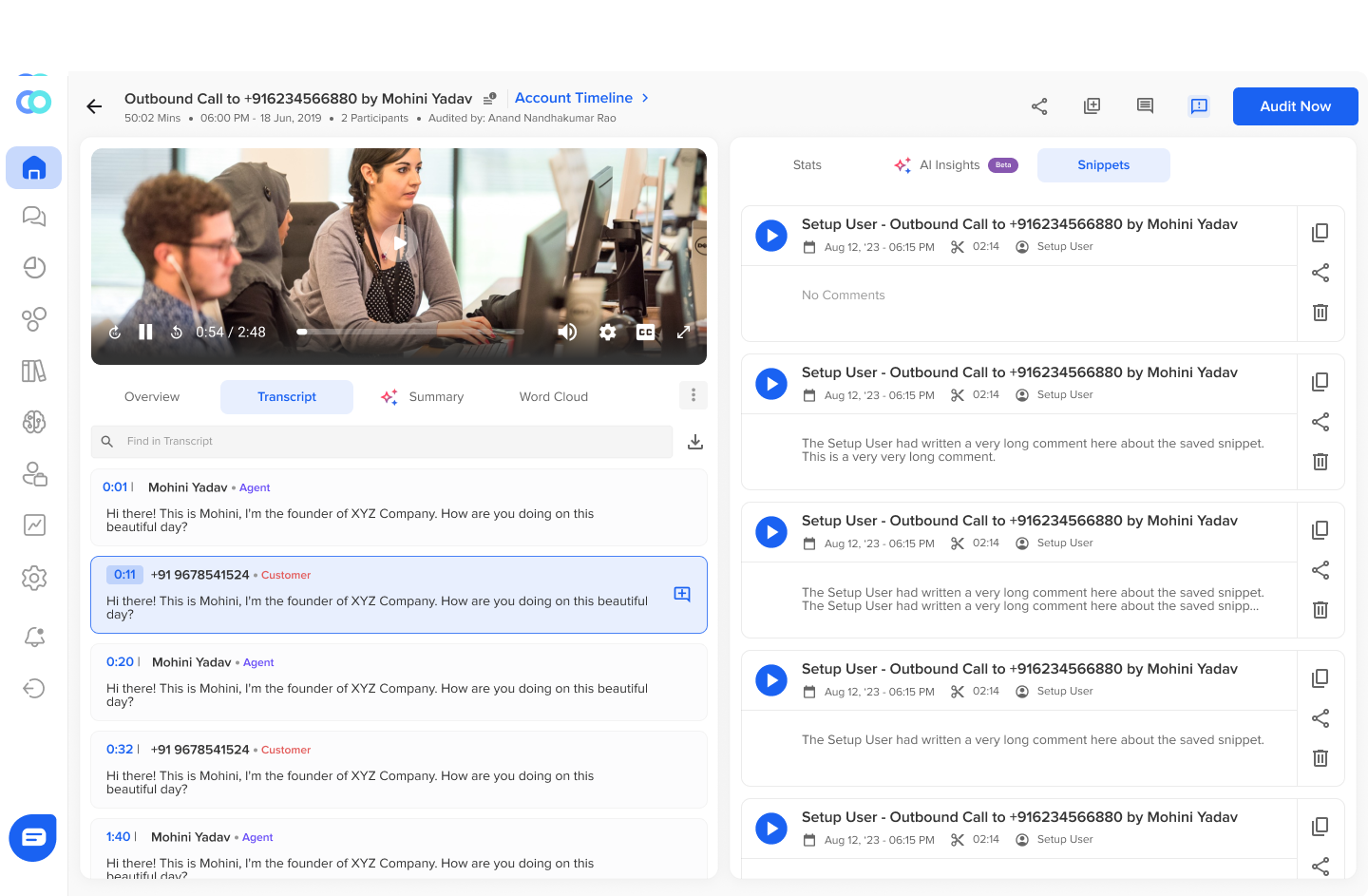
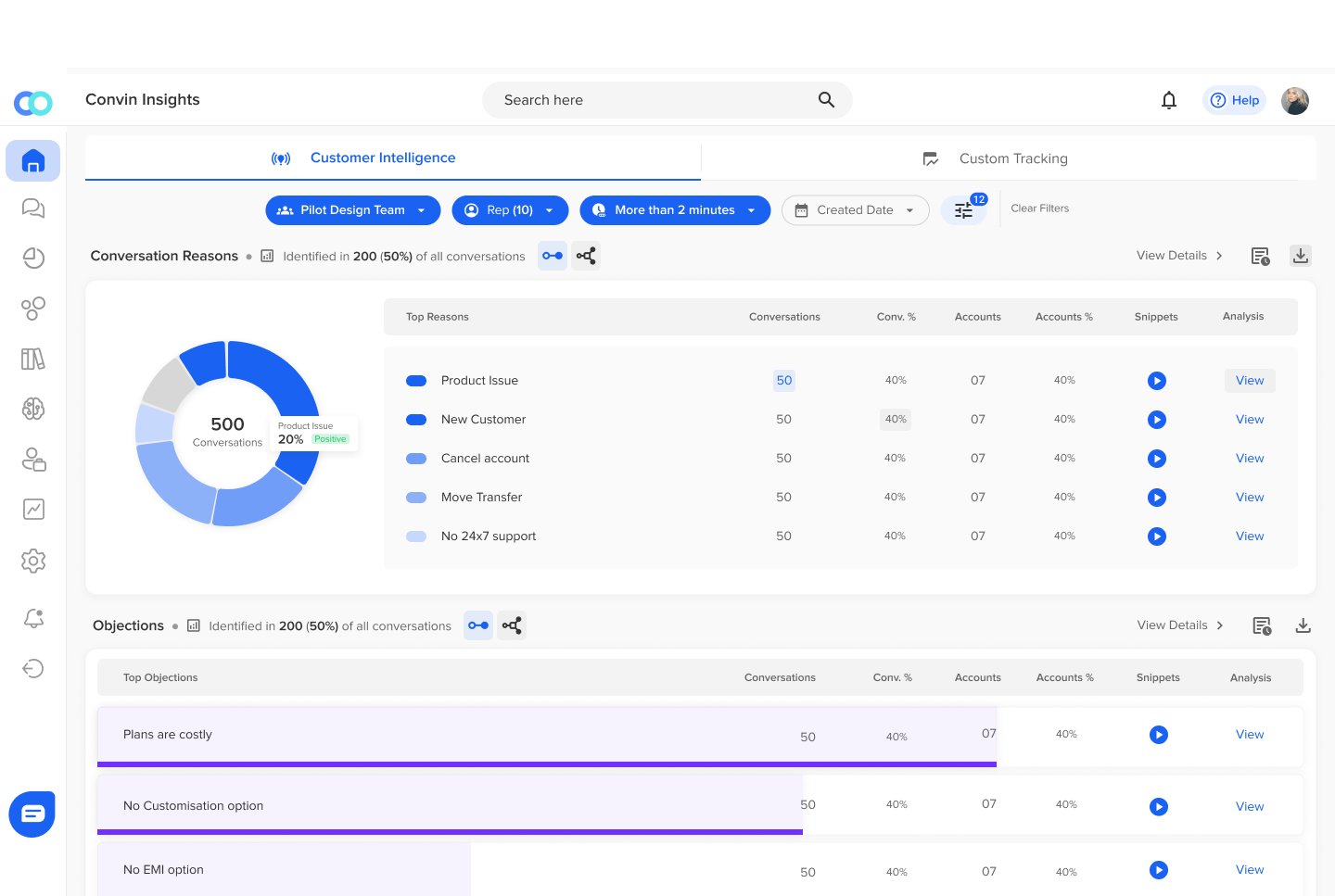
Convin’s automated QA and conversation intelligence layer analyzes 100% of calls, providing evidence of how well conversations are understood. This mirrors the “understanding” requirement in your RFP questions.
By surfacing intent, compliance, and behavioral signals, Convin helps teams spot where bots and humans need orchestration support.
Vendors that can connect intelligence to service outcomes give you the transparency you need to make contract decisions with confidence.
Insurance Inbound Call Automation
Inbound calls surface compliance risk, documentation needs, and workflow gaps. Convin’s conversation intelligence layer highlights where logic breaks, where customers get stuck, and where agent assist can correct course. It acts as a verification mechanism for any automation stack.
With this visibility, teams can benchmark their current inbound performance before investing in or evaluating a voicebot solution.
With the evaluation framework complete, let’s wrap by reinforcing the core message that Procurement and IT should leave with.
Schedule your Convin demo today!
Choose An Insurance Voicebot Proven By Evidence
The real value of these 12 RFP questions is simple: they expose dialers immediately. When a vendor can prove orchestration, intelligence, and workflow depth, you have confidence that the solution will withstand real insurance complexity. And when they can't, you avoid a costly mistake.
If you want to pressure-test your own environment first, consider a soft, low-effort step: take a 15-minute diagnostic using last week’s calls with Convin. No commitment, just clarity.
FAQs
- How does an insurance voicebot improve first notice of loss (FNOL) processing?
An insurance voicebot speeds up FNOL by capturing incident details, verifying policy data, and routing the claim to the right workflow without waiting for a human agent.
- Can an insurance voicebot handle multiple regional languages for policyholders?
Yes, modern insurance voicebots support multilingual interactions, allowing carriers to serve diverse customer bases with consistent accuracy and compliance.
- What security standards should an insurance voicebot comply with?
Core expectations include encryption, access controls, audit logging, and alignment with standards like SOC 2, HIPAA (if applicable), and regional insurance regulations.
- How does an insurance voicebot reduce agent workload during peak seasons?
It absorbs repetitive calls, renewals, payment reminders, and document requests, freeing agents to focus on complex underwriting or claims conversations.
- What metrics indicate that an insurance voicebot is performing well?
Key indicators include intent accuracy, containment rate, average handling time reduction, compliance adherence, and customer satisfaction improvements.


.avif)


.avif)