


In a market where more than 86% of insurance consumers say they’re willing to pay more for a better experience, the difference is no longer just price or policy, it’s the way they feel when they interact with you.
When a customer senses they’re being heard, understood and treated as a person, the whole dynamic of the insurance customer experience shifts.
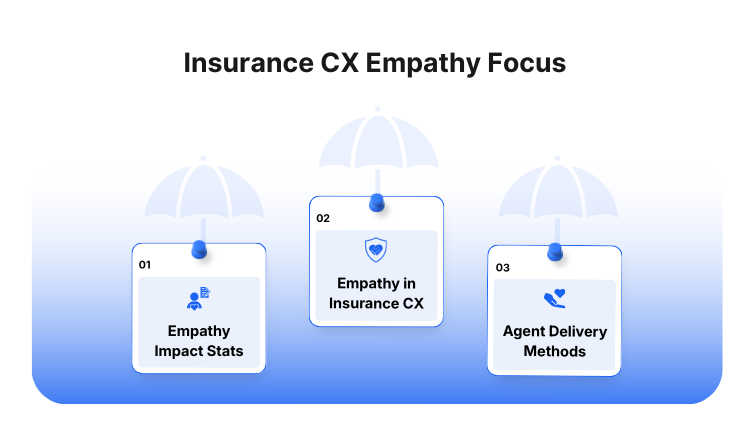
What’s inside this blog? You’ll discover how tone, listening and human connection drive stronger retention.
We’ll break down how empathetic communication in insurance requires more than friendly words, it demands tools that surface emotional cues, soft skills training insurance teams can’t ignore, and why human touch insurance service models are proving their worth.
Then we’ll examine how a unified solution like Convin can support this transformation by enabling real‑time agent assistance, voice‑of‑customer analytics and emotion‑aware conversations.
Lead your insurance CX with empathy-driven insights from Convin
Why Insurance Customer Experience Needs Empathy Today
In an era of digital policy portals and chatbots, the human connection still counts. For insurers, cultivating a superior insurance customer experience means more than smooth transactions. It means feeling heard, understood, and respected by real people.
- A decade‑long study of 3.8 million feedback items found that policyholder loyalty hinges on “feeling valued” rather than simply price or product.
- At the same time, only 14% of companies say customer satisfaction is their strongest capability, even though 85% consider it essential.
- When tone and listening are poor, customers churn. Empathy becomes a differentiator.
If insurers want to elevate their insurance customer experience, they must focus on more than dots on a service funnel.
They must train agents in human‑centric skills, listen for emotional cues and weave the human touch insurance service into every interaction.
1. Empathetic Communication Insurance Agents Must Master
Empathetic communication isn’t just “be nice.” It’s about active listening, responsive tone, and genuine engagement. When agents shift from hearing (passive) to listening (active), they open channels of trust.
For example, recognising a caller’s frustration and saying, “I understand how this looks from your side,” changes the dynamic instantly. Tone matters: a calm, reassuring voice builds confidence; a flat, scripted tone does not.
Modern contact centres using emotion detection tools find that voice or sentiment analysis uncovers unspoken signals like stress or anxiety.
When agents personalise conversations with context (“Last month you asked about renewing early, let’s revisit that”), they demonstrate empathy and drive satisfaction.
Empathetic communication becomes a core pillar of insurance customer experience, not an optional extra.
2. Emotional Intelligence Agents Use to Build Trust
Emotional intelligence (EI) equips agents with self‑awareness, regulation and empathy. When an agent recognises they’re beginning to sound rushed or indifferent, they can recalibrate and refocus.
That matters because policy questions often connect to personal anxieties (claims after an accident, fear of premium hikes).
Agents trained in EI handle emotional escalations with calm: they mirror tone, pause when needed, invite the caller to speak, and reassure before moving to resolution.
Studies show that voice analysis tools can detect sentiment shifts mid‑call which correspond to emotional triggers.
Insurance carriers investing in emotional intelligence see lower complaint volumes and higher retention.
Emotional intelligence is more than a nice phrase, it’s a training outcome that elevates insurance customer experience via human empathy.
Elevate agent trust skills with data-backed empathy nudges with Convin
Embedding Empathy into Insurance Customer Experience Strategy
Empathy can’t be delivered sporadically; it must be built into the strategy for insurance customer experience. You need human‑first design, listening systems that scale, and models where the human touch insurance service is leveraged in key moments.
1. Soft Skills Training Insurance Teams Cannot Ignore
Soft skills training in insurance isn’t about polite greetings; it’s mastering listening, tone, emotional cues and adaptability. Premium carriers invest in role‑plays, simulations and real‑time coaching. Key skills include:
- Active listening and phrasing reflective responses
- Tone modulation: calming anxious policyholders, energising satisfied ones
- Emotional cue recognition: detecting frustration, confusion, fear
Such training yields measurable ROI. For example, carriers deploying conversation intelligence report first‑call resolution improvements of over 35%.
Soft skills training insurance programs are foundational to embedding empathy in your insurance customer experience strategy.
2. The Value of Human Touch Insurance Service Models Provide
Even as digital tools proliferate, moments of human‑to‑human connection remain irreplaceable. Consider high‑emotion events, claims calls, cancellations, major life changes. Here the human touch insurance service model excels.
Automated self‑service may handle the routine, but empathy humanises the complex. One case: carriers using live agents supported by emotion analytics processed claims 47% faster and raised satisfaction by 41%.
When human agents are empowered with analytics (tone detectors, emotional cues), they deliver elevated service. Blending digital efficiency with human connection optimises the insurance customer experience.
Humanize service with empathy-powered insights from Convin
This blog is just the start.
Unlock the power of Convin’s AI with a live demo.

Tools That Enable Empathy in Insurance Conversations
Empathy at scale isn’t easy. But with tools that analyse tone, listening patterns and emotional cues, insurers can systematise the human touch.
This is where technology underpins empathy, without replacing it.

1. Convin’s Real‑Time Agent Assist for Empathetic Conversations
Convin’s Real‑Time Agent Assist listens in on live calls, transcribes speech, analyses tone, and pushes prompts to agents. It's not about replacing agents, it’s about guiding them. Features include:
- Real‑time guidance and next‑best‑action prompts.
- Alerts for negative sentiment or compliance risk during calls.
- Battlecards and dynamic coaching to adjust agent tone and messaging mid‑call.
- Stats: claims processing time cut by up to 25%; new hire ramp‑up reduced; first‑call resolution improved over 35%.
By guiding agents to adjust tone and listen actively, Real‑Time Agent Assist becomes a tool for empathetic communication insurance teams can rely on.
Real‑Time Agent Assist bridges the gap between intention and execution in delivering a superior insurance customer experience.
2. Using Voice of Customer Software to Understand Emotion
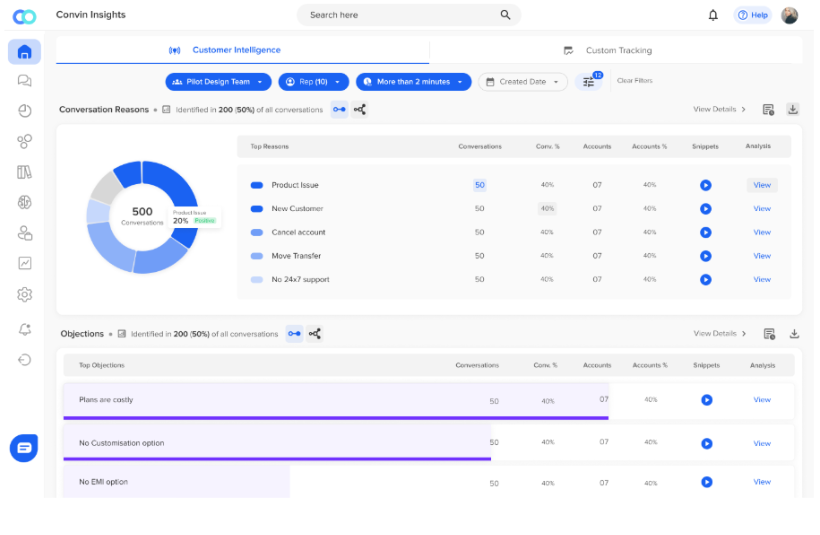
Voice of Customer (VoC) software captures feedback, but the next evolution is emotional insight in calls. Call analytics detect pitch changes, pauses, frustration, and silence.
For insurers, this means:
- Identifying interactions where tone dropped or confusion spiked
- Aggregating emotional patterns across touchpoints and using results to coach teams
- Using call analysis to map where “empathy gaps” exist and fixing them
One insurer found that post‑call voice analytics uncovered hidden stress cues missed in traditional surveys.
Voice of Customer software turns raw feedback into emotional intelligence, enhancing the insurance customer experience by building insight into tone and listening.
Empower agents with real-time empathy support via Convin
Convin’s Role in Elevating Insurance Customer Experience
When you combine empathetic communication insurance practices, emotional intelligence agents, soft skills training insurance programmes and the human touch insurance service model, you unlock a powerful insurance customer experience. Convin ties these elements together with technology and data.
- Convin’s platform integrates Real‑Time Agent Assist, Conversation Intelligence and Voice of Customer software to monitor, prompt and coach for empathy.
- Insurers using Convin report improved NPS and CSAT, fewer escalations and faster resolution times. For example, AI in insurance with Convin reduced claims turnaround by 58% and improved first‑call resolution to 79%.
- Call analytics on the Convin platform reveal tone mismatches, listening gaps and emotion signals,enabling targeted training and strategy shifts.
By leveraging Convin, carriers can embed empathy into every stage of interaction rather than leaving it to chance.
The result: stronger policyholder relationships, higher retention and a differentiated insurance customer experience.
Turn feedback into emotional intelligence with Convin’s VoC
Building Long‑Term Insurance Relationships with Empathy
Empathy is no longer a soft skill, it’s the foundation of a strong insurance customer experience. From active listening and tone awareness to emotional intelligence and personalized support, the need for human connection is growing louder.
As digital touchpoints expand, so does the expectation for empathy across every interaction. Insurance leaders must embed empathy across systems, training, and technology.
This means prioritizing soft skills training insurance programs, leveraging empathetic communication insurance methods, and maintaining the human touch insurance service model, all while capturing emotional signals in real time.
The result isn’t just better service; it’s stronger policyholder loyalty and higher retention.
With a unified platform combining real-time guidance, voice analytics, and customer intelligence, Convin subtly powers this transformation.
Insurers ready to lead with empathy, and scale it without losing the human element, have the tools at hand.
Book you Convin AI demo today!
FAQ
1. What role does empathy play in customer relations?
Empathy builds trust by helping agents understand and respond to customer emotions in real time. In industries like insurance, where conversations often involve stress or urgency, empathetic listening and communication directly improve satisfaction, reduce churn, and deepen long-term relationships.
2. What is empathy in insurance?
Empathy in insurance refers to an agent’s ability to recognize and respond to a policyholder’s emotional state during conversations. It involves active listening, tone awareness, and personalized support, especially during high-stakes interactions like claims or cancellations. Tools like Convin help insurers detect emotional cues and scale empathy across teams.
3. How can empathy impact the customer expert relationship?
Empathy transforms transactional exchanges into trust-based partnerships. When insurance agents engage with emotional intelligence and personalized tone, it strengthens the bond between customer and expert. This leads to improved retention, faster resolution, and a more human-centric insurance customer experience.
4. Why is empathy important in the relationship with a client?
Empathy humanizes client relationships, especially in service-driven sectors like insurance. It ensures clients feel heard and respected, even when facing complex or emotional issues. With platforms like Convin, insurers can embed empathy into daily interactions and deliver consistent, emotion-aware service.


%20BLOG10%20examples%20of%20artificial%20intelligence%20in%202024.webp)



.avif)