

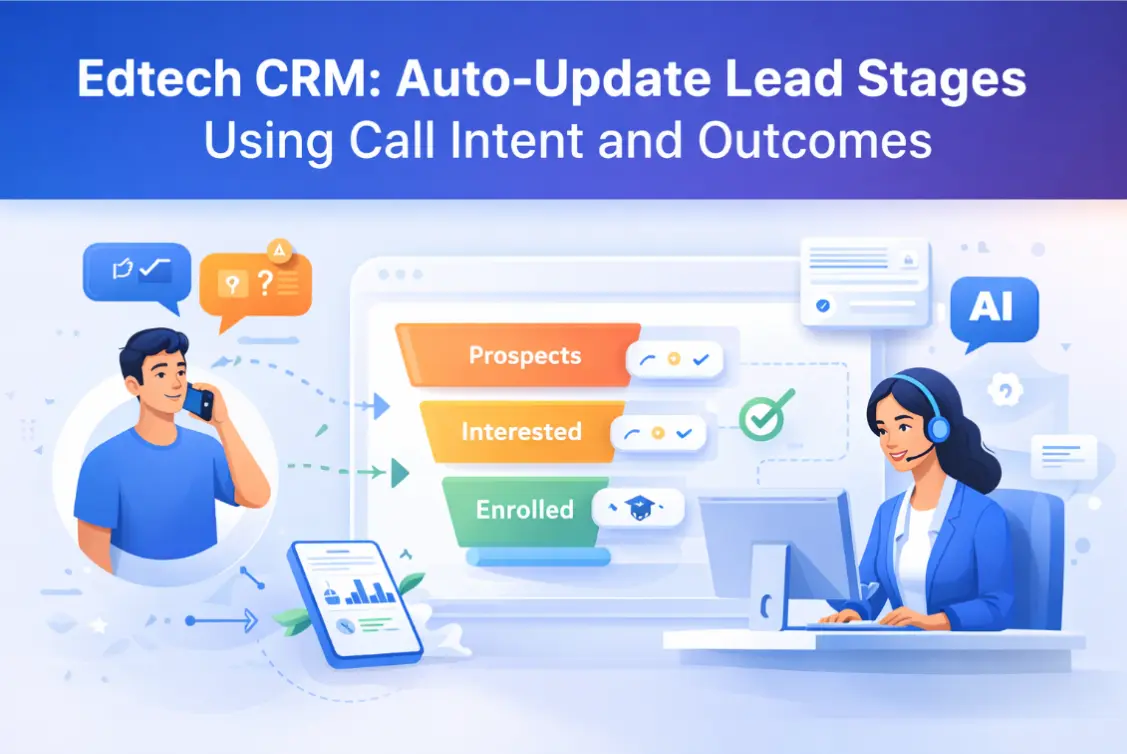
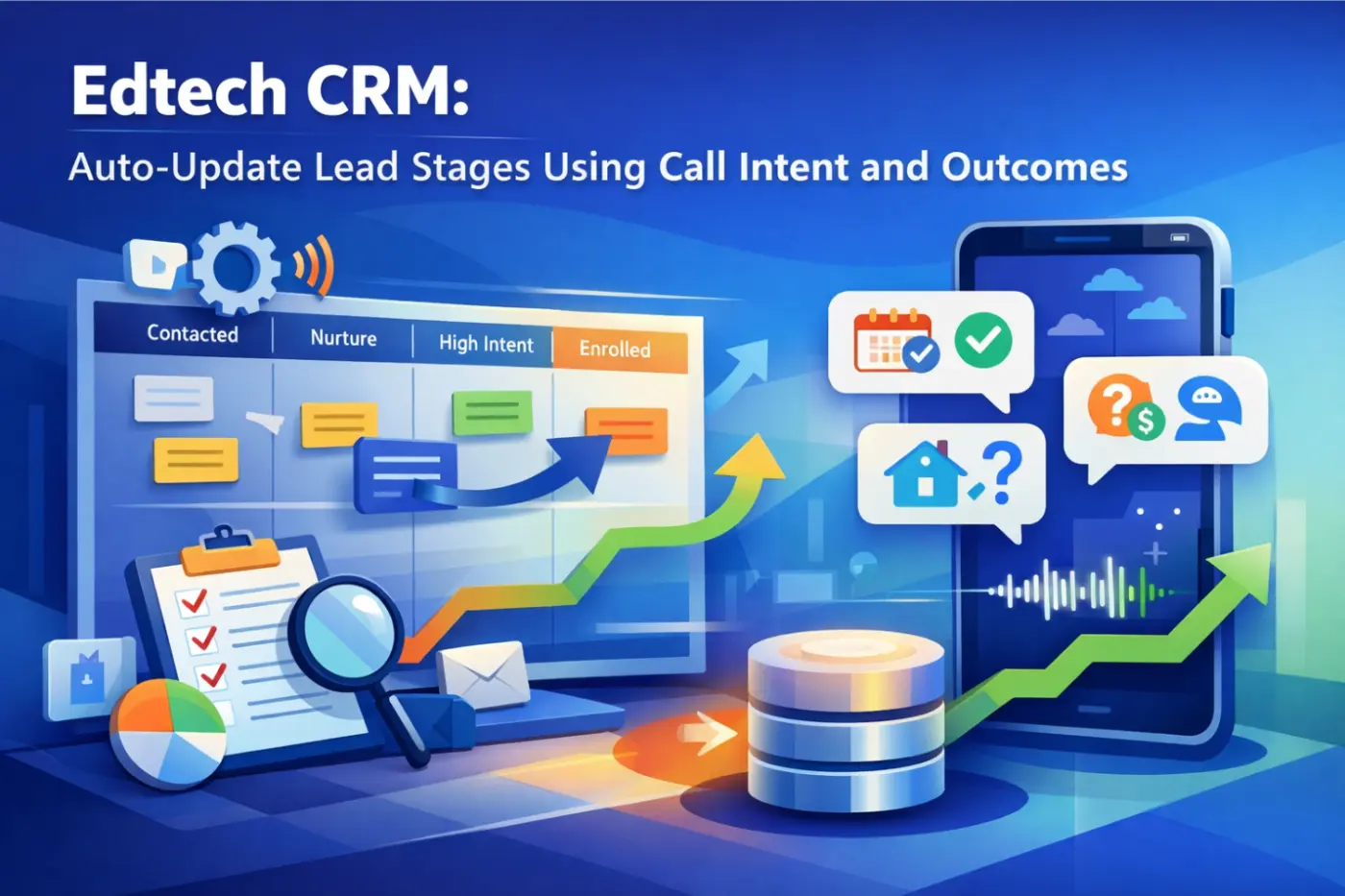
Edtech admissions teams speak to hundreds of students daily. Every call carries signals like interest level, urgency, objections, and readiness to enroll. Yet most Edtech CRMs still rely on manual updates or static rules to move leads across stages.
That gap costs enrollments.
A simple intent layer removes guesswork by converting what students say into clear, trackable outcomes. For example:
“I’m ready to enroll this month” → High Intent
“I need to discuss with my parents” → Nurture
“Call me after exams” → Deferred
“Fees are too high” → Objection – Pricing
When call intent and outcomes don’t automatically update lead stages, Edtech CRMs lose their purpose. Counselors follow up blindly. Managers misread funnel health. High-intent students wait too long. This is exactly why structured intent capture keeps the Edtech CRM aligned with student reality.
This is where a modern Edtech CRM integrated with conversation intelligence changes the game—by auto-updating lead stages based on what students actually say.
Map repeat follow-ups to missing intent fields in CRM
Why Edtech CRM Lead Stages Break Without Call Intelligence
Edtech CRM pipelines look structured on dashboards. But underneath, they often run on assumptions.
A student might say “I’ll enroll this week” on a call. Yet the lead still sits in Contacted. Another expresses doubts about fees but gets marked Warm anyway. These mismatches compound quickly.
Without call intelligence:
- Lead stages depend on counselor memory
- Updates happen hours or days later
- Intent gets lost between calls
- Follow-ups miss context completely
Over time, the CRM stops reflecting reality.
An Edtech CRM becomes reliable only when call intent and outcomes directly influence lead stages, automatically and consistently.
See example phrases that trigger nurture, deferred, or objection stages
How Call Intent Translates Into Accurate Lead Stages
Every admissions call carries intent signals—spoken clearly or implied subtly. Modern conversation intelligence systems can detect and structure these signals.
Common intent signals include:
- Enrollment readiness
- Fee objections
- Timeline clarity
- Comparison with alternatives
- Need for parental approval
- Request for follow-up materials
When these signals are captured accurately, they can auto-map to CRM stages in real time.
Create SLA-bound callback tasks so counselor promises never disappear
This blog is just the start.
Unlock the power of Convin’s AI with a live demo.

Making Edtech CRM Act On Call Intent
Manual CRM updates slow teams down and create inconsistency across counselors. When your Edtech CRM connects with Convin, lead stages can update right after the call ends, without extra effort from the counselor.
What changes operationally
- Lead stages update within minutes based on what Convin detects in the call, not what a counselor remembers later
- Convin extracts intent, objections, timeline, and next step, then logs structured fields into the Edtech CRM automatically
- Dispositions reflect what the student actually said, for example: “Ready This Month,” “Needs Parent Approval,” “Fee Objection,” “Deferred Until Exams”
- Follow-ups trigger only when the lead state changes, so counselors do not spam students with fixed sequences
- Convin creates owned tasks with due times, so callback promises do not disappear inside notes
- Automated QA checks whether counselors confirmed the next step, time window, and decision-maker alignment
What this fixes in the funnel
- High-intent students get immediate next steps because Convin flags urgency and triggers the right action in the Edtech CRM
- Low-intent leads move into nurture with clear reasons, so counselor time stays focused on convert-ready conversations
- Counselors start each call with full context because Convin lets them jump to key moments, last objection, last promise, last hesitation
- Managers see real funnel movement instead of activity noise because Convin turns conversation outcomes into trackable CRM states
- Forecasting becomes reliable because intent distribution is based on 100% conversation data, not self-reported tags
Most Edtech CRMs were built to store data, not interpret conversations. They rely on dropdowns, post-call notes, and self-reported dispositions. At scale, that breaks in predictable ways: updates get skipped under pressure, intent gets misclassified, and follow-ups get delayed. Convin closes that gap by listening to admissions calls, converting spoken intent into structured CRM actions, and keeping ownership clear through tasks and SLAs. Follow-up quality improves because context stays attached to the lead. Counselors reference concerns naturally, students do not repeat themselves, and outreach stays timely and relevant.
Result: faster follow-ups after strong calls, more accurate lead stages, cleaner handoffs, and better connect-to-conversion performance.
See how Convin logs intent fields into your Edtech CRM
Reliable Edtech CRM Forecasting Starts With Call-Based Lead Stages
Forecasting breaks when lead stages are outdated or inflated. Auto-updating stages using call intent, sentiment, and outcomes makes pipelines predictable, especially during peak admission cycles. With conversation-backed CRM data, admissions leaders get clearer intent visibility, earlier signals on stalled enrollments, and steadier week-on-week funnel movement, which improves staffing, campaign planning, and coaching focus.
Where Convin Fits: Convin sits on top of your existing Edtech CRM to capture 100% of admissions calls, extract intent and outcomes, auto-update lead stages, and trigger follow-ups and coaching actions. That keeps CRM stages current, prevents high-intent students from slipping, and turns CRM data from storage into decision intelligence.
Plan staffing using real lead-stage movement, not activity counts
What does auto-updating lead stages mean in an Edtech CRM?
Auto-updating lead stages in an Edtech CRM means the system automatically moves a lead forward or backward based on call intent and conversation outcomes, instead of relying on manual counselor updates.
How does call intent help an Edtech CRM manage lead stages better?
Call intent captures what students actually express during calls—interest level, objections, timelines, and readiness—which allows the Edtech CRM to reflect real enrollment likelihood accurately.
Why do manual lead stage updates fail in most Edtech CRM setups?
Manual updates depend on memory, discipline, and time. In high-volume admissions environments, this leads to delays, missed context, and inconsistent CRM data.
How does auto-updating lead stages improve admissions follow-ups?
When lead stages update automatically after calls, counselors know exactly where each student stands, making follow-ups timely, personalized, and far more effective.
Can Edtech CRM auto-updated lead stages improve enrollment forecasting?
Yes. When lead stages are driven by real call outcomes, forecasting becomes more reliable because the pipeline reflects true student intent, not activity counts.



.avif)