


Most insurance teams still review under 2% of calls, creating blind spots in compliance, CX, and coaching. Call center QA automation closes that gap by delivering full coverage, consistent scoring, and real insights. Convin helps insurance teams finally see what’s been missing, so what could you unlock next?
Call center QA automation is the technology that automatically reviews customer calls, flags compliance risks, scores agent performance, and delivers coaching insights at scale, eliminating manual sampling limits for contact centers.
Audit more than 2% of calls with Convin!
The 2% Audit Problem in Call Center QA Automation
Insurance contact centers handle some of the most sensitive customer conversations, such as claims, renewals, policy explanations, and grievances. Yet most teams still audit less than 2% of calls. This is where call center QA automation becomes the conversation starter.
It exposes how much context is lost, how many coachable moments slip away, and how much compliance risk goes unreported when manual processes can’t keep up.
Insurance leaders often assume performance gaps stem from agents, but the real issue is that traditional QA simply can’t surface enough insight. When only a fraction of calls is reviewed, the organization reacts to symptoms instead of understanding patterns.
Manual QA Limitations Create Hidden Risk
Manual QA was never built for the complexity of modern insurance operations. Long call durations, intricate disclosures, and varied product lines make it impossible to review meaningful coverage manually. These manual QA limitations expand risk pockets because issues remain invisible until they escalate into customer complaints or compliance queries.
With limited bandwidth, QA teams naturally prioritize a narrow sample of calls, often the “safe ones.” This means policy mis-explanations, missed disclosures, or mishandled claims conversations rarely get flagged early.

In conclusion, the insurance industry’s growing complexity amplifies why manual QA limitations can no longer be the backbone of quality programs. It's precisely the environment where call center QA automation offers not just efficiency, but critical visibility.
If the 2% audit ceiling is the visible problem, the deeper challenge lies in why insurance teams struggle to review more calls in the first place. That’s where operational realities and structural constraints begin to show up.
Transform QA from sampling to full coverage.
Why Insurance Teams Struggle Without Call Center QA Automation
Insurance workflows demand precision. Agents must answer underwriting questions, verify details, explain riders, and document every promise. Without call center QA automation, these complexities lead to inconsistent scoring, delayed error detection, and limited insight into emerging risks.
The combination of high call volume and strict regulatory requirements makes manual QA feel like chasing a moving target. Teams know more calls need to be reviewed, but bandwidth, inconsistency, and fragmentation stand in the way.
Automated Call Auditing Exposes What Manual Misses
The volume of insurance calls grows every year, yet QA headcount rarely scales at the same pace. That’s why automated call auditing becomes essential; it surfaces risky patterns, spot-checks disclosures, and ensures complaint triggers aren’t overlooked.

Automation doesn’t replace human judgment; it expands its reach by revealing the 98% of conversations no one has time to hear.
In conclusion, automated call auditing gives insurance teams clarity. It turns scattered insight into structured visibility that manual workflows simply can’t match, reinforcing why call center QA automation is now foundational.
Contact Center Quality Assurance Must Scale With Volume
Insurance call complexity has risen, but contact center quality assurance processes remain static. When QA doesn’t scale, patterns like repeated mis-selling, documentation mistakes, or claim missteps remain hidden until they hit compliance dashboards.
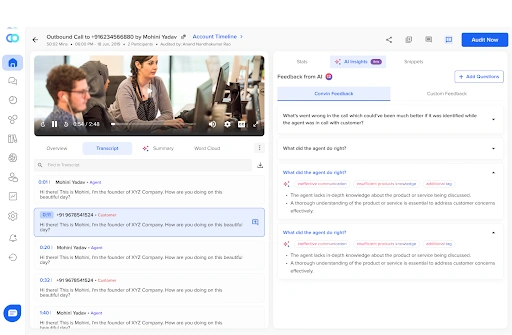
Teams need more than sampling; they need full coverage and consistent scoring frameworks.
In conclusion, scalable contact center quality assurance is possible only when paired with call center QA automation, which ensures that insights scale with call volume, not with headcount.
Once teams acknowledge what’s slipping through the cracks, the natural question becomes: What does “good” look like? Let’s sketch that vision before introducing how insurance teams bring it to life.
Upgrade your QA workflow today.
This blog is just the start.
Unlock the power of Convin’s AI with a live demo.

What Good Looks Like With Call Center QA Automation
A mature insurance QA function looks very different from today’s 2% world. With call center QA automation, teams move from reactive auditing to proactive risk detection. They uncover emerging compliance issues earlier, coach agents consistently, and create feedback loops that strengthen customer conversations.
Good isn’t just about more audits; it’s about better decision-making, faster resolution, and fewer escalations.
Call Monitoring For Compliance And CX Precision
In insurance, every word matters. Required disclosures, claim details, and product suitability statements each carry regulatory sensitivity. That’s why call monitoring supported by automation becomes critical. It ensures no misstep hides inside an overlooked call.

Automated call monitoring can detect language gaps, missing statements, or incorrect advice long before a compliance audit flags them externally.
In conclusion, pairing call monitoring with call center QA automation gives teams a sharper, earlier, and more reliable picture of compliance accuracy and CX health.
Once the vision of “good” is clear, the next step is understanding how insurance teams practically implement it across workflows without overwhelming agents or QA teams.
Start closing the 2% audit gap today.
How Insurance Teams Use Call Center QA Automation Effectively
Insurance organizations using call center QA automation start by plugging workflow gaps without overhauling everything at once. They use automated quality management for consistent scoring and automated coaching to ensure every agent gets targeted, timely improvement.
The focus remains on elevating accuracy, reducing compliance exposure, and strengthening customer trust.
Call Center Coaching Insights That Improve Every Agent
Insurance interactions depend heavily on advisers communicating clearly and compliantly. With call center coaching insights, supervisors finally see which moments confuse agents, which objections derail them, and which explanations lack clarity.
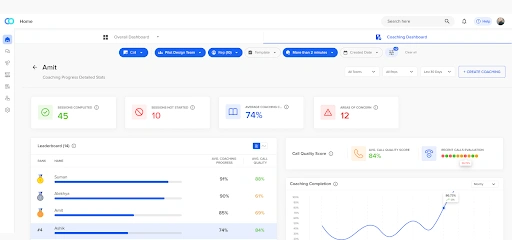
These insights help teams coach with context and not guesswork.
In conclusion, coaching insights become significantly more actionable when powered by call center QA automation, because every insight is backed by real conversations.
Agent Performance Analytics For High-Risk Moments
Some interactions carry more risk than others, claim denials, sensitive disclosures, renewal pricing, policy cancellations. Agent performance analytics help teams pinpoint these high-risk moments quickly and understand which behaviors lead to escalations or compliance failures.
Analytics clarify which agents need support, where scripts fail, and why certain patterns repeat.
In conclusion, analytics guided by call center QA automation give insurance leaders the confidence to intervene early and systematically.
Best Tools For Auto-Auditing Customer Calls
Insurance teams evaluating the best tools for auto-auditing customer calls should weigh accuracy, coverage, compliance-readiness, and integration depth, not just feature lists. Tools that adapt to insurance terminology, regulatory language, and long conversations bring the biggest lift.
Early adopters report faster QA cycles and deeper insight into customer friction.
In conclusion, choosing the right tools amplifies the impact of call center QA automation, helping teams modernize QA without disrupting daily operations.
By now, the path is clear: the 2% audit ceiling is a structural limitation, not a performance issue. That brings us to a natural closing reflection.
Schedule your Convin demo now!
Fixing The 2% Gap With Call Center QA Automation
Relying on 2% audits forces insurance teams into a perpetual cycle of reacting late, missing risk, and coaching inconsistently. Call center QA automation breaks that cycle by expanding visibility across 100% of conversations and surfacing insights that manual QA never had the time or scale to uncover.
Insurance leaders don’t need more sampling; they need more certainty. And certainty comes from full coverage, automated risk detection, and coaching aligned to real customer interactions.
FAQs
- Why do most call centers still rely on manual QA despite its low audit coverage?
Many call centers stay with manual QA because it feels familiar, requires no new infrastructure, and appears easier to control. However, high call volumes, lengthy conversations, and staffing limits make manual sampling too shallow to reveal meaningful patterns or compliance risks.
- How does failing to audit more than 2% of calls impact customer trust in regulated industries?
When only a small fraction of calls is reviewed, misdisclosures, inconsistent explanations, and unresolved issues slip through unnoticed. Over time, this leads to customer frustration, policy misunderstandings, and a perception that the brand isn’t transparent or accountable, especially in insurance, banking, and healthcare.
- What are the early warning signs that a QA team is missing critical compliance errors?
Indicators include recurring escalations, repeated customer complaints about misinformation, sudden spikes in regulatory queries, and supervisors discovering issues during coaching that QA never flagged. These patterns often signal blind spots caused by low audit coverage.
- How can call centers estimate the true cost of undetected mistakes caused by limited QA sampling?
Teams can calculate this by reviewing complaint categories, rework hours, compliance penalties, churn rates, and operational delays tied to incorrect information. When extrapolated across all calls, not just the 2% reviewed, the financial and reputational impact becomes clear.
- What operational changes are needed before adopting automated QA tools effectively?
Call centers benefit from preparing clean call recordings, defining scoring rubrics, aligning compliance requirements, and training supervisors on data-driven coaching. These steps ensure that automated insights integrate smoothly into daily workflows and deliver immediate value.


.avif)

.avif)