

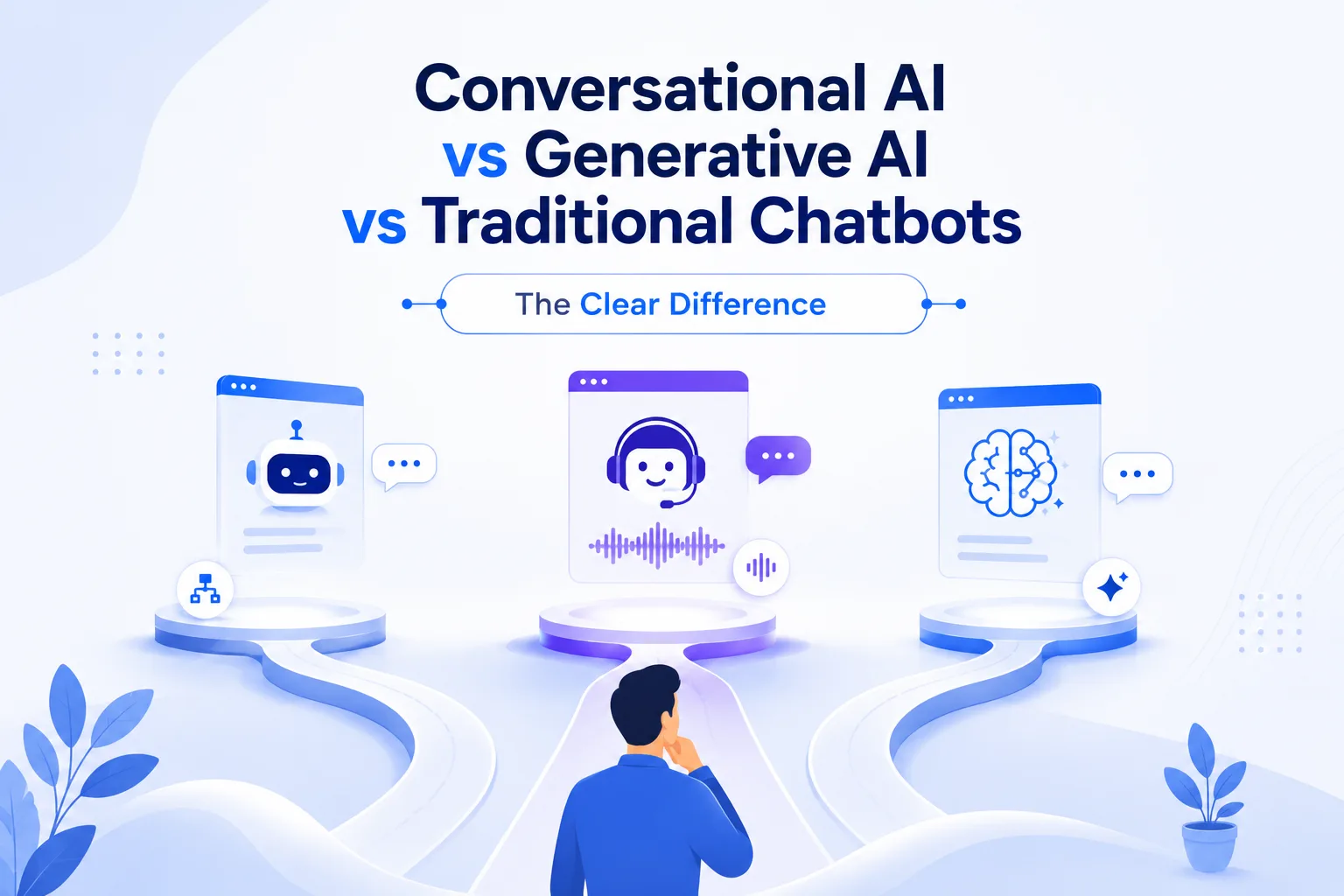
The debate around conversational AI vs generative AI has become central to modern customer experience design. Businesses are no longer asking whether automation matters; they are asking how each approach changes control, scalability, response quality, and customer satisfaction.
At a technical level, conversational AI vs generative AI refers to two different system philosophies. Conversational AI is built for structured understanding, intent detection, and guided task completion. Generative AI is built for flexible language generation, synthesis, and open-ended responses.
In practice, the strongest CX stacks do not treat conversational AI vs generative AI as an either-or choice. They combine them, using structured orchestration where precision matters and generative reasoning where flexibility adds value.
See how leading teams use conversational and generative AI together
Core Architecture Behind Conversational AI Vs Generative AI Systems
The biggest difference in conversational AI vs generative AI lies in how each system plans and produces responses.
Conversational AI typically relies on intent classification, dialog state, workflow logic, and predefined decision paths. That makes it highly predictable and better suited for controlled business processes.
Generative AI, by contrast, uses probabilistic language modeling to create responses dynamically from context. It is more flexible, but it also introduces more variance in tone, structure, and accuracy.
In most enterprise environments, conversational AI vs generative AI works best as a layered system rather than a competing one. The structured layer keeps interactions reliable, while the generative layer adds adaptability where needed.
Understand how Convin brings structure and intelligence together in conversations.
How Chatbots Evolved Into Conversational AI Vs Generative AI
Traditional chat systems show the clearest difference between conversational AI vs generative AI.
A structured chatbot identifies the user’s intent, maps it to a workflow, and returns a controlled response. This makes it effective for FAQs, routing, and repetitive support flows.
A generative system interprets the message more broadly and creates a response on the fly. That makes it more natural in conversation, but also less deterministic if not carefully constrained.
System Behavior Breakdown
- In structured systems, conversational AI vs generative AI is implemented through predefined decision trees and guided bot logic.
- In more advanced systems, conversational AI vs generative AI shifts toward intent-aware adaptation, allowing the system to handle edge cases more gracefully.
- In fully generative setups, responses are produced dynamically in real time based on the full conversation context.
This is why conversational AI vs generative AI is often discussed in chatbot strategy. The real question is not which one sounds smarter, but which one is better controlled for the business outcome.
Explore how Convin improves conversation flow across customer interactions.
This blog is just the start.
Unlock the power of Convin’s AI with a live demo.

Where Conversational AI Vs Generative AI Delivers Real Value
Enterprise platforms make the comparison between conversational AI vs generative AI more concrete.
Tools such as NiCE CXone, Genesys Cloud CX, Cresta, Balto, and Observe.AI each address a specific layer of the customer experience stack rather than delivering a fully unified system.
- NiCE focuses on CX orchestration across channels and workflows, coordinating interactions at scale.
- Genesys specializes in customer journey management and contact center infrastructure for large enterprise environments.
- Cresta delivers real-time AI-driven agent assist, helping improve live conversation efficiency and decision-making.
- Balto provides in-call guidance and scripted support to help agents follow optimal conversation paths.
- Observe.AI focuses on conversation intelligence, quality assurance automation, and post-call analytics.
While each platform is strong in its own domain, they typically function as complementary but separate layers, which often leads enterprises to combine multiple tools to achieve full CX coverage.
In these environments, conversational AI vs generative AI is rarely a pure product choice. Most tools handle one layer of the workflow, while the broader CX system still depends on how those layers connect.
Convin appears in conversations around conversational AI vs generative AI because it represents a hybrid direction, bringing AI phone interactions, real-time assistance, and conversation intelligence into one lifecycle.
See how Convin unifies fragmented CX tools into one conversation layer.
Platform Landscape Shaping Conversational AI Vs Generative AI
When applied in live operations, conversational AI vs generative AI affects how efficiently support, sales, and service teams function.
Structured conversational AI is strong in workflows where consistency matters: routing tickets, qualifying leads, tracking compliance, and guiding repetitive tasks. Generative AI becomes useful when the interaction requires flexible summarization, response variation, or contextual drafting.
Workflow Applications
- Ticket routing in conversational AI vs generative AI workflows
- Lead qualification in conversational AI vs generative AI for sales
- Compliance tracking in conversational AI vs generative AI for QA
- Response optimization in conversational AI vs generative AI for agent assist
These use cases are commonly evaluated across industries such as banking, e-commerce, telecom, and SaaS, where conversational AI and generative AI are applied for query handling and summaries, order support and personalization, complaint resolution workflows, and ticket automation with automated responses. They are often discussed alongside platforms like Convin because they demonstrate how multiple CX capabilities can operate within a single system instead of being split across separate tools.
In every case, conversational AI vs generative AI works best when the system is designed for both structure and adaptability.
Discover how Convin improves real time sales and support conversations.
Operational Gaps In Conversational AI Vs Generative AI Adoption
Understanding conversational AI vs generative AI also means understanding where each one breaks down.
Conversational AI can be highly reliable, but it may feel rigid when users go off-script. Generative AI can feel more natural, but it introduces higher risk unless it is constrained by policy, retrieval, or workflow logic.
These limitations explain why enterprises rarely rely on only one system. In many stacks, conversational AI vs generative AI is not a choice between old and new. It is a question of how much structure the business needs to preserve trust, compliance, and consistency.
That is also why platforms like Convin are often positioned in these stacks: they add structure to flexible AI workflows and help keep the system operationally usable.
Learn how Convin reduces gaps between automation and execution.
Future Direction Of Conversational AI Vs Generative AI In CX
The future of conversational AI vs generative AI is convergence, not competition.
The next generation of CX systems will likely use structured intent handling for precision, generative response creation for flexibility, real-time assistance for live interactions, and post-conversation intelligence for optimization.
Future Architecture Model
- Structured intent handling in conversational AI vs generative AI
- Dynamic response generation in conversational AI vs generative AI
- Real-time agent assistance in conversational AI vs generative AI
- Post-conversation intelligence in conversational AI vs generative AI
These capabilities are increasingly discussed alongside Convin because they reflect a hybrid model: AI-driven phone interactions, real-time support, and conversation intelligence working together inside a unified system.
The strongest future systems will not force businesses to choose between conversational AI vs generative AI. They will combine both in a way that improves control, relevance, and scale.
See how Convin is shaping hybrid conversation intelligence systems.
FAQs
Q: What is the main difference between conversational AI vs generative AI?
Conversational AI follows structured workflows and intent detection, while generative AI creates dynamic responses using contextual language models.
Q: Why are businesses comparing conversational AI vs generative AI?
Businesses compare them to balance control, accuracy, scalability, and flexibility in customer experience automation and support systems.
Q: Can conversational AI vs generative AI work together?
Yes, most modern CX systems combine both to manage structured workflows and enhance responses with generative flexibility.
Q: Which is better for customer support, conversational AI vs generative AI?
Conversational AI is better for structured support flows, while generative AI improves agent assistance and response quality.
Q: What are the limitations of conversational AI vs generative AI?
Conversational AI can be rigid, while generative AI may lack consistency and requires guardrails for accuracy and compliance.
Q: How will conversational AI vs generative AI evolve in the future?
They will converge into hybrid systems combining structured intent handling with generative intelligence for end-to-end CX optimization.


.webp)


.avif)