

Your customer doesn't think in channels.
A student discovers your brand through Instagram and starts a WhatsApp conversation. A loan customer asks a servicing question through chat and later calls your support team. A patient sends a voice note in Tamil and expects an immediate response.
To your organization, these are different workflows. To the customer, they're part of the same conversation.
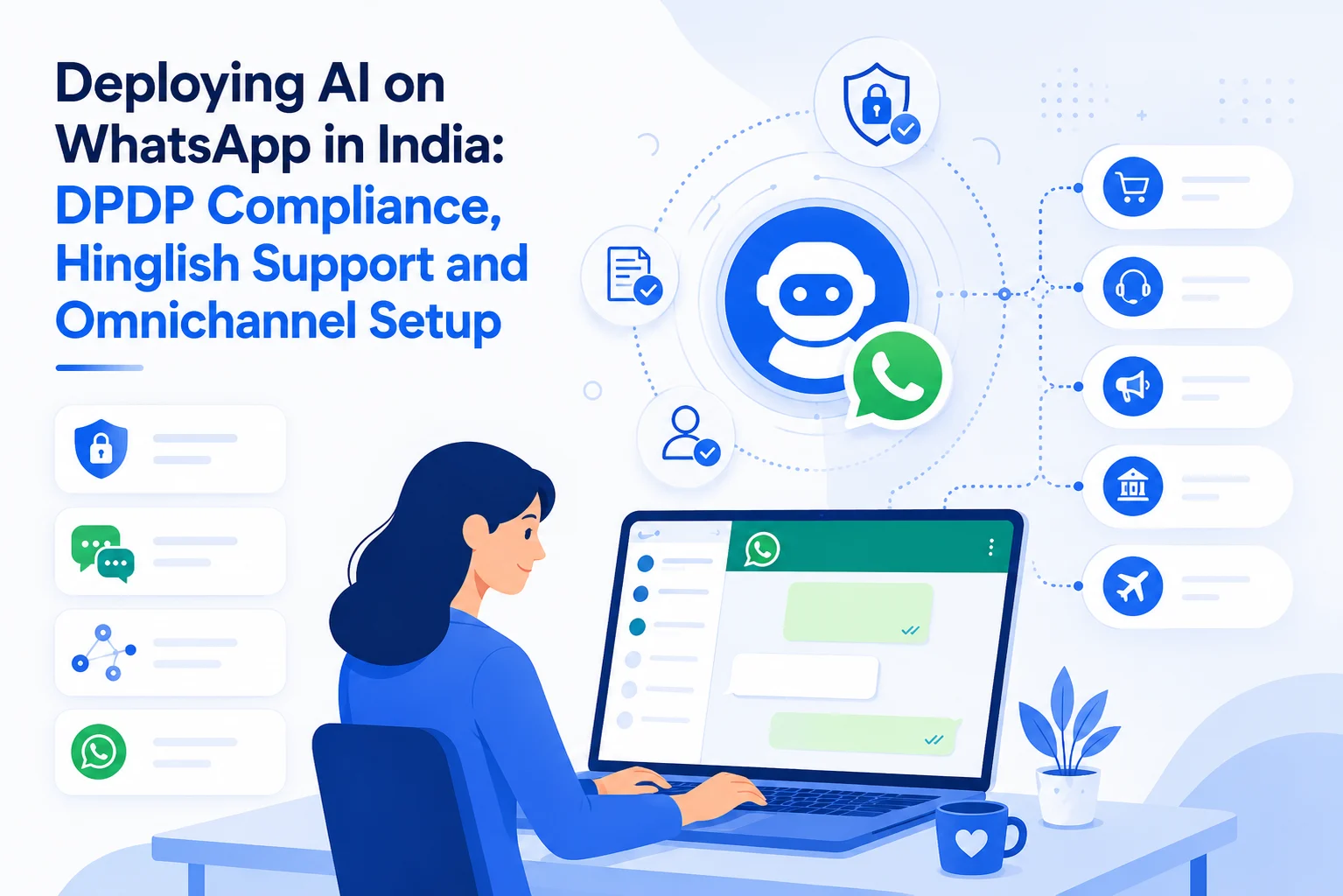
That is why deploying an AI chatbot for WhatsApp India has become more complex than simply connecting a bot to the WhatsApp Business API. Enterprises must navigate DPDP compliance, Meta's messaging rules, regional language support, voice interactions, and omnichannel integration simultaneously.
The challenge isn't building a chatbot. The challenge is building a customer engagement system that works the way Indian customers actually communicate.
Turn every WhatsApp conversation into measurable business outcomes.
What an AI Chatbot for WhatsApp India Really Needs to Do
An AI chatbot for WhatsApp India must do far more than answer common questions.
It needs to understand when it is allowed to process customer data, recognize multiple Indian languages, maintain context across fragmented conversations, and transfer customers to human agents without losing information.
In simple terms, an AI chatbot for WhatsApp India is an automation layer that manages customer conversations on WhatsApp while remaining compliant with DPDP requirements, following Meta's messaging policies, understanding Indian language behavior, and integrating with CRM and contact center systems.
The strongest deployments treat WhatsApp as one part of a broader customer communication ecosystem rather than an isolated messaging channel.
This distinction matters because most failures happen at the edges. A chatbot may answer questions effectively, but if consent records are missing, language comprehension breaks down, or context disappears during escalation, the customer experience suffers.
Platforms like Convin address this challenge by treating WhatsApp as one component within a larger conversation intelligence framework that spans voice, chat, email, and human-assisted interactions.
Build WhatsApp AI that understands every customer context.
DPDP Compliance Is No Longer Optional
For many enterprises, compliance is the first consideration when evaluating an AI chatbot for WhatsApp India.
The Digital Personal Data Protection Act (DPDP) received Presidential assent in August 2023, while the implementation rules were notified in November 2025. Organizations effectively have until May 2027 to ensure compliance, but waiting until the deadline creates unnecessary risk.
The most important principle is straightforward: if your chatbot collects, stores, or processes personal data, valid consent is required.
That consent must be:
- Free
- Specific
- Informed
- Unambiguous
Many organizations mistakenly assume that if a customer sends a WhatsApp message, they have automatically consented to all future communication. That assumption does not align with DPDP requirements.
Purpose limitation creates another challenge. Data collected for customer support cannot automatically be reused for marketing. If a customer agrees to receive order updates, that does not create permission to send promotional offers later.
The responsibility ultimately belongs to the enterprise.
Under DPDP, the organization deploying the chatbot is considered the Data Fiduciary. Even if a third-party platform powers the AI, the business remains accountable for compliance failures.
A Data Fiduciary is the organization that determines how and why customer data is processed. Under DPDP, the Data Fiduciary remains responsible even when external vendors provide the technology.
The implications become particularly important when customers exercise their right to erasure.
Imagine a loan customer requesting deletion of their data. The enterprise must locate and remove records across CRM systems, conversation logs, analytics environments, and any associated datasets. Without centralized data management, this process quickly becomes operationally difficult.
This is where conversation intelligence platforms provide significant value. Convin's automated QA and compliance monitoring capabilities help organizations track consent, identify potential violations, and maintain audit-ready records across 100% of customer interactions instead of relying on the industry-standard 2% to 5% manual sampling approach.
Stay compliant while scaling customer conversations with Convin.
This blog is just the start.
Unlock the power of Convin’s AI with a live demo.

Meta's Rules Matter as Much as DPDP
Compliance does not stop with Indian regulations.
Every AI chatbot for WhatsApp India must also operate within Meta's Business API framework.
The most important rule is the 24-hour customer service window.
When a customer sends a message, businesses can respond freely within the following 24 hours. Once that window closes, outbound communication generally requires pre-approved template messages.
This sounds simple until automation enters the picture.
A chatbot must continuously track conversation status and understand when it can generate free-form responses versus when it must switch to approved templates. Failure to do so can negatively impact quality ratings, reduce messaging limits, and potentially result in account restrictions.
Template governance also affects marketing operations.
Following Meta's shift to per-message pricing in July 2025, businesses now pay different rates depending on message type:
- Marketing templates: approximately ₹0.88 per delivered message
- Utility templates: approximately ₹0.16 per message
- Authentication templates: approximately ₹0.13 per message
- Service messages within the 24-hour window: free
The operational lesson is clear. Consent management, template governance, and AI workflows cannot be treated as separate projects.
They need to be designed together.
Convin addresses this challenge by embedding compliance logic directly into conversational workflows, helping organizations respect messaging windows, manage templates correctly, and maintain clear audit trails.
Automate WhatsApp engagement without risking compliance violations.
Why Hinglish Support Determines Success
Many global chatbot platforms underestimate one of the most important realities of the Indian market.
Customers do not communicate in neat linguistic categories.
They communicate in Hinglish.
A customer is far more likely to write:
"bhai price kya hai iss product ka?"
than:
"What is the price of this product?"
This creates a problem for translation-based systems.
Translation engines assume a source language and a target language. Hinglish is neither. It is a fluid blend of Hindi and English, often written in Roman script and mixed within the same sentence.
That means the challenge is not translation.
It is comprehension.
An effective AI chatbot for WhatsApp India must:
- Detect code-mixed language automatically
- Understand intent across language boundaries
- Maintain context during language switches
- Respond in the same conversational register
Research shows that 56.3% of Indian internet users prefer Hinglish, highlighting why English-only or translation-first approaches often underperform.
Customers also expect natural language matching.
If someone begins in Hindi, they expect Hindi responses. If they switch to English for technical terminology, they expect the AI to follow without confusion. If they use Tamil, Bengali, Marathi, or Telugu, they expect the same consistency.
Convin's in-house language model was developed specifically for Asian languages and supports more than 35 languages, including Hindi, English, and Hinglish. Rather than translating everything into English first, the model is designed to understand Indian language patterns natively.
That distinction becomes increasingly important as enterprises expand into tier-2 and tier-3 markets, where regional language engagement directly influences customer satisfaction and conversion rates.
Engage Indian customers naturally across every language variation.
Indian Users Behave Differently Than Global Chat Personas
Another common deployment mistake is designing for idealized conversations instead of real customer behavior.
Indian WhatsApp users rarely send a complete question in a single message.
Instead, they often communicate like this:
"Hi"
"I ordered something"
"Last week"
"Still not delivered"
"Order ID 78234"
"Please check"
A basic chatbot treats these as separate messages.
A better system waits briefly, aggregates the inputs, and identifies the full intent before responding.
Voice behavior presents another challenge.
In many tier-2 and tier-3 regions, voice notes are often preferred over text input. Users may be comfortable speaking but less comfortable typing long messages.
A WhatsApp AI strategy that ignores voice interactions excludes a substantial portion of potential customers.
The architecture increasingly needs to support:
Speech-to-Text → Intent Detection → Response Generation → Text or Voice Reply
Language switching further complicates matters.
Customers may start in Hindi, introduce English terminology, and then switch back to Hindi without warning. The AI must preserve context across those transitions instead of treating them as new conversations.
Formality also matters.
In sectors such as BFSI, healthcare, and government services, respectful language is expected. A chatbot should generally default to formal communication and adapt only when appropriate.
Convin's conversation intelligence capabilities help manage these realities by identifying language preferences, maintaining context, and consolidating fragmented interactions into coherent customer journeys.
Capture intent accurately across India's unique messaging habits.
WhatsApp Should Connect to Your Entire Customer Stack
The most successful deployments do not treat WhatsApp as a standalone channel.
They treat it as an entry point.
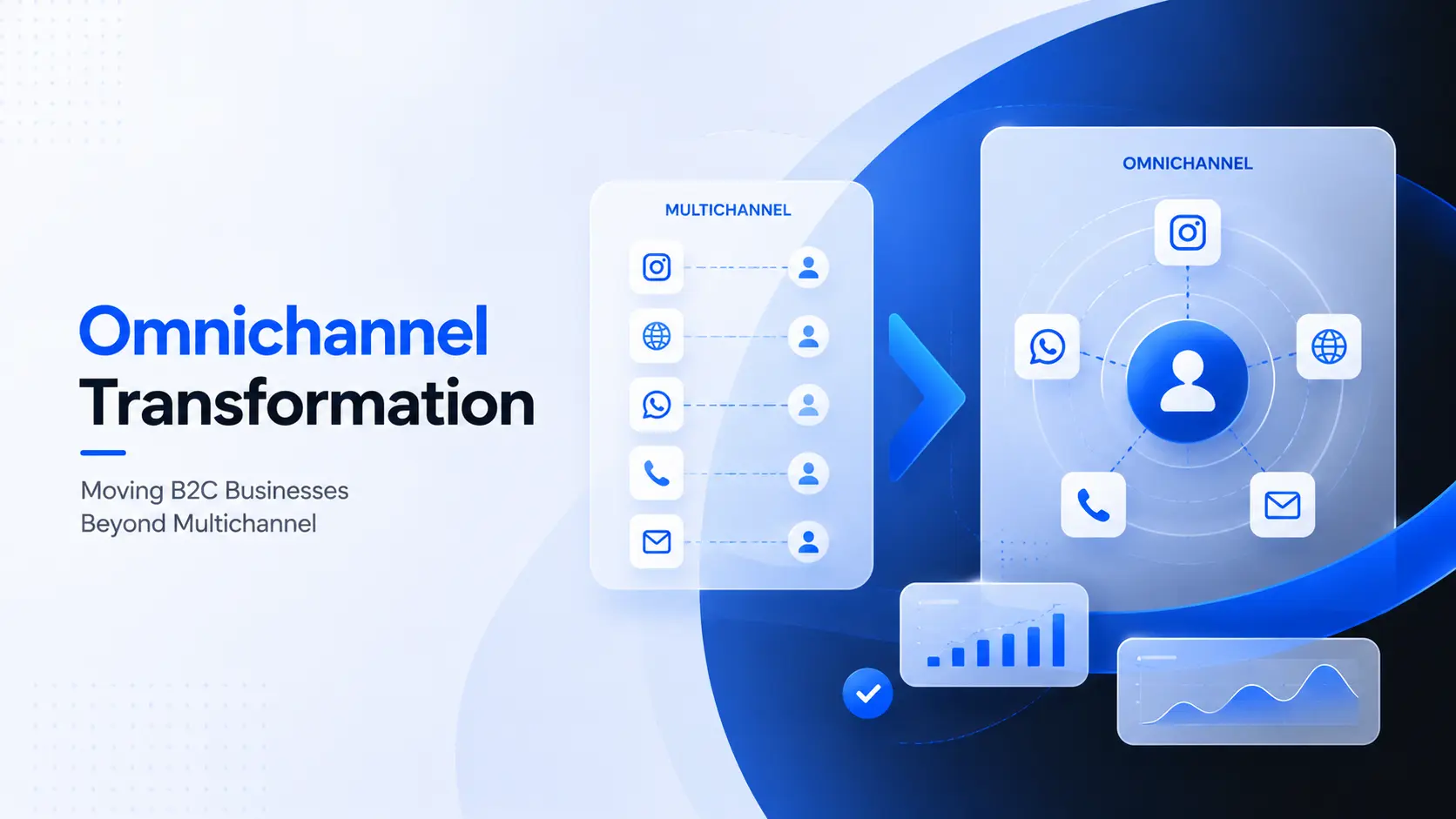
A customer might begin on WhatsApp, escalate to a phone conversation, receive an email follow-up, and return to WhatsApp later. Throughout that journey, context must remain intact.
Without integration, customers are forced to repeat themselves repeatedly.
That creates frustration and increases operational costs.
A modern AI chatbot for WhatsApp India should connect directly with CRM systems, contact center software, and telephony platforms.
Popular Indian enterprise environments often include:
- LeadSquared
- Kapture CX
- Salesforce
- HubSpot
- Freshworks
Telephony integrations frequently involve:
- Exotel
- Knowlarity
- Ozonetel
The goal is not merely data synchronization.
The goal is context continuity.
When a WhatsApp conversation escalates to a human agent, that agent should receive:
- Full conversation history
- Customer profile information
- Detected intent
- Sentiment indicators
- Recommended next actions
This is where Convin's broader platform becomes particularly valuable.
Rather than operating as a WhatsApp-only solution, Convin combines conversation intelligence, automated QA, real-time Agent Assist, and AI Phone Calls within a unified architecture.
As a result, customers experience a continuous journey instead of disconnected interactions across channels.
Unify customer journeys across voice, chat, and WhatsApp.
What to Ask Vendors Before You Deploy
Vendor selection often determines long-term success more than chatbot features themselves.
Before choosing a platform, ask these questions:
Where is customer data stored and processed?
While DPDP does not require blanket data localization, many BFSI and healthcare organizations still prefer stronger control over data handling.
How does the platform capture and manage consent?
Consent should be timestamped, auditable, and linked to a specific purpose.
Can customer data be deleted across all systems?
A right-to-erasure request should not trigger a manual investigation involving multiple departments.
What security certifications are available?
At a minimum, enterprises should look for:
- ISO 27001
- SOC 2 Type II
- Regular VAPT assessments
How does the system handle Indian language behavior?
Support for Hinglish, regional languages, voice notes, and language switching should be demonstrated, not simply claimed.
The strongest vendors understand that success in India requires more than generic chatbot technology. It requires solutions built around Indian regulatory requirements, customer communication patterns, and enterprise workflows.
Choose AI infrastructure built for India's enterprise realities.
Common Questions About AI Chatbot for WhatsApp India
Does DPDP require consent before using a WhatsApp chatbot?
DPDP requires valid consent before personal data is processed for a defined purpose. Businesses must clearly communicate what data is collected, why it is collected, and how it will be used.
Can AI chatbots understand Hinglish effectively?
Yes, but only if they are designed for code-mixed language understanding. Translation-based approaches often struggle because Hinglish blends Hindi and English within the same sentence.
What happens when the 24-hour WhatsApp window closes?
After the service window expires, businesses generally need approved template messages for outbound communication. Free-form AI responses are restricted outside the active service window.
Is WhatsApp automation enough on its own?
Usually not. Most enterprise customer journeys extend beyond WhatsApp and involve CRM systems, phone calls, email, and human agents. Omnichannel integration is typically required for a complete customer experience.
Do Indian enterprises need on-premise deployments?
Not always. The right approach depends on industry requirements, compliance obligations, and internal security policies. Many organizations use cloud deployments, while some regulated sectors prefer hybrid or on-premise models.
Get enterprise-ready answers before your WhatsApp AI rollout.
Building WhatsApp AI the Right Way
Deploying an AI chatbot for WhatsApp India is no longer just a customer service project.
It is a compliance project, a language project, and an operational architecture project at the same time.
The organizations seeing the best results are not simply deploying chatbots. They are building systems that understand Hinglish, respect DPDP requirements, follow Meta's messaging framework, and maintain context across every customer touchpoint.
That combination is what separates a chatbot that answers questions from a platform that drives meaningful customer outcomes.
Convin was built around exactly those requirements, helping Indian enterprises connect compliance, conversation intelligence, and omnichannel customer engagement into a single operating model.
Transform conversations into growth with Convin's AI platform.
FAQ
Q: What technologies power an AI chatbot for WhatsApp India at enterprise scale?
An AI chatbot for WhatsApp India typically uses LLMs, NLP engines, retrieval-augmented generation (RAG), workflow orchestration layers, and deep integrations with CRM and contact center systems to manage end-to-end conversations.
Q: How is an AI chatbot for WhatsApp India trained on company-specific data?
An AI chatbot for WhatsApp India is trained using a combination of curated knowledge bases, historical chat logs, and RAG pipelines so it can retrieve accurate business-specific answers without retraining the core model.
Q: What KPIs should businesses track for an AI chatbot for WhatsApp India success?
Key KPIs for an AI chatbot for WhatsApp India include first-contact resolution rate, containment rate, average response time, conversion rate, and customer satisfaction (CSAT) across journeys.
Q: Why do AI chatbots for WhatsApp India fail in production environments?
AI chatbots for WhatsApp India often fail due to poor system integration, weak context management, lack of fallback to humans, and inadequate handling of real user behavior across fragmented conversations.
Q: How does an AI chatbot for WhatsApp India handle high message volumes during peak traffic?
An AI chatbot for WhatsApp India handles scale using cloud-based auto-scaling, message queuing systems, load balancing, and asynchronous processing to ensure consistent response times under peak load.


.webp)


.avif)