

Customers no longer wait on emails, sit through support queues, or tolerate delayed responses. They expect businesses to reply instantly, on the platforms they already use every day. Yet many brands still struggle with fragmented communication, slow follow-ups, and customer conversations scattered across channels.
That shift in customer behavior is exactly why conversational messaging platforms have become central to modern engagement strategies.
Apps like Facebook, Instagram, Snapchat, and especially WhatsApp have transformed how consumers interact with businesses. With over 2.78 billion active users and more than 100 billion messages exchanged daily, WhatsApp has evolved from a simple messaging app into one of the most powerful customer communication channels in the world.
Scale real-time customer conversations on WhatsApp with Convin AI.
Why WhatsApp Marketing Has Become the Core B2C Growth Channel
WhatsApp marketing is no longer just a messaging tactic. For B2C brands, it has become a high-intent engagement layer connecting marketing, support, sales, fulfillment, and retention in a single customer journey.
The shift is driven by changing customer behavior:
According to research from McKinsey & Company, consumers increasingly expect personalization and immediate engagement during buying journeys. Simultaneously, KPMG reports that customer experience quality now strongly influences retention and lifetime value across digital-first businesses.
For B2C companies, WhatsApp marketing sits directly at the intersection of these expectations.
Why WhatsApp Outperforms Traditional Marketing Channels
Email inboxes are crowded. SMS lacks conversational continuity. App notifications are often ignored.
WhatsApp creates persistent, real-time customer engagement.
The real advantage is not just message delivery. It is contextual continuity.
Customers can:
- Ask questions instantly
- Continue previous conversations
- Receive support without switching channels
- Complete purchases inside conversational flows
- Get personalized recommendations in real time
This is where omnichannel AI platforms fundamentally change campaign performance. Turn one-way campaigns into real customer conversations.
What Makes AI-Powered WhatsApp Campaigns Different
Most brands still treat WhatsApp marketing like SMS broadcasting. That approach limits conversions.
AI-powered WhatsApp campaigns move beyond scheduled blasts into adaptive customer engagement systems.
Traditional WhatsApp Broadcast Marketing vs AI-Driven Engagement
Traditional campaigns stop after delivery.
AI-driven engagement continues the conversation.
For example:
- If a customer abandons checkout, AI can trigger contextual nudges
- If a customer asks about delivery, AI can route support instantly
- If browsing intent increases, AI can escalate to live sales agents
- If engagement drops, campaigns can automatically adapt timing and messaging
This transforms WhatsApp from a notification tool into a revenue engine.
This blog is just the start.
Unlock the power of Convin’s AI with a live demo.

The Problem With Isolated WhatsApp Campaigns
Many B2C brands still operate WhatsApp separately from:
- Website journeys
- Call center interactions
- CRM systems
- Email automation
- Support workflows
This creates fragmented customer experiences.
A customer who:
- Clicks on an Instagram ad
- Visits the website
- Chats on WhatsApp
- Calls support
- Returns through email
should not feel like they are interacting with five different systems. Omnichannel AI platforms unify these touchpoints into a single engagement layer.
Build AI-powered customer journeys across every touchpoint with Convin.
How Omnichannel AI Makes WhatsApp Marketing Smarter
An omnichannel AI platform does not simply automate messages. It connects customer behavior signals across channels to improve targeting, timing, and conversions.
Core Capabilities of Omnichannel AI in WhatsApp Marketing
Instead of static workflows, AI continuously adapts engagement.
Top Predictions: What’s Next for WhatsApp Marketing?
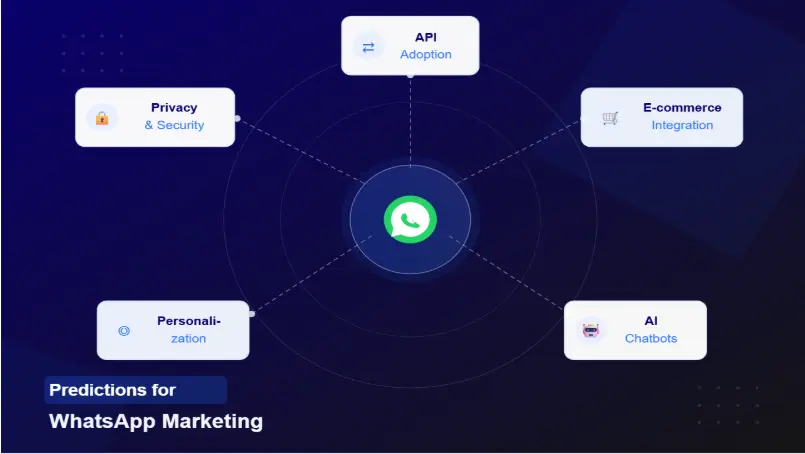
Alt Text: WhatsApp marketing trends with AI, personalization, APIs, and ecommerce.
1. Wider Adoption of the WhatsApp Business API
The WhatsApp Business API is seeing rapid adoption across enterprises and SMBs as businesses use it to automate support, customer updates, and large-scale engagement more efficiently.
2. Deeper Integration with E-Commerce and Digital Payments
WhatsApp is rapidly evolving into a commerce platform where businesses can showcase products, enable payments, automate order updates, and deliver personalized shopping experiences directly within chats.
3. Growing Use of AI-Powered Chatbots
AI-driven chatbots are becoming central to WhatsApp business communication, helping companies automate support, qualify leads, schedule appointments, and deliver instant customer responses at scale.
4. More Personalized Customer Engagement
Businesses are shifting from mass messaging to personalized communication using customer behavior and interaction data to deliver targeted campaigns and more meaningful one-to-one conversations.
5. Enhanced Focus on Privacy and Data Protection
As messaging becomes central to customer engagement, businesses are prioritizing data privacy, consent management, and compliant communication to meet evolving regulations.
The Future of WhatsApp Marketing Is AI-Driven
WhatsApp automation is no longer limited to basic auto-replies. As AI continues to evolve, businesses are using it to create faster, more personalized, and more intelligent customer experiences at scale.
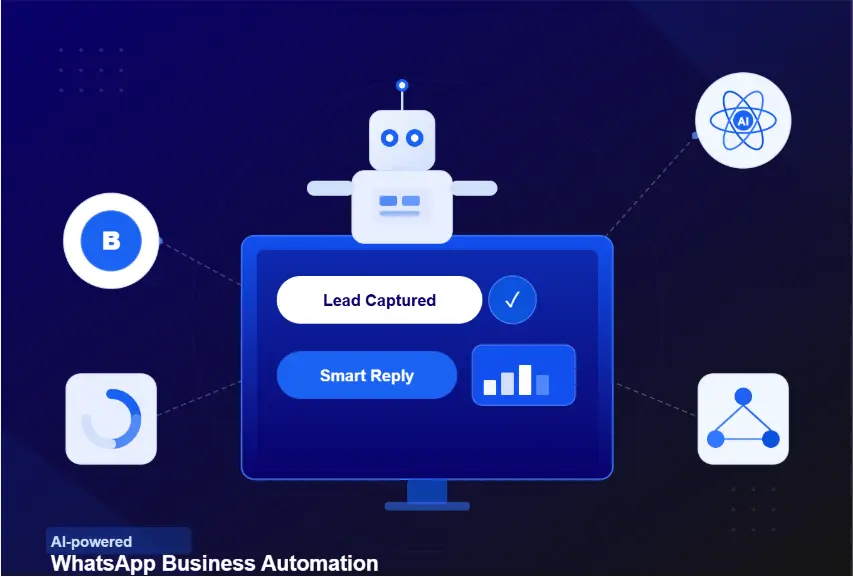
Alt Text: WhatsApp marketing automation with AI chatbots, smart replies, leads, and analytics.
AI is transforming customer engagement by enabling always-on support, more natural conversations, personalized interactions, and smarter workflow automation across the customer journey. Using NLP and behavioral insights, businesses can automate responses, recommendations, reminders, and campaigns while continuously optimizing engagement strategies through AI-powered analytics.
As customer expectations continue to rise, businesses that combine WhatsApp automation with AI-driven workflows will be better positioned to deliver faster engagement, stronger customer relationships, and higher conversions.
Book your demo to explore smarter WhatsApp journeys with Convin.
FAQs
1. How do B2C brands use WhatsApp marketing as part of an omnichannel strategy?
B2C brands connect WhatsApp with websites, CRM systems, support channels, and email journeys to create continuous customer experiences across acquisition, sales, and retention.
2. What is the difference between WhatsApp broadcast marketing and AI-driven WhatsApp engagement?
Broadcast marketing sends static messages, while AI-driven engagement personalizes conversations using customer behavior, intent detection, and real-time automation.
3. How does omnichannel AI improve WhatsApp marketing open rates and response
rates?
Omnichannel AI optimizes timing, personalization, targeting, and conversational context, helping brands increase engagement and customer responsiveness.
4. What WhatsApp marketing use cases deliver the highest ROI for D2C brands in India?
Cart recovery, COD verification, personalized recommendations, loyalty campaigns, delivery tracking, and conversational support often generate the highest ROI.
5. Why is WhatsApp marketing important for mobile-first B2C brands?
WhatsApp aligns with mobile-first customer behavior, enabling faster engagement, higher responsiveness, and conversational buying experiences.
6. Can AI-powered WhatsApp campaigns reduce customer support workload?
Yes. AI automation handles repetitive queries, routes conversations intelligently, and improves resolution speed while maintaining customer experience quality.
.webp)

.avif)

.avif)


.avif)