

At 11:30 AM, the marketing team launches a WhatsApp campaign targeting abandoned leads. Within minutes, customers begin responding. Some ask for callbacks. Some engage on email but ignore the WhatsApp message entirely. A few high-intent leads are ready to convert, but they remain unassigned because the CRM has not updated in real time.
Meanwhile, the sales team continues working from yesterday’s lead sheet, completely unaware of the latest interactions. Customer support has no visibility into campaign activity, and the same customer ends up receiving a promotional email, a missed call, and yet another reminder message within a span of 20 minutes.
The issue is not a lack of automation. It is that most automation systems still operate in silos.
This is the operational reality for many B2C businesses today. Traditional marketing automation platforms were built for campaigns, not continuous customer conversations. They perform well when journeys are linear and channels are limited. But modern customer behavior no longer follows predictable paths.
Customers now move fluidly across WhatsApp, voice calls, email, website chat, and mobile apps, expecting businesses to maintain context seamlessly across every interaction.
According to Salesforce’s State of the Connected Customer report, 79% of customers expect consistent interactions across departments, yet many companies still struggle with disconnected engagement systems.
McKinsey’s research on personalization also found that companies leading in customer personalization generate 40% more revenue from those activities compared to average performers.
The problem is no longer about sending more campaigns. The real challenge is coordinating customer conversations across channels without creating operational chaos internally.
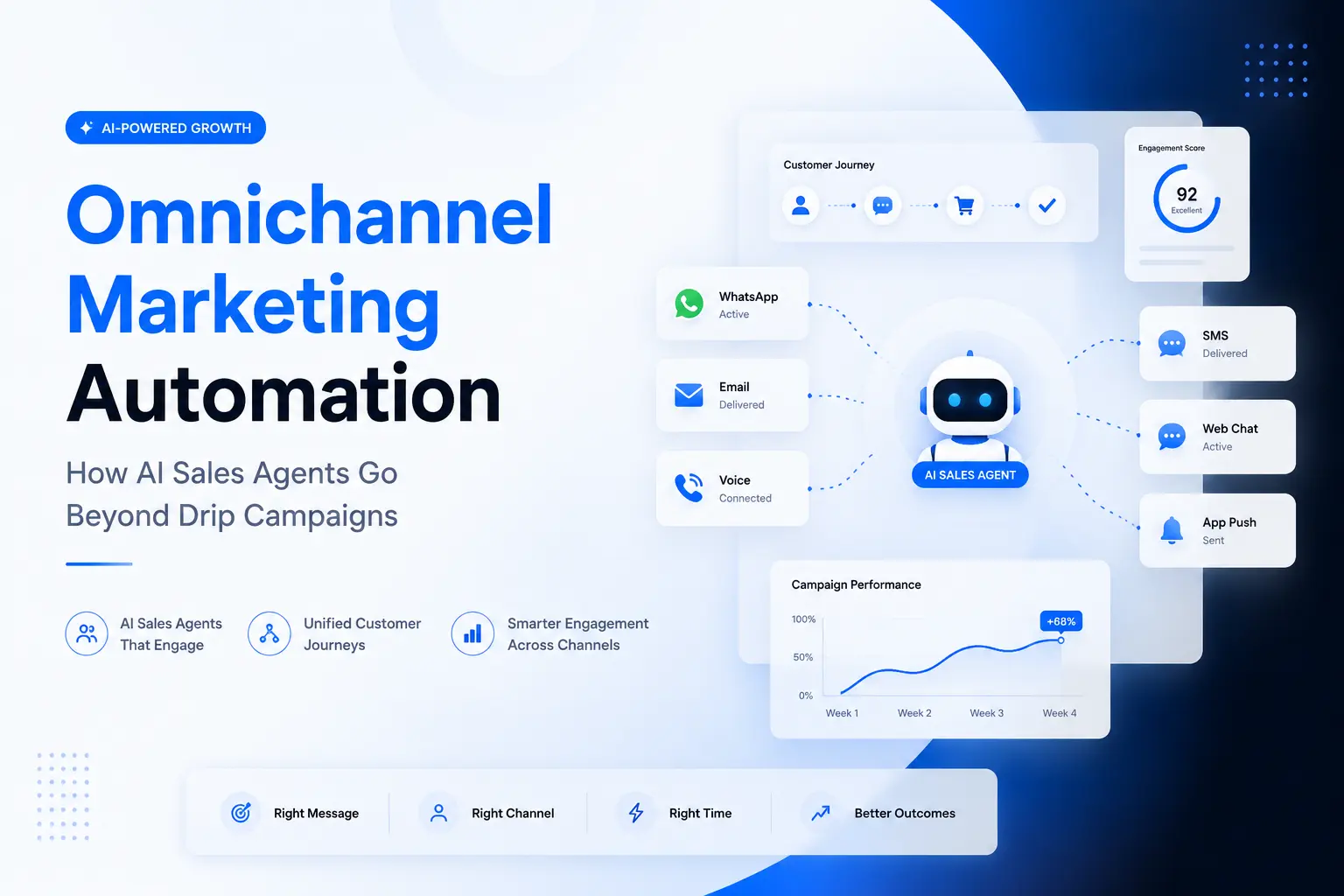
This is why omnichannel marketing automation is evolving beyond traditional drip campaigns. Businesses are increasingly adopting AI sales agents that can respond dynamically to customer behavior, automate lead qualification, trigger real-time follow-ups, and coordinate engagement seamlessly across channels.
The shift is subtle but significant. Automation is moving from simple workflow execution to intelligent conversation orchestration, directly impacting conversion speed, customer experience, and operational efficiency.
Understand how AI is reshaping customer conversation flow.
The Shift: AI Agents vs. Traditional Drips
Traditional drip campaigns follow "broadcast-and-hope" logic. They send pre-written emails on a fixed schedule, which leads to high fatigue and low engagement.
Traditional drip campaigns were built around fixed timelines: Day 1 follow-up, Day 3 reminder, Day 7 re-engagement. While this approach helped businesses automate outreach at scale, the experience often remained predictable and transactional. Even with light personalization, most workflows still relied on predefined schedules rather than actual customer intent.
That model is now beginning to shift.
AI-driven omnichannel automation introduces a more adaptive approach where workflows respond dynamically to customer behavior instead of following rigid sequences. Engagement can now adjust automatically based on actions such as email opens, link clicks, inactivity, conversation responses, or channel preferences.
As a result, businesses are moving away from high-volume broadcasting toward more contextual engagement. Instead of increasing message frequency, AI systems focus on improving timing, channel relevance, and response quality. This not only reduces manual campaign management effort but also creates more natural customer interactions across WhatsApp, email, voice, and other channels.
The difference is becoming increasingly clear: traditional drip campaigns automate schedules, while AI-driven automation continuously adapts to customer behavior in real time.
Why Static Campaign Automation Is Becoming a Bottleneck
The problem with many automation stacks is not the lack of channels.
It is the lack of orchestration.
Marketing teams often operate separate tools for:
- Email campaigns
- WhatsApp broadcasts
- CRM follow-ups
- Contact center operations
- Lead qualification
- Retargeting journeys
As customer journeys become more fragmented, these disconnected systems create operational delays and inconsistent experiences.
KPMG’s research on customer experience transformation highlights that consumers increasingly expect continuity across digital and human interactions. Repeating information across channels or receiving disconnected follow-ups directly impacts trust and conversion quality.
This creates three major operational problems for B2C businesses.
Delayed lead response
High-intent leads often wait too long for engagement because workflows depend on manual assignment or siloed systems.
In industries like insurance, edtech, healthcare, and BFSI, even short delays can significantly reduce conversion probability.
Channel fatigue
Customers frequently receive repetitive messages across email, SMS, and WhatsApp because systems are unable to coordinate engagement states centrally.
Instead of personalization, the experience feels automated in the worst possible way.
Manual campaign operations
Marketing and sales teams spend substantial effort managing workflows manually:
- Uploading lead lists
- Segmenting campaigns
- Triggering reminders
- Coordinating follow-ups
- Updating CRM statuses
As scale increases, operational complexity grows faster than team capacity.
This is where AI sales agents are changing the structure of automation itself.
Experience Convin automating disconnected customer follow-ups.
How Omnichannel AI Automates WhatsApp, Voice & Email Touchpoints
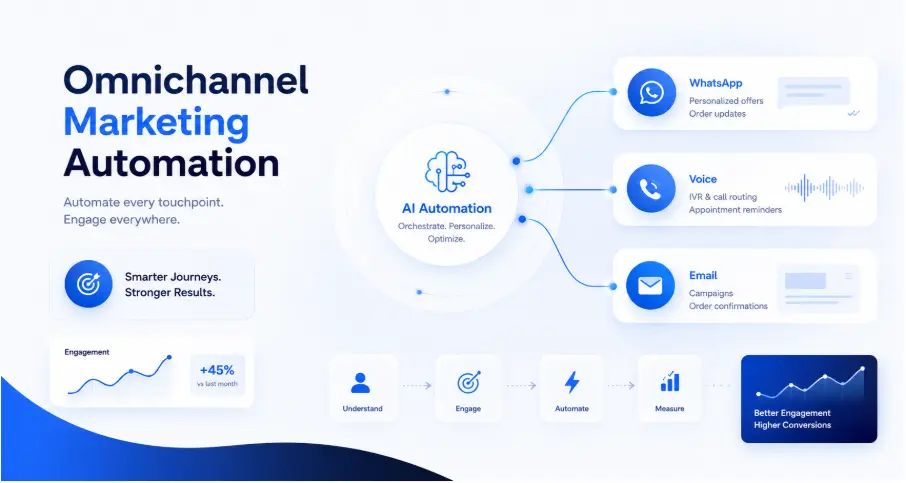
AI sales agents operate differently from traditional automation tools because they are designed around conversation continuity rather than isolated campaigns.
Instead of executing fixed sequences, they continuously evaluate customer actions and decide the next best engagement step.
For example, an omnichannel AI agent can:
- Initiate outbound WhatsApp engagement after lead capture
- Qualify intent through conversational flows
- Trigger voice AI callbacks for high-intent users
- Send personalized email summaries after interactions
- Pause campaigns automatically when conversion signals appear
- Sync conversation outcomes directly into CRM systems
The orchestration layer becomes dynamic.
This matters especially in high-volume B2C environments where customer engagement depends on timing, responsiveness, and personalization at scale.
For instance, if a customer:
- Clicks a pricing page
- Misses a sales call
- Responds positively on WhatsApp
the AI agent can automatically prioritize follow-up actions without requiring manual coordination between marketing and sales teams.
This reduces operational lag while maintaining engagement continuity.
Instead of teams managing campaigns channel by channel, AI systems manage customer journeys holistically.
This blog is just the start.
Unlock the power of Convin’s AI with a live demo.

What Triggers Omnichannel Marketing Automation Workflows Across Different Channels
Modern omnichannel workflows are increasingly event-driven rather than schedule-driven.
The trigger is no longer “Day 3” or “Day 5.”
The trigger is customer behavior.
Some common automation triggers include:
Website behavior
Actions like:
- Pricing page visits
- Form abandonment
- Repeat sessions
- Product exploration depth
can trigger personalized outreach automatically.
Conversational signals
AI systems can detect:
- Purchase intent
- Objections
- Urgency
- Sentiment changes
during conversations and trigger follow-up workflows accordingly.
CRM and lifecycle events
Workflows can activate based on:
- Lead stage changes
- Payment reminders
- Renewal windows
- Incomplete onboarding
- Cart abandonment
Engagement inactivity
Instead of generic reminders, AI agents can dynamically decide:
- Which channel to use
- When to follow up
- Whether escalation is required
This improves engagement efficiency while reducing unnecessary communication volume.
The result is a more coordinated customer experience across the funnel.
See how Convin drives smarter engagement with behavioral AI triggers.
How Indian B2C Brands Reduce Manual Campaign Effort
In India, omnichannel automation adoption is accelerating fastest in industries handling large inbound lead volumes and multilingual customer interactions.
This includes:
- Edtech
- Healthcare
- Real estate
- Insurance
- Ecommerce
- Financial services
The operational challenge in these sectors is scale.
Teams often manage:
- Thousands of inbound leads daily
- Multiple regional languages
- High follow-up dependency
- Distributed call center operations
- Aggressive response-time expectations
Traditional campaign systems struggle in these environments because manual coordination becomes unsustainable.
B2C brands are increasingly using omnichannel AI systems to:
- Automate lead qualification
- Trigger multilingual WhatsApp engagement
- Route priority leads instantly
- Reduce repetitive agent tasks
- Maintain continuous follow-ups without manual intervention
The impact is not only marketing efficiency.
It also affects:
- Speed-to-lead
- Contact center productivity
- Conversion consistency
- Customer experience quality
McKinsey’s research on AI-driven customer operations shows that companies integrating AI into customer engagement workflows often improve both operational efficiency and revenue performance simultaneously.
This is why omnichannel marketing automation is gradually shifting from a campaign optimization tool into a broader revenue operations capability.
See how Convin automates lead engagement with less manual effort.
The Future of Omnichannel Marketing Automation Is Conversational
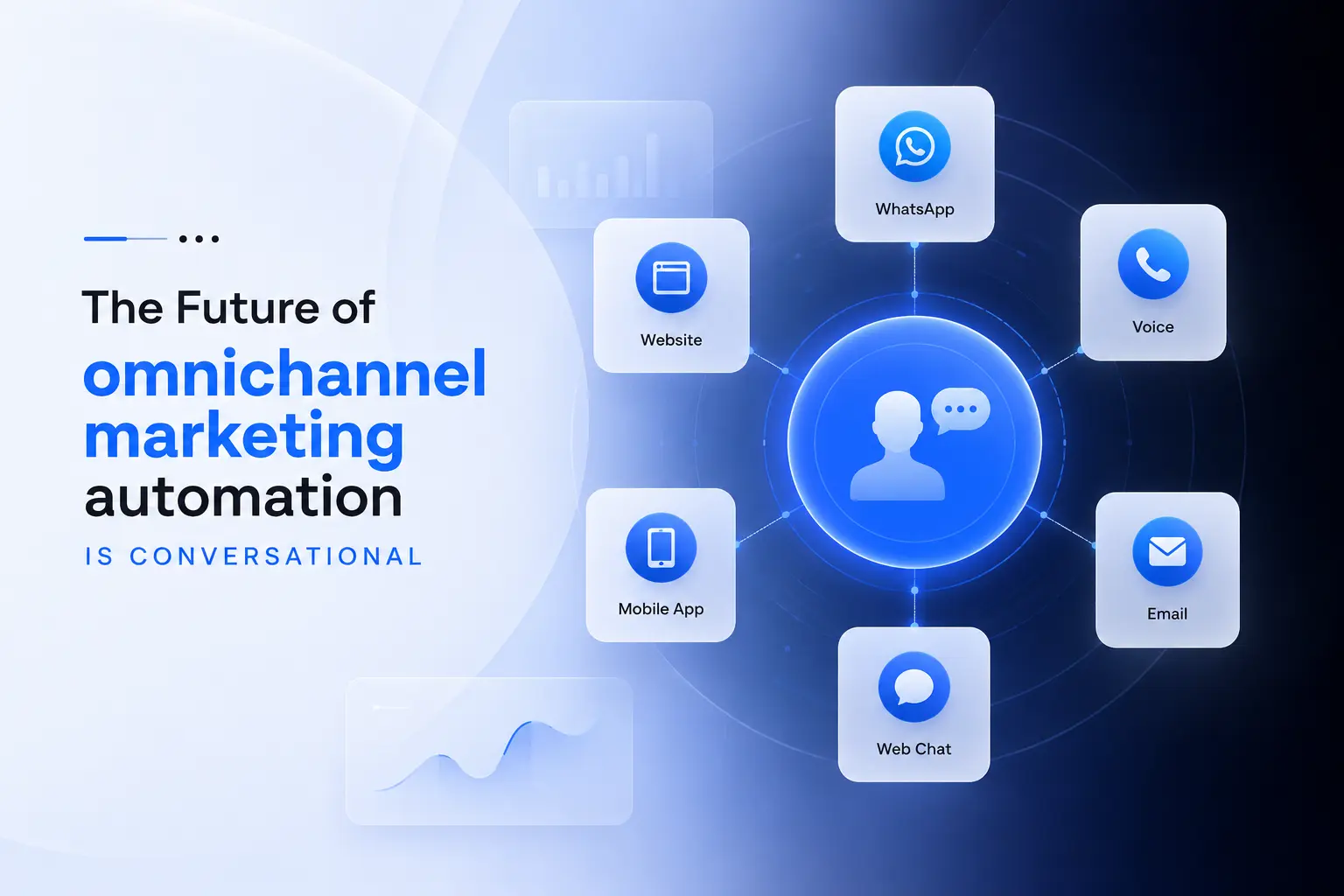
The next phase of automation is not about sending more campaigns. It is about managing customer intent in real time across channels.
As customer journeys become increasingly non-linear, businesses need systems capable of:
- Understanding engagement context
- Coordinating conversations
- Triggering actions dynamically
- Reducing operational dependency on manual workflows
This is where AI sales agents are reshaping omnichannel marketing automation.
Instead of functioning as isolated campaign engines, modern AI systems act as orchestration layers connecting marketing, sales, and customer engagement into one continuous workflow.
For B2C businesses managing high-volume customer interactions, that shift is becoming less of a competitive advantage and more of an operational requirement.
Explore how Convin powers AI-led conversational customer journeys.
What This Means for B2C Growth Teams
Omnichannel marketing automation is moving beyond fixed drip campaigns toward real-time, behavior-driven orchestration. Instead of sending pre-scheduled messages, AI sales agents now respond dynamically to customer actions across WhatsApp, email, voice, and chat, keeping every interaction contextual and timely.
This shift helps businesses reduce delays, eliminate channel conflicts, and ensure high-intent leads are never missed or left unassigned. Marketing, sales, and support teams no longer operate in silos but work from a unified, continuously updated customer view.
For high-volume B2C businesses, the real change is clear: automation is no longer just about sending campaigns efficiently, but about managing customer conversations intelligently across the entire journey.
Book your demo to see unified AI-led customer conversations.
FAQs
1. Is omnichannel marketing automation only useful for large enterprises?
No. Even mid-sized businesses benefit because it reduces manual follow-ups, improves response time, and helps teams manage leads across multiple channels without losing context.
2. Do AI sales agents replace human sales teams?
No. AI sales agents handle repetitive tasks like follow-ups, qualification, and routing, while human teams focus on closing deals and handling complex conversations.
3. How difficult is it to integrate omnichannel automation with existing CRM systems?
Most modern platforms are designed for easy CRM integration through APIs or native connectors, allowing real-time syncing of leads, conversations, and engagement data.
4. Can omnichannel automation work with regional languages?
Yes. Many AI-driven systems support multilingual conversations, enabling businesses to engage customers in regional languages across WhatsApp, voice, and chat.
5. What industries benefit the most from conversational automation?
Industries with high lead volumes and fast response needs, such as education, insurance, real estate, healthcare, and e-commerce, see the most impact.

.webp)


.avif)