

A customer discovers your brand through an Instagram ad during lunch break. They click through to your website, browse a product, and leave without purchasing.
Two hours later, they send a message on WhatsApp asking about pricing. No one responds for 45 minutes.
The next morning, your sales team calls them without context. The customer has to repeat everything again:
"I already spoke to someone yesterday."
By evening, the customer has purchased from a competitor.
This is not a lead generation problem.
It is a communication continuity problem.
Modern B2C customers move rapidly across channels. They discover on social media, ask questions on WhatsApp, respond to SMS, continue on calls, and expect brands to remember every interaction instantly.
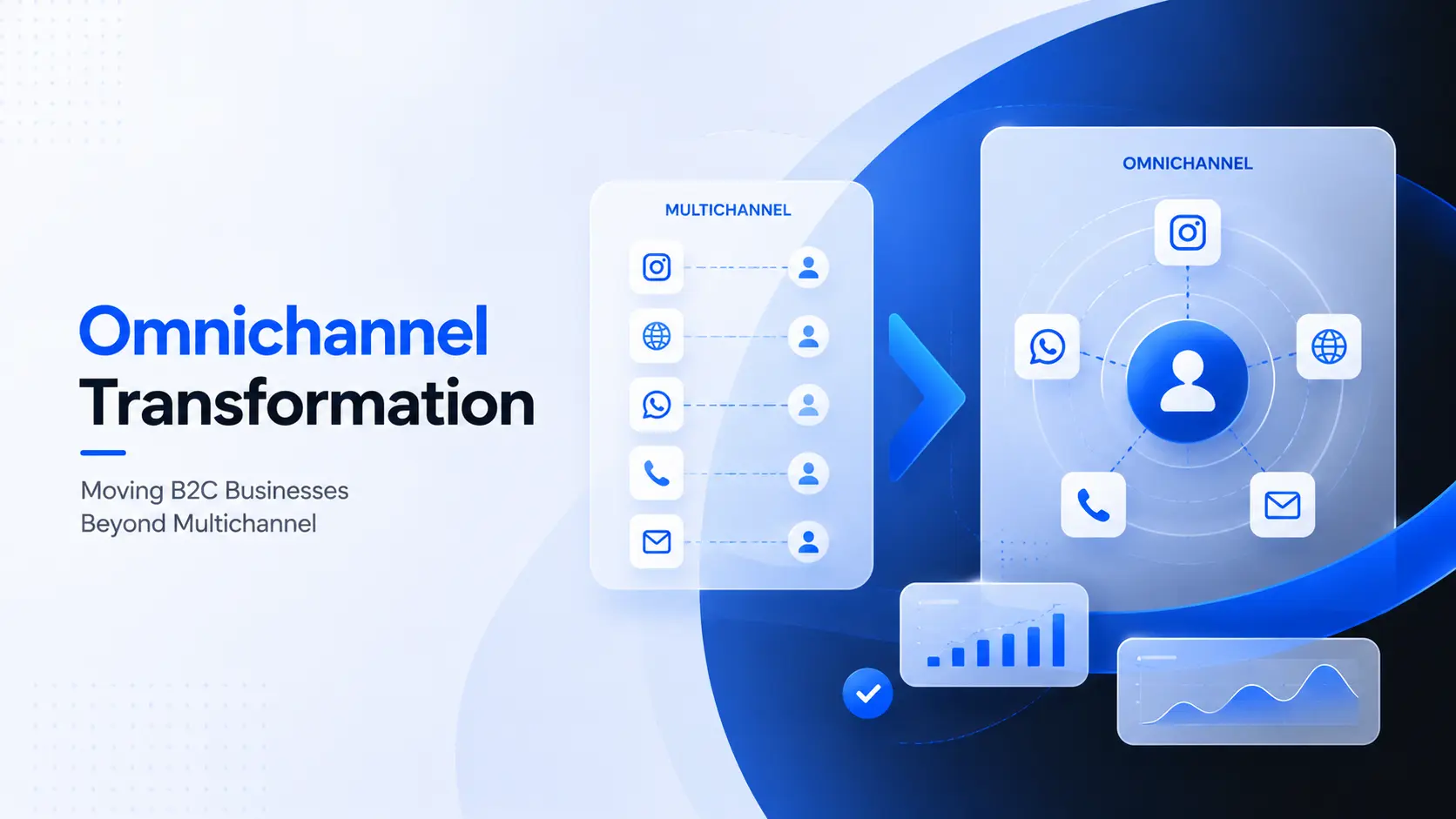
Most businesses already use multiple communication channels. The issue is that these systems operate independently. Conversations become fragmented, teams lose context, follow-ups become inconsistent, and customer experience suffers.
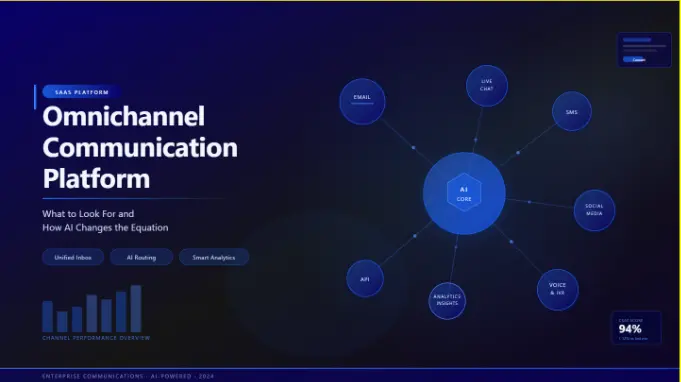
That is why businesses are increasingly investing in an omnichannel communication platform. Not simply to add more channels, but to unify conversations, automate engagement, and create continuity across the customer journey.
In this blog, we will break down what businesses should actually look for in an omnichannel communication platform and how AI is fundamentally changing what these systems can do.
What Is an Omnichannel Communication Platform and What Should It Do for a B2C Business?

An omnichannel communication platform is a centralized system that allows businesses to manage customer interactions across multiple channels from a single unified environment.
These channels typically include:
- Voice calls
- SMS
- Website chat
- Mobile apps
- Social messaging platforms
However, simply connecting channels is not enough.
For a B2C business, the platform must create continuity across the entire customer journey. Customers should be able to move between channels without losing conversation history, intent, or context.
A strong omnichannel communication platform should help businesses:
- Centralize customer conversations
- Eliminate fragmented communication
- Improve lead response speed
- Automate follow-ups
- Route conversations intelligently
- Reduce manual agent effort
- Maintain consistent customer experiences
- Improve conversion rates and retention
This becomes especially important in high-volume industries such as:
- BFSI
- EdTech
- Healthcare
- Ecommerce
- Real estate
- Travel
- Insurance
In these sectors, delayed responses and disconnected conversations directly impact revenue.
Salesforce’s 2025 State of the Connected Customer report found that 73% of customers expect businesses to treat them like individuals rather than just another transaction.
The expectation from customers has changed. They no longer evaluate businesses only by product quality or pricing. They evaluate responsiveness, continuity, and convenience.
An omnichannel communication platform becomes the operational layer that enables this experience at scale.
Where Most Traditional Communication Systems Fail
Many businesses believe they already have omnichannel communication because they use multiple channels.
In reality, they are often operating with disconnected tools:
- One dashboard for WhatsApp
- Another for calling
- Separate CRM notes
- Manual follow-ups
- No shared conversation history
This creates operational silos.
Agents cannot see prior interactions. Marketing teams cannot track engagement journeys. Customers repeat information across channels. Follow-ups become inconsistent.
As conversation volumes grow, these inefficiencies compound rapidly.
This is exactly where AI-powered omnichannel systems are changing the equation.
This blog is just the start.
Unlock the power of Convin’s AI with a live demo.

How Does AI Omnichannel Differ From Multi-Channel Tools?
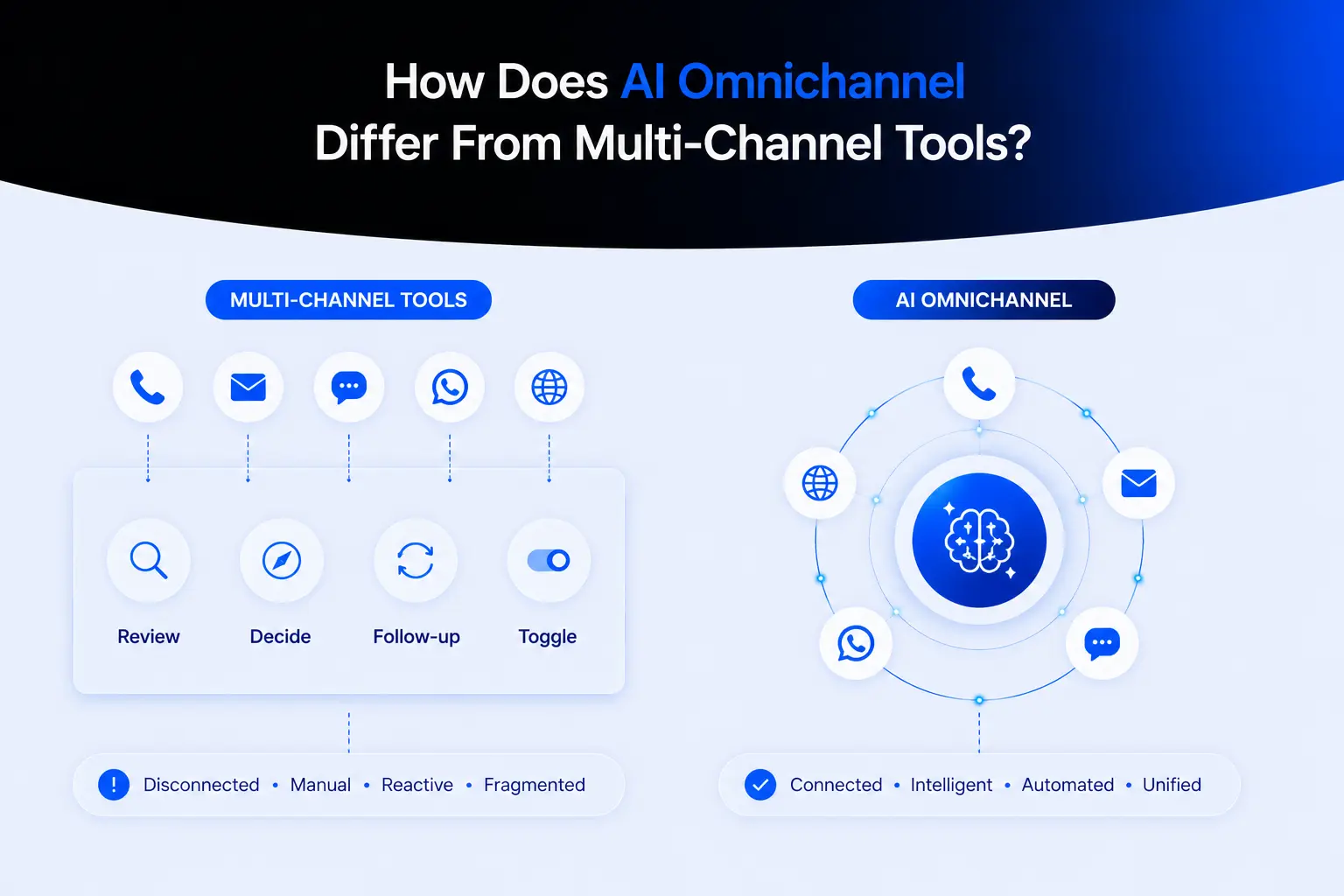
A standard multi-channel tool gives businesses access to multiple communication channels.
An AI-powered omnichannel communication platform goes significantly further. It introduces intelligence, automation, orchestration, and real-time decision-making into customer conversations.
McKinsey notes that AI-powered customer engagement systems can coordinate and personalize interactions across touchpoints to improve conversion, retention, and upselling outcomes.
The difference is not just technical. It changes operational outcomes entirely.
Standard Multi-Channel Systems Focus on Access
Traditional systems primarily help businesses:
- Send messages
- Receive inquiries
- Manage tickets
- Handle basic routing
While useful, these platforms still rely heavily on manual operations.
Agents often need to:
- Read conversation history manually
- Decide next actions themselves
- Perform repetitive follow-ups
- Switch between systems constantly
As customer volume increases, scalability becomes difficult.
AI-Powered Omnichannel Platforms Focus on Continuity and Automation
AI-powered systems actively manage customer journeys instead of simply hosting conversations.
These platforms can:
- Trigger automated follow-ups
- Prioritize high-intent leads
- Summarize conversations instantly
- Detect customer intent
- Recommend next-best actions
- Route conversations intelligently
- Personalize interactions across channels
- Maintain unified conversation memory
For example:
If a customer abandons a form midway, the platform can automatically initiate a WhatsApp reminder. If the customer later responds through a call, the agent immediately sees prior interactions and intent history.
This reduces friction for both customers and teams.
AI Also Improves Operational Efficiency
Beyond customer experience, AI dramatically improves internal efficiency.
Businesses can automate:
- Lead qualification
- Appointment reminders
- Payment follow-ups
- Renewal campaigns
- Feedback collection
- Re-engagement campaigns
This reduces dependency on manual outreach while improving consistency.
Most importantly, AI enables businesses to scale communication without proportionally scaling operational complexity.
Which Channels Must An Omnichannel Platform Support For B2C Sales In India?
India’s B2C communication landscape is uniquely complex.
Customers use different channels depending on:
- Geography
- Language preference
- Internet accessibility
- Urgency
- Age group
- Purchase stage
An omnichannel communication platform built for India must support channels that align with real customer behavior rather than global assumptions.
WhatsApp Is Non-Negotiable
For many Indian consumers, WhatsApp is the primary business communication channel.
Customers use it for:
- Product inquiries
- Appointment scheduling
- Payment confirmations
- Support requests
- Purchase decisions
Businesses without strong WhatsApp integration risk losing responsiveness where customers are most active.
The platform should support:
- Automated messaging
- Two-way conversations
- Campaign broadcasts
- AI-driven responses
- CRM-linked conversation tracking
Voice Still Plays a Critical Role
Despite digital growth, voice remains essential for:
- High-intent conversions
- Financial services
- Healthcare
- Real estate
- Education counseling
Customers often prefer speaking to an agent before making important decisions.
The platform should support:
- Inbound and outbound calling
- AI voice agents
- Call recording
- Real-time assistance
- Context-aware call routing
SMS Remains Important for Reach and Reliability
SMS continues to be effective for:
- OTPs
- Reminders
- Payment alerts
- Time-sensitive communication
Especially in regions with inconsistent internet connectivity, SMS remains operationally valuable.
Email and Web Chat Support the Broader Journey
While WhatsApp and voice dominate engagement, email and website chat remain important for:
- Documentation
- Formal communication
- Long-form customer support
- Website conversion workflows
Multilingual Support Is Essential in India
An effective omnichannel communication platform should also support multilingual engagement.
According to KPMG’s India CX Report 2025, minimizing customer effort and delivering personalized experiences remain two of the strongest drivers of customer experience value in India.
Customers respond more positively when businesses communicate in their preferred language across channels.
This becomes particularly important for:
- Regional expansion
- Tier-2 and Tier-3 markets
- High-volume customer operations
The broader the channel support and language capability, the more effectively businesses can engage diverse customer segments across India.
Convin unifies AI-powered customer engagement across every channel.
How Does An Omnichannel Platform Maintain Context When Customers Switch From WhatsApp to Voice?
Context continuity is one of the biggest challenges in customer communication.
Without it, every channel switch feels like a new conversation.
Customers become frustrated when they have to:
- Repeat information
- Re-explain issues
- Restart conversations
- Reconfirm preferences repeatedly
An effective omnichannel communication platform eliminates this fragmentation.
Unified Customer Profiles Centralize Conversation History
Modern platforms maintain centralized customer profiles that store:
- Previous conversations
- Interaction timelines
- Channel history
- Purchase intent
- Agent notes
- Behavioral signals
This creates a persistent communication memory across channels.
If a customer first interacts through WhatsApp and later receives a call, the agent can immediately see:
- What the customer asked earlier
- Which products they viewed
- What stage they are in
- Whether they showed buying intent
The conversation continues naturally instead of restarting.
AI Helps Maintain Real-Time Context
AI-powered systems strengthen this continuity further.
They can:
- Summarize previous conversations instantly
- Detect customer sentiment
- Surface key talking points for agents
- Identify unresolved concerns
- Recommend contextual next actions
This significantly improves customer experience while reducing agent workload.
Intelligent Routing Preserves Continuity
Advanced platforms also use contextual routing.
For example:
- Repeat customers can be prioritized automatically
- Existing conversations can route to the same agent
- High-intent leads can escalate instantly
- Support conversations can transfer without information loss
This operational continuity directly improves:
- Customer satisfaction
- Conversion rates
- First-contact resolution
- Agent productivity
In modern B2C operations, context retention is no longer optional. It is a core expectation.
Convin maintains seamless customer context across every channel.
AI Is Redefining Expectations From Omnichannel Communication Platforms
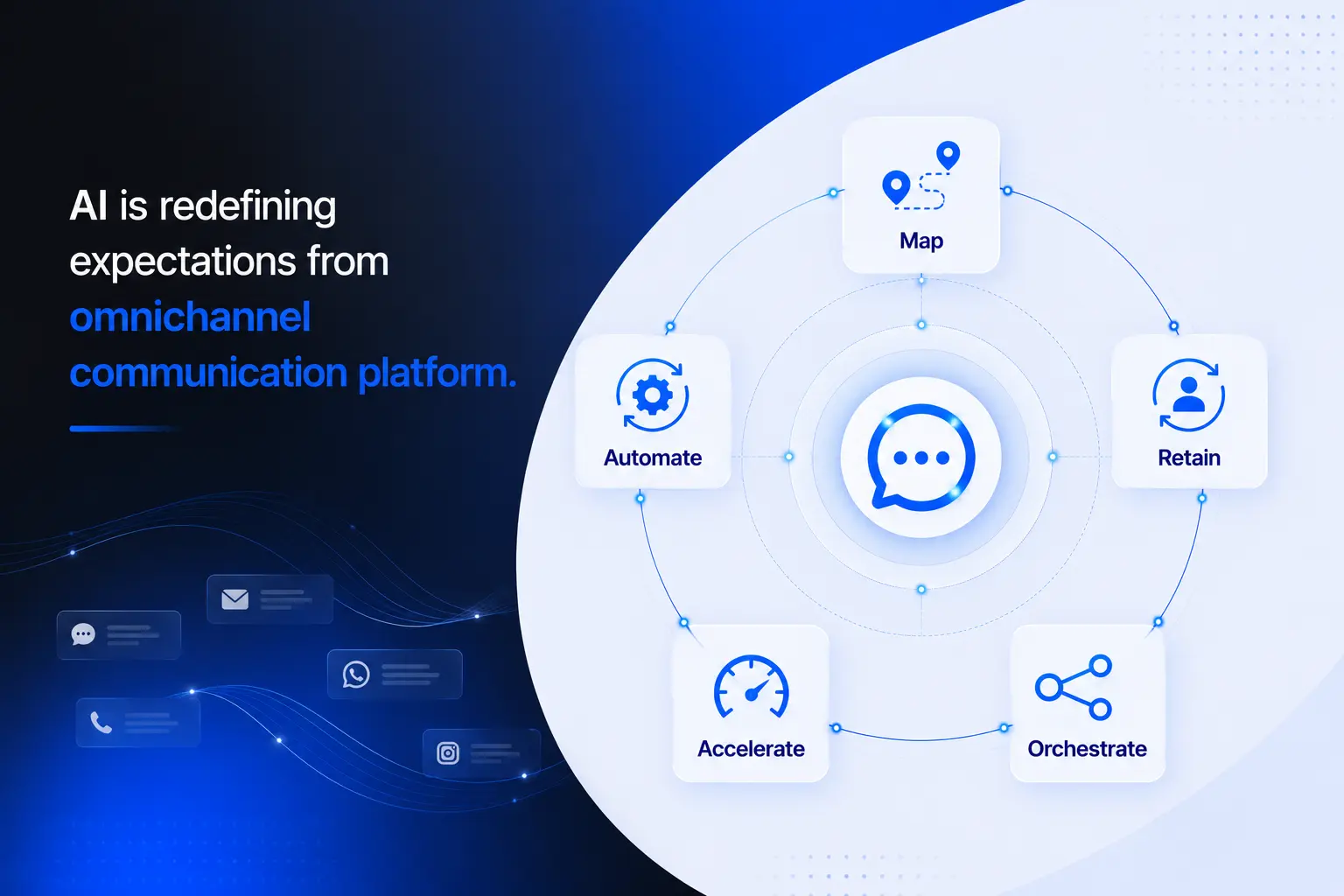
Businesses no longer need communication systems that simply connect channels.
They need platforms that:
- Understand customer journeys
- Automate repetitive engagement
- Preserve context
- Improve responsiveness
- Scale conversations intelligently
The shift from fragmented communication tools to AI-powered omnichannel communication platforms is becoming a competitive necessity for B2C businesses.
As customer expectations continue to rise, the ability to deliver fast, connected, and context-aware experiences will directly influence growth, retention, and operational efficiency.
The businesses that succeed will not necessarily be the ones with the most channels.
They will be the ones that create the most seamless conversations across those channe
What This Means For Your Business
Customer communication is no longer limited to a single channel or isolated interaction. Modern B2C journeys move rapidly across WhatsApp, voice, SMS, web chat, and more, often within the same buying cycle.
An effective omnichannel communication platform helps businesses bring these conversations together into one connected experience. With AI added to the equation, businesses can move beyond basic communication management toward intelligent engagement that improves responsiveness, continuity, and operational efficiency.
As customer expectations continue to evolve, businesses that invest in AI-powered omnichannel communication will be better positioned to scale engagement, improve conversions, and deliver more seamless customer experiences across every touchpoint.
FAQs
1. Can an omnichannel communication platform integrate with a CRM?
Yes. Most modern platforms integrate with CRMs to centralize customer data, conversation history, and engagement activity.
2. Is an omnichannel communication platform suitable for small businesses?
Yes. Small businesses can use omnichannel platforms to improve responsiveness, automate communication, and scale customer engagement efficiently.
3. How long does it take to implement an omnichannel communication platform?
Implementation timelines vary, but many cloud-based platforms can be deployed within a few weeks depending on integrations and business requirements.
4. Can AI handle customer conversations without human agents?
AI can manage routine inquiries and qualification tasks, while complex or high-value conversations can be escalated to human agents.
5. How do businesses measure the success of an omnichannel communication platform?
Common metrics include response time, conversion rates, customer satisfaction, engagement rates, and agent productivity.

.webp)


.avif)