


Customers no longer evaluate support based on how many channels a business offers. They evaluate whether the experience feels connected.
A customer may begin an inquiry on WhatsApp, continue it through a phone call, and later expect updates over email. They do not expect to repeat information every time the channel changes. When that continuity breaks, customer effort increases immediately.
This shift in expectation is exactly why Omnichannel AI is becoming central to modern CX strategy.
India’s conversational AI market has already reached INR 38,100 crore and is projected to grow to INR 1,52,310 crore by 2030. At the same time, 88% of Indian CX leaders say AI tools are already delivering measurable ROI.
The difference now is not whether businesses use AI. It is whether their AI systems create connected customer journeys or fragmented ones.
Omnichannel AI Fixes Fragmented Customer Journeys
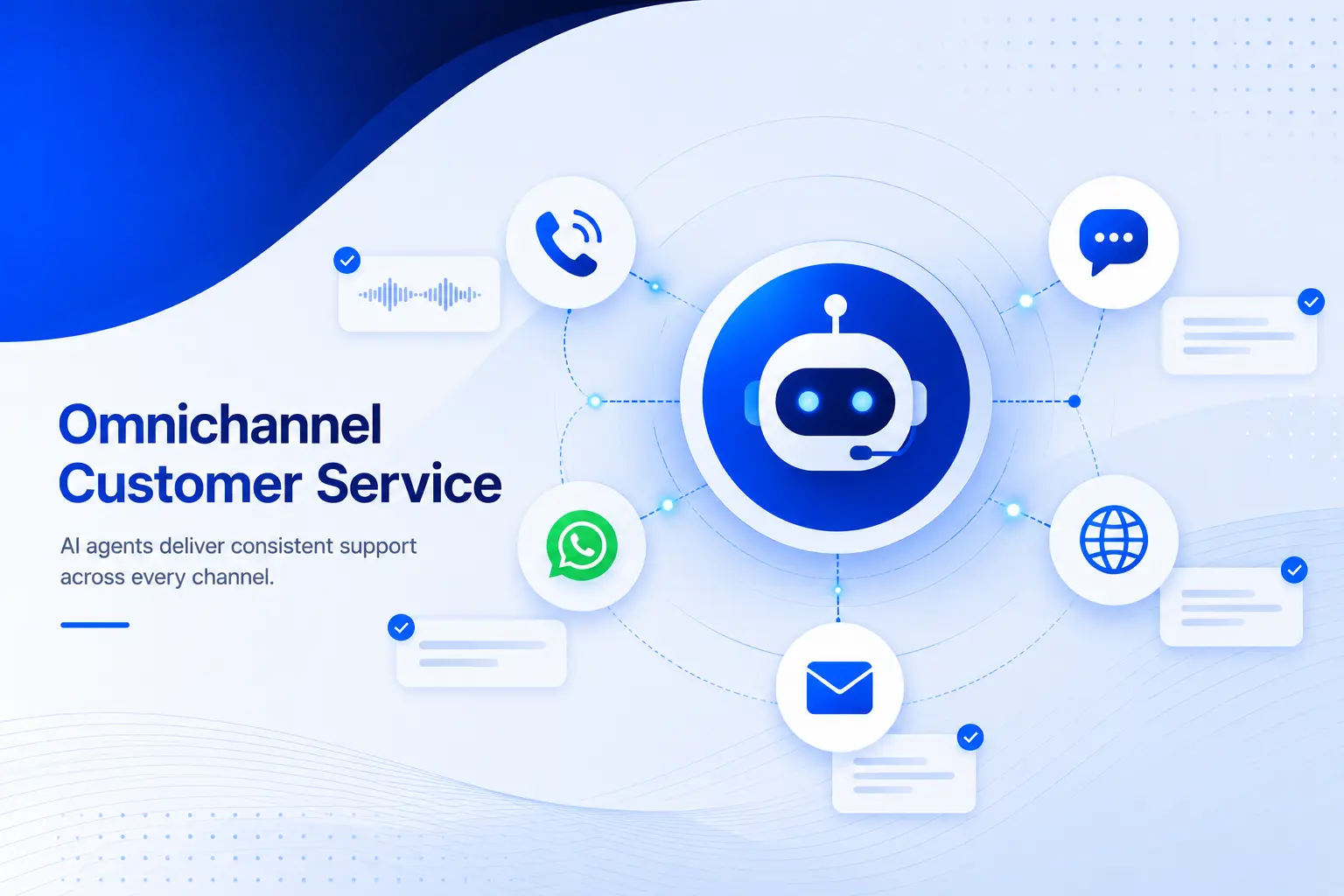
Most businesses today operate across calls, chat, WhatsApp, email, and social channels. However, in many support environments, these systems still function independently, creating disconnected customer experiences.
Convin solves this by unifying conversations across every channel into a single customer view. Its AI Phone Agents, Conversation Intelligence, and CRM integrations ensure that customer identity, intent, and history remain consistent across interactions.
A customer may switch channels during a journey, but Convin ensures the context moves with them—eliminating repetition and improving resolution speed.
When context is unified through Convin’s omnichannel layer, every interaction becomes faster, more accurate, and more predictable.
See how continuity removes friction customers instantly notice.
Omnichannel AI Creates Shared Customer Context
Customers expect systems to remember them across every interaction, regardless of channel shifts.
Convin enables this by maintaining a persistent customer memory layer powered by Conversation Intelligence and AI-driven data stitching across CRM, telephony, and messaging platforms.
With Convin’s AI Phone Agents, conversations can begin, evolve, and continue across channels without losing context—even when interactions shift from WhatsApp to voice or email.
Discover why remembered conversations build stronger customer trust.
This blog is just the start.
Unlock the power of Convin’s AI with a live demo.

Why Omnichannel AI Improves Resolution Rates
Resolution speed improves when all interaction data is unified and accessible in real time.
Convin removes operational friction by connecting every customer touchpoint into a single intelligence system powered by Conversation Intelligence, AI Phone Agents, and Automated QA.
Organizations using Convin have achieved:
- 21% increase in sales
- 27% improvement in CSAT
- 25% increase in retention
- 56-second reduction in AHT
- 60% lower ramp-up time
Convin ensures every interaction contributes to system-wide learning, improving resolution efficiency over time.
Explore what faster resolution looks like with connected conversations.
Where Multichannel Supports Omnichannel AI
Multichannel systems still support early-stage customer engagement strategies, especially when businesses expand across WhatsApp, chat, email, and voice. However, as customer volume increases, fragmentation becomes a major challenge because each channel operates in isolation.
Omnichannel AI addresses this limitation by connecting all channels into a single, continuous customer journey where context, history, and intent move seamlessly with the customer across touchpoints.
For example, a customer may raise a refund request on WhatsApp, follow up later on a phone call, and then receive confirmation via email. In a multichannel setup, they would likely need to repeat their issue at each step. With an omnichannel AI system, the entire conversation history travels with the customer, so the next interaction automatically continues from where the last one ended—without repetition or delays.
With over 800 million internet users, 700 million smartphone users, and 500 million WhatsApp users in India, customers frequently switch between channels within the same interaction. Omnichannel AI ensures this movement is fluid rather than fragmented, removing the need for customers to restart conversations.
Businesses adopting omnichannel AI systems are already seeing 30–50% lower service costs and 20–40% higher conversion rates, with every AI-handled interaction saving approximately four minutes of operational effort through improved continuity and reduced repetition.
Understand when multichannel works—and when continuity matters more.
Omnichannel AI for Cross-Channel Continuity
Omnichannel AI works by unifying identity, interaction history, routing logic, analytics, and automation workflows into a single system.
Instead of treating each interaction as a separate ticket, the system connects all interactions into a continuous customer journey.
Convin integrates with cloud telephony systems, CRM platforms, dialers, QA systems, messaging tools, and conferencing systems while continuously analyzing conversations using NLP and machine learning models.
The ecosystem includes Automated QA, AI Phone Agents, Conversation Intelligence, and behavioral analytics working together as one unified layer.
See the systems powering truly connected customer conversations.
Convin Omnichannel AI for Scalable CX
Omnichannel AI delivers value through orchestration rather than isolated automation by building a unified customer experience layer where every interaction is connected in real time.
In Convin, this is achieved through a tightly integrated architecture where multiple AI modules work on a shared data and intelligence layer instead of operating as separate tools.
At a technical level, the setup typically includes:
- AI Phone Agents (Voice + Messaging Layer): Handle inbound and outbound interactions, trigger reminders, and execute follow-ups while continuously logging structured interaction data.
- Conversation Intelligence Layer: Uses NLP models to extract intent, sentiment, objections, and outcomes from every call or chat, converting unstructured conversations into usable data signals.
- Unified Customer Context Engine: Maintains persistent identity resolution across channels (WhatsApp, voice, email, chat), ensuring every interaction is mapped to a single customer timeline.
- Automated QA System: Continuously evaluates 100% of interactions for compliance, quality, and performance metrics instead of sample-based review.
- Workflow + CRM Sync Layer: Pushes real-time updates into CRMs, ensuring every interaction immediately reflects in business systems without manual intervention.
Together, these layers create a continuous feedback loop: every interaction is analyzed, stored, and reused to improve routing, automation accuracy, and future engagement quality.
This architecture enables omnichannel AI to function as a single orchestration system rather than multiple disconnected automation tools—ensuring every customer touchpoint strengthens the next one.
See how AI orchestration transforms interactions into operational improvement.
Building Connected CX With Omnichannel AI
Customer experience is shifting from channel expansion to experience continuity.
Market signals reinforce this shift:
- India’s AI ecosystem continues to scale rapidly with strong CAGR growth projections
- Omnichannel AI is becoming a core CX foundation rather than an optional layer
- Businesses increasingly require unified AI systems instead of fragmented tools
As journeys become more complex, the ability to maintain context across interactions becomes essential for scaling customer operations effectively.
Learn the framework behind scalable, connected customer experiences.
Omnichannel AI Sets the New CX Standard
Customer expectations are now defined by continuity, not channel availability. They expect systems to remember interactions, preserve context, and deliver consistent experiences across every touchpoint.
When continuity breaks, customer trust breaks with it.
Omnichannel AI addresses this by connecting conversations, systems, and workflows into a unified experience layer.
Convin’s AI ecosystem—AI Phone Agents, Conversation Intelligence, Automated QA, CRM automation, behavioral analytics, and orchestration systems—enables businesses to scale customer operations while maintaining continuity and personalization.
As customer journeys become increasingly complex, connected experiences are no longer a differentiator.
They are becoming the baseline expectation for every customer interaction.
See why connected experiences are becoming the new customer expectation.
FAQs
How does omnichannel AI impact customer retention over time?
It improves retention by reducing friction, preserving context, and delivering consistent experiences that build trust and long-term engagement.
What challenges arise when migrating from multichannel AI to omnichannel AI?
Common challenges include data silos, system integration complexity, and aligning teams around a unified customer experience strategy.
How does omnichannel AI handle data privacy across channels?
It centralizes data governance, ensuring consistent compliance policies while maintaining secure access across all integrated channels.
Can omnichannel AI integrate with legacy CX systems effectively?
Yes, with proper APIs and middleware, omnichannel AI can extend legacy systems while gradually modernizing the CX infrastructure.
What industries benefit the most from omnichannel AI adoption?
Industries with high customer interaction volumes like BFSI, ecommerce, healthcare, and telecom gain the most from omnichannel AI.
.avif)




.avif)