

There is a question I keep hearing from CMOs and VP Growth leaders: “We have HubSpot, WhatsApp Business, and a call center. Why does the experience still feel disjointed?”
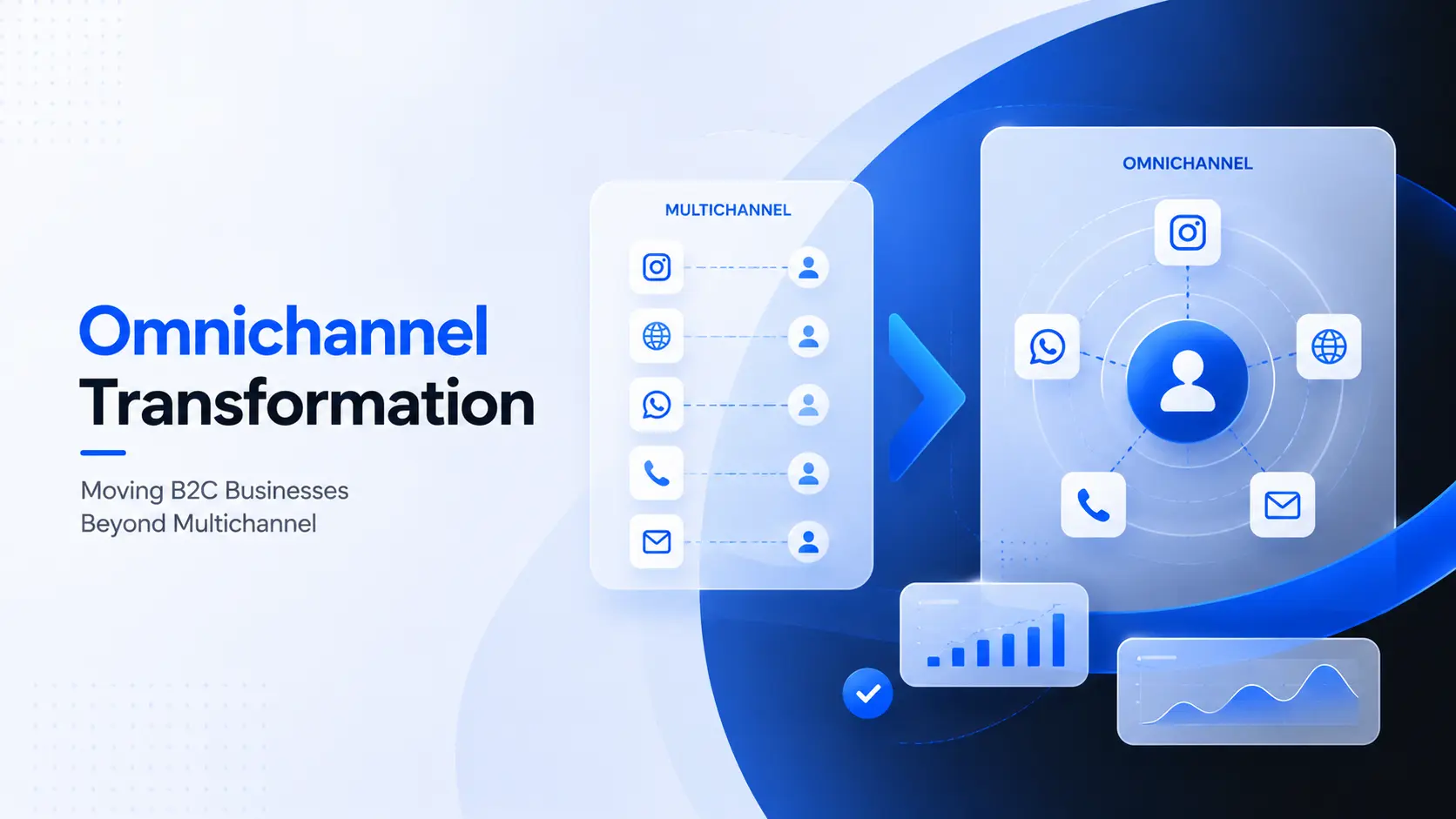
The answer is usually the same. Their tools run in parallel, not as one journey.
That is where customer journey automation matters. It is not another campaign layer. It is the system that decides what happens next based on what the customer actually did, said, or felt, then moves that decision across channels without forcing the customer to repeat themselves. The need is real. Bain says 80% of companies believe they deliver a superior customer experience, while only 8% of customers agree
Nextiva also reports that 86% of companies with multiple CX tools have siloed data
[Source: Bain & Company, Nextiva State Of Customer Experience 2025].
Convin is built for that gap. Its model is to connect conversation intelligence, voice, WhatsApp, email, and CRM so the journey stays continuous instead of fragmented
See Convin orchestrate every customer journey in action.
What Customer Journey Automation Actually Means in Modern Revenue Teams
Customer journey automation is not a drip campaign with a fancier name.
A drip campaign is pre-sequenced. Email 1 goes out on day 0, email 2 on day 3, and so on. The journey does not change just because the customer changes. Real customer journey automation is dynamic. It listens, interprets, and reacts.
Customer journey automation uses real-time customer behavior, intent, and sentiment to decide the next best action across channels. Unlike a drip campaign, it adapts in the moment, so a customer who called yesterday and went silent today does not get treated like a brand-new lead.
Forrester defines customer journey orchestration as using real-time individual-level data to analyze current behavior, predict future behavior, and adjust the journey in the moment for more customer lifetime value
That is the right frame. The system should not just send messages. It should choose the next move.
The scale of the opportunity is why this category is growing so quickly. The AI customer support tools market is valued at $12.06 billion in 2024 and projected to reach $47.82 billion by 2030
The broader AI marketing market is projected to reach $107.5 billion by 2028
[Source: Forrester Wave CJO Q2 2024, Kodif, SuperAGI].
Build adaptive journeys with Convin's AI orchestration layer.
How Omnichannel AI Preserves Context Across Every Customer Interaction
Context loss is the silent killer of customer experience.
[Source: Deloitte Digital 2024 Global Contact Center Survey].
That is why omnichannel AI has to behave like one memory, not four disconnected tools.
Convin’s architecture is designed around that idea. It records and synthesizes every voice call, WhatsApp exchange, email, and chat interaction into a live customer profile, so the next channel starts with the full history instead of a blank slate.
Cloudflight describes the same pattern in omnichannel conversational AI, where history, preferences, and inquiry status move forward automatically when a customer changes channels.
Parloa adds that sentiment can trigger escalation without losing the transcript or state .
The business outcome is measurable. Kodif says AI-driven omnichannel strategies reduce channel switching during issue resolution by 40% to 60%
Plivo says omnichannel service lifts CSAT to 67%, compared with 28% for disconnected multichannel
[Source: Salesmate, Armatis, Cloudflight, Parloa, Plivo].
SuperAGI says strong omnichannel strategies retain 89% of customers, versus 33% for those without one
Unified Customer Profile: a live record of what the customer did, said, and preferred across every channel, used to keep the next interaction context-aware.
Keep customer context unified across every Convin channel.
This blog is just the start.
Unlock the power of Convin’s AI with a live demo.

What AI-Orchestrated Customer Journey Automation Looks Like in Practice
The journey should feel like one conversation, even when it moves across channels.
A lead clicks an ad, submits a callback form, and gets an AI call within seconds. The AI qualifies intent, budget, and timeline. The call summary then becomes a WhatsApp message with the relevant offer or next step. If the customer opens the message but does not act, an email with relevant content follows. That is not three campaigns. It is one orchestrated loop.
Speed matters at the first touch. The MIT lead response study says contacting a lead within 5 minutes makes a company 100 times more likely to connect and 21 times more likely to qualify the lead.
Harvard Business Review says that companies responding within one hour are 7 times more likely to qualify the lead
That is why real-time orchestration matters.
Convin’s outbound and journey logic fits this stage well. Its AI Phone Calls can capture objections, budget signals, and sentiment in real time, then trigger the next message or handoff immediately.
That is the difference between response automation and journey automation.
Voice AI can enrich follow-up with loyalty status, preferences, and past interactions, then extend the conversation into SMS, email, or WhatsApp
[Source:MIT Lead Response Study].
Turn every interaction into revenue with Convin automation.
How AI Decides the Next Best Action in Real Time
The next step should not come from a fixed calendar. It should come from the customer state.
This is where the next best action logic becomes critical. CDP.com defines it as using customer data, business rules, and AI to determine the most relevant action at any moment. Teneo.ai describes the practical application as combining a customer’s full history with action scoring to recommend or automatically execute the best next step. Genesys extends this with predictive engagement, where intent signals trigger proactive callbacks, content nudges, or self-service flows before customers even reach out.
Convin’s decision layer works the same way in practice. It reads intent, sentiment, behavior history, and CRM context, then chooses the next action. If a customer sounds frustrated, it escalates. If the intent is high, it routes to a specialist. If the customer goes quiet, it can shift into re-engagement mode.
[Source:CDP, Teneo ai, Genesys, McKinsey, McKinsey Sales Insights].
Let Convin AI decide next best customer action.
Why Traditional Drip Campaigns Fail to Deliver True Personalization
Drip campaigns are built for schedules. Customer journeys are built for behavior.
That is the core difference. A drip workflow says, “If the person opened the email, send email B.” Journey automation says, “What did the customer do, what did they feel, and what is the best next move now?” Real Story Group and CX Today both make the same point, that traditional platforms run fixed logic while orchestration learns and reacts in real time
The gap shows up in workflow complexity too. In the research brief, traditional teams are spending 60% to 70% of their time managing workflows instead of optimizing outcomes. That happens because every extra channel adds more branches, more exceptions, and more manual maintenance.
This is where Convin’s conversation intelligence becomes useful. Instead of relying on a prebuilt branch for every possible path, it learns from 100% of interactions and uses those signals to drive the next action
That is also why the results can be stronger. Convin’s proof bank shows a 27% increase in CSAT, a 25% improvement in retention, a 10x jump in conversions on high-potential lead segments, and a 21% improvement in collection rates
[Source: Convin.ai customer retention and engagement case studies].
Replace drip campaigns with Convin real-time journey intelligence.
How Convin’s Data Engine Powers Real-Time Customer Journey Intelligence
Customer journey automation only works when the data layer is strong.
Convin’s model depends on three things. First, unified customer profiles, so every interaction is available in one place. Second, real-time signal processing, so sentiment, intent, keywords, and compliance flags surface during the interaction. Third, behavioral intelligence, so the system learns from every conversation rather than from a tiny survey sample.
That matters because most CSAT tools still depend on 5% to 10% response samples, while Convin’s Auto QA evaluates 100% of omnichannel conversations
The difference is not just volume. It is statistical confidence. If the system can see everything, it can route better, score better, and intervene earlier.
The output is measurable. Your research brief says Convin deployments have produced a 27% increase in CSAT, a 25% retention lift, a 10x conversion jump on high-potential leads, and a 21% improvement in collection rates, 60% cost reduction and 90% process automation from the standing proof bank
That is the practical promise of customer journey automation. Not more messages. Better timing, better context, and better outcomes.
Power decisions using Convin unified customer intelligence engine.
How to Implement Customer Journey Automation Without Rebuilding Your Stack
You do not need to automate every journey at once.
The safest place to begin is the highest-friction journey, usually post-lead-capture or post-purchase onboarding. That lets you prove the value quickly without rewiring the whole stack. The usual mistake is trying to automate everything at once and ending up with a more complicated workflow than before.
A fintech example makes this clear. A user drops off during KYC. Convin triggers a voice follow-up, then sends WhatsApp with the right document link, then uses email only if the customer still has questions. A D2C example looks different. The journey may start with onboarding, continue with usage nudges, then shift to retention and reorder prompts over 30, 60, and 90 days. The system adapts because the signals are different.
McKinsey’s personalization data helps frame the payoff. Personalization can raise revenue 5% to 15% and improve marketing efficiency by 10% to 30%. That is the upside of getting journey automation right.
[Source: McKinsey]
Launch Convin journeys without replacing your existing stack.
FAQ
Q: How do businesses measure ROI of customer journey automation?
Customer journey automation ROI is measured using metrics like conversion rate lift, response time reduction, customer lifetime value, and cost per acquisition improvement.
It becomes clearer when comparing performance before and after orchestration across all channels.
Q: What data is required for customer journey automation to work effectively?
Customer journey automation requires unified customer profiles, real-time behavioral signals, interaction history, and CRM data.
Without clean and connected data, the system cannot accurately decide the next best action.
Q: How long does it take to implement customer journey automation in an enterprise setup?
Customer journey automation implementation can take a few weeks for basic workflows and several months for full omnichannel orchestration.
Timelines depend on CRM maturity, data readiness, and integration complexity.
Q: Does customer journey automation replace existing marketing automation tools?
Customer journey automation does not fully replace marketing automation tools but sits above them as an orchestration layer.
It connects email, SMS, WhatsApp, and voice into one adaptive system.
Q: What are the most common mistakes in customer journey automation deployments?
Common mistakes include starting without clean data, over-automating without human fallback, and treating channels as separate systems.
Successful customer journey automation focuses on coordination, not just message volume.


.webp)


.avif)