

The adoption of field service management software has grown rapidly over the last decade, driven by the need for faster service, better coordination, and higher customer expectations. The global market is already valued at over $6 billion in 2026 and is projected to grow at double-digit rates, reaching nearly $9–13 billion+ within the next few years.
This growth reflects a clear shift. Businesses are investing heavily in FSM tools to improve scheduling, dispatch, and operational efficiency. But while field service management software has become essential for managing jobs, it does not fully address what drives revenue.
Because in home services, revenue does not start with dispatch. It starts with a call.
Research shows that 25% to 60% of inbound calls are missed by small and mid-sized businesses, especially during peak hours. Even when businesses answer calls, poor handling or lack of follow-up can prompt customers to move on immediately. In high-intent industries like HVAC, plumbing, or electrical services, such neglect means lost jobs, not just missed interactions.
This area is where most field service management software evaluations fall short. They focus on operational workflows but ignore the conversation layer where conversions actually happen.
If you are evaluating field service management software for home services, the real question is not just how well it manages jobs. It measures how effectively it helps you capture and convert demand.
This blog will help you evaluate that missing layer. From call QA and coaching to conversion tracking, you will learn what to validate before you buy so your software does not just improve operations but drives real revenue growth.
See how your call handling impacts revenue before choosing software.
Why Field Service Management Software Alone Is Not Enough
Field service management software is built to streamline operations. It helps teams handle scheduling, dispatch, job tracking, and technician workflows. These are important. But they only solve one part of the problem.
Revenue in home services is not driven by operations alone. It is driven by how customer conversations are handled from the very first call.
Most field service software does not give visibility into what happens during calls. You can track jobs perfectly, but still lose leads because of poor call handling. This area is where many service businesses face hidden losses.
The Gap Between Operations and Conversions
A typical field service management system focuses on:
- scheduling and dispatch
- technician productivity
- job completion tracking
But it does not answer critical questions like
- Are calls being handled properly
- Are leads being converted into bookings
- Are agents following the right process
Without this layer, you are managing work but not improving outcomes.
Missed Calls and Lost Revenue
One of the major gaps in field service management software for home services is the lack of call visibility.
- Missed calls often go untracked
- Poor conversations are never reviewed
- High intent leads drop off without follow-up
This directly affects booking rates. Even a small decline in conversion can significantly reduce revenue over time.
No Call Quality Monitoring
Most FSM platforms do not include call quality monitoring for field service teams.
Without QA:
- There is no consistent way to evaluate performance
- Issues in conversations go unnoticed
- Training becomes reactive instead of proactive
Manual reviews are not scalable. Teams end up reviewing only a small percentage of calls, which is not enough to drive real improvement.
Lack of Coaching and Continuous Improvement
Most systems for service businesses lack built-in call coaching software, even when they identify issues.
- Feedback is delayed
- Agents repeat the same mistakes
- Performance gaps remain unresolved
This creates a cycle where call handling does not improve, even as demand grows.
No Connection Between Calls and Revenue
A major limitation of traditional field service software is the lack of call conversion tracking.
You cannot easily see:
- Which calls led to bookings
- Which conversations failed
- How much revenue is lost due to poor handling
Without such data, measuring field service software ROI becomes incomplete.
Field service software helps you run operations. But without call QA, coaching, and conversion tracking, it cannot help you grow revenue.
To truly improve performance, you need a system that connects customer conversations to business outcomes.
Identify where your FSM is missing revenue opportunities.
The Missing Layer: Call QA and Coaching in Field Service Software
Most field service management software is designed to manage jobs, not conversations. It helps you track what happens after a job is booked. But it does not show you what happens before that, when a customer actually calls.
Why Field Service QA Is Important
Every booking starts with a conversation. In home services, customers often call with urgency. They want quick answers, clear pricing, and immediate action.
But without call quality monitoring for field service, you have no visibility into:
- how calls are handled
- whether the right questions are asked
- if the customer is guided toward booking
This means you cannot identify what is working and what is not.
The Problem with Manual QA
Many teams try to solve this issue with manual call reviews. But this approach does not scale.
- Only a small percentage of calls are reviewed
- Feedback is delayed and inconsistent
- High intent conversations are often missed
Manual QA creates blind spots, especially as call volume increases.
How AI Call Monitoring Changes This
Modern AI call monitoring for service businesses solves this by analyzing every interaction.
It enables:
- automatic call scoring based on quality parameters
- keyword and intent detection
- identification of missed opportunities
This approach brings consistency to call QA software for home services and ensures no conversation goes unchecked.
Coaching Is What Drives Improvement
QA alone is not enough. The real value comes from coaching.
Without structured call coaching software for service businesses:
- agents do not know what to improve
- mistakes keep repeating
- performance stays inconsistent
With the right system, coaching becomes:
- continuous instead of occasional
- data driven instead of opinion based
- actionable instead of generic
Linking Conversations to Results
The biggest advantage of combining QA and coaching is visibility into results.
You can start to understand:
- which conversations lead to bookings
- where leads drop off
- how agent performance impacts revenue
This is where conversation intelligence for field service teams becomes critical. It connects call behavior to business outcomes.
Without call QA and coaching, your system for managing field service is only handling operations.
When you add this missing layer, you start to improve conversations, increase conversions, and drive real revenue growth.
Automate call quality monitoring without increasing QA effort.
This blog is just the start.
Unlock the power of Convin’s AI with a live demo.

How Convin Adds a Revenue Layer to Field Service Management Software
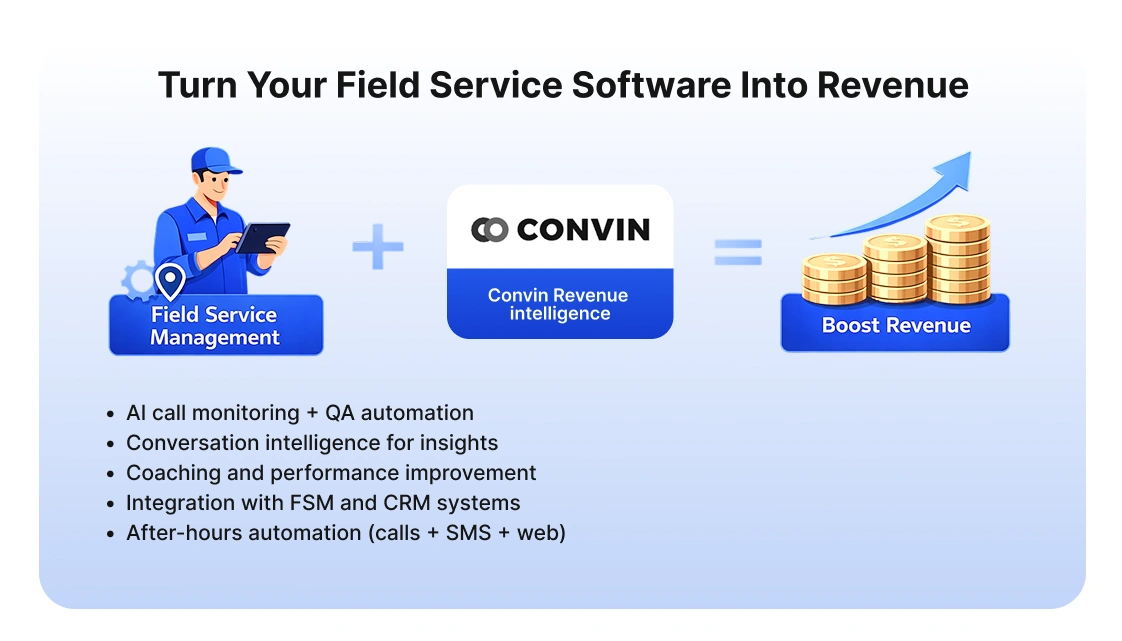
Most field service management software helps you run operations. Convin helps you improve the conversations with your customers that actually drive revenue.
It functions as an additional layer on your current system, providing visibility, control, and improvement for every call, message, and interaction.
- Turns Conversations Into Measurable Data
Convin looks at customer interactions from different channels, helping field service teams understand what customers are asking, spot common issues, and find missed chances right away, improving management in a usually overlooked area.
- Automates Call Quality Monitoring
Convin utilizes AI call monitoring to analyze and score all calls for service businesses, highlighting quality gaps and ensuring consistent call quality monitoring without raising QA efforts.
- Enables Continuous Coaching
Convin enhances team performance by offering structured coaching, actionable feedback for agents, and performance tracking across teams, transforming quality assurance into a continuous improvement system.
- Connects Calls to Revenue Outcomes
Convin offers significant advantages in tracking call conversions, enabling users to identify which calls result in bookings, where leads fail to convert, and the impact of agent performance on revenue. This capability makes the measurement and actionability of call conversion tracking and field service software ROI possible.
- Reduces Missed Opportunities
Convin aids in capturing leads that might be lost by identifying missed and unanswered calls, enabling automated follow-ups, and supporting after-hours engagement, thus ensuring fewer leads are overlooked.
- Works Alongside Your Existing FSM
You do not need to replace your current field service management system, as Convin integrates with your existing tools, adding a revenue-focused layer. Convin enhances conversations and conversions, while FSM manages operations.
Convin bridges the gap between operations and revenue.
Adding call QA, coaching, and conversion visibility to your field service management software helps you capture more leads, improve call quality, and increase bookings without increasing spend.
How to Validate This During a Demo (Before You Buy)
When evaluating field service management software, most demos focus on workflows like scheduling and dispatch. That is useful, but it does not tell you how the system impacts revenue.
To make the right decision, you need to validate the call QA and coaching layer during the demo itself.
- Ask for Real Call Visibility
Do not rely on feature explanations. Ask to see the actual call data.
- Can the system show recorded calls end to end
- Can you search calls by customer, issue, or outcome
- Does it provide full visibility into conversations
This helps you evaluate whether the field service management system gives real insight into customer interactions.
- Check How Call Quality Is Measured
Many tools claim to support call monitoring, but the depth matters.
Ask:
- Is call quality monitoring for field service automated or manual
- Are calls scored consistently
- Can the system detect key phrases, intent, and missed steps
Strong AI call monitoring for service businesses should analyze every call, not just a sample.
- Validate Coaching and Feedback Workflows
Insights alone are not enough. You need to see how improvement happens.
During the demo, check:
- Are there clear coaching recommendations
- Can managers track agent performance easily
- Does the system support continuous improvement
Effective call coaching software for service businesses should make it easy to turn insights into action.
- Review Call Conversion Tracking
A key part of the ROI of field service software is understanding how calls translate into bookings.
Ask to see:
- booking rates from calls
- conversion trends across agents
- drop-off points in conversations
Without call conversion tracking, you cannot accurately measure performance.
- Test Missed Call and After-Hours Handling
Missed opportunities often happen outside normal hours.
Check whether the system can:
- identify missed calls instantly
- trigger automated follow-ups
- capture leads after hours
This is critical for field service management software for home services, where urgency drives decisions.
A demo should not just show features. It should prove how the system improves conversations, conversions, and revenue. If you fail to clearly demonstrate these areas, you are not fully evaluating the platform's capabilities.
Turn your FSM into a revenue engine with AI.
How Poor Call Handling Impacts Revenue in Home Services
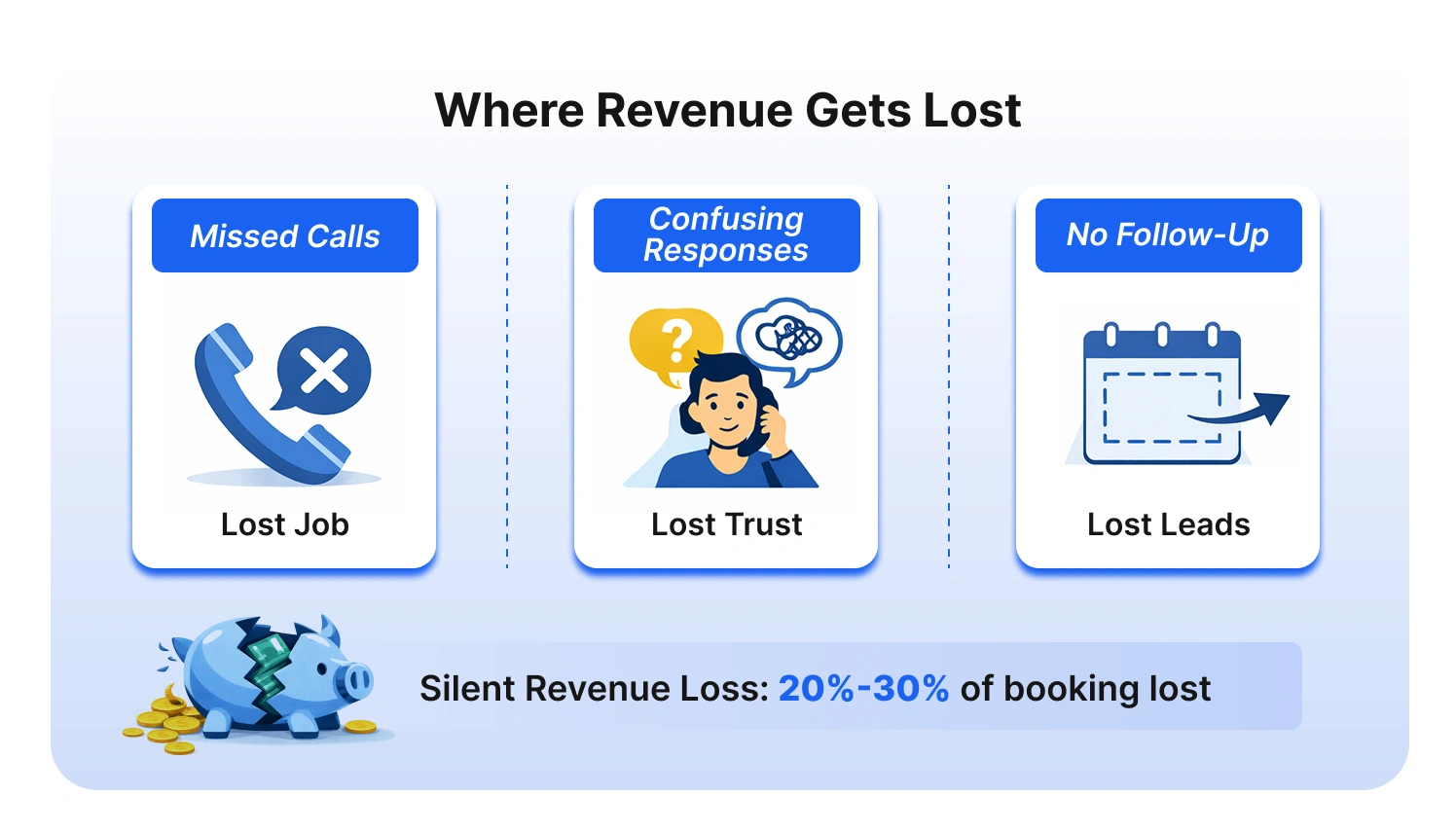
In home services, every call is a potential job. Whether it is HVAC, plumbing, or electrical, most customers call when they need immediate help. That makes call handling one of the most critical parts of the business.
But poor call handling often goes unnoticed because field service management software does not track what happens inside conversations.
Missed Calls Mean Missed Jobs
When calls go unanswered, the impact is immediate.
- Customers move to the next available provider
- High intent leads are lost within minutes
- There is no recovery without a follow-up system
Most field service management software for home services does not capture or highlight missed call patterns. As a result, businesses underestimate how many jobs they are losing.
Poor Conversations Reduce Trust
Even when calls are answered, the quality of the conversation matters.
- unclear responses create confusion
- lack of urgency reduces confidence
- weak communication lowers booking intent
Without call quality monitoring for field service, these issues remain hidden. Teams assume calls are handled well, but conversion rates tell a different story.
No Follow-Up Leads to Drop-Off
Many service businesses rely on callbacks or delayed responses. This creates friction.
- customers forget or move on
- competitors respond faster
- leads with high intent are lost
Without structured call coaching software for service businesses, teams do not consistently follow up or handle callbacks effectively.
No Visibility Into Conversion Gaps
A major issue is the lack of call conversion tracking.
Businesses cannot clearly see:
- how many calls turn into bookings
- where conversations fail
- which agents perform better
This makes it difficult to improve performance or accurately measure the ROI of field service software.
After-Hours Calls Are Often Lost
A large portion of calls in home services come after business hours.
- emergencies happen at night or on weekends
- customers expect immediate response
- missed after-hours calls result in lost revenue
Most FSM tools do not handle these situations effectively, leading to consistent leakage.Poor call handling does not just affect customer experience. It directly impacts revenue.
Without visibility, QA, and coaching, businesses lose jobs silently through missed calls, weak conversations, and a lack of follow-up.
Improving call handling is one of the fastest ways to increase bookings without increasing lead volume.
Quantify how much revenue you are losing from calls.
Field Service Management Software Evaluation Checklist (With Call QA Layer)
Choosing the right field service management software is not just about dispatch, scheduling, or technician workflows. Those features matter, but they only help after a job is already in motion.
A strong buying decision should also evaluate how well the platform supports customer conversations, call quality, and revenue visibility. This is where most field service software evaluations fall short.
Here is a practical checklist to help you assess both operations and the call QA layer before you buy.
1. Check Call Recording and Visibility
Start by understanding whether the system gives you full visibility into customer conversations.
Ask:
- Are all inbound and outbound calls recorded
- Can managers easily access and review calls
- Can calls be searched by customer, issue, or agent
Without this, there is no way to identify missed opportunities or improve call handling.
2. Evaluate Call Quality Monitoring
A good field service management system should help you monitor how calls are handled, not just log them.
Look for:
- automated call scoring
- keyword and intent detection
- quality alerts for missed steps or poor responses
This is essential for effective call quality monitoring for field service teams.
3. Review Coaching and Feedback Capabilities
Call QA only matters if it leads to improvement.
Check whether the platform supports:
- agent performance insights
- coaching recommendations
- trend analysis across teams
Strong call coaching software for service businesses helps managers improve consistency and conversion rates.
4. Measure Call Conversion and Revenue Attribution
Traditional field service management software for home services lacks one of the most important features: revenue visibility.
Make sure you can track:
- which calls turn into bookings
- lead drop-off points
- booking rates by team or agent
This helps you understand real field service software ROI.
5. Assess Missed Call and After-Hours Handling
Home services businesses often receive urgent calls outside regular business hours.
Check whether the system can:
- flag missed calls instantly
- automate callbacks or SMS follow-ups
- support after-hours lead capture
This helps reduce lost jobs and improves customer response.
6. Look for Integration With Existing Tools
Your field service management software should work smoothly with your CRM, phone systems, and communication tools.
Ask:
- Does it integrate with your current workflows
- Can it unify customer and call data
- Will teams need to switch between multiple systems
A connected setup makes adoption easier and improves efficiency.
7. Validate Reporting and Actionability
Good reporting should help you make decisions, not just show activity.
Look for dashboards that show:
- call quality trends
- booking conversion rates
- missed call impact
- agent performance
The goal is to turn insights into action.
The best field service management software should help you manage both operations and revenue. If you only evaluate dispatch and scheduling features, you risk missing the layer that directly impacts bookings.
Use this checklist to make sure your software helps you improve customer conversations, reduce missed opportunities, and drive long-term growth.
Use this checklist before your next FSM demo.
Conclusion: Stop Evaluating Features. Start Evaluating Revenue Impact
Most businesses choose field service management software based on operational capabilities. They compare scheduling tools, dispatch features, and reporting dashboards.
Combining field service management (FSM) tools with conversation intelligence is essential for business growth. While FSM tools enhance scheduling efficiency, technician productivity, and workflow visibility, they do not improve lead handling directly.
Revenue is driven by conversations, and without call quality monitoring, missed calls and poor conversations hinder trust and conversion rates. Implementing call coaching software helps teams enhance performance and increase bookings.
Therefore, it is crucial to assess not only FSM capabilities but also how they contribute to improving conversations and revenue, ensuring a comprehensive evaluation of their effectiveness.
Book a demo with Convin and see how your calls turn into measurable revenue outcomes
FAQs
1. What is the difference between field service management software and call tracking software?
Field service management software focuses on scheduling, dispatch, and job tracking, while call tracking software focuses on customer conversations. Combining both helps improve call conversion tracking and overall revenue visibility.
2. How does AI call monitoring improve field service performance?
AI call monitoring for service businesses analyzes 100% of calls, identifies gaps, and highlights missed opportunities. This improves call quality monitoring for field service and helps teams increase booking rates.
3. Can small home service businesses benefit from call coaching software?
Call coaching software for service businesses helps even small teams improve consistency, handle leads better, and increase conversions without hiring more staff or increasing lead volume.
4. How do you measure ROI from field service management software?
To measure field service software ROI, track metrics like booking rates, missed calls, and revenue from calls. Adding call conversion tracking gives a clearer picture of performance and growth opportunities.


.avif)


.avif)