


Cold outreach has changed more in the last five years than in the previous two decades. What once relied on human-heavy cold calling teams and rigid scripts is now powered by automation, AI-driven conversation models, and real-time intent detection systems.
Yet, despite the rapid evolution, most go-to-market teams in 2026 still face a fundamental confusion: Is AI cold calling software enough, or do we need an omnichannel AI sales agent?
This distinction is not just semantic. It directly impacts pipeline quality, conversion rates, sales efficiency, and how scalable your outbound motion actually is.
Buyers are no longer looking for definitions, they are actively evaluating tools that solve specific problems like low connect rates, inconsistent follow-ups, and fragmented outreach systems across channels.
Let’s break down both approaches clearly, compare them objectively, and understand why the distinction is now critical for modern revenue teams.
AI Cold Calling Software: What It Really Means in 2026
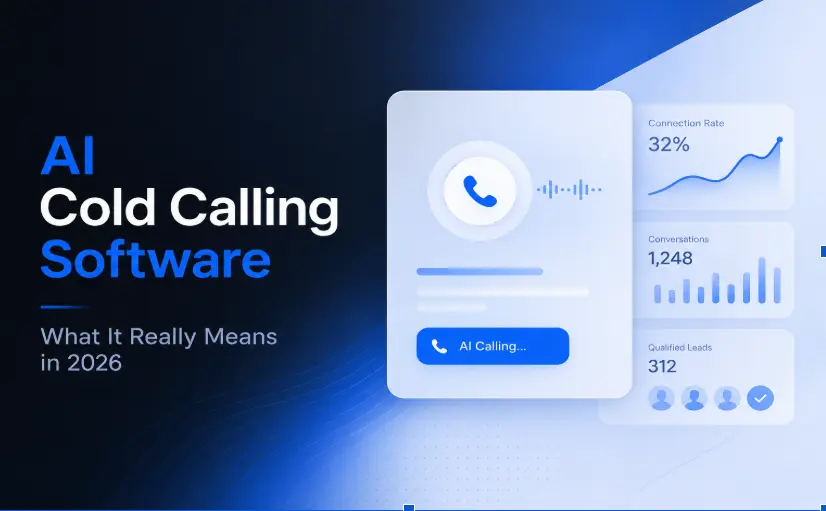
AI cold calling software refers to systems designed primarily to automate or assist outbound calling workflows. These platforms focus heavily on voice-based engagement, often using AI voice agents, predictive dialers, or scripted conversational models.
The core goal is simple: maximize call volume and improve connect-to-conversion efficiency in voice channels.
Core capabilities of AI cold calling software
- Automated outbound dialing at scale
- AI-driven voice scripts and responses
- Lead prioritization for calling queues
- Basic CRM sync and call logging
- Call transcription and sentiment tagging
However, most AI cold calling systems remain channel-limited. They are optimized for voice, but not for the full customer journey.
Where It Works Best
AI cold calling software performs well when:
- The sales motion is heavily phone-driven
- The market is warm or semi-qualified
- Speed-to-connect matters more than nurturing depth
- SDR teams need productivity amplification
For industries like insurance, real estate, and high-volume B2B outbound, AI cold calling delivers real efficiency gains, faster dialing, smarter lead prioritization, and less idle time between calls. When buyers respond well to phone outreach, layering AI on top of existing call workflows creates measurable results without a full process overhaul.
But in 2026, buyers rarely stay in one channel. That is where limitations start showing.
A missed call could have been a WhatsApp reply. An ignored email could have been converted on a different platform. When outreach is limited to voice, those moments vanish, no fallback, no continuity, no way to recover intent that was already there.
Boost outbound efficiency with AI-driven calling with Convin.
What is an Omnichannel AI Sales Agent?
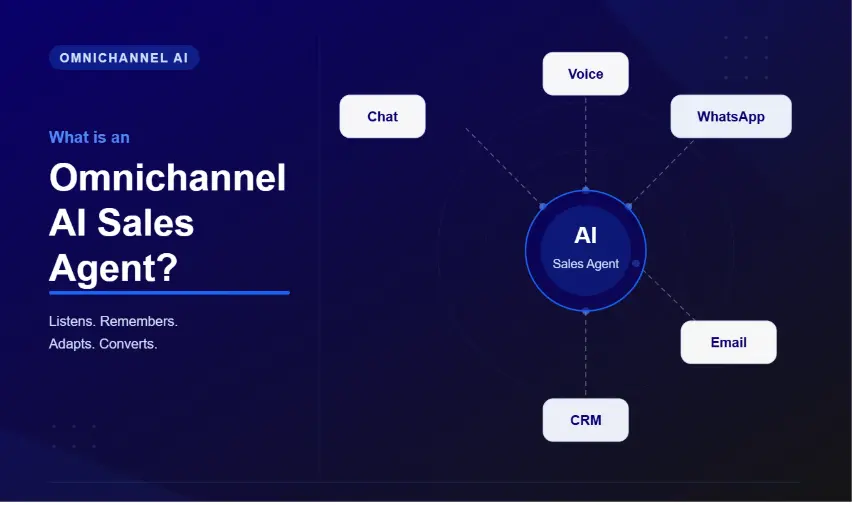
An omnichannel AI sales agent is a more advanced revenue automation system that engages prospects across multiple channels, voice, WhatsApp, email, chat, and sometimes social touchpoints, while maintaining a single unified conversation memory.
Instead of optimizing only calls, it optimizes the entire buyer journey.
This category includes platforms like modern AI SDR systems that don’t just call leads but also nurture, follow up, re-engage, and qualify them across channels.
Core capabilities of omnichannel AI sales agents
- Unified customer conversation memory across channels
- AI-driven engagement on WhatsApp, email, and voice
- Dynamic lead nurturing based on intent signals
- Context-aware follow-ups without repetition
- Automated qualification and routing to human reps
Why this model is emerging now
Buyers in 2026 expect:
- Non-intrusive engagement
- Context continuity across platforms
- Faster response times on preferred channels
- Less repetitive communication
For B2C businesses, this matters because the modern buyer rarely converts through a single channel. They browse, compare, ask questions, go quiet, and re-engage — often across different platforms and at unpredictable times. An omnichannel AI sales agent is built to follow that journey without dropping context or requiring manual intervention from the sales team. Omnichannel AI sales agents align directly with these expectations.
AI Cold Calling Software vs Omnichannel AI Sales Agent: Key Differences
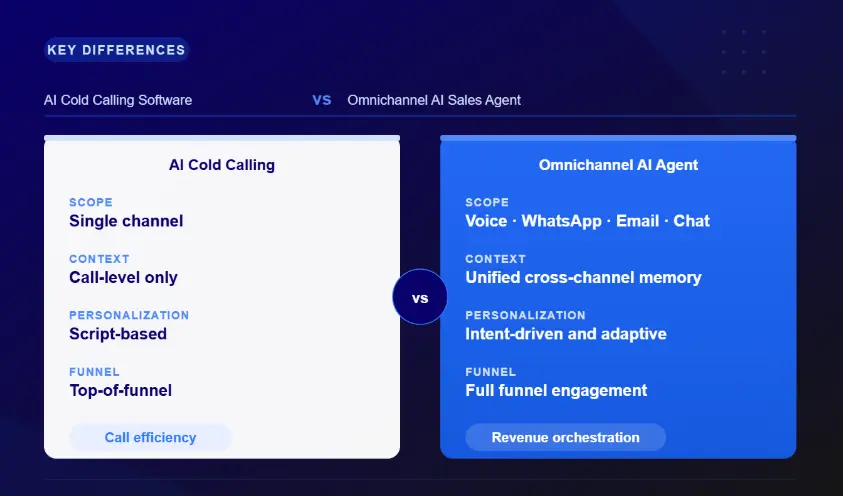
The easiest way to understand the gap between these two systems is to look at what each one is actually built to do.
AI cold calling software is a productivity tool. It makes outbound calling faster, reduces SDR idle time, and improves top-of-funnel reach, all within a single channel.
An omnichannel AI sales agent is revenue infrastructure. It connects every channel a buyer touches, carries context across the entire journey, and adapts based on intent rather than scripts.
One makes calling more efficient. The other makes the buying journey smarter.
For B2C businesses where customers move across WhatsApp, voice, email, and chat before converting, the gap between these two approaches is the gap between faster outreach and higher revenue
Compare smarter sales automation strategies with Convin AI.
This blog is just the start.
Unlock the power of Convin’s AI with a live demo.

Performance Metrics Comparison: What Actually Changes
When evaluating tools, MOFU buyers typically focus on measurable outcomes. Here’s how both systems differ across key sales metrics.
Improve pipeline velocity with AI-driven engagement.
When Should You Use AI Cold Calling Software vs Omnichannel AI Sales Agent?
Choosing between the two depends heavily on your sales maturity, deal complexity, and buyer behavior.
Use AI cold calling software when:
- Your sales motion is heavily call-centric
- You run high-volume outbound SDR teams
- Your target customers respond primarily to phone outreach
- You need quick productivity gains without process overhaul
Use omnichannel AI sales agents when:
- Your buyers engage across WhatsApp, email, and chat
- Your sales cycles involve multiple touchpoints
- Lead drop-offs after first interaction are high
- You want to reduce dependency on human SDR bandwidth
- You are scaling revenue operations, not just outbound calls
Why This Distinction Matters in 2026
The difference between these two systems is becoming more important due to how buyers behave today.
1. Buyers no longer live in a single channel
A prospect might see your email, ignore your call, and respond on WhatsApp two days later. If your system cannot unify this journey, context is lost. Conversational AI platforms built for omnichannel engagement handle exactly this scenario.
2. Sales cycles are longer and more fragmented
Even SMB deals now involve multiple stakeholders, multiple comparison points, and extended evaluation windows. Single-channel systems struggle in such environments.
3. AI expectations have evolved
Modern AI is no longer expected to just "automate calls." It is expected to predict intent, maintain memory, and adapt messaging in real time. AI examples across industries show this shift clearly.
4. Revenue teams are shifting from SDR efficiency to revenue orchestration
The focus is no longer "How many calls did we make?" It is now "How efficiently did we convert intent into revenue across channels?" Understanding inbound vs outbound dynamics is key to answering that question. This is the real shift that separates legacy tools from modern AI sales agents.
What This Means For You
The debate between AI cold calling software and omnichannel AI sales agents is not about which is "better" in absolute terms. It is about what stage your revenue system is operating at.
If your goal is to increase call efficiency, cold calling software still plays a role. But if your goal is to build a scalable, adaptive, and high-conversion revenue engine, omnichannel AI sales agents represent the next step in evolution.
In 2026, the strongest sales organizations are not choosing between channels, they are connecting them into a single intelligent system. The automation trends shaping contact centers this year make that direction clear.
FAQs
1. What is the main difference between AI cold calling software and omnichannel AI sales agents?
AI cold calling software focuses on voice-based outreach, while omnichannel AI sales agents manage engagement across multiple channels with unified context.
2. Is AI cold calling software still effective in 2026?
Yes, especially for high-volume outbound calling, but it is limited compared to omnichannel systems in nurturing and conversion.
3. How does an omnichannel AI sales agent improve conversions?
It maintains context across channels like WhatsApp, email, and calls, reducing drop-offs and improving follow-up consistency.
4. Can AI cold calling software replace SDR teams?
It can enhance SDR productivity but cannot fully replace strategic engagement and multi-channel nurturing.
5. Why is omnichannel engagement becoming more important in sales?
Because buyers now interact across multiple platforms and expect consistent, contextual
.avif)



.avif)