

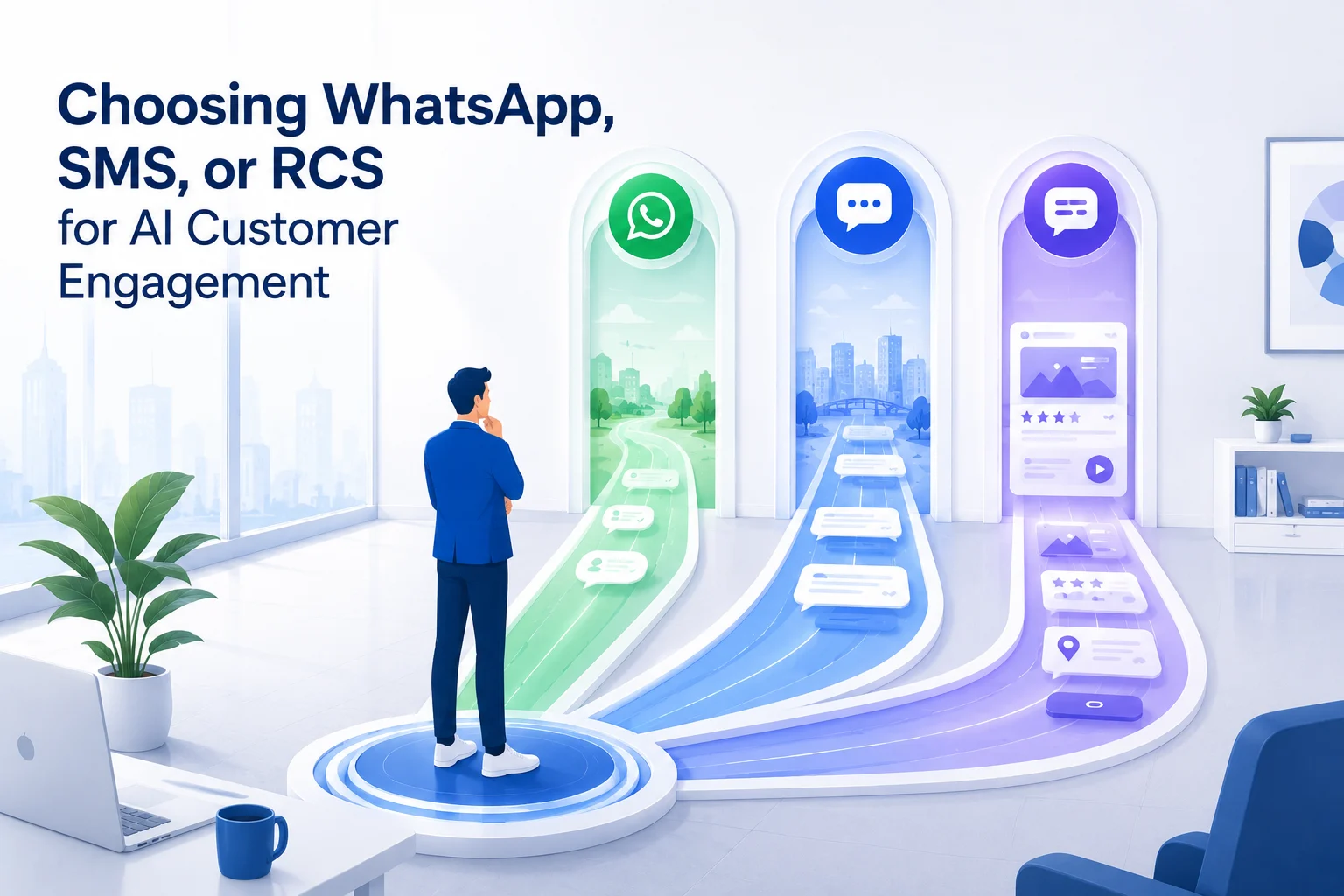
Your customer does not care which channel your team prefers. They care whether the message arrives, whether it feels relevant, and whether they can act on it without friction.
That is why the WhatsApp vs SMS AI automation debate is really a decision about orchestration. SMS gives you reach and reliability. WhatsApp gives you depth and interaction. RCS gives you a richer Android-native experience with branded assets and suggestions. The real question is not which channel exists. It is which channel should your AI choose at each moment so the conversation keeps moving.
Let Convin route every message through the highest-converting channel.
What Each Channel Actually Gives Your AI
Choosing between WhatsApp vs SMS AI automation is not a simple either-or choice. WhatsApp is best for rich, two-way conversations and follow-up inside a service window, SMS is best for universal reach and short alerts, and RCS is best when you want branded rich messaging on supported Android devices. The winning strategy is usually a mix, not a single channel.
SMS is the thinnest layer. It is plain text, heavily constrained by headers and commercial messaging rules, and best suited for OTPs, reminders, and urgent notifications where simplicity matters more than interaction. TRAI’s current framework requires registered headers for commercial communication, which makes SMS more structured but also less flexible than chat-first channels.
WhatsApp gives your AI the most room to work. Meta’s Business Platform supports interactive CTAs, dynamic product lists, rich media, and a 24-hour customer service window that resets when the user messages again. That is why WhatsApp is the natural home for qualification, nurture, support, payment collection, and voice-note driven conversations.
RCS sits between the two. Google’s RCS for Business platform supports rich cards, media, PDFs, suggested replies, suggested actions, verification, and read receipts. It is more expressive than SMS and more branded than standard text, but it still relies on a partner-led ecosystem and device support through Google Messages and carrier-backed infrastructure.
Orchestrate smarter customer journeys across every messaging channel
How The Cost Picture Changes In India
Cost is where most channel debates get distorted, because the cheapest send is not always the cheapest conversion.
WhatsApp Business Platform pricing is now per delivered message, not per conversation, and Meta says pricing varies by market and message category.
The platform still keeps service replies inside the 24-hour customer service window free, which makes organic support and post-click conversations much cheaper than outbound campaigns.
Meta also introduced the newer marketing pricing structure for 2026, with India marked as a higher marketing-rate market.
For India, secondary pricing guides place WhatsApp marketing around ₹0.8631 per delivered message, while utility and authentication messages are far cheaper and service messages remain free inside the active window.
SMS pricing in India is typically far lower on a per-send basis, with common bulk rates ranging from ₹0.16 to ₹0.25 per message, and TRAI also specifies a promotional SMS charge of Re. 0.05 in its commercial communications framework.
That is why cost-per-send is the wrong north star. A channel that costs more per message can still win if it produces more replies, more qualified leads, or more completed payments. Meta positions WhatsApp for promotions, commerce, and notifications, while Google positions RCS for delivery notifications and more complex conversation flows.
Convin’s own messaging around AI orchestration is useful here, it is observed to have up to 60% lower operational costs and 10x conversions in its AI-driven phone and conversation workflows, which reinforces the point that the routing layer matters more than any single channel’s sticker price.
Cost per conversion: the better metric for channel selection, because it accounts for response rate, qualification quality, and downstream outcomes instead of only the price of sending a message.
Optimize conversion outcomes, not just messaging spend.
This blog is just the start.
Unlock the power of Convin’s AI with a live demo.

Which Channel Wins For Which Job
For OTPs and urgent alerts, SMS still wins. It is the most universal, it does not depend on a separate business chat app, and it remains the cleanest fallback when you need the message to land with minimal friction. TRAI’s commercial-header framework also makes SMS the most regulated and most structured of the three.
For sales conversations, support, collections, and payment nudges, WhatsApp usually wins. Meta’s platform is built for interactive commerce, utility notifications, and service conversations, and its service window makes back-and-forth support practical. If you need rich media, clickable actions, or a conversation that can last longer than one short alert, WhatsApp is the strongest default.
For branded transactional messaging on Android-first audiences, RCS can be a strong middle ground. Google’s platform offers verified branding, rich cards, suggested replies, and analytics, making it more engaging than SMS for organizations that want a more visual, app-like experience without requiring a separate download.
For collections and payment reminders, the best answer is usually a sequence, not a single channel. Start with WhatsApp for rich reminder and payment-link flows, use SMS as a fallback if the first delivery fails, and reserve voice for unresolved high-value cases. Convin’s own collection-oriented content ties this kind of orchestration to a 21% improvement in collection rates, plus 27% higher CSAT and lower operational cost.
Match every customer intent with the right channel.
How AI Should Decide The Channel In Real Time
The smartest omnichannel systems do not ask, “Which channel do we like best?” They ask, “Which channel is most likely to move this specific customer forward right now?”
That decision can be based on message type, customer history, device context, time of day, and delivery success. A payment reminder that needs a tap and a rich explanation belongs on WhatsApp. A one-time verification code belongs on SMS. A promotional message aimed at an Android-heavy audience with a verified sender identity can be a good RCS candidate.
A practical fallback chain looks like this. Send the first attempt on WhatsApp. If the user is outside the customer-service window or the message is not delivered in time, move to SMS for the essential action.
If your setup supports it and the device can render it, RCS can deliver a richer follow-up than plain text. That is an orchestration problem, not a channel loyalty problem.
This is where Convin’s platform logic matters, as an AI agent platform that powers omnichannel customer interactions, with conversation intelligence, compliance monitoring, and real-time handoff across channels. That is the layer that lets an AI choose the right channel instead of forcing the business to guess one in advance.
Empower AI to choose channels with conversion intelligence.
What Compliance Changes In India
Compliance is not a side note in India. It directly affects which channel you can use, how you can send, and what kind of message the customer receives.
For SMS, TRAI’s commercial communication framework requires registered headers for sender identity and has separate structures for transactional, service, promotional, and government messages. Recent TRAI updates also continue to refine commercial communication rules, which means SMS is still the most operationally controlled channel in the mix.
For WhatsApp, the rules are different but still strict. Meta’s Business Messaging Policy governs what is allowed on the platform, and the 24-hour customer service window determines when businesses can send free-form service messages versus when templates are required. That is why a WhatsApp automation layer needs policy awareness, not just language generation.
For RCS, Google requires partners to register before sending messages, and business use cases are categorized so the right rules can be applied. The platform also emphasizes trust signals like verified branding and read receipts, which makes compliance and sender identity part of the user experience instead of an afterthought.
The broader implication is simple. If your AI automation is not aware of platform rules, it is not enterprise-ready. Convin’s compliance-monitoring positioning, including 100% compliance monitoring on its platform, is relevant because channel choice without policy control creates avoidable risk.
Stay compliant while scaling omnichannel customer engagement.
What The Best Channel Mix Looks Like
The strongest strategy is usually not WhatsApp or SMS or RCS. It is all three, used for different jobs.
Use SMS for verification, urgent nudges, and fallback delivery. Use WhatsApp for rich two-way conversations, commerce, support, and payment flows. Use RCS for branded Android-native messaging where verified identity and richer presentation improve the customer experience. That mix is especially useful in India, where businesses need both reach and interaction depth.
If you are a BFSI brand, the mix often looks like this: SMS for OTP, WhatsApp for servicing and payment reminders, voice for escalations, and RCS only where your audience and provider support justify it.
If you are D2C, WhatsApp usually becomes the primary conversation layer, SMS becomes the fallback, and RCS becomes a selective experiment. If you are edtech, WhatsApp often leads on qualification while SMS carries critical reminders and confirmation messages.
Convin’s published outcomes help explain why this mix matters. Convin’s platform supports 35+ Asian languages, automated QA, real-time guidance, and strong commercial outcomes such as 27% higher CSAT, 17% better collection rates, and 60% lower ramp-up time. That is what an orchestration layer is supposed to do, it keeps the channels from becoming disconnected experiences.
Schedule a Convin demo and transform fragmented customer journeys
FAQ
Q: How do businesses measure success in a WhatsApp vs SMS AI automation strategy?
Businesses should track cost per conversion, response rates, delivery rates, customer engagement, and revenue attribution.
WhatsApp vs SMS AI automation decisions are most effective when tied to business outcomes rather than message volume.
Q: Can WhatsApp vs SMS AI automation work without a CRM integration?
Yes, but the value is limited.
CRM integration helps WhatsApp vs SMS AI automation maintain customer context, personalize outreach, and track conversions across channels.
Q: Which industries benefit most from WhatsApp vs SMS AI automation?
BFSI, collections, healthcare, edtech, telecom, and e-commerce often benefit the most.
These sectors rely on timely customer communication where WhatsApp vs SMS AI automation can improve engagement and operational efficiency.
Q: How does customer preference influence WhatsApp vs SMS AI automation decisions?
Modern AI systems analyze past engagement patterns to determine where customers are most likely to respond.
This makes WhatsApp vs SMS AI automation more personalized and effective than rule-based channel selection.
Q: What role does AI play beyond channel routing in WhatsApp vs SMS AI automation?
AI can classify intent, personalize messaging, predict engagement likelihood, and automate follow-up actions.
The strongest WhatsApp vs SMS AI automation strategies use AI to optimize the entire customer journey, not just message delivery.


.avif)