

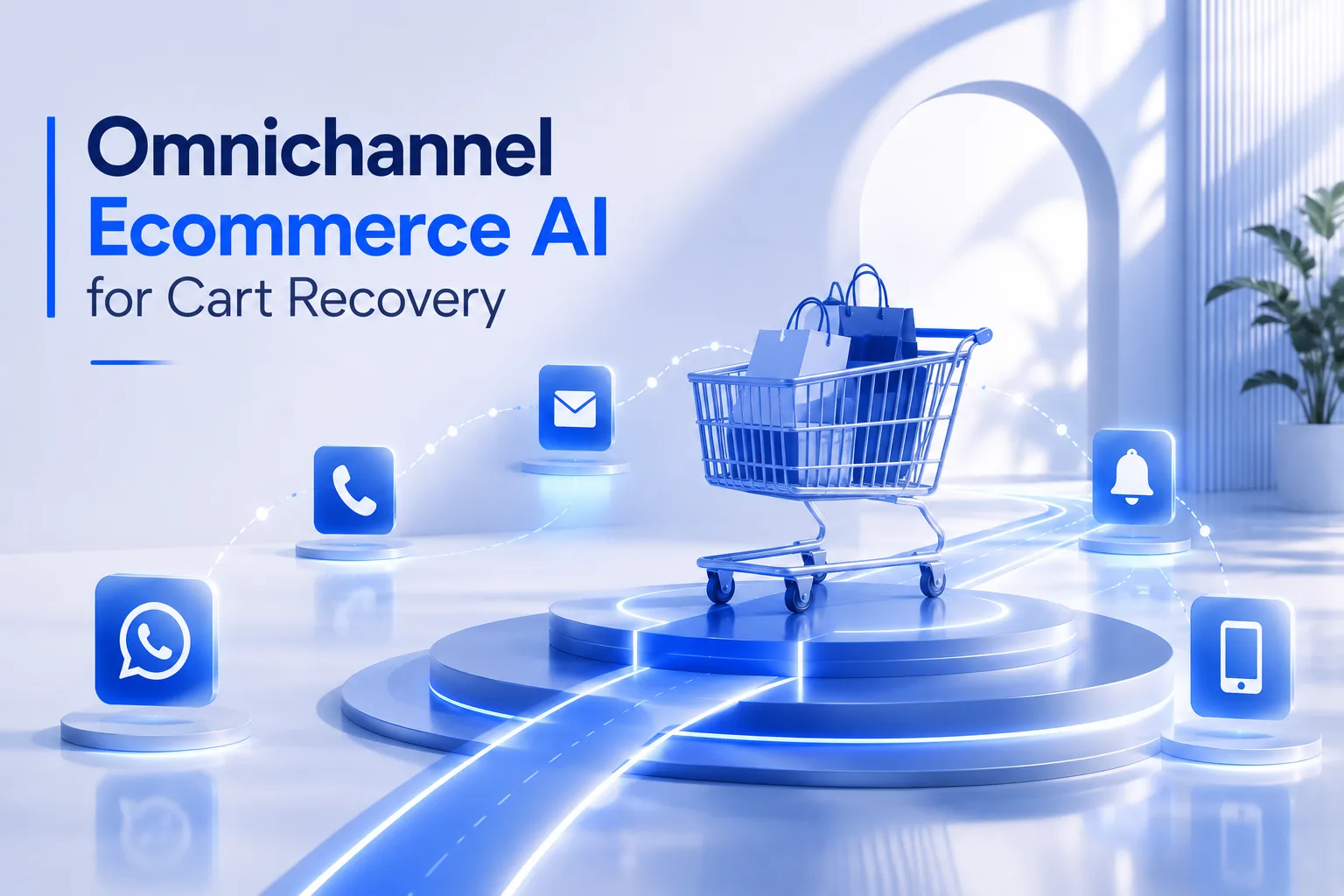
If you run a D2C brand in India and you are still relying on email alone to bring back abandoned carts, you already know the pain. The cart is full, the intent is high, and the buyer disappears before your next message lands.
That is the real problem in omnichannel ecommerce. Cart recovery is not a reminder problem. It is a timing problem, a channel problem, and increasingly, a decisioning problem. The brands that recover well are not simply sending more messages. They are choosing the right channel, at the right moment, with the right context, and they are doing it before intent cools.
Convin sits in that layer. It treats cart recovery as a conversation that can move across WhatsApp, voice, push, and email without losing memory. That is what changes abandoned carts from dead ends into live revenue.
Recover abandoned carts faster with Convin’s omnichannel AI
Cart Abandonment Rates Indian D2C Brands Can’t Ignore
Before talking about cart recovery, it is important to understand how large the problem really is.
India's average cart abandonment rate stands at 72.4 percent in 2025–2026, while mobile abandonment can climb to 85.65 percent during major sale periods. This is not an isolated conversion issue. It is a recurring revenue leak that affects every stage of the ecommerce funnel.
The problem typically breaks down into four areas:
1. Customers get distracted before checkout
Online shopping rarely happens without interruptions. A customer may receive a call, switch apps, compare products elsewhere, or simply postpone the purchase.
2. Checkout friction appears at the wrong moment
Unexpected shipping fees, lengthy forms, account creation requirements, or payment failures often surface when purchase intent is highest, causing customers to leave.
3. Traditional recovery arrives too late
Many brands rely on email as the primary recovery channel. By the time the email reaches the customer, attention has shifted elsewhere and the original buying intent has weakened.
4. Recovery strategies focus on messages, not journeys
Abandonment is rarely a one-channel problem. A customer who ignores an email may respond to a WhatsApp reminder, answer a voice call, or complete a purchase after an in-app prompt. Treating recovery as a single message instead of a coordinated journey limits recovery rates.
The result is simple: every abandoned cart represents lost revenue that continues to accumulate when recovery efforts remain confined to a single channel.
That is why cart recovery should be treated as a customer journey rather than a follow-up message. The goal is not just to remind customers. It is to re-engage them through the channels where they are most likely to respond while purchase intent still exists.
Recover more abandoned carts with Convin AI
Why Email-Only Cart Recovery Has Hit Its Limit
Email still has a role in ecommerce recovery, but it is no longer the engine.
A few years ago, email-only flows felt effective because they were novel. Today, they are background noise. Even optimized email sequences now recover only 2 to 5 percent of abandoned carts for most D2C brands, while true omnichannel recovery workflows can recover 15 to 30 percent on high-intent carts.
That gap is what changes economics. It is not just a better response rate. It is a different recovery model altogether. Email is slow, silent, and easy to ignore. It works best as reinforcement, not as the first or only recovery touch.
The deeper issue is that email assumes the customer is still sitting in the same mental state they were in when they left checkout. They are not. Purchase intent fades quickly, especially on mobile, and the further a brand gets from the original cart event, the more it has to work to regain attention. That is why the winning brands are moving to channel sequences that begin sooner and speak more directly.
Convin’s approach is built on that reality. It does not ask email to do all the work. It uses email where email is strong, for detail, reassurance, and follow-through, but it lets higher-intent channels carry the first recovery move.
Evidence: [Alhena AI Abandoned Cart Recovery Report 2026].
See how Convin outperforms email-only recovery
This blog is just the start.
Unlock the power of Convin’s AI with a live demo.

How Convin Orchestrates Omnichannel Ecommerce Recovery Across Channels
The difference between having channels and orchestrating them is the difference between activity and recovery.
In Convin's omnichannel recovery flow, each channel serves a different purpose. WhatsApp drives immediate engagement, voice resolves objections, push notifications provide timely reminders, and email supports customers who need more context before purchasing.
What matters is not that all four channels exist. What matters is that they are sequenced, not spammed. The customer should feel one coherent recovery motion, not four disconnected pings.
Orchestrate every recovery channel with Convin
The AI Decision Engine Behind Cart Recovery Timing and Messaging
This is where most brands underestimate cart recovery. They think the problem is sending the message. The real problem is deciding what to send, when to send it, and on which channel.
Convin’s recovery logic starts with signal collection. At the moment a cart is abandoned, the system looks at cart value, product type, prior purchase history, past channel response, device type, and the time of day. That creates a routing decision. A low-value cart from an app user may get pushed first. A high-AOV cart with a known phone number may get a voice call. Most carts start with WhatsApp.
Timing matters just as much. The first nudge typically lands inside a 20 to 45 minute window, when intent is still warm. If there is no response, a second touch can follow at 2 to 4 hours, and a final follow-up may come at 24 hours, often through a different channel. That is how a recovery sequence stays relevant instead of becoming repetitive.
Convin also adapts the message itself. A first-time shopper may need proof and reassurance. A repeat buyer may need convenience. A five-time abandoner should not be treated like a fresh lead. The system can also control discount logic, so it does not train customers to abandon carts on purpose just to earn a coupon.
That is the real advantage of orchestration. It lets the brand respond to behavior instead of forcing every buyer through the same sequence.
Evidence: [Convin.ai Product Documentation].
Let Convin trigger the next best recovery action
Personalisation, Language, and High-Intent Customer Messaging
Most cart recovery fails because the tone is wrong, not because the offer is weak.
A message that sounds generic can make the brand feel desperate. A message that sounds too promotional can make the brand feel careless. The best recovery flows feel like a helpful continuation of the shopping experience, not a sales chase.
That starts with product-level context. The message should mention the exact item, the color, the variant, or the cart bundle. It should sound like the brand knows what the customer was about to buy. It also needs customer-level context. A returning buyer should get a different tone from a first-time browser, because their trust level is different.
Language matters even more in India. Convin supports 35 plus languages, including Hinglish, which makes recovery feel native instead of translated. That is not a cosmetic detail. A shopper who browsed in Hindi and gets a recovery message in stiff English is less likely to respond. The message must match the customer’s language and tempo, or it already feels detached.
Upsell also has to be selective. Recovery is not the moment to push every possible add-on. When done well, a complementary recommendation appears only when it genuinely helps the buyer complete the order. Otherwise, it gets in the way.
This is where omnichannel ecommerce recovery becomes more than automation. It becomes judgment at scale.
Personalize every cart recovery conversation with Convin
Conversion Impact of Omnichannel Ecommerce AI
The numbers justify the shift.
Email-only cart recovery generally sits in the 2 to 5 percent range. Omnichannel recovery workflows move that to 15 to 30 percent on high-intent carts. WhatsApp nudges in India are often recovering 15 to 25 percent of abandoned carts on their own, and voice recovery can push even higher for carts with strong intent and higher value.
Convin’s own client metrics strengthen the case further. Published materials show a 60 percent increase in sales-qualified leads and a 90 percent reduction in manpower requirements across AI-led recovery and re-engagement workflows. That matters because cart recovery is not only about revenue recovered. It is also about how much manual follow-up the brand no longer needs to do.
There is also an order value effect. Recovered carts in omnichannel flows often show 15 to 20 percent higher average order value than direct-session purchases. That happens because the recovery sequence resolves hesitation, answers objections, and sometimes surfaces a better bundle or more complete order.
The cost side is equally important. AI-driven recovery is far cheaper than paid retargeting for the same recovered sale. In practice, WhatsApp plus voice sequences can recover carts at a fraction of what brands spend trying to pull the same customer back through ads.
Evidence: [Omnichat Conversational Commerce 2026 Report], [Convin.ai Client Metrics, 2024 to 2025].
Measure recovery revenue with Convin intelligence
Real-World Use Cases of Omnichannel Ecommerce AI in Action
The real test of any recovery system is whether it works in the messy middle of a live Indian ecommerce stack.
A D2C beauty brand using WhatsApp, voice, and Instagram DM for cart recovery saw an 18 percent revenue lift in the first quarter after implementation. The sequence was simple but disciplined, a WhatsApp message at 30 minutes, a social proof touch at 4 hours, and a voice AI call at 24 hours for higher-value carts.
A fashion brand recovered ₹2.5 crore per month in carts that its old email sequence never touched. The big unlock was not a flashier offer. It was reaching WhatsApp-first customers through a channel they already used, instead of waiting for email responses that were never coming.
A furniture brand using Convin’s AI Phone Call for carts above ₹8,000 converted 22 percent of outbound recovery calls into purchases. That worked because the call did what email could not. It answered delivery questions, assembly questions, and EMI objections in real time.
Technically, this works because Convin integrates with Shopify, WooCommerce, Magento, and custom stacks through webhooks and APIs. It also connects to Razorpay, PayU, Cashfree, and UPI flows, so the recovery path does not break at payment. Approved WhatsApp Business API templates keep the flow compliant, DPDP rules are respected for consent and opt-out, and human escalation happens automatically when a conversation becomes too complex for automation.
That is the real before and after. Before, cart recovery is a three-email drip. After, it is a live, multi-channel conversation that knows when to nudge, when to explain, and when to hand off.
If your abandoned cart recovery still runs on email alone, you already know the answer. The brand that wins is not the one that sends the most reminders. It is the one that remembers the customer, moves fast, and uses the right channel at the right moment. Convin is built for that operating model.
Book a Convin demo and recover more abandoned carts
FAQ
Q: What is the best time to send an abandoned cart recovery message?
The best time for omnichannel ecommerce recovery is usually within the first hour after cart abandonment, when purchase intent is still high.
Q: Which channel delivers the highest abandoned cart recovery rates?
WhatsApp often delivers the highest omnichannel ecommerce recovery rates in India because messages are opened and acted on faster than email.
Q: Can omnichannel ecommerce recovery work without discounts?
Yes. Omnichannel ecommerce recovery can recover carts through timely reminders, product information, social proof, and personalized assistance without relying on discounts.
Q: How many cart recovery messages should a brand send?
Most omnichannel ecommerce recovery workflows perform best with two to four messages spread across multiple channels instead of repeated reminders on one channel.
Q: Does omnichannel ecommerce recovery increase average order value?
Yes. Omnichannel ecommerce recovery can increase average order value by helping customers complete purchases and discover relevant products before checkout.


.avif)