

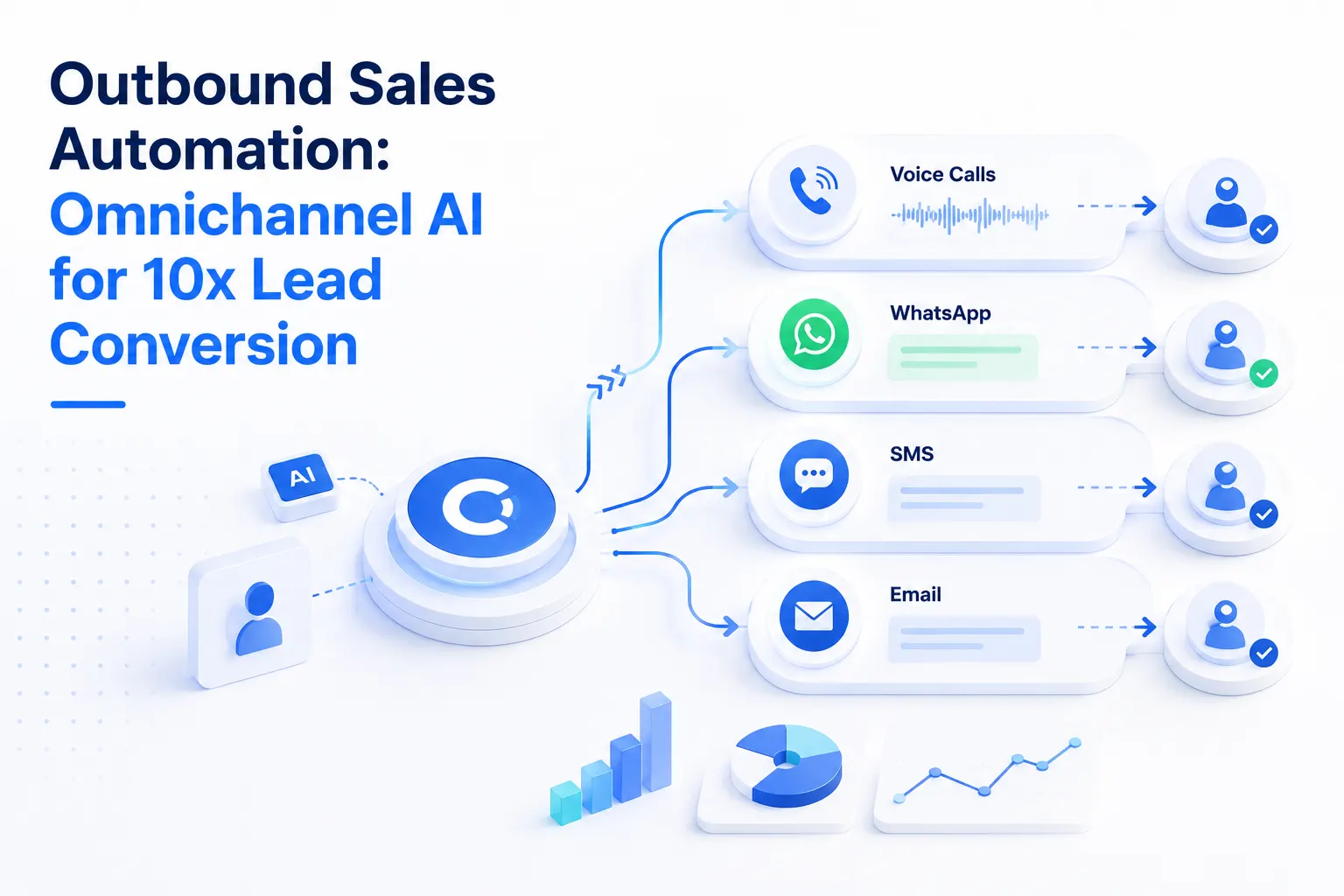
Your leads do not live on one channel. Your outbound should not either.
I have spent enough time inside sales floors to know the math no longer works. You have a database of 50,000 leads sitting in your CRM. Your 12-person SDR team dials maybe 200 a day each, and half of those go unanswered. Follow-ups slip. WhatsApp messages go out late. Emails sit in drafts. By the time the team circles back, the lead has already spoken to a competitor.
That is the problem outbound sales automation was supposed to fix. But most tools only solved one piece of it, an auto-dialer here, an email sequencer there, a WhatsApp bot running in isolation. None of them thought like a salesperson who knows when to call, when to text, and when to send a WhatsApp nudge.
The shift now is to outbound sales automation that works as one coordinated AI brain across voice, WhatsApp, SMS, and email. Convin is an AI Agent Platform that can automate up to 60% of lead qualification, and McKinsey says businesses using AI in sales workflows report a 50% increase in leads and appointments while cutting costs by 40% to 60%.
(Source: Convin.ai product page, McKinsey quote echoed on Convin’s sales AI page.)
Automate every outbound touchpoint with Convin's AI orchestration.
What Modern Outbound Sales Automation Really Delivers
Traditional outbound sales automation was channel-specific. You had a predictive dialer for calls, an email sequencer for email, and maybe a separate WhatsApp vendor. Each tool had its own logic and its own data silo.
Omnichannel AI changes that architecture. Convin’s AI Phone Calls platform, for example, does not just auto-dial. It can coordinate voice, WhatsApp, SMS, and email from a single orchestration layer. The AI decides which channel to use first based on lead behavior, time of day, and past response patterns. If a call goes unanswered, it does not just redial blindly. It can trigger a WhatsApp message later, follow up by email the next morning, and try another call in a different slot.
(Source: Convin.ai AI Agent Platform page.)
That is the difference between a sequencer and a sales brain. A sequencer follows a fixed rulebook. The AI adapts in real time. Convin’s public benchmarks proves this kind of automation can drive 100% inbound/outbound call automation, 90% lower manpower requirement, 60% lower operational costs, and 60% more sales-qualified leads.
(Source: Convin.ai product pages.)
Replace disconnected outreach tools with one intelligent sales engine.
How AI Orchestrates the Right Outreach at the Right Time
The first question every head of sales asks is simple, who controls the sequence?
The answer should be both you and the AI.
You define the guardrails, business hours per channel, maximum touches per day, cool-off periods, and channel priority tiers. The AI works inside those rules, but it makes micro-decisions in real time. If a lead opened your email but did not reply, the AI can move WhatsApp higher in the queue. If a lead picked up a call and asked to be contacted later, the system can schedule a callback and remember the preferred time.
WhatsApp is often the best first follow-up channel because Meta’s platform is built for two-way conversations and supports marketing, utility, authentication, and service messages. Meta says WhatsApp business messages are charged per message delivered, and marketing messages are designed to announce deals, share promotions, make product recommendations, and offer assisted selling.
(Source: WhatsApp Business Platform pricing and marketing pages.)
SMS still matters, but mostly as the fallback or urgency channel. TRAI’s commercial communication rules require registered headers, which makes SMS tightly governed in India and best suited for authenticated or high-priority messaging.
(Source: TRAI Telecom Commercial Communications Customer Preference Regulations.)
A practical outbound sequence is often call first for high-intent leads, WhatsApp with a recap, email with context, and SMS only when the other routes fail. The lead sees one respectful progression, not four disconnected pings.
Orchestration layer: the rules engine plus AI layer that chooses the next channel, timing, and message type based on lead behavior and business constraints.
Let AI optimize every outreach sequence for higher conversions.
This blog is just the start.
Unlock the power of Convin’s AI with a live demo.

What Voice AI Can Automate Across the Sales Funnel Today
Can AI voice calls actually work for outbound sales?
Yes, and better than most teams expect.
Convin’s AI Phone Calls platform is built to handle natural conversation, interruptions, and code-switching between English and Hindi, which is non-negotiable for Indian outbound motions. Its public benchmark pages also claim 100% compliance monitoring, up to 60% lead qualification automation, 27% CSAT improvement, 21% improvement in collection rate, 10x jump in conversions, 60% reduction in operational costs, and 90% lower manpower requirement.
(Source: Convin.ai product pages and support/voice automation pages.)
That matters because voice remains the fastest way to qualify serious buyers. The AI can ask the first questions, handle objections, detect buying intent, and then hand the hot lead to a human SDR with full context already attached. The human closes. The AI did the heavy lifting.
Convin’s outbound voice content also says companies using AI-powered calls see a 30% increase in lead conversion rates, which is a good proxy for why voice still deserves a central place in outbound orchestration.
(Source: Convin.ai Outbound Calling Page.)
Qualify leads faster using AI-powered outbound voice conversations.
How AI Coordinates WhatsApp, SMS, and Email Into One Outreach Engine
Voice gets the headlines. The real conversion magic in outbound sales automation usually happens in the follow-up channels.
WhatsApp is the strongest channel for rich follow-up and conversational selling. Meta’s utility messages help send order updates, account updates, payment reminders, and appointment reminders, while marketing messages are designed for offers, coupons, and assisted selling. WhatsApp also works inside a 24-hour customer service window, which makes it ideal for rapid back-and-forth after the first touch.
(Source: WhatsApp Utility, Marketing, and Business Platform pages.)
SMS is the fallback when WhatsApp delivery fails, the lead is not active on WhatsApp, or the message needs to be short and urgent. TRAI’s registered-header framework keeps SMS dependable, but also more regulated and less flexible for rich outbound conversations.
(Source: TRAI commercial communications regulations.)
Email handles longer-form nurturing. In an AI-led stack, the system can write personalized cold emails from CRM data, parse replies, and decide whether the lead is interested, not now, or opting out. That is how outbound sales automation stops being a brute-force blast machine and starts becoming a thoughtful follow-up system.
Convin’s omnichannel positioning fits that model. Its platform describes itself as turning every interaction into actionable intelligence, which is exactly what outbound needs when messages are spread across voice, WhatsApp, SMS, and email.
(Source: Convin.ai omnichannel platform pages.)
Connect every channel into one seamless revenue workflow.
How AI Lead Scoring Protects Pipeline Quality and Database Health
One of the biggest risks in outbound sales automation is database burn.
If you hammer 50,000 leads with aggressive multi-channel sequences, you will get opt-outs, spam complaints, and sender-reputation damage. Good AI avoids that by scoring responses continuously. A lead can be high intent, mildly curious, timing objection, price objection, or hard no. Each state should trigger a different next action.
A “not now” should not get another call tomorrow. It should move into a 30, 60, or 90-day nurture path with softer WhatsApp touches and value-led email. A “tell me more” should trigger a quick callback. A hard no should flow into suppression everywhere, across voice, SMS, WhatsApp, and email at once.
That is where Convin’s compliance and qualification positioning matters. The company says it can provide 100% compliance monitoring and automate up to 60% of lead qualification, which is the exact combination you need when scale starts to create risk.
(Source: Convin.ai homepage and lead qualification page.)
The point is not to send more. The point is to send the right next message, or stop sending entirely.
Prioritize the right prospects before outreach opportunities disappear.
The Outbound Automation Metrics That Drive Real Revenue Impact
Let’s talk economics, because outbound sales automation is really a CFO conversation.
The cleaner benchmark is cost per qualified meeting, not cost per message. A low-cost channel that fails to book meetings is expensive in disguise. A slightly more expensive channel that produces better response quality can be much more efficient.
Bridge Group data puts cost per qualified opportunity at $487 with human-only SDR pods versus $224 in hybrid AI-human pods, a 54% reduction. AI SDR platforms are commonly priced around $500 to $5,000 per month, while a fully loaded human SDR can cost $80,000 to $120,000 a year in the US, or roughly ₹4 to ₹8 lakh a year in India before attrition and training. Pavilion’s GTM benchmarks point to an average 8:1 pipeline ROI in the first year, and the payback period is often 3 to 5 months for teams with an existing outbound motion.
(Sources: Bridge Group, G2, Pavilion GTM Benchmarks, 2026.)
That is why one omnichannel deployment can feel like replacing the output of 15 to 25 SDRs at typical Indian B2C scale, even if the exact number varies by segment and process maturity. The savings are not just labor savings. They are also better conversion quality, faster follow-up, and less database waste.
Lower acquisition costs while increasing qualified pipeline generation.
What to Evaluate Before Launch: Compliance, CRM Integration, and Operational Readiness
Outbound AI in India has to be built for compliance from day one.
For SMS, TRAI’s commercial communications rules require registered headers and preference management. For WhatsApp, Meta controls message categories, template rules, and the 24-hour service window. For data handling, the DPDP Act, 2023 says it is meant to govern digital personal data in a way that recognises both the right of individuals to protect their data and the need to process it for lawful purposes.
(Source: TRAI regulations, Meta WhatsApp Business Platform, DPDP Act 2023.)
That means your CRM must be clean before you switch on AI. Phone validation, opt-in status fields, consent labels, suppression logic, and segmentation should already be in place.
Convin’s implementation story fits that operational reality. The platform says it can achieve 100% compliance monitoring, plugs into CRMs such as Salesforce, Zoho, and LeadSquared, and works with telephony providers like Exotel, Knowlarity, and Plivo. That makes it a layer on top of your existing stack, not a rip-and-replace project.
(Source: Convin.ai product and implementation pages.)
Most teams can go live in 2 to 3 weeks, and a 50-person sales team is usually live in under 30 days if the CRM and handoff logic are already clean. The technology is no longer the bottleneck. Operational readiness is.
Launch compliant AI outreach without disrupting existing sales operations.
FAQ
Q: How do small and mid-sized businesses benefit from outbound sales automation?
Outbound sales automation helps SMBs scale outreach without hiring large SDR teams.
It improves follow-up consistency, lead coverage, and response speed across multiple channels.
Q: What are the most important features to look for in an outbound sales automation platform?
Key features include AI lead scoring, omnichannel sequencing, CRM integration, analytics, compliance controls, and human handoff workflows.
These capabilities help outbound sales automation drive better conversion outcomes.
Q: Can outbound sales automation personalize outreach at scale?
Yes. Modern outbound sales automation platforms use CRM data, behavioral signals, and AI-generated messaging to personalize interactions across calls, email, SMS, and WhatsApp.
Q: How often should businesses review and optimize outbound sales automation workflows?
Outbound sales automation workflows should be reviewed regularly based on response rates, conversion data, and channel performance.
Many organizations optimize sequences monthly or quarterly to improve results.
Q: What are the biggest mistakes companies make with outbound sales automation?
Common mistakes include over-contacting leads, ignoring opt-out signals, using generic messaging, and failing to align automation with buyer intent.
Effective outbound sales automation focuses on relevance, timing, and customer experience.


.avif)