

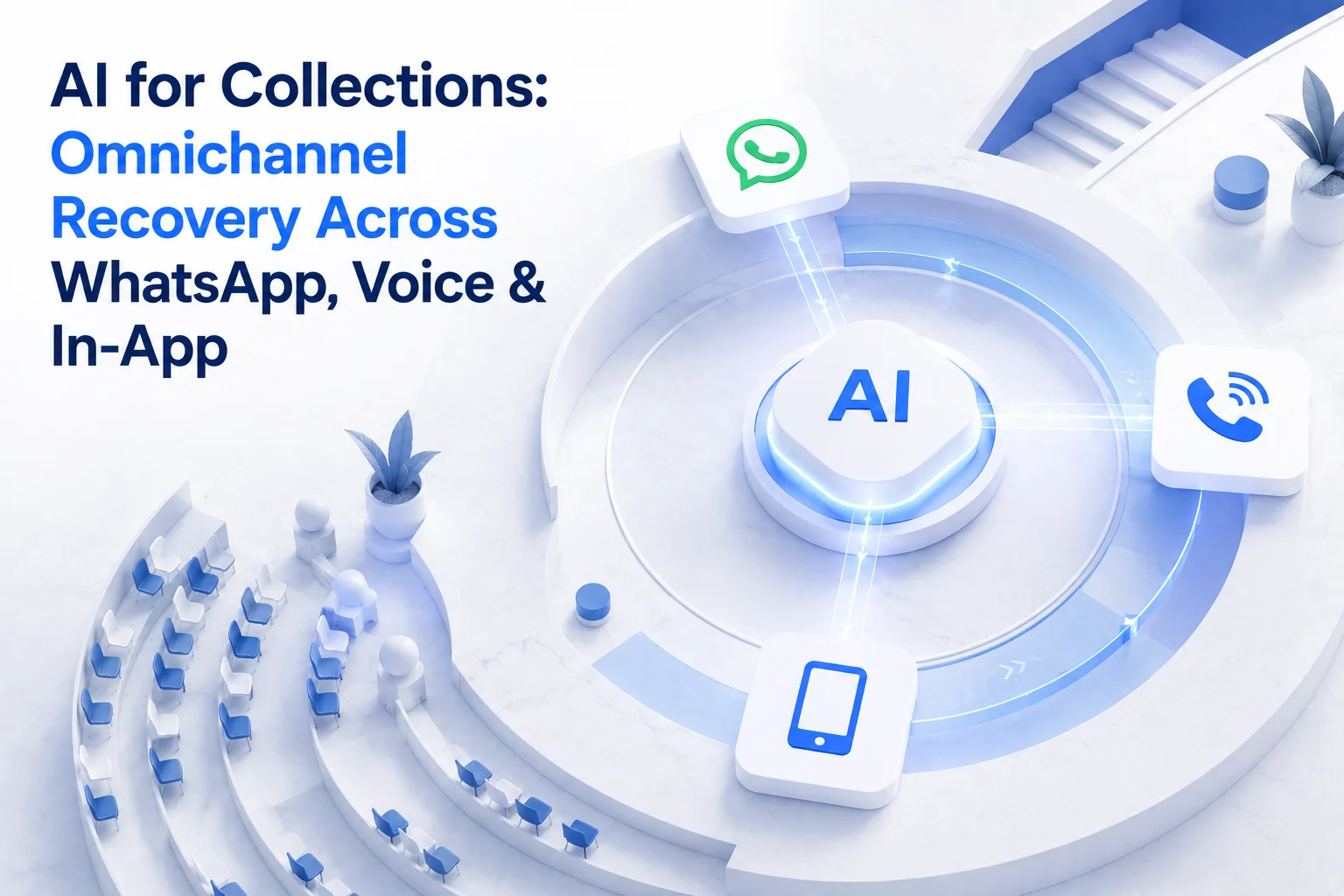
If you run collections at an NBFC, BNPL company, or telecom in India, you already know the core problem. Accounts that could have been resolved in the 0 to 30 DPD window slide into 60 to 90 DPD, not always because the borrower cannot pay, but because the outreach missed the right person, at the right time, on the right channel.
That is where AI for collections has become more than a productivity layer. It is now the operating system for early recovery, promise-to-pay capture, and compliant borrower engagement. The reason is simple. Borrowers ignore unknown calls, mute generic SMS, and respond differently depending on channel, timing, and tone. One channel alone cannot cover that complexity. A coordinated system can.
Convin’s approach is built around that reality. It brings voice, WhatsApp, SMS, and in-app nudges into one sequence, then uses AI to decide what happens next. The result is collections that feel timely to the borrower and controlled to the lender.
(Source: [Convin AI Collections Pages], [WhatsApp Business Platform Pricing], [RBI Fair Practices Code])
Recover more payments with Convin's omnichannel collections AI.
Why Single-Channel Collections Fail to Maximize Recovery Rates
The problem with single-channel collections is not effort. It is reach.
Traditional collection teams can only reach a fraction of delinquent accounts each day, making it difficult to intervene when recovery odds are highest. Since borrowers in the first 30–60 days of delinquency are significantly more likely to repay, AI-powered collections help lenders capitalize on this critical window by automating outreach at scale. The result is broader account coverage, faster engagement, lower operational costs, and stronger recovery outcomes.
(Source: [Convin Debt Collection Blog], [Convin Digital Collection In Banking])
The real shift is structural. Instead of one channel trying to do everything, AI decides which channel is likely to work first, then escalates intelligently.
Expand borrower reach with Convin's AI-driven engagement workflows.
Inside Convin's Omnichannel AI Collections Engine
The strongest collections flows do not choose one channel. They sequence them.
(Source: CarmaOne Omnichannel Collections Playbook, 2026; CarmaOne WhatsApp Plus AI Calling Dual-Channel Study, 2026)
Voice is the escalation layer. Convin’s voice AI is built to handle Hindi-English code-switching, regional accents, objections, and live handoff when the borrower is clearly hot or clearly in distress. In the research dump, voice AI is credited with 2x higher promise-to-pay conversion than manual calling and a 60 to 70 percent reduction in collections operating costs. CarmaOne’s dataset also says AI can execute 10,000 plus simultaneous calls per hour across 12 plus Indian languages.
(Source: CarmaOne Omnichannel Collections Playbook, 2026)
SMS sits underneath both. It is cheap, auditable, and useful as a reminder or confirmation layer. At ₹0.10 to ₹0.20 per message, it works well for pre-due nudges, payment confirmation, and post-call follow-up. In-app notifications close the loop for BNPL and digital lending users who are already inside the app and one tap away from payment.
Convin’s role is to make those touches feel like one journey instead of four disconnected pings.
(Source: [Convin EMI Reminder Blog], [WhatsApp Business Platform Utility Messaging])
Channel Orchestration: The AI-driven sequence that decides whether to nudge on WhatsApp, voice, SMS, or in-app based on borrower behavior, DPD stage, and prior response.
See how Convin automates collections across every borrower channel.
This blog is just the start.
Unlock the power of Convin’s AI with a live demo.

Why DPD-Based Collection Strategies Outperform Volume-Driven Outreach
Most collections teams still run the same script across every overdue account. That is exactly the mistake AI should fix.
That is the content gap your competitors often miss. They talk about AI calling, but they do not explain how the message itself changes by bucket. That is where real recovery gains come from.
(Source: CarmaOne DPD Bucket Strategy, 2026 )
Personalize collection strategies by DPD stage with Convin.
When AI Should Escalate Collection Conversations to Human Agents
The best AI for collections does not try to replace the collector in every scenario. It knows when to stop.
Your research brief identifies four escalation triggers that matter most. The first is account risk, meaning the DPD stage and account value. The second is conversational, such as a dispute, distress signal, or vulnerability mention. The third is behavioral, such as sustained non-response or a broken promise-to-pay. The fourth is compliance, including abuse, legal threats, or a request that needs a human decision.
This is where the Yale SOM nuance is important. Your research notes say AI callers are less effective than humans at extracting verbal repayment promises from higher-risk accounts, and promises made to AI are more likely to be broken. That is not a weakness to hide. It is a reason to design a hybrid model. Let AI handle volume, timing, and compliance. Let humans handle the complex negotiation.
(Source: Yale SOM Study)
Convin’s value here is seamless handoff. The AI should not just escalate the account. It should pass the borrower context, tone, and conversation summary to the collector in real time. Convin’s digital collection content says its BFSI customers have seen 37 percent higher resolution rates and 55 percent higher first-contact resolutions when AI handles the early work and humans step in only when complexity requires it.
(Source: [Convin Digital Collection In Banking])
Balance AI efficiency with human expertise using Convin.
How Convin Automates RBI and DPDP-Compliant Collections
Compliance is not a slide in the deck. It is the architecture.
RBI’s Fair Practices Code requires non-coercive recovery methods, proper disclosures, recording of recovery-agent calls, and restricted calling hours. RBI’s FAQ material also flags early and late calls as harsh practice, and the broader framework requires lenders to follow documented fair-practice rules.
(Source: [RBI Fair Practices Code], [RBI FAQ On Borrower Calling Hours])
Your research dump also notes that AI collections platforms can hardcode the 8 AM to 7 PM window, enforce contact caps, scrub DNC lists, and log every attempt. That is the right way to think about compliance. The system should make bad behavior impossible, not merely discourage it.
DPDP adds another layer. The 2025 Rules were notified on 14 November 2025, with key provisions coming into force in phases over 18 months. The law itself is about lawful processing of digital personal data, which means borrower data must be handled with purpose limitation, retention discipline, and proper rights handling.
(Source: [Digital Personal Data Protection Rules, 2025, MeitY])
That is why Convin’s compliance story matters. The company says it offers 100 percent compliance monitoring and automated call audits, which is exactly what lenders need when every interaction must stand up in a regulatory review.
(Source: [Convin Contact Center Compliance], [Convin AI Call Center Workflow Automation])
Strengthen collections compliance with Convin's automated monitoring.
How Convin Connects Collections, Payments, and LMS Workflows for Faster Recovery
Collections AI only works if it speaks to the LMS.
If a borrower pays through UPI, NACH, eMandate, or any other rail, the system should stop the sequence immediately. If it does not, you create duplicate nudges and unnecessary complaints. That is why real-time LMS sync is not a nice-to-have. It is the difference between automation and embarrassment.
Your research notes say Convin integrates with the LMS, generates tokenized UPI payment links, and closes the loop with real-time confirmation. That means the workflow becomes reminder, payment link, confirmation, and sequence closure. No manual reconciliation. No stale lists.
The ROI case is strong enough to justify the architecture. Your brief cites a 21 percent increase in collection rate, 60 percent cost reduction, 30 percent manual-call reduction, and 18 percent faster recovery cycles from Convin’s published materials. It also cites a 40 percent reduction in first-level call volume and a 40 percent lower roll rate into 60 plus DPD for one NBFC after deployment.
(Source: [Convin Collection Cost Blog], [Convin Digital Collection In Banking])
That is the real promise of AI for collections. Not just more messages, but smarter timing, cleaner handoffs, tighter compliance, and better recovery economics.
Connect collections workflows seamlessly with a Convin demo.
FAQ
Q: How long does it take to implement AI for collections in an NBFC or lending business?
AI for collections can often be deployed within a few weeks when LMS, CRM, and communication channels are already integrated.
Implementation timelines depend on workflow complexity and compliance requirements.
Q: What KPIs should lenders track to measure AI for collections performance?
Key AI for collections metrics include collection rate, promise-to-pay rate, roll rate reduction, recovery cycle time, right-party contact rate, and cost per recovered account.
Q: Can AI for collections support multilingual borrower communication?
Yes. Modern AI for collections platforms can communicate in multiple regional languages and adapt messaging based on borrower preferences.
This improves engagement and response rates across diverse customer bases.
Q: Which lending sectors benefit most from AI for collections?
AI for collections is widely used by NBFCs, banks, fintech lenders, BNPL providers, telecom companies, and microfinance institutions.
Organizations with high account volumes typically see the greatest operational impact.
Q: How does AI for collections improve borrower experience compared to traditional collections?
AI for collections delivers timely reminders, personalized outreach, and consistent communication across channels.
This reduces borrower friction while helping lenders maintain recovery effectiveness.



.avif)