


A customer sees your ad on Instagram, clicks through to your website, browses a product, and leaves without buying. Later that evening, they open WhatsApp and ask a question about the same product. The next day, they call customer support expecting clarity, but the agent has no idea what was already discussed.
From the outside, it looks like the brand is present everywhere. Inside the system, every interaction is disconnected.
This is the gap most teams discover when they start exploring omnichannel meaning in a real business context. It is not about whether channels exist. It is about whether those channels actually remember the customer. And that is usually where the problem begins.
Most organizations believe they understand what is omnichannel, but what they are actually running is a collection of tools, not a unified experience. And when customers move faster
than systems can sync, the experience starts to feel fragmented even if every channel is technically active.
The true omnichannel meaning is not simply being present across multiple channels. It is creating a connected customer journey where context travels with the customer, no matter where the conversation continues.
Unify customer context across channels with Convin.
What Omnichannel Actually Means Beyond the Buzzword
.webp)
Omnichannel is often misunderstood as “being available everywhere.” In reality, availability is the easiest part. Integration is the difficult part.
At its core, omnichannel means that a customer can move from one channel to another without losing context. The system remembers what the customer said, what they viewed, what they abandoned, and what they asked earlier. The customer does not need to repeat anything, and the business does not need to restart the conversation.
In most B2C businesses, however, channels operate like separate teams. Marketing runs campaigns on WhatsApp. Support handles calls. Sales responds to emails. Each function sees only a partial version of the customer journey.
This is where the real misunderstanding of omnichannel begins. It is not a channel strategy. It is a continuity strategy.
Salesforce’s State of the Connected Customer report (2025) highlights this shift clearly. It notes that customers increasingly expect companies to understand their history and preferences across every interaction, not just within a single platform. In simple terms, customers do not think in channels anymore. They think in experiences.
When businesses align with this expectation, the experience stops feeling like fragmented conversations and starts feeling like one continuous dialogue.
What Is Omnichannel Marketing and What Does an Omnichannel Campaign Actually Mean?
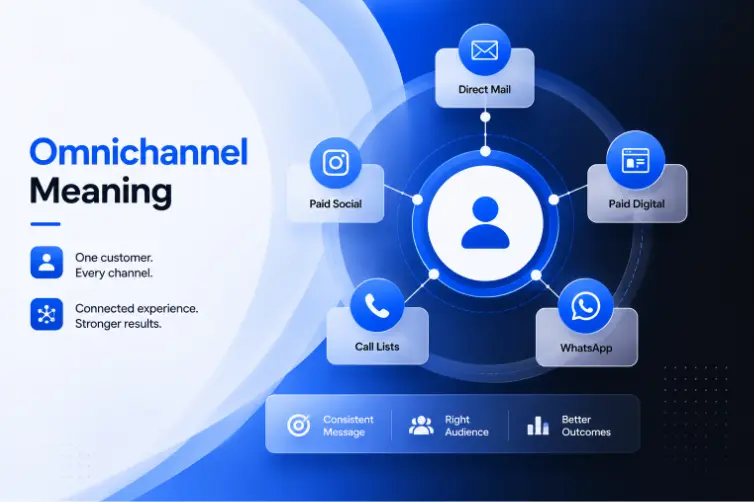
So, what is omnichannel marketing? Or more specifically, what is an omnichannel campaign?
Simply stated, omnichannel marketing is the practice of delivering a single, consistent message to a defined audience across multiple channels during a specific promotional period, while keeping the experience connected rather than fragmented.
An omnichannel campaign takes this a step further in execution. It ensures that the same core message is reinforced across different touchpoints, but adapted to how audiences naturally engage with each channel.
These “multiple different ways” are the “channel” part of omnichannel and typically include:
Direct Mail- still one of the few channels capable of reaching a large share of a defined audience in a physical, attention-grabbing format.
Email- effective for structured communication, especially when promoting products, offers, or detailed information that users can act on digitally.
Paid Social- placing targeted messaging within social media environments like Facebook, Instagram, and similar platforms based on audience behavior and interests.
Paid Digital- using programmatic and display advertising to reach users across websites and apps based on intent signals, browsing patterns, and location-based targeting.
Call Lists- outbound calling workflows designed to engage high-intent or prioritized prospects through direct human interaction.
See how Convin unifies customer context across every channel.
What Is the Difference Between Omnichannel and Multichannel in Plain Terms?
The difference between multichannel and omnichannel is often explained as “presence versus integration,” but that still feels abstract. Understanding this distinction is essential to understanding the true omnichannel meaning for modern B2C businesses. A simpler way to understand it is through customer memory.
In a multichannel setup, every channel behaves like it has no memory of the others. A customer who chats on WhatsApp and later calls support has to repeat everything again. The system does not carry forward context, so each interaction resets the journey.
In an omnichannel setup, memory is shared. The customer does not have to repeat themselves because the system already knows the full history.
This difference sounds small on paper, but in real customer journeys, it changes everything. It reduces frustration, shortens resolution time, and makes interactions feel smoother without increasing human effort.
Industry research consistently shows that companies integrating interaction data across channels achieve better resolution efficiency and higher customer satisfaction, because agents operate with full context rather than fragmented inputs.
The key shift is not technological alone. It is structural. Businesses stop treating channels as separate pipelines and start treating them as parts of one connected system.
See how connected conversations work in practice with Convin.
This blog is just the start.
Unlock the power of Convin’s AI with a live demo.

What Does a Real Omnichannel Experience Look Like for a B2C Customer?
A real omnichannel experience is not something the customer notices directly. In practice, the simplest way to understand omnichannel meaning is to look at how customers move between channels without losing context.
Consider a typical purchase journey in a B2C setting. A customer browses a product on a website, adds it to cart, and leaves. Later, they receive a WhatsApp message referencing the exact product they viewed. They respond asking for details. A support agent then calls them, already aware of what the customer was interested in and what concern they raised earlier.
There is no repetition. No re-explaining. No friction in starting over.
That continuity is what defines omnichannel customer experience in practice. It is not about using multiple channels. It is about ensuring that every channel reflects the same customer story.
What matters here is not just personalization, but continuity of intent. When a business remembers context across channels, the experience feels faster, even when the underlying process is more complex.
Which Industries Benefit Most From an Omnichannel Approach?
Omnichannel is not equally critical for every business model. Its impact becomes most visible in industries where decisions are not instant but evolve across multiple interactions.
In e-commerce, for example, customers often browse multiple times before purchasing. Without continuity, retargeting becomes generic and less effective. In BFSI, where decisions involve trust and documentation, fragmented communication can directly reduce conversion. In healthcare, continuity affects follow-ups and patient engagement. In travel and hospitality, customers constantly switch between devices and platforms before finalizing bookings.
In each of these cases, the customer journey is not linear. It is fragmented by nature. Omnichannel systems help bring that fragmentation back into a single view.
According to KPMG's Global Customer Experience Excellence Report 2025–2026, organizations investing in trust, personalization, and integration consistently outperform peers, with industries like banking, healthcare, and retail showing the strongest gains in retention and customer satisfaction.
The real value is not just better communication. It reduces friction in decision-making, which directly affects revenue outcomes.
Why Omnichannel Is No Longer Optional in 2026
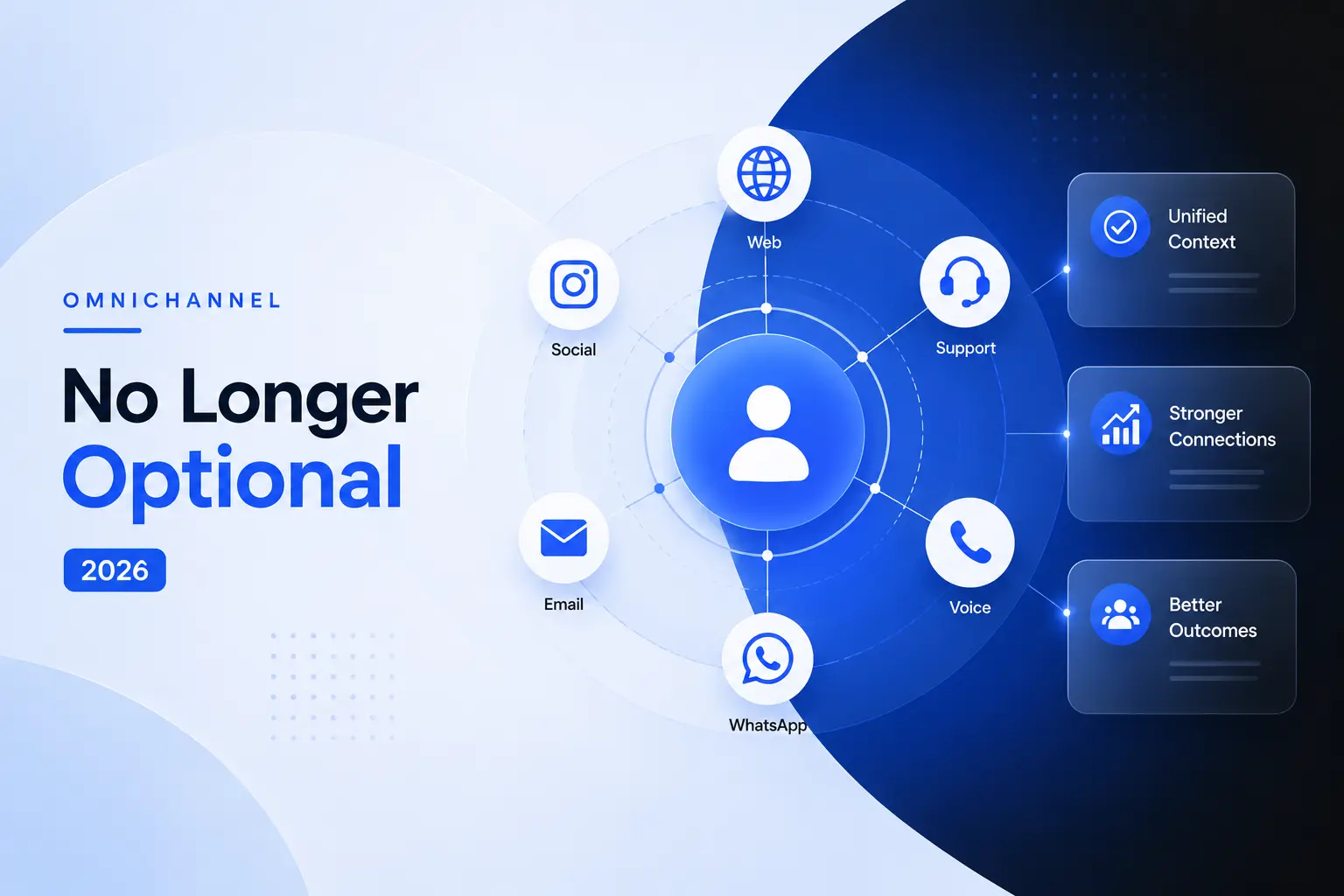
Customer expectations have changed faster than most business systems. People now expect every brand to remember them, regardless of where the conversation started.
This shift is subtle but powerful. A disconnected experience no longer feels normal. It feels broken. Even if each channel is working correctly, the lack of continuity makes the overall experience feel incomplete.
That is why the conversation around omnichannel meaning is evolving. It is no longer about channels at all. It is about memory, context, and continuity across the entire customer journey.
Brands that succeed in this environment are not necessarily the ones that adopt more tools. They are the ones that make those tools work together in the background so the customer never feels the complexity.
And that is where modern B2C growth is increasingly being decided.
What Does It Actually Mean for B2C Businesses?
The true omnichannel meaning goes far beyond being present on multiple channels. It is about creating a connected experience where customer context, preferences, and conversations move seamlessly across every touchpoint.
As customer expectations continue to rise in 2026, businesses that prioritize continuity over channel count will be better positioned to improve engagement, increase retention, and deliver stronger customer experiences.
Book your demo to see seamless omnichannel customer journeys.
FAQs
1. How does omnichannel improve customer retention?
Omnichannel improves retention by creating consistent experiences and reducing customer frustration across channels.
2. What technologies are required to build an omnichannel strategy?
Businesses typically need CRM systems, automation tools, customer data platforms, and connected communication channels.
3. Can small and mid-sized businesses implement omnichannel experiences?
Yes. Many cloud-based solutions allow businesses to adopt omnichannel capabilities without large investments.
4. How do AI systems support omnichannel customer journeys?
AI helps maintain context, automate interactions, route conversations, and enable smoother customer experiences.
5. What metrics should businesses track to measure omnichannel success?
Common metrics include customer satisfaction, retention, conversion rates, response times, and resolution rates.
.avif)

.avif)


.avif)