


Customer conversations are no longer just data for support. They are one of the most important things that modern businesses have. Every interaction gives us information about what the customer wants, what they don't want, and what they plan to do. Most leaders don’t have the time to review individual conversations at scale. Instead, they rely on reports and summaries that often arrive after key moments have passed.
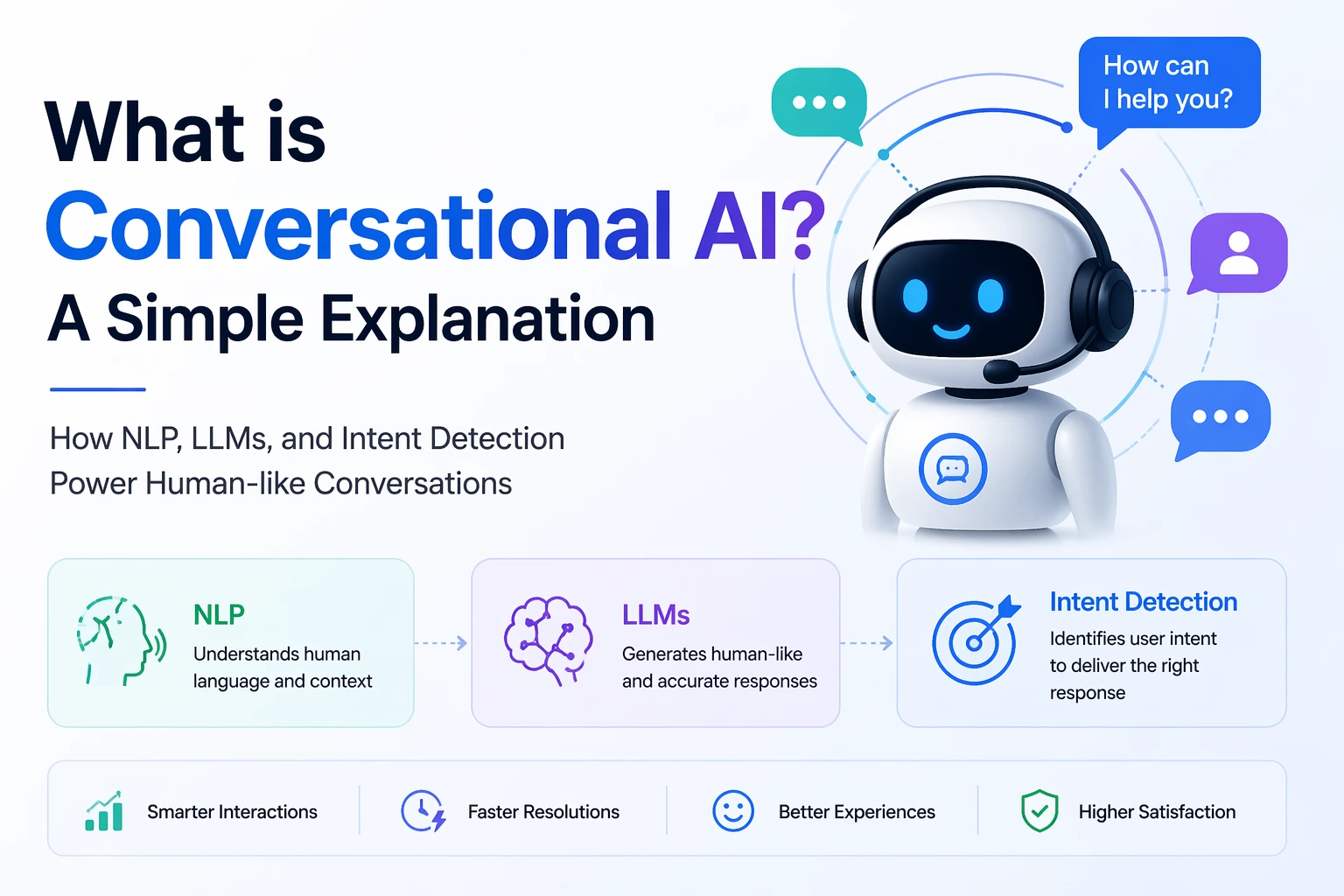
Conversational AI is not a standalone tool. It is an intelligence layer embedded within systems that helps businesses understand and act on customer interactions. By applying natural language processing, large language models, and intent detection, it analyzes conversations at scale and uncovers patterns that are not visible through manual review.
This enables teams to identify high-impact opportunities across sales, support, and customer experience. Instead of relying on assumptions, businesses can see what drives conversions, where customers face friction, and how interactions impact outcomes.
Conversational AI also makes conversations measurable by evaluating intent, sentiment, outcomes, and agent behavior. This turns everyday interactions into actionable data that teams can use to improve performance and decision-making.
See how conversational AI can drive smarter growth
Pillar 1: Understanding Conversational AI fundamentals
Business leaders hear the term “conversational AI” often, but it is still misunderstood. Many assume it is just another layer of automation. That is not accurate. A common reason for this confusion is how conversational AI is presented. It is often reduced to visible interfaces like chatbots, which are only one part of a much larger system.
Conversational AI is not just about chat interfaces. It is the underlying intelligence that helps systems understand, interpret, and respond to conversations across channels.
Conversational AI explained simply
This is a simple way to think about conversational AI software: It works like an intelligence layer over all of your conversations. It records what customers say. It finds patterns that teams often miss.
It does not tell your company what to do. Instead, it highlights what needs attention and suggests the next best actions, so teams can make faster and more informed decisions. That could mean finding common reasons why people say no to sales. It could mean better training for support agents. It could mean finding questions that come up a lot that should affect content and SEO.This is where examples of conversational AI come in handy.
A sales manager can use it to find out which talk tracks lead to more sales. A support leader can use it to figure out why problems keep coming up. A marketing leader can use it to find out exactly how customers talk about their problems.
Why does this matter for business leaders?
Most leaders do not have direct visibility into customer conversations. They can see reports, dashboards, and summaries. Leaders do get reports and summaries, but these often lack the context behind customer behavior. They show what happened, but not why it happened. As a result, teams make decisions based on incomplete understanding.
That creates serious blind spots across the business. You may not know why deals are slowing down. You may not know why support quality varies across teams. You may also miss the questions customers keep asking before they buy.
This is where the real value of conversational AI becomes clear. Because reviewing every conversation manually is not feasible, most teams rely on small samples to assess performance. This approach often misses critical patterns and high-impact interactions., leaders can understand what is happening across every interaction. That makes decisions faster, sharper, and more grounded in reality.
For business leaders, this means:
- A clearer view of customer conversations
- Faster and better decision-making
- Stronger alignment across sales, support, and marketing
- More reliable performance insights
- A deeper understanding of customer needs and intent
This is also why conversational AI use cases are expanding quickly. It is no longer limited to customer support alone. Today, it plays a growing role in revenue strategy, coaching, compliance, and long-term growth planning.
How conversational AI creates strategic value
The strongest conversational AI use cases come from turning everyday customer conversations into strategic inputs. That is what makes conversational AI so valuable for business leaders.
Instead of treating conversations as operational records, leaders can use them as a source of business intelligenceThis positions conversational AI not just as a support function, but as a system that drives revenue, performance, and decision-making across teams.
Here’s where this creates value:
Conversational AI makes these outcomes possible by analyzing every customer interaction in real time and turning them into structured insights.
- Sales teams can identify the messages that improve conversions because conversational AI uses intent detection to spot buying signals and large language models to analyze what responses lead to successful outcomes.
- Support teams can spot recurring friction points and service gaps as conversational AI applies natural language processing to detect patterns, complaints, and negative sentiment across thousands of conversations.
- Marketing teams can use real customer language to improve content and campaigns since conversational AI captures how customers actually speak and uses large language models to surface common phrases, objections, and preferences.
- Leaders can align teams around the same customer insights because conversational AI centralizes data from all interactions, using intent detection and natural language processing to create consistent, actionable insights across departments.
It also unlocks stronger SEO and content strategy. Instead of guessing what prospects are searching for, teams can use real conversation data to find better content opportunities. That is one of the most practical conversational AI benefits for growth teams today. It helps businesses create content that matches real customer intent, not assumptions.
Where conversational AI meets Convin
This is where conversational AI becomes practical, and where Convin stands out. Convin brings conversational AI into everyday customer interactions by turning conversations into real-time intelligence.
Convin uses conversational AI to capture and process conversations across calls, chats, and emails. It applies natural language processing, large language models, and intent detection to understand every interaction deeply.
With conversational AI, Convin does more than analyze conversations. It identifies intent, detects patterns, and highlights what is working and what is not. This helps businesses uncover performance gaps and improve outcomes faster.
Convin’s conversational AI also delivers real-time guidance to agents. It suggests the next best action during live conversations, helping teams respond more effectively and consistently.
With Convin, conversational AI turns every interaction into actionable insight. This makes it easier to improve customer experience, optimize performance, and scale smarter decisions across teams.
Understand customer conversations with Convin
Pillar 2: Breaking Down How Conversational AI Works
Conversational AI records conversations, processes them, analyzes them, and then takes action based on what it learns. It goes beyond simple automation by enabling businesses to uncover insights from conversations in real time. Instead of manually reviewing interactions, it processes large volumes of data instantly and identifies patterns with high accuracy. This allows teams to make faster, smarter decisions based on reliable insights.
How does AI that talks work?
The process usually starts by gathering interactions from multiple channels. That includes phone calls, chats, emails, and other customer touchpoints. Once captured, the system converts spoken conversations into text.
It then organizes both speech and written inputs into structured data. After that, AI models analyze the content for patterns. They identify customer intent, sentiment, risks, and opportunities.
In simple terms, here is how conversational AI works:
- Accept customer input through voice or text
- Use natural language processing to understand the message
- Apply intent detection to identify the customer’s goal
- Use large language models to interpret context and shape the response
- Deliver the best next response or action in real time
.webp)
The role of automation and intelligence
Human review cannot scale with growing conversation volumes. But the real limitation is not just speed. It is the inability to make timely decisions. This is where conversational AI creates a real advantage. Conversational AI does not just analyze conversations. It highlights what needs attention right now and what can wait.
Instead of reviewing past interactions, leaders can focus on active risks and opportunities. Conversational AI shifts teams from reactive analysis to proactive decision-making.
With Convin, conversational AI becomes operational. Leaders get real-time visibility into live conversations, allowing them to intervene early, prevent escalations, and guide outcomes as they happen.
The real strength of conversational AI is not just insight. It is prioritization and timing. It helps teams act on the right conversations at the right moment.
With conversational AI, leaders can:
- Identify performance risks before they impact outcomes
- Focus coaching on high-impact conversations instead of random sampling
- Reduce delays between insight and action
- Create consistent decision-making across teams
Convin makes this actionable by embedding conversational AI directly into daily workflows. Teams move faster, act smarter, and improve performance continuously.
Turn every interaction into actionable insight with Convin
This blog is just the start.
Unlock the power of Convin’s AI with a live demo.

Pillar 3: Key Problems Conversational AI Solves
Conversational AI helps solve the operational issues that slow growth. Most businesses struggle with limited visibility into customer conversations, inconsistent customer experience, manual QA, and disconnected teams. When leaders cannot see what customers are asking, feeling, or objecting to, decisions get made with partial context.
For business leaders, that means conversational AI can help:
- Standardize quality across teams
- Improve customer experience with faster insight loops
- Reduce manual review and delayed feedback
- Use real customer language to improve SEO, messaging, and content strategy
The shift is already happening at scale. Salesforce’s latest State of Service is based on 6,500 service professionals worldwide. Zendesk’s 2025 CX Trends Report surveyed nearly 5,100 consumers and 5,400 CX leaders, agents, and technology buyers across 22 countries. McKinsey also notes that tomorrow’s fully AI-enabled customer care organizations will look very different from today’s teams.
That is why conversational AI use cases are expanding beyond support. Today, they shape quality management, coaching, compliance, customer experience, and revenue strategy. With Convin, businesses can act on this by recording, transcribing, and analyzing conversations across channels, monitoring 100% of interactions, and giving agents real-time guidance.
Start solving these challenges with Convin today
Pillar 4: Building a Conversational AI Strategy
The future of business is increasingly conversation-driven. Every customer call, chat, and email carries signals about intent, trust, risk, and opportunity. For years, most companies treated these conversations as operational records. Now, forward-looking leaders are starting to treat them as strategic assets.
As businesses grow, the number of customer interactions rises quickly. Without the right system, leaders are left with summaries, isolated reports, and sampled reviews. That creates blind spots across sales, support, compliance, and customer experience, conversational AI changes that model. It helps leaders understand what is really happening across customer interactions at scale.
Leaders who adopt conversational AI early are in a stronger position to:
- Build a deeper understanding of customer needs
- Scale operations with more consistency
- Improve coaching and quality across teams
- Strengthen customer experience through real-time insight
- Use conversational AI insights to guide strategy
- Gain a measurable competitive advantage
The real opportunity goes beyond efficiency. Yes, conversational AI automation can reduce manual effort. But its larger value is in helping leaders build smarter operating systems. Companies that adopt conversational AI solutions early do not just improve one team. They create a system where every conversation becomes a source of insight.
Over time, that leads to:
- Better alignment across sales, support, and marketing
- Faster decision-making based on customer reality
- Stronger customer trust and experience
- More scalable processes across high-volume teams
- Better use of data across the business
Through Convin, the evolution from theory to practice has been achieved. Convin assists organizations in logging, transcribing, analyzing customer conversations, getting actionable insights into agent performance, automating coaching, and giving live guidance.
This way, leaders need not rely solely on quarterly reviews to get the full picture. They can utilize relevant conversation intelligence to ensure quality, performance, and success in their interactions with customers. In the coming years, leaders will not succeed just by working fast. Rather, they will succeed by knowing more about their customers than their competitors know. This is precisely the reason why conversational AI can be a leadership tool.
Turn every conversation into a growth advantage with Convin
Final Thoughts: Why Conversational AI Matters Now
Conversational AI is no longer optional. It is a strategic advantage for modern business leaders. The real value of conversational AI for business lies in what it unlocks. It improves visibility, strengthens execution, and supports smarter growth decisions.
As more teams adopt conversational AI solutions, they gain better customer understanding and stronger operational control. They also unlock practical conversational AI benefits across sales, support, and marketing. From better coaching to sharper strategy, the impact is clear. The right conversational AI software helps leaders turn conversations into action.That is why the strongest conversational AI use cases are now tied to performance, customer experience, and long-term growth. For business leaders, the opportunity is not just to automate conversations, but to learn from them and lead with more confidence.
Get started with Convin’s solution today
FAQ’s
1. What is conversational AI?
Conversational AI is technology that helps businesses understand, analyze, and respond to customer conversations. It works across calls, chats, and emails to turn interactions into useful insights.
2. How does conversational AI work?
Conversational AI captures conversations, converts them into text, and analyzes them using AI models. It identifies intent, sentiment, trends, and performance gaps, then turns them into actionable recommendations.
3. What problems does conversational AI solve?
Conversational AI helps solve common business challenges like poor visibility into customer conversations, inconsistent support quality, delayed feedback, and missed revenue opportunities. It also improves coaching, compliance, and customer experience.
4. What are the benefits of conversational AI for business leaders?
For business leaders, conversational AI provides better visibility into customer interactions, faster decision-making, stronger team alignment, and more accurate performance insights. It also helps teams uncover valuable conversational AI use cases across functions.
5. How can conversational AI improve customer experience?
Conversational AI in customer service helps businesses identify customer pain points, improve agent performance, and deliver faster, more consistent support. This leads to better service quality and higher customer satisfaction.



.avif)