

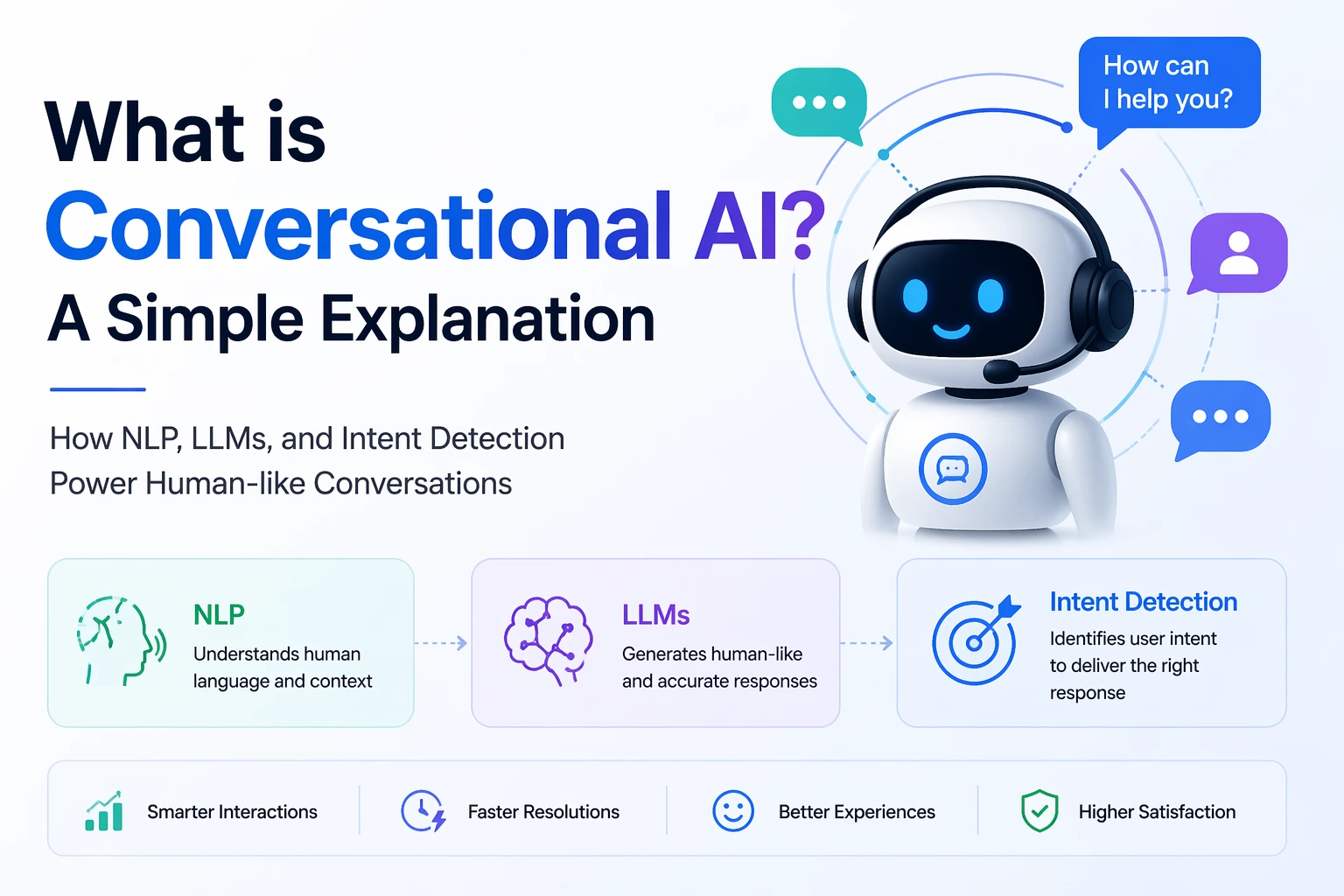
Businesses today struggle to make sense of customer conversations at scale. Queries are complex, intent is unclear, and manual analysis is slow. Most contact centers still review less than 5% of interactions manually. This creates blind spots in customer experience and decision-making. According to Gartner, conversational AI will power a majority of customer interactions in the coming years. At the same time, McKinsey & Company reports that AI can automate up to 70% of customer interactions. This is where conversational AI becomes essential. It helps businesses analyze, understand, and respond to conversations instantly.
Conversational AI uses natural language processing, large language models, and intent detection. These technologies help decode customer intent and automate responses. According to IBM, businesses using conversational AI see faster response times and improved accuracy. This leads to better customer satisfaction and lower operational costs. From support to sales, conversational AI is reshaping communication. It enables real-time insights, automation, and personalization at scale. In this blog, you will learn how conversational AI works. You will also understand natural language processing, large language models, and intent detection.
See conversational AI in action with real-time insights
What is Conversational AI?
Conversational AI enables machines to talk like humans. It powers real-time, automated conversations across channels. Today, conversational AI is used in chat, voice, and messaging systems. It helps businesses handle thousands of interactions instantly.
According to Gartner, conversational AI will power most customer interactions soon. This shows how fast conversational AI adoption is growing. Conversational AI improves response time and consistency. It also reduces dependency on manual support teams.
Understand where conversational AI fits your workflow
NLP In Conversational AI
Natural language processing is the foundation of conversational AI. It enables machines to understand and interpret human language in real time. According to IBM, natural language processing is widely used in applications like chatbots, virtual assistants, and sentiment analysis. This makes conversational AI more accurate and scalable across industries.
Natural language processing also works closely with machine learning models. These models continuously improve accuracy based on past interactions. As a result, conversational AI becomes faster, smarter, and more context-aware over time.
How does natural language processing actually work?
Natural language processing follows a step-by-step process. It converts raw text into meaningful insights.
- It breaks sentences into smaller parts
- It analyzes grammar and sentence structure
- It identifies entities like names or actions
- It maps meaning using context
Natural language processing allows conversational AI to understand intent clearly. It reduces confusion in responses.
How does NLP handle real conversations?
Natural language processing processes both text and voice inputs. It works closely with speech recognition systems. Speech recognition converts voice into text first. Then natural language processing interprets that text.
Example: The user says, “I need help with billing.” Natural language processing detects the topic and urgency. This helps conversational AI respond correctly. It improves interaction quality instantly.
Why is NLP critical for conversational AI?
Natural language processing is essential for conversational AI systems. It enables meaningful and human-like communication.
- Natural language processing helps conversational AI understand context and tone
- It enables AI chatbots to handle complex and multi-step queries
- Natural language processing supports multilingual communication
- It improves speed and accuracy in conversational AI responses
- Natural language processing enhances user experience across channels
- Conversational AI relies on natural language processing for intelligent automation
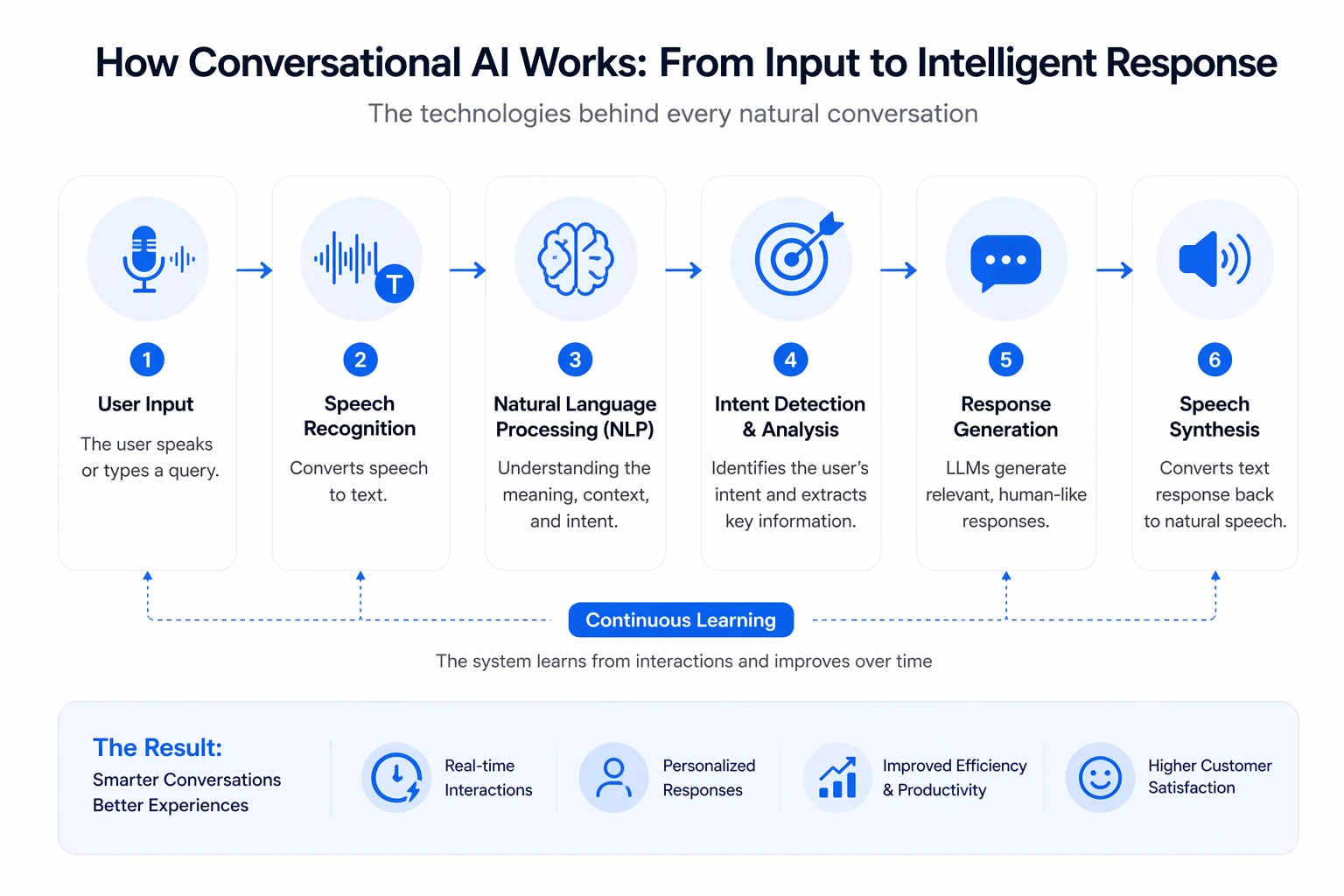
Without natural language processing, conversational AI cannot function effectively. It remains the foundation of modern AI-driven communication.
Explore how natural language processing improves accuracy
This blog is just the start.
Unlock the power of Convin’s AI with a live demo.

How Do Intent Detection And ML Work?
Intent detection and machine learning are core to conversational AI decisions. They ensure the system understands users and responds correctly. Intent detection focuses on identifying user goals. Machine learning ensures those decisions improve over time. Together, they make conversational AI smarter and more reliable.
What does intent detection actually do?
Intent detection helps conversational AI understand what the user wants. It works closely with natural language processing. Intent detection analyzes both keywords and context.
It ensures the right action is taken instantly. For example, a user says, “Cancel my order.” intent detection identifies the request immediately.
Here is how intent detection supports conversational AI:
- Identifies user intent from text and voice inputs
- Maps queries to the correct workflow or response
- Reduces confusion in AI chatbots interactions
- Improves accuracy of automated replies
- Enables faster and more relevant responses
How does machine learning improve decisions?
Machine learning helps conversational AI learn from past interactions. It improves predictions and responses over time. Machine learning continuously trains intent detection models. This increases accuracy with every conversation. Convin uses machine learning to analyze conversations deeply. It identifies performance gaps and coaching needs.
Here is how machine learning enhances conversational AI:
- Learns patterns from historical conversations
- Improves intent detection accuracy continuously
- Adapts to new and complex user queries
- Reduces errors in AI chatbots responses
- Enables smarter automation across workflows
See how intent detection improves automation
How Do LLMs And Speech Recognition Respond?
Large language models and speech recognition complete the conversational AI loop. They turn understanding into natural, human-like responses. These technologies make conversational AI feel less robotic. They enable smooth and real-time interactions across channels.
What do large language models actually do?
Large language models generate responses in conversational AI. They are trained on massive datasets of human language. Large language models understand context, tone, and intent. This helps conversational AI deliver relevant replies.
For example, in customer support:
A user says, “I’m frustrated with my delayed order.” Large language models help conversational AI respond like this: “I’m sorry for the delay. Let me check your order status.” This feels natural and contextual.
Here is how large language models improve conversational AI:
- generate human-like and context-aware responses
- reduce dependency on rigid scripts
- handle complex and multi-turn conversations
- improve AI chatbots flexibility
- personalize responses based on user behavior
According to McKinsey & Company, generative AI can automate a significant share of customer interactions. Convin leverages large language models within its conversational AI engine. It helps analyze conversations and generate actionable insights for teams.
How does speech recognition support conversations?
Speech recognition enables voice-based conversational AI. It converts spoken language into text instantly. This allows conversational AI to process voice queries. It works closely with natural language processing.
For example: A customer calls support and says, “Track my order.” Speech recognition converts this into text. Then conversational AI processes and responds instantly. Here is how speech recognition enhances conversational AI:
- enables voice assistants and IVR systems
- reduces manual input for users
- improves accessibility across devices
- speeds up interaction time
- supports real-time voice conversations
Convin integrates speech recognition with conversational AI. It records and transcribes calls with high accuracy. This helps teams analyze conversations at scale. It also improves agent performance through insights.
Why do these technologies matter together?
Large language models and speech recognition work together in conversational AI. They ensure both understanding and response quality.
- Speech recognition captures user input accurately
- Large language models generate meaningful responses
- Conversational AI delivers seamless interactions
With Convin, this combination becomes more powerful. It not only responds but also analyzes every interaction. Teams get real-time coaching and performance insights. This improves both efficiency and customer experience.
Learn how large language models power smarter responses
Bringing It All Together: Conversational AI Explained
Conversational AI is transforming how businesses communicate with customers. It combines natural language processing and intent detection to understand queries accurately. It also uses machine learning and large language models to improve over time. Today, customers expect instant and personalized responses. Conversational AI helps businesses meet these expectations at scale.
It reduces response time and improves consistency. It also lowers operational costs by automating repetitive tasks. With tools like Convin, conversational AI goes beyond automation. It analyzes conversations and provides real-time coaching to agents. This leads to better performance and higher customer satisfaction. Understanding conversational AI is the first step. Using it effectively drives real business growth.
Get started with Convin’s solution today
FAQs
1. What is conversational AI?
Conversational AI is technology that enables machines to interact with humans. It uses natural language processing and machine learning to respond in real time.
2. How does conversational AI work?
Conversational AI uses speech recognition and natural language processing. Then intent detection and large language models generate responses.
3. Where is conversational AI used?
Conversational AI is used in customer support and sales. AI chatbots and voice bots handle queries instantly.
4. Why is conversational AI important?
Conversational AI improves response speed and accuracy. It helps businesses scale customer interactions efficiently.
5. How does Convin use conversational AI?
Convin uses conversational AI to analyze customer conversations. It provides real-time insights and agent coaching to improve performance.




.avif)