

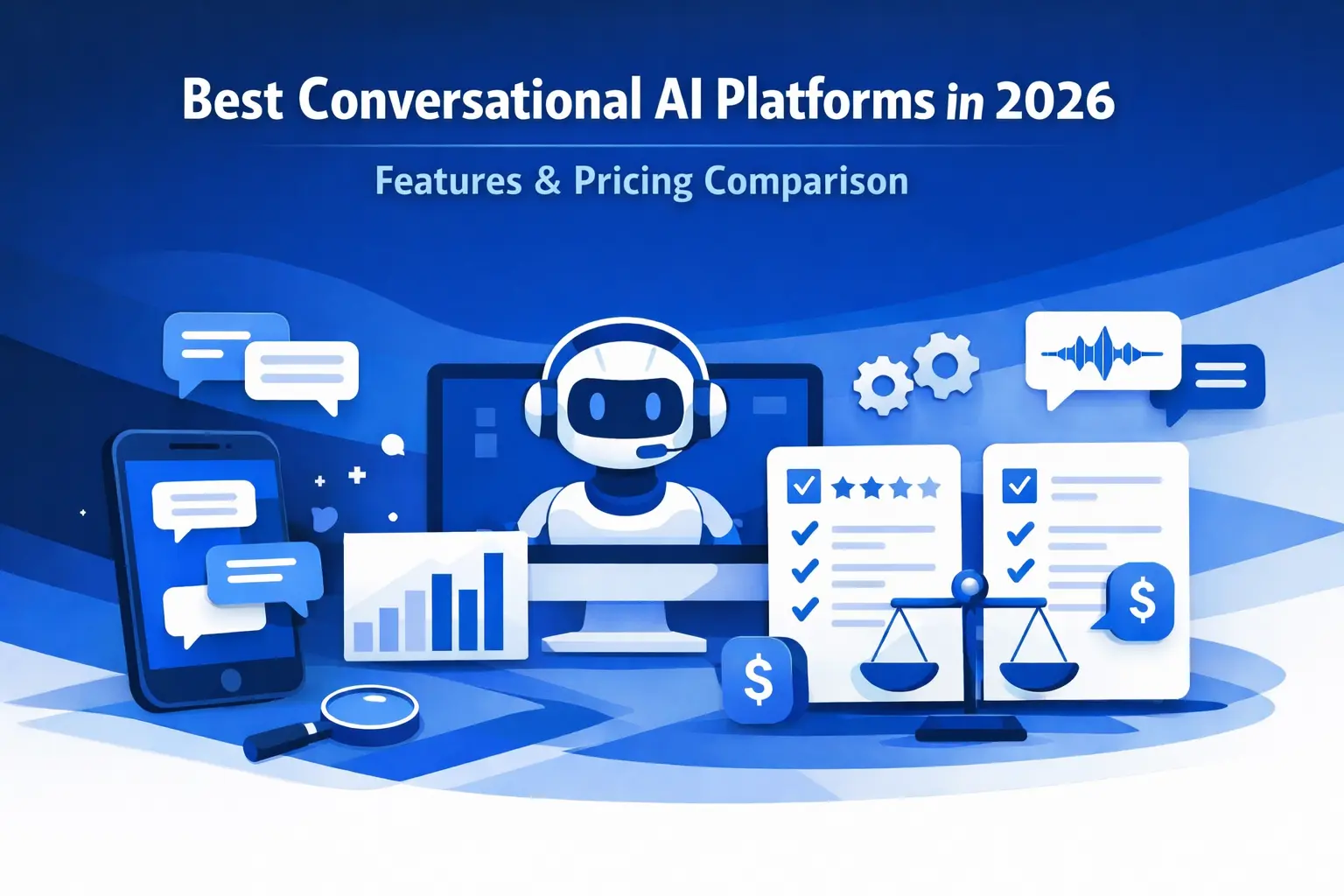
A conversational AI platform is a system that helps businesses handle customer conversations across chat, voice, and messaging without relying on manual replies or rigid scripts.
Instead of just following predefined rules, it uses technologies like NLP and machine learning to understand what customers mean, even when they phrase things differently or switch context mid-conversation.
In practice, this means it can do more than answer FAQs. It can qualify leads, book appointments, route conversations, and sync data into your CRM while keeping responses consistent as volume grows.
Conversational AI platforms are commonly used across functions like:
- Customer support, to handle repetitive queries and improve response times
- Sales and lead qualification, to engage prospects and capture intent early
- Appointment booking and follow-ups, to streamline scheduling and reduce drop-offs
- Internal workflows, to automate routine tasks and information access
These workflows allow banks to engage customers intelligently, reduce human workload, and deliver 24/7 service, all with a single AI agent.
Traditional agents, on the other hand, rely heavily on manual processes, fixed scripts, and limited context from past interactions. As conversation volumes grow, this often leads to delays, inconsistency, and difficulty maintaining quality at scale.
Want to know why AI agents are replacing traditional agents? Explore the top 10 reasons here.
The goal is not just automation, but building a more reliable, scalable, and insight-driven way to handle conversations across the business.
Once you understand what a conversational AI platform should do, the next step is comparing how different tools approach conversation intelligence, coaching, and automation.
Some platforms focus heavily on sales forecasting and pipeline visibility, while others are designed for QA automation, customer support, and operational performance. The right choice depends on where conversations impact your business most.
Here are five widely used platforms and where they typically fit.
- Convin: Offers custom enterprise pricing based on factors like conversation volume, number of agent seats, integrations, and required AI capabilities. Typically suited for businesses looking for large-scale QA automation, agent coaching, and contact center optimization.
- Gong: Uses premium enterprise pricing, usually structured around annual contracts and user seats. Best suited for mid-sized to large sales organizations that need advanced revenue intelligence, forecasting, and deal analytics.
- Chorus by ZoomInfo: Follows enterprise-focused pricing and is often bundled with the broader ZoomInfo ecosystem. Works best for organizations already invested in ZoomInfo’s sales intelligence and prospecting tools.
- Salesloft: Primarily follows a per-user subscription model. Pricing scales with the size of the sales team and additional engagement or analytics features required by outbound and SDR teams.
- Avoma: Offers tiered SaaS pricing with lower entry barriers compared to enterprise-heavy platforms. Suitable for startups and smaller teams that want meeting summaries, notes, and lightweight conversation insights without complex implementation.
This blog is just the start.
Unlock the power of Convin’s AI with a live demo.

As businesses grow, the volume of customer interactions increases across channels like calls, chat, and messaging platforms. Managing these conversations manually becomes difficult to sustain. Teams often struggle with delayed responses, inconsistent communication, and missed opportunities, especially during peak hours or after business hours.
Over time, these gaps start impacting both customer experience and revenue outcomes, making it harder for businesses to maintain quality at scale.
Conversational AI helps address these challenges by:
- Handling high volumes of interactions efficiently, without overwhelming support or sales teams
- Reducing response times across channels, ensuring customers receive timely and consistent replies
- Supporting teams with automation and insights, so agents can focus on higher-value conversations
- Improving overall customer experience, by delivering faster, more accurate, and context-aware interactions
For many organizations, conversational AI becomes more than just a support tool. It acts as a way to scale operations while maintaining consistency, improving responsiveness, and capturing more opportunities without proportionally increasing headcount.
For example, many teams are now exploring how conversational AI is transforming call-based interactions to reduce wait times and improve efficiency.
See how conversation quality drives business results with Convin.
Hidden costs are where many businesses underestimate spending. For example:
- Voice AI often charges per minute, which can add up quickly
- High API usage can increase costs as automation scales
- Custom workflows or integrations may require additional investment
A platform that looks affordable upfront may become expensive at scale if these factors are not considered.
The key is to evaluate conversational AI not just on price, but on cost efficiency per outcome, such as cost per resolved query or cost per conversion.
At the end of the day, no two businesses have the same conversations, the same customers, or the same challenges. That's why there's no single "best" conversational AI platform, only the one that fits your specific needs.
Start asking questions: How does this platform perform when things get messy? What happens when conversation volumes spike? Will this actually save my team time, or just shift the work around?
The businesses that get the most out of conversational AI aren't the ones with the biggest budgets. They're the ones that took the time to understand what they actually needed, tested before they committed, and focused on real outcomes, faster responses, happier customers, and revenue that doesn't slip through the cracks.
If you're still evaluating, that's okay. Take the time to get it right. Run a pilot. Talk to teams already using the platform. Look beyond the feature list and into the numbers that actually matter to your business.
Because when you find the right fit, conversational AI stops feeling like a tool you manage, and starts feeling like a teammate you can rely on.
1. How Do You Choose The Right Conversational AI Platform For Your Business?
Choosing the right conversational AI platform depends on your use case, scale, and integration needs. Businesses should evaluate factors like supported channels (voice, chat, WhatsApp), ease of deployment, analytics capabilities, and how well the platform integrates with existing CRM and support tools. A pilot or demo run is often the best way to validate fit.
2. How IVR Differs From Traditional Chatbots
Traditional chatbots follow fixed scripts and rule-based flows, which limit how they respond to unexpected or complex queries. In contrast, conversational AI uses NLP and machine learning to understand intent, context, and variations in language. This makes it far more flexible, allowing it to handle dynamic conversations and improve continuously as it learns from interactions.
3. Can Conversational AI Integrate With Existing Business Systems?
Yes, most modern conversational AI platforms are built to integrate seamlessly with tools like CRM systems, helpdesk software, telephony platforms, and marketing automation tools. These integrations ensure that customer data flows across systems, enabling more personalized and efficient interactions.
4. How Secure Are Conversational AI Platforms?
Conversational AI platforms typically offer enterprise-grade security features such as data encryption, role-based access control, and compliance with standards like GDPR and SOC 2. However, the level of security depends on the vendor, so businesses should evaluate security certifications and data handling policies before choosing a platform.
5. How Long Does It Take To Implement A Conversational AI Platform?
Implementation timelines can vary from a few days for basic chatbot setups to several weeks for complex, enterprise-grade deployments. The timeline depends on customization requirements, integrations, and the complexity of workflows being automated.
6. What Metrics Should You Track To Measure Conversational AI Success?
Key metrics include conversation resolution rate, response time, customer satisfaction (CSAT), conversion rate, and cost per interaction. Tracking these metrics helps businesses understand the impact of conversational AI on both operational efficiency and revenue outcomes.
.webp)

.avif)


.avif)