

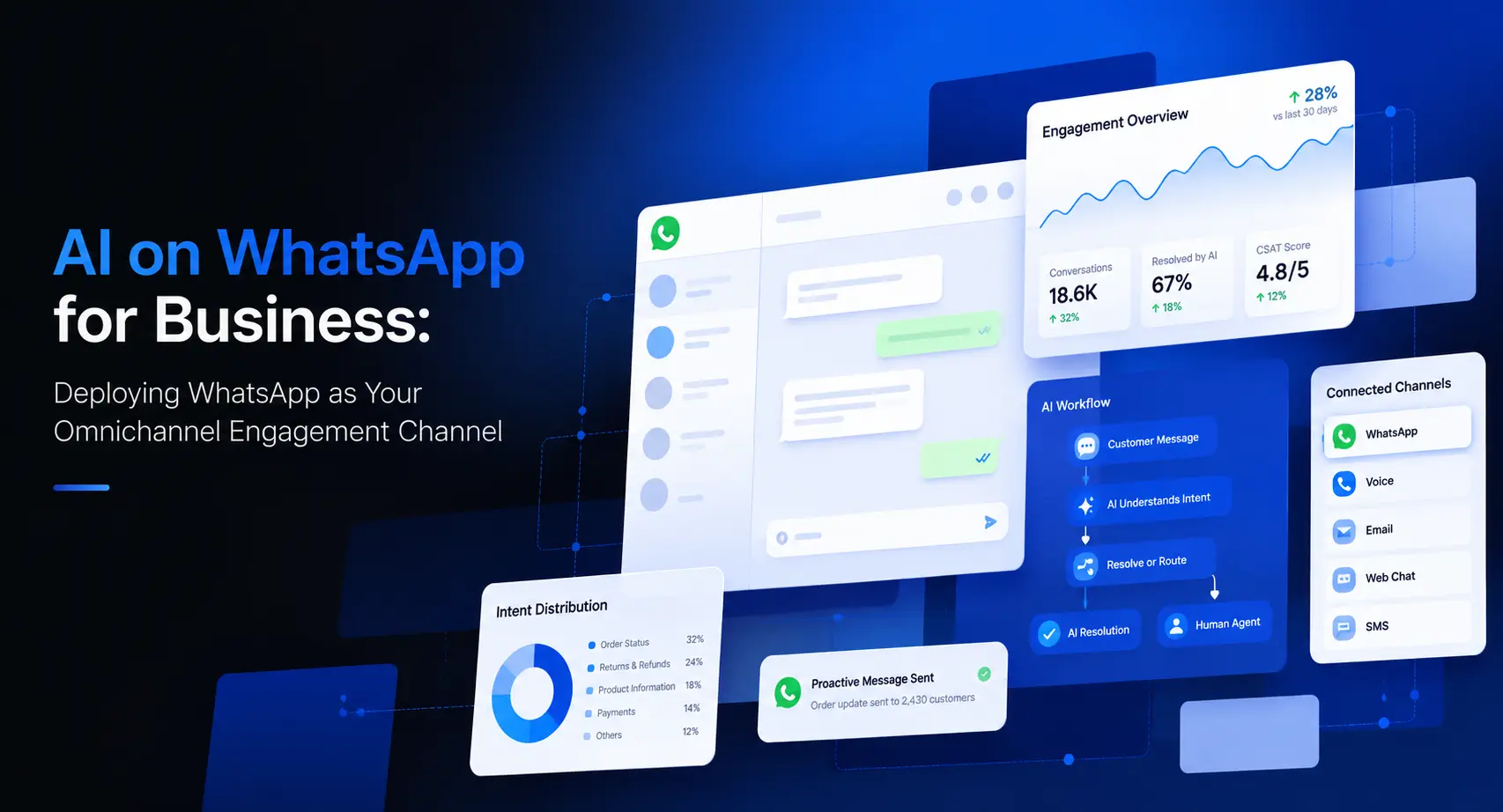
Your customers are not waiting by their email. They are on WhatsApp, messaging friends, tracking orders, and expecting the same instant, conversational experience from the businesses they buy from.
With over 2 billion active users globally and open rates that dwarf every other digital channel, WhatsApp is no longer a peripheral communication tool. For customer-facing teams, it has become the channel where relationships are won or lost in real time.
The shift happening right now is not just about adding WhatsApp to your channel mix. It is about deploying AI on WhatsApp as an integrated layer within a true omnichannel platform, one where every conversation, regardless of where it starts, is intelligent, connected, and continuous.
Why WhatsApp Has Become the Omnichannel Epicenter
With over 2 billion active users and an average open rate of 98%, WhatsApp is no longer just a messaging app, it is where your customers already are. For businesses investing in omnichannel engagement, ignoring WhatsApp means leaving one of the most high-intent, high-visibility channels completely untapped.
But presence alone is not the differentiator. What separates brands that simply have a WhatsApp number from brands that win on WhatsApp is intelligence, specifically, AI embedded into every conversation. When AI is layered onto WhatsApp and connected across your voice, email, and CRM touchpoints, you stop reacting to customer queries and start orchestrating seamless customer journeys.
This is the operational reality that modern omnichannel platforms are built around: WhatsApp as an active engagement channel, not a passive inbox.
How Businesses Use AI on WhatsApp as Part of Omnichannel
Deploying WhatsApp in isolation is a tactical move. Deploying it as part of an AI-powered omnichannel strategy is a structural one, and the difference shows up in customer retention, resolution speed, and revenue.
Here is how leading businesses are operationalizing AI on WhatsApp within their broader engagement stack:
- Conversational Lead Qualification at Scale
AI agents on WhatsApp can engage inbound leads the moment they drop a message, asking qualifying questions, capturing intent, and routing high-value prospects to the right sales rep or scheduling a callback. This replaces the traditional lag between form submission and first outreach, compressing the top-of-funnel timeline dramatically.
- Proactive Customer Communication
Rather than waiting for customers to reach out, AI on WhatsApp enables businesses to push proactive notifications, order updates, appointment reminders, payment confirmations, and re-engagement nudges, all at scale. These messages are not just automated blasts; they are context-aware, personalized, and trigger-based.
- Post-Sale Support and Retention Flows
AI agents handle post-purchase queries, returns, warranties, onboarding walkthroughs, without human intervention. When integrated with CRM and order management systems, the AI already knows who the customer is, what they bought, and what they are likely asking about before they even finish typing.
- Seamless Handoff to Human Agents
Omnichannel does not mean fully automated. AI on WhatsApp is designed to recognize when a conversation exceeds its scope and escalate gracefully, passing full conversation context to a live agent so the customer never has to repeat themselves. This warm handoff is what separates AI-assisted support from frustrating bot loops.
Want to see how these use cases map to your business?
Book a discovery call to explore your omnichannel WhatsApp deployment.
What Types of Customer Queries Can AI Handle on WhatsApp
One of the most common concerns among business leaders evaluating WhatsApp AI is: what can it actually handle without breaking the customer experience? The answer, when properly trained and integrated, is more than most teams expect.
The practical implication here is that AI can autonomously resolve 60-70% of inbound WhatsApp conversations in most B2C and mid-market B2B contexts, freeing human agents to focus exclusively on high-stakes interactions.
Curious which query types are costing your team the most time?
This blog is just the start.
Unlock the power of Convin’s AI with a live demo.

How WhatsApp AI Connects to Voice and Email in an Omnichannel Platform
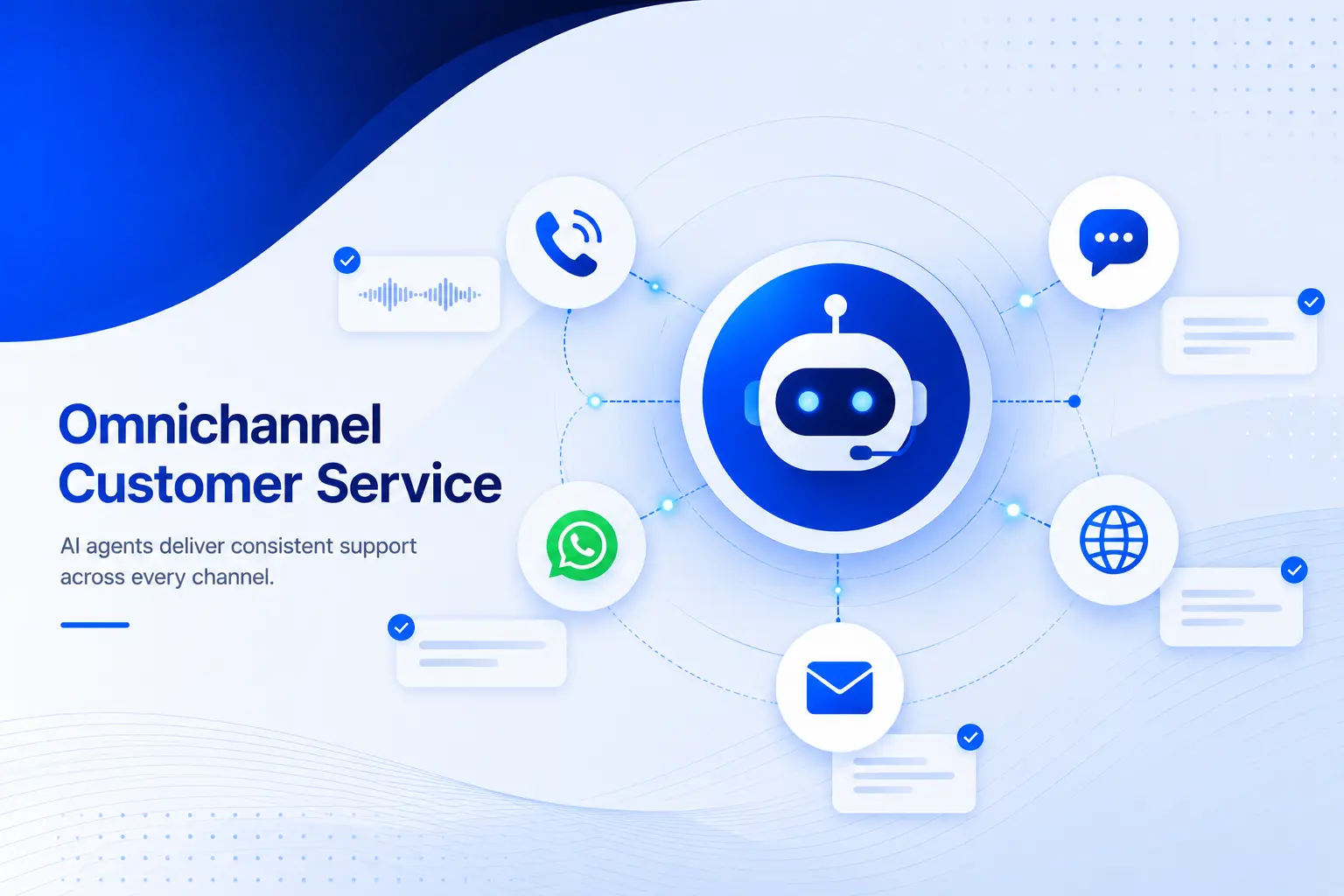
The real power of WhatsApp AI is not what happens within WhatsApp, it is what happens across your entire channel stack. A true omnichannel platform ensures that a conversation that starts on WhatsApp can continue seamlessly on a call or an email thread, with full context preserved at every step.
- The Cross-Channel Intelligence Layer
When WhatsApp AI is integrated into an omnichannel platform, every interaction generates structured data, intent signals, sentiment scores, resolution status, and customer preferences. This data flows into a unified customer profile that is accessible to your voice bots, email automation, and live agents in real time.
Consider this common customer journey:
- A customer messages on WhatsApp asking about a billing issue.
- The AI resolves part of the query but identifies escalation potential.
- The system schedules an outbound call and sends an email summary, all triggered automatically.
- When the agent calls, they see the complete WhatsApp thread and the AI's resolution notes.
This is not a future vision, it is what an integrated omnichannel AI stack enables today.
- Voice-to-WhatsApp Continuity
After a support call ends, AI can automatically send a WhatsApp follow-up: a summary of the resolution, next steps, or a CSAT survey. This closes the loop on voice interactions and moves satisfaction measurement to the channel where customers are most likely to respond.
- Email-to-WhatsApp Re-Engagement
When email open rates drop, and for many brands they have, WhatsApp becomes the re-engagement channel of choice. AI can identify unresponsive email leads or dormant customers and trigger a WhatsApp nudge, effectively rescuing campaigns that would otherwise go unacknowledged.
- Unified Reporting Across Channels
Because all channel interactions feed into the same intelligence layer, contact center managers get a single view of customer engagement, resolution rates by channel, escalation patterns, CSAT by touchpoint, and agent performance, without stitching together data from siloed tools.
What Is the ROI of Adding WhatsApp to Your Omnichannel AI Stack
The business case for WhatsApp AI is no longer theoretical. The ROI shows up clearly across operational efficiency, customer experience, and revenue growth.
Cost Reduction Through Automation
When AI handles 60–70% of WhatsApp conversations autonomously, the impact on support operations is immediate. Routine requests like order updates, appointment scheduling, FAQs, payment reminders, and lead qualification can be resolved instantly without requiring human intervention.
This significantly reduces agent workload while improving consistency and scalability. Unlike traditional support teams that fluctuate based on staffing, training, and workload pressure, AI delivers predictable service quality at scale, 24/7.
Businesses adopting AI-powered WhatsApp support typically see:
- Faster response times, often dropping from hours to seconds
- Lower handling times for repetitive customer queries
- Higher first-contact resolution rates
- Improved CSAT scores due to faster, more convenient support
- Better agent utilization by shifting human teams toward complex or high-value conversations
The result is a leaner support operation that scales without proportional increases in headcount.
Revenue Impact: Conversion and Retention
WhatsApp AI does not only reduce costs, it directly contributes to revenue growth.
AI-driven lead qualification keeps prospects engaged in the channel they already prefer, reducing drop-offs and shortening sales cycles. Automated follow-ups and proactive engagement flows help recover dormant leads, abandoned carts, and inactive accounts without increasing manual outreach effort.
At the same time, faster and more personalized support experiences improve customer retention. Even small reductions in churn can create substantial long-term revenue impact, especially for businesses with high customer lifetime value.
In many cases, WhatsApp becomes more than a support channel. It evolves into a revenue-driving engagement layer across marketing, sales, onboarding, and customer success.
The Compounding Effect of Omnichannel Integration
The ROI multiplies when WhatsApp AI is integrated into a broader omnichannel AI ecosystem.
A standalone WhatsApp bot creates isolated efficiency gains. But when WhatsApp connects with voice AI, CRM systems, email automation, ticketing platforms, and customer intelligence tools, every interaction strengthens the entire system.
Customer context flows seamlessly across channels. Conversations become continuous instead of fragmented. AI models improve because they learn from every touchpoint, not just one channel in isolation.
This creates a compounding effect:
- Better personalization across channels
- Smarter routing and prioritization
- Higher conversion rates from a unified customer context
- Stronger customer relationships through consistent experiences
- More accurate analytics and forecasting
The result is not just automation, but a continuously improving customer engagement engine.
Want a clearer picture of the ROI you can expect? Talk to our team, and we’ll build a business case tailored to your contact volume, workflows, and omnichannel strategy.
See What an AI-Powered WhatsApp Deployment Looks Like for Your Business
Every omnichannel environment is different: different volumes, different customer journeys, different integration requirements. The most effective way to understand what WhatsApp AI can do for your specific operation is to walk through it with someone who has built and deployed these systems.
The real value of an AI-powered WhatsApp deployment comes from how intelligently it connects with the rest of your engagement stack, your CRM, voice systems, support workflows, email automation, and customer data layer.
When implemented correctly, WhatsApp becomes more than a messaging channel. It becomes a central orchestration layer for customer engagement.
Whether your priority is reducing support load, improving lead response times, increasing conversions, or creating a more unified customer experience, the right deployment strategy determines how quickly you see measurable impact.
FAQs
- How long does it take to deploy WhatsApp AI in an omnichannel setup?
Deployment timelines depend on the complexity of your workflows and integrations. Basic WhatsApp AI deployments can go live within a few weeks, while enterprise omnichannel implementations involving CRM, voice, and ticketing integrations may take longer.
- Can WhatsApp AI support multiple languages?
Yes. Most modern AI platforms support multilingual conversations, allowing businesses to engage customers in their preferred language while maintaining consistent support quality across regions.
- Does WhatsApp AI work only for customer support?
No. Businesses use WhatsApp AI across sales, marketing, onboarding, collections, appointment management, customer retention, and post-purchase engagement, not just support operations.
- What systems can WhatsApp AI integrate with?
WhatsApp AI can integrate with CRM platforms, helpdesk software, order management systems, payment gateways, marketing automation tools, and voice AI platforms to create a unified customer engagement workflow.
- How do businesses measure the success of WhatsApp AI?
Common performance metrics include response time reduction, automation rate, first-contact resolution, CSAT scores, lead conversion rates, agent productivity, and customer retention improvements.




.avif)