

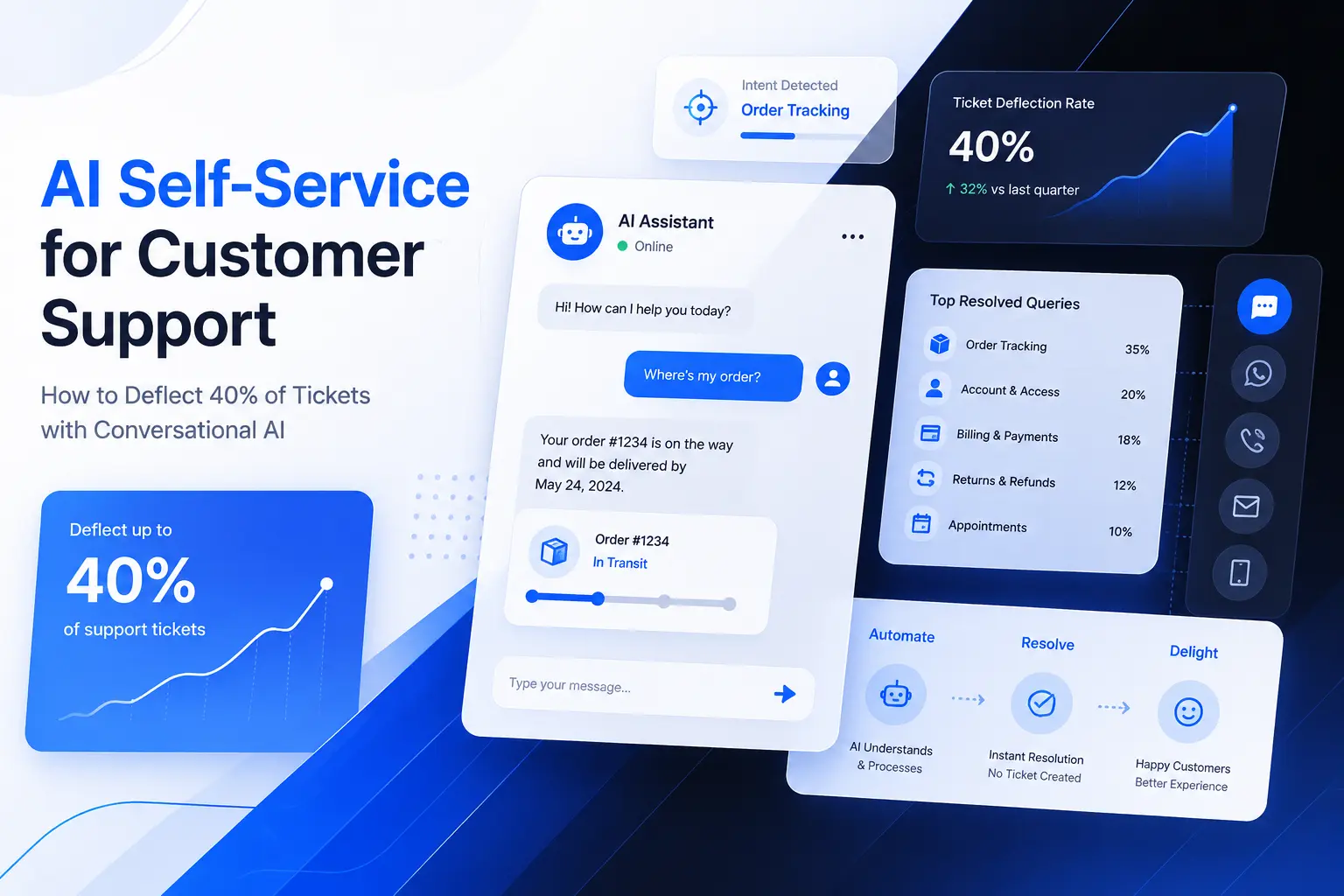
At 9:07 AM on a Monday, your support queue is already overflowing.
Customers are asking the same questions they asked yesterday:
“Where’s my order?”
“How do I reset my password?”
“I was charged twice.”
“Can I reschedule my appointment?”
Your agents are busy. Wait times are rising. CSAT is slipping. And despite hiring more people, the ticket volume keeps growing faster than the team can handle.
Now imagine a different scenario.
A customer opens your website chat at midnight. An AI assistant instantly understands the issue, verifies the account, pulls data from backend systems, and resolves the request in under two minutes. No wait time. No human intervention. No ticket created.
That’s what modern AI self-service is starting to make possible.
Modern conversational AI is no longer limited to scripted chatbots that frustrate customers. Today’s omnichannel AI systems can understand intent, maintain context across channels, automate workflows, and resolve a large percentage of repetitive support requests without involving an agent.
For support teams dealing with large ticket volumes, this can take a huge amount of pressure off agents.
The goal isn’t to remove human agents from support. It’s reducing unnecessary tickets so agents can focus on conversations that truly require human judgment.
In this blog, we’ll explore how conversational AI helps businesses deflect up to 40% of support tickets, where those results realistically come from, which support queries are ideal for automation, and how to measure whether your self-service strategy is actually working.
Why Ticket Volume Keeps Increasing
Most support teams don’t struggle because customers are impatient.
They struggle because support demand scales faster than operational capacity.
As businesses expand across channels like website chat, WhatsApp, email, voice, and mobile apps, customer expectations change dramatically. Customers no longer want to “submit a ticket” and wait hours for a reply. They expect immediate answers, contextual conversations, and resolution without friction.
The problem is that a huge percentage of incoming tickets are repetitive.
Password resets.
Refund status.
Delivery tracking.
Subscription updates.
Appointment confirmations.
Basic troubleshooting.
These interactions consume thousands of agent hours despite being highly predictable.
This is where AI can genuinely reduce the load on support teams.
Instead of forcing agents to repeatedly answer low-complexity questions, AI self-service systems handle those interactions instantly and at scale.
The impact goes beyond reducing ticket volume. It’s faster resolution, reduced operational costs, and a dramatically better customer experience.
How Does Conversational AI Reduce Support Ticket Volume?
Conversational AI reduces ticket volume by resolving customer issues before they ever become human-assisted support interactions.
Traditional support automation relied heavily on rigid workflows:
“Press 1 for billing.”
“Choose from these six options.”
“Type YES to continue.”
Modern conversational AI works differently.
It understands natural language, identifies intent, retrieves contextual information, and takes actions across backend systems in real time.
Instead of merely routing customers, AI can actually solve problems.
For example:
- A customer asks for the order status
- AI pulls live shipment data from the logistics system
- The customer receives an immediate update
- No ticket is generated
Or:
- A customer wants to change a subscription plan
- AI verifies identity
- Presents available plans
- Processes the update automatically
- Confirms completion instantly
Again, no human agent is involved.
This is called ticket deflection.
But successful AI self-service is not only about answering FAQs. The biggest gains happen when conversational AI integrates deeply with operational systems like CRM platforms, payment gateways, order management tools, scheduling systems, and knowledge bases.
The more actions AI can complete autonomously, the higher the deflection rate becomes.
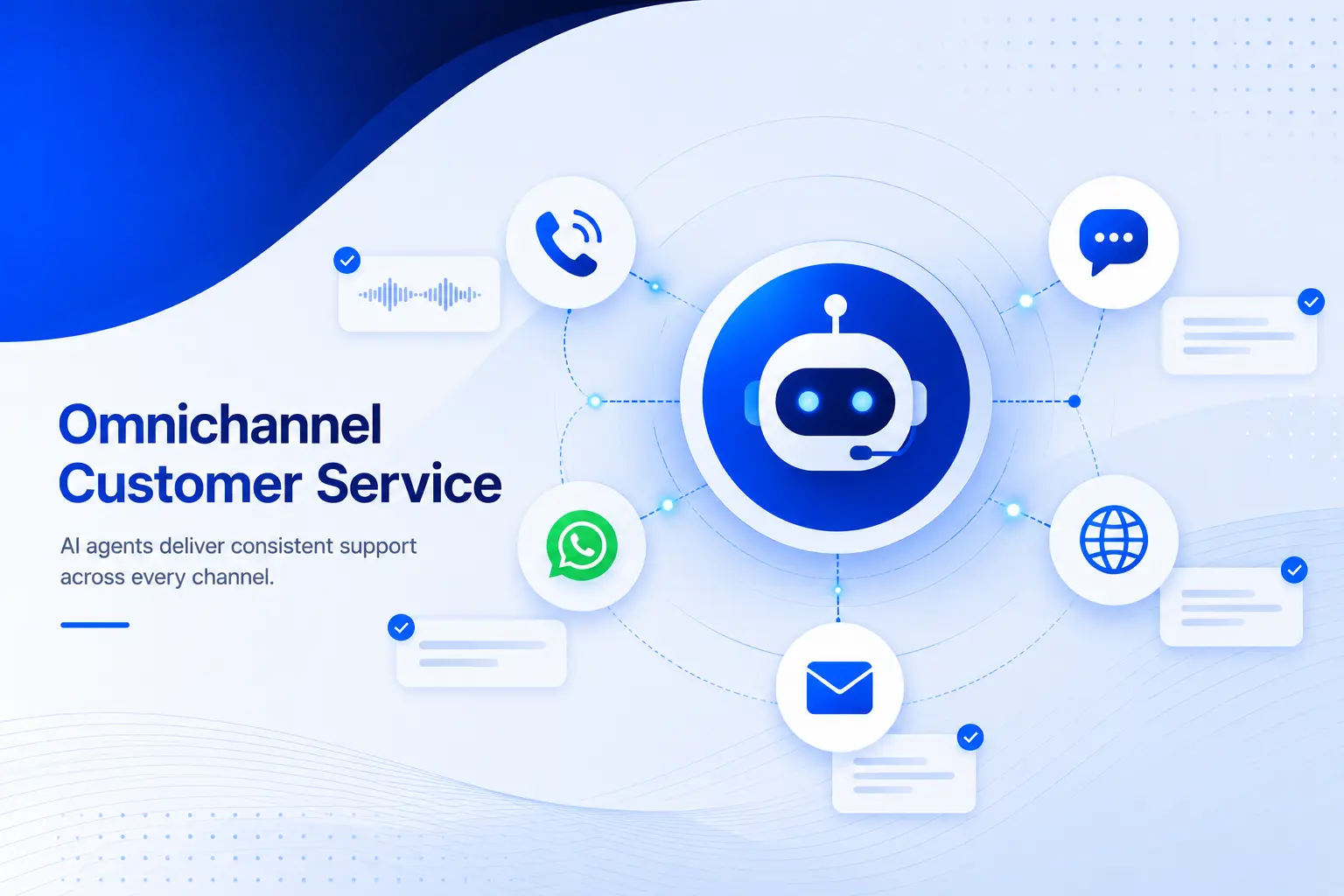
Another major advantage is omnichannel continuity.
Customers may start a conversation on WhatsApp, continue on web chat, and escalate to voice support later. Omnichannel conversational AI maintains context across those touchpoints, reducing repetition and accelerating resolution.
That continuity alone significantly lowers frustration-driven ticket escalations.
See how conversational AI fits into your workflows with a quick Convin walkthrough.
What Deflection Rates Are Realistic With Omnichannel AI?
One of the biggest misconceptions around AI self-service is the belief that automation can eliminate most support operations overnight.
In reality, sustainable ticket deflection depends on several factors:
- Query complexity
- Backend integrations
- Knowledge base maturity
- Channel coverage
- Conversation design
- Escalation quality
For most businesses, realistic outcomes look like this:
The important point is that deflection is cumulative.
You don’t achieve 40% ticket reduction through one chatbot launch. You achieve it by continuously identifying repetitive interactions and automating them incrementally.
The highest-performing AI self-service systems typically focus on:
- High-volume repetitive requests
- Authentication-enabled workflows
- Transactional support actions
- Proactive customer engagement
- Intelligent routing and escalation
Another critical factor is channel adoption.
If customers primarily contact support through voice calls but AI is deployed only on website chat, deflection potential remains limited.
Omnichannel AI expands automation coverage across:
- Website chat
- Mobile apps
- Voicebots
- SMS
- Social messaging platforms
The broader the channel coverage, the larger the operational impact.
This blog is just the start.
Unlock the power of Convin’s AI with a live demo.

Which Query Types Are Best Suited for AI Self-Service?
Not every support interaction should be automated.
The best AI self-service strategies identify where automation improves customer experience instead of creating friction.
Generally, conversational AI performs best when requests are:
- Repetitive
- Rules-based
- Transactional
- Low emotional sensitivity
- Process-driven
Some of the most successful use cases include:
- Account and Authentication Requests
These are among the easiest workflows to automate.
Examples:
- Password resets
- OTP verification
- Login assistance
- Account unlocking
- Profile updates
These interactions are highly structured and can often be completed entirely without agent involvement.
- Order Tracking and Delivery Updates
Customers frequently contact support simply because they lack visibility.
Conversational AI can instantly retrieve:
- Shipment status
- Delivery ETAs
- Tracking links
- Delay explanations
- Pickup schedules
Providing real-time answers prevents customers from escalating simple information requests into tickets.
- Billing and Payment Queries
Many billing-related requests follow predictable workflows:
- Invoice downloads
- Payment confirmations
- Subscription renewals
- Refund status
- EMI details
- Plan upgrades
AI systems integrated with billing platforms can resolve these efficiently while reducing pressure on finance support teams.
- Appointment Scheduling and Rescheduling
Healthcare, banking, automotive, education, and service industries handle massive scheduling volumes.
AI can:
- Check availability
- Confirm appointments
- Reschedule bookings
- Send reminders
- Trigger cancellations
This significantly reduces inbound support demand while improving operational efficiency.
- Product and Troubleshooting Guidance
Conversational AI can also guide customers through step-by-step troubleshooting using:
- Knowledge bases
- Interactive flows
- Dynamic decision trees
- Context-aware recommendations
In many cases, customers prefer self-service because it provides immediate resolution instead of waiting for an agent.
Schedule a quick session to map your top automation opportunities.
Where Human Agents Still Matter in AI Self-Service
AI self-service is powerful, but it works best when it knows its limits. The goal is not to replace human agents entirely, it is to ensure humans are focused only on conversations where they truly add value.
Here’s where human involvement remains essential:
• Complex or emotionally sensitive customer issues
Not every customer interaction is transactional. Some situations involve frustration, urgency, or emotional stress, like unresolved complaints, service failures, or repeated support loops.
In these cases, customers don’t just want an answer; they want reassurance, ownership, and empathy. Human agents are far better equipped to handle tone, emotion, and nuanced communication that builds trust and defuses tension.
• Retention and high-stakes commercial conversations
When a customer is considering cancellation, downgrade, or switching providers, the conversation becomes strategic rather than operational.
These interactions often require negotiation, persuasion, and contextual judgment based on customer history, value, and intent signals. AI can support insights, but human agents are critical for closing retention loops effectively.
• Fraud, billing disputes, and financial escalations
Any case involving money movement, fraud suspicion, or disputed transactions typically needs human oversight due to risk, compliance, and edge-case complexity.
Even if AI can identify and categorize the issue, resolution often requires cross-functional validation and careful decision-making that goes beyond automation rules.
• Advanced technical troubleshooting
While AI can handle common FAQs and guided troubleshooting, deeper technical issues often involve layered diagnostics, system-specific exceptions, or multiple dependencies.
These scenarios require human agents who can interpret context, ask follow-up questions, and coordinate with backend or engineering teams when needed.
• Edge cases that don’t fit predefined workflows
No matter how strong an AI system is, there will always be exceptions, unusual account states, rare product behaviors, or customer-specific configurations.
These “unknown unknowns” are where rigid automation breaks down, and human adaptability becomes essential.
How Do You Measure Self-Service Success in Conversational AI?
Many businesses evaluate AI self-service incorrectly.
They focus only on chatbot containment rates without measuring actual customer outcomes.
A successful conversational AI strategy should be measured across operational, customer, and business metrics.
- Ticket Deflection Rate
This measures how many interactions were resolved without human intervention.
A common formula is:
Ticket Deflection Rate= AI-Resolved Conversations/ Total Support Conversations×100
However, high deflection means nothing if customers remain dissatisfied.
That’s why additional metrics matter.
- First Contact Resolution (FCR)
This measures whether customer issues were solved in the first interaction without escalation or follow-up.
Strong AI self-service systems often improve FCR because customers receive instant responses instead of waiting in queues.
- Average Resolution Time
AI dramatically reduces resolution times for repetitive requests.
Instead of waiting hours for an email response, customers can resolve issues within seconds through conversational interfaces.
Lower resolution times directly improve customer satisfaction.
- Escalation Quality
A high-performing AI system should escalate conversations intelligently.
That means:
- Correct routing
- Preserved context
- Accurate intent detection
- Minimal customer repetition
Poor escalation experiences destroy trust even if deflection metrics appear strong.
- Customer Satisfaction (CSAT)
Ultimately, customers care about outcomes, not automation. If conversational AI resolves problems quickly and accurately, CSAT rises naturally.
But if customers feel trapped inside poorly designed automation loops, satisfaction declines rapidly. This is why conversational design matters just as much as AI capability.
The Future of Customer Support Is Preventive, Not Reactive
The next evolution of AI self-service goes beyond answering customer questions. It focuses on preventing support requests altogether.
Modern conversational AI platforms increasingly use predictive intelligence to:
- Detect customer friction early
- Trigger proactive notifications
- Recommend actions automatically
- Prevent operational issues from escalating
For example:
- Notifying customers about delayed shipments before they ask
- Suggesting payment retries before subscription failures occur
- Guiding users proactively during onboarding confusion
This transforms support from a reactive function into a proactive customer experience engine. And that shift fundamentally changes how businesses scale support operations.
What This Means For Your Business
AI self-service for customer support is no longer a future concept.
Businesses are already using conversational AI to automate repetitive workflows, reduce support costs, improve response times, and deflect a significant percentage of inbound tickets.
But successful implementation requires more than deploying a chatbot.
The real value comes from:
- Omnichannel consistency
- Backend integrations
- Intelligent escalation
- Continuous optimization
- Customer-centric conversation design
When done correctly, conversational AI doesn’t make support feel robotic.
It makes support feel effortless.
And in a world where customer expectations continue rising across every channel, effortless support becomes a serious competitive advantage.
Book a Convin demo to explore implementation in your support stack.
FAQs
1. Is AI self-service only suitable for large enterprises, or can SMBs use it too?
AI self-service is not limited to large enterprises. SMBs can actually benefit faster because they usually have high volumes of repetitive queries but limited support teams. Modern conversational AI platforms are increasingly low-code or no-code, making it easier for smaller teams to deploy automation for FAQs, order updates, and basic workflows without heavy engineering effort.
2. How long does it typically take to implement conversational AI for support automation?
Implementation timelines vary based on complexity. A basic AI chatbot integrated with FAQs can be deployed in a few days to a couple of weeks. However, deeper omnichannel AI systems that connect with CRMs, billing systems, and backend workflows usually take 4-12 weeks depending on integration depth, data readiness, and use case complexity.
3. Does AI self-service require a large knowledge base to function effectively?
Not necessarily. While a well-structured knowledge base improves accuracy, modern conversational AI can also work with existing documentation, help center articles, past ticket data, and even structured APIs. Over time, performance improves as the system learns from real interactions and is continuously refined.
4. Can conversational AI handle multilingual customer support?
Yes, most advanced conversational AI systems support multilingual interactions either natively or through real-time translation layers. This allows businesses to serve customers across different regions without building separate support teams for each language, while still maintaining consistent resolution quality.
5. What happens when AI gives an incorrect or incomplete answer?
When AI confidence is low or it cannot fully resolve an issue, it should escalate the conversation to a human agent with full context. Best-in-class systems also log these failures to improve future responses. This feedback loop ensures the system becomes more accurate over time rather than repeatedly making the same mistakes.




.avif)