

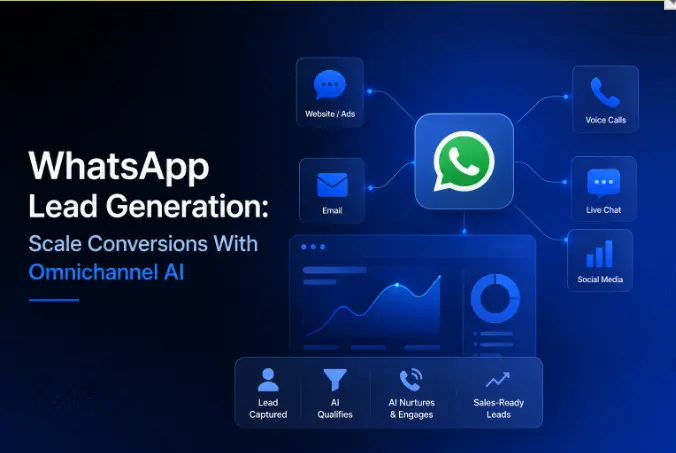
A potential customer clicks on your ad. For a moment, they’re interested, maybe even ready to buy. But before the conversation begins, another email arrives, a notification pops up, or they simply move on. By the time your follow-up reaches them, the lead has already gone cold.
This is why businesses are turning to WhatsApp lead generation. Unlike crowded inboxes or impersonal outreach, WhatsApp feels immediate and natural because it’s already part of everyday communication. Businesses can connect with leads while interest is still high, start real conversations instantly, and move prospects from first touch to qualification much faster.
Why WhatsApp Is the Most Powerful Lead Generation Channel Right Now
Many businesses still use WhatsApp like a basic support channel. But today, most high-intent customer conversations start there long before a purchase is made.
A prospect clicks an ad, explores a product, and sends a message expecting an immediate response. The faster and more relevant the conversation feels, the higher the chance the buyer stays engaged.
This is where an AI sales agent creates real impact.
Instead of delayed replies and disconnected follow-ups, AI keeps conversations active from the first message to conversion. It can answer product questions instantly, qualify intent, guide buyers toward the next action, and maintain momentum without making the interaction feel robotic.
When managed effectively, WhatsApp becomes more than a communication platform. It becomes a sales channel that helps businesses:
- respond instantly to buying intent
- keep leads engaged without delays
- deliver consistent conversations at scale
- reduce missed follow-ups and drop-offs
- move prospects smoothly toward conversion
The real challenge is not getting leads to message you. It is sustaining the conversation once they do.
According to McKinsey & Company's AI 2025 report, businesses are increasingly shifting toward AI-driven engagement systems that coordinate customer interactions across the full lifecycle rather than optimizing isolated touchpoints.
This shift is especially important for lead generation because modern customer journeys are no longer linear.
An AI-powered workflow removes the friction that typically slows sales teams down, making every interaction faster, more organized, and conversion-focused.
See how Convin’s WhatsApp CRM drives faster, organized conversations.
From First Touch to Qualification: The AI-Powered WhatsApp Workflow
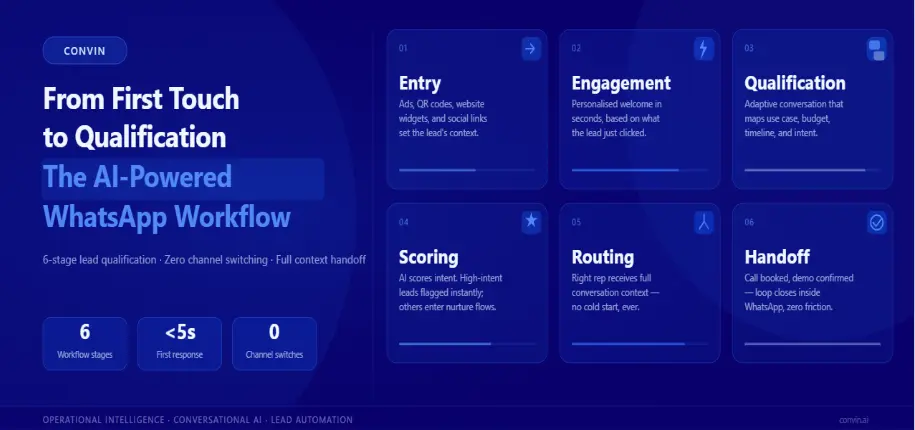
The workflow has six stages, and AI handles the majority of them without human involvement until the lead is genuinely ready to buy.
Stage 1- Entry point The lead initiates contact through a Click-to-WhatsApp ad, a QR code on packaging or a store display, a website chat widget, or a social media bio link. The entry point determines the initial context, what campaign they came from, what product they were looking at, what audience segment they belong to.
Stage 2- Instant engagement Within seconds, the AI sends a personalized welcome message based on the entry context. Not a generic greeting, a message that references what the lead just clicked or scanned. This matters because response speed is directly correlated with conversion probability. The longer the gap between interest and response, the lower the chance of conversion.
Stage 3- Qualification conversation The AI asks a structured but natural series of questions, use case, budget range, timeline, location, specific needs. This is not a form disguised as a chat. It is a genuine conversation where the AI adapts follow-up questions based on answers. A lead who mentions urgency gets a different path than one who is early in the research stage.
Stage 4- Lead scoring Based on the conversation, the AI assigns a score. High-intent leads, those who have a clear use case, a defined timeline, and have asked about pricing, are flagged for immediate human follow-up. Low-intent leads enter a nurture sequence. Unresponsive leads get a re-engagement trigger set at a behaviorally determined interval.
Stage 5- Routing High-intent leads are routed to the right sales rep or team with full context already attached, what they said, what they asked, what they were interested in. The rep does not start from scratch. They continue a conversation that has already been warmed.
Stage 6- Handoff confirmation The lead receives a confirmation on WhatsApp, a booked call, a demo scheduled, a follow-up time confirmed. The entire qualification-to-handoff loop closes inside the same channel where it started, with no friction and no channel switching required from the lead's side.
The entire process from first touch to qualified handoff can happen in under five minutes for a high-intent lead, and fully automatically, at any time of day.
Realistic AI WhatsApp Conversion Rates for B2C Leads in India
Benchmarks vary by industry, lead source, and the degree to which AI is integrated into the follow-up workflow. But the data available points to a consistent pattern: AI-qualified WhatsApp leads convert at significantly higher rates than form-based or cold outreach leads, and the gap widens as the omnichannel integration deepens.
At the channel level, WhatsApp chatbot campaigns achieve an average lead conversion rate of around 28%, compared to typical email campaign conversion rates of 2–5%.
The difference comes down to speed, engagement, and continuity of conversation. Email campaigns often rely on delayed responses and generic nurture sequences, while AI-powered WhatsApp workflows can engage leads instantly, ask qualification questions in real time, and route high-intent prospects directly to sales teams.
This also changes how quickly businesses can react to buying intent. Instead of waiting hours or days for manual follow-ups, AI workflows continue the conversation automatically and keep leads engaged throughout the decision-making journey.
Key advantages include:
- Instant response to inbound inquiries
- Automated lead qualification at scale
- Real-time routing to sales teams
- Personalized follow-up based on customer behavior
- Lower lead leakage across channels
This reduces lead drop-off and keeps conversations active while customer intent is still high.
The open rate advantage (90–98% on WhatsApp versus 20–25% on email) is part of the story, but the bigger factor is the quality of the conversation.
AI-powered WhatsApp workflows create two-way interactions instead of passive marketing touchpoints. Leads can ask questions, receive instant responses, share preferences, book appointments, complete applications, or get product recommendations within the same conversation thread.
This level of interaction increases both engagement and conversion quality because the conversation adapts dynamically to customer intent rather than following a fixed marketing sequence.
AI-powered conversations help businesses:
- Identify high-intent buyers earlier
- Reduce response delays
- Improve appointment booking rates
- Deliver personalized recommendations instantly
- Maintain engagement without manual intervention
For high-volume B2C businesses in India, this matters more than it might seem. When AI handles the initial conversation layer, qualifying intent and routing leads in real time, sales teams engage only with prospects who are already warmed up, compressing the funnel without adding headcount.
This continuous engagement helps businesses identify high-intent buyers earlier and move them through the funnel much faster than traditional lead capture methods.
A lead who has answered qualification questions and received a relevant, personalized follow-up is fundamentally different from one who filled out a form.
For Indian B2C markets specifically, a few industry-level benchmarks are worth noting:
Why Traditional WhatsApp Lead Generation Starts Breaking at Scale
WhatsApp automation works well initially because it improves response speed and reduces manual effort. Businesses often see immediate gains in:
- lead capture,
- appointment scheduling,
- and basic customer engagement.
But as lead volume increases, operational complexity grows rapidly.
Most businesses eventually encounter problems such as:
- repetitive follow-ups,
- fragmented customer data,
- disconnected sales conversations,
- poor prioritization,
- and inconsistent lead nurturing.
The issue is not WhatsApp itself.
The issue is treating WhatsApp as an isolated communication tool instead of part of a broader customer engagement ecosystem.
How Omnichannel AI Solves the WhatsApp Lead Generation Scaling Problem
The issue most businesses hit is not a WhatsApp problem. It is an architecture problem.
WhatsApp generates the conversation. But the systems sitting behind it, CRM, sales team, follow-up workflows, support queues, are not connected to it in real time. Every lead that comes in through WhatsApp requires a human to read it, interpret it, log it, assign it, and follow up. That process works at low volume. It breaks under scale.
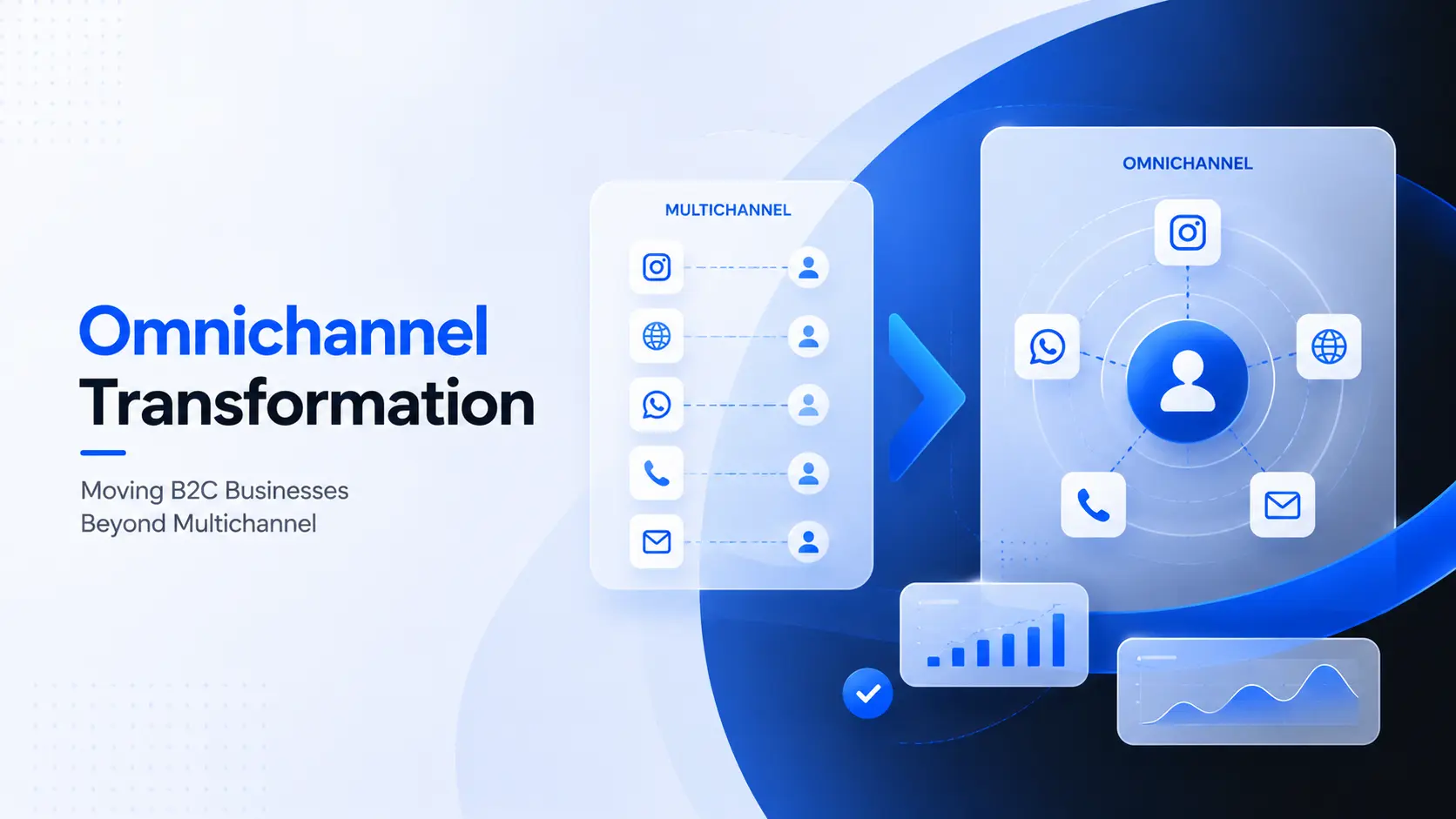
Omnichannel AI solves this by replacing the manual handoffs with an intelligent orchestration layer that connects WhatsApp to every downstream system automatically.
In practical terms, this means:
- Qualification happens in the conversation, not after it
Instead of collecting a name and number and passing it to a rep to qualify later, the AI qualifies the lead inside the WhatsApp conversation itself, scoring intent, identifying urgency, and routing only sales-ready leads to the human team.
- Context travels with the lead
When a lead moves from WhatsApp to a phone call to an email follow-up, the context does not reset. Every interaction updates the same customer record, and every follow-up action starts from where the last one left off, not from zero.
- Follow-ups trigger automatically based on behavior, not schedules
A lead who opens a product message but does not reply gets a different follow-up than one who asks a pricing question and goes quiet. Omnichannel AI reads those behavioral signals and responds accordingly, without a rep having to manually track each conversation.
- Volume stops being a constraint
A sales team of ten can only manage a certain number of active conversations simultaneously. An omnichannel AI layer has no such ceiling. Every lead gets an immediate, relevant, personalized response, regardless of when they reach out or how many others are doing the same.
The result is a lead generation system that gets more efficient as it scales, rather than one that demands more headcount every time lead volume grows.
This is the structural shift that separates businesses using WhatsApp as a messaging tool from those using it as a revenue engine.
This blog is just the start.
Unlock the power of Convin’s AI with a live demo.

The Future of WhatsApp Lead Generation Is Contextual AI
The future of lead generation is no longer about sending more messages or increasing outreach volume.
It is about understanding customers better across every interaction.
Modern buyers expect businesses to:
- remember previous conversations,
- personalize responses,
- respond instantly,
- and maintain continuity across channels.
This is why conversational AI is rapidly evolving into contextual customer intelligence.
According to McKinsey & Company's research on AI and customer personalization, businesses are increasingly investing in AI systems capable of orchestrating customer journeys rather than automating isolated tasks, with 41% of organizations reporting AI as a direct competitive differentiator in customer experience.
WhatsApp remains one of the most important engagement channels in this ecosystem.
But standalone automation is no longer enough.
Businesses that connect WhatsApp with omnichannel AI, conversational intelligence, and workflow orchestration will be far better positioned to improve conversions, reduce operational inefficiencies, and scale customer engagement sustainably.
How Convin Helps Businesses Scale WhatsApp Lead Generation
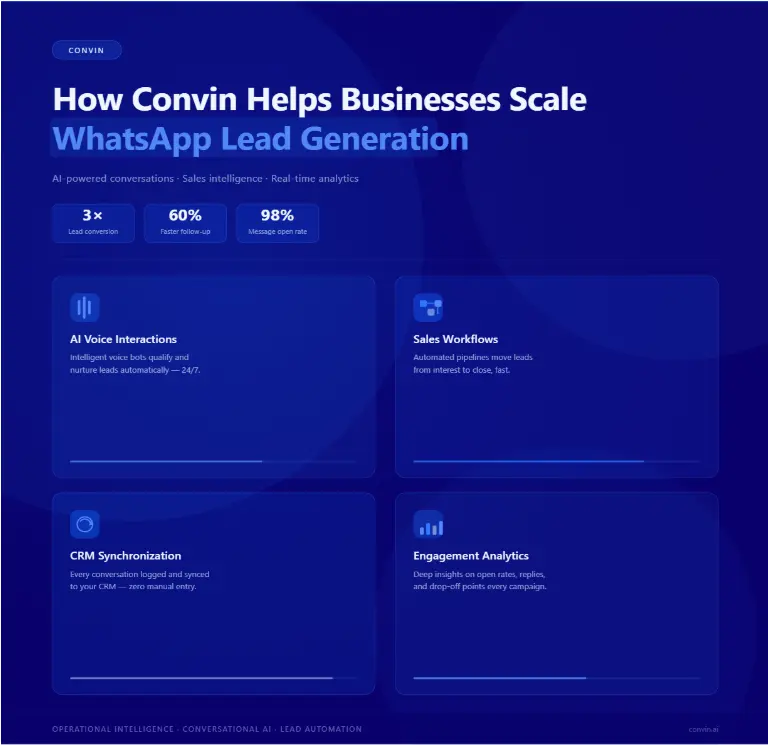
Many businesses already have CRM systems, sales teams, and WhatsApp workflows in place. The real challenge is connecting them intelligently.
Convin helps businesses transform WhatsApp lead generation into a connected omnichannel engagement system powered by conversational intelligence, AI automation, and real-time customer context.
Instead of operating through disconnected tools, businesses can unify:
- WhatsApp conversations,
- AI voice interactions,
- sales workflows,
- CRM synchronization,
- and customer engagement analytics
inside one operational ecosystem.
This allows sales teams to:
- qualify leads faster,
- automate follow-ups intelligently,
- reduce response delays,
- and maintain continuity throughout the buyer journey.
More importantly, Convin helps businesses scale lead engagement without sacrificing personalization or customer experience quality.
Scale WhatsApp lead generation intelligently with Convin AI. Book your demo.
What Is In For You
WhatsApp has evolved far beyond a simple messaging platform. For modern B2C businesses, it has become one of the most effective channels for engaging, qualifying, and converting leads in real time.
But generating leads on WhatsApp is only part of the challenge. The real advantage comes from combining WhatsApp with omnichannel AI that can maintain context, automate follow-ups intelligently, and keep customer conversations moving without friction. Businesses that build connected, AI-driven workflows will be far better positioned to scale conversions while delivering faster and more personalized customer experiences.
Ready to Scale WhatsApp Lead Generation? Book your Convin AI demo today.
FAQs
1. Can WhatsApp lead generation work for high-ticket sales?
Yes. High-ticket buyers need more touchpoints and qualifications. AI-powered WhatsApp workflows handle early nurturing and qualification, so sales reps engage only with informed, high-intent leads.
2. Does omnichannel AI replace human sales teams?
No. Omnichannel AI automates qualification, follow-ups, lead scoring, and routing, so sales teams can focus on closing high-intent leads and building relationships. The result is a more productive sales team, not a smaller one.
3. Can WhatsApp lead generation integrate with CRM platforms?
Yes. Omnichannel platforms sync WhatsApp chats with CRMs in real time, giving sales reps complete customer context automatically.
4. Why do many WhatsApp lead generation campaigns fail?
Most failures happen when businesses use WhatsApp for broadcasts instead of automated lead nurturing and qualification, causing leads to drop off after the first interaction.
5. Is AI-powered lead qualification suitable for small businesses?
Yes. Small businesses benefit greatly from AI qualification because it automates responses, lead scoring, and follow-ups, helping sales teams focus only on high-intent leads.




.avif)