

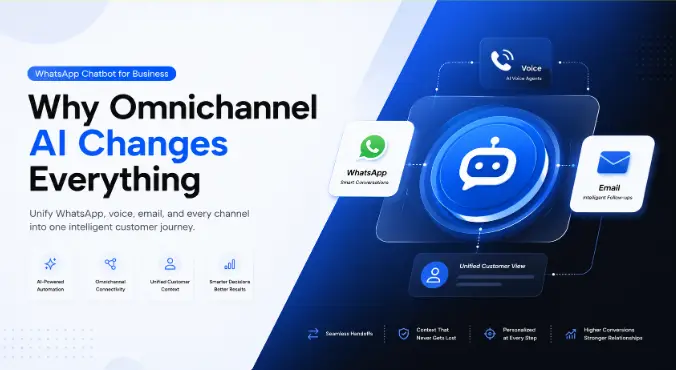
For years, businesses viewed a WhatsApp chatbot for business as the fastest way to modernize customer communication. The logic made sense: customers already live on WhatsApp, response times matter, and automation reduces support load.
Initially, the results look impressive.
Response times drop. Lead capture improves. Appointment reminders reduce no-shows. Basic support becomes scalable.
But as customer journeys become more fragmented across channels, businesses start discovering a deeper operational problem: the chatbot works, yet the customer experience still feels broken.
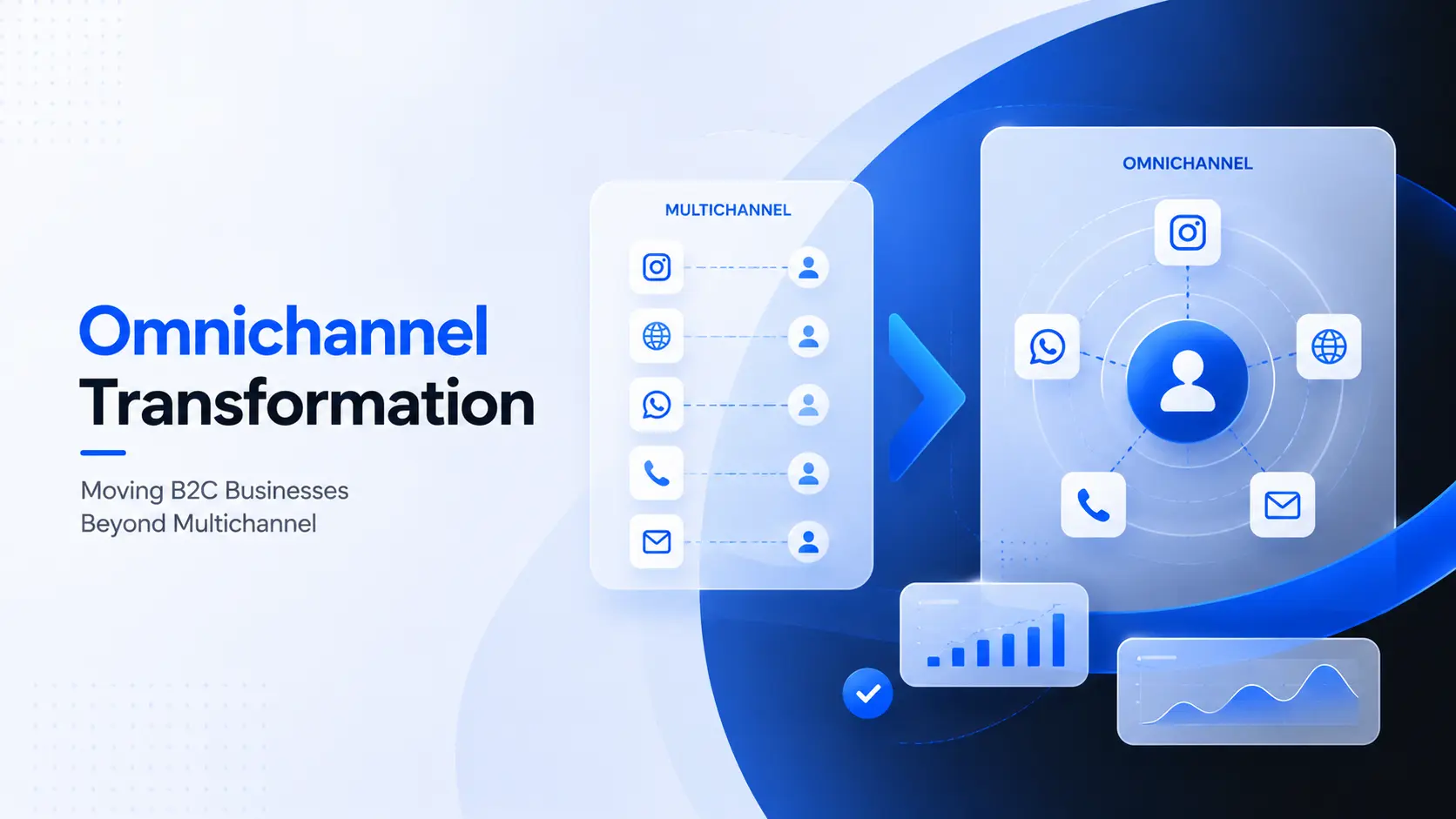
Customers no longer interact with businesses through a single channel. They may discover a brand on Instagram, ask questions on WhatsApp, switch to a phone call, follow up via email, and return later expecting continuity. Yet many standalone chatbots treat each interaction as a separate conversation, creating fragmented customer experiences and operational inefficiencies.
A 2025 McKinsey & Company report describes the future of customer engagement as the “next best experience,” where AI coordinates customer interactions across channels using integrated customer data. The focus is shifting from isolated automation to real-time orchestration across the entire customer journey.
Similarly, the 2025-26 Global Customer Experience Excellence research from KPMG found that leading organizations are shifting from fragmented automation toward unified AI-driven customer ecosystems designed around continuity, trust, and contextual engagement.
The question is no longer: “Do we need a WhatsApp chatbot?”
The real question is: “Can our chatbot understand the full customer journey?”
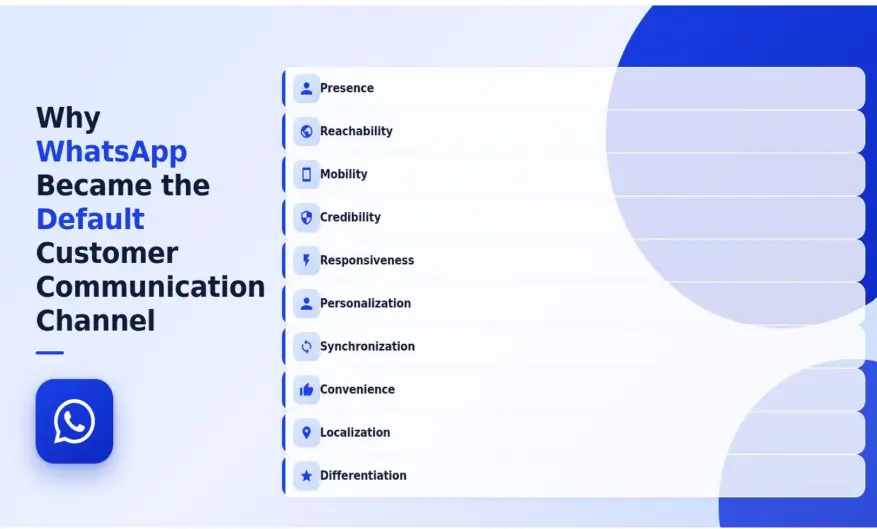
Why WhatsApp Became the Default Customer Communication Channel
Dealers manage their business through WhatsApp. They handle logistics, negotiate deals, track payments, and stay connected to their network through WhatsApp groups and direct messages. If your loyalty program exists only in an email channel or a portal, you’re already behind.
1. Attention Follows Where Communication Happens
Dealers receive hundreds of emails and portal notifications every week, many of which go unnoticed. WhatsApp messages, however, appear instantly on their phones and are far harder to ignore. Loyalty reminders, reward alerts, and tier updates sent through WhatsApp are far more likely to be seen and acted upon.
2. Conversational Accessibility
Email feels formal and one-sided. WhatsApp is conversational. Dealers can instantly ask about points, rewards, or eligibility and get quick responses, making engagement easier and more natural.
3. Mobile-First Business Operations
Most dealers manage operations directly from their phones while traveling, meeting customers, or handling inventory. Loyalty programs that depend on portal logins or email checks disrupt their workflow. WhatsApp fits seamlessly into how dealers already work.
Social Proof and Peer Influence
WhatsApp groups create dealer communities where members discuss rewards, share achievements, and ask questions. That peer-driven engagement often influences participation more effectively than direct brand communication. .
4. Rapid Feedback Loop
Dealers can quickly report redemption issues or ask for support directly within WhatsApp conversations. Faster responses build trust and prevent small frustrations from turning into dissatisfaction.
5. Personal Touch at Scale
WhatsApp communication feels more personal than automated emails. Tailored messages about rewards, tier upgrades, or category-specific offers create stronger engagement and improve program participation.
6. Integration with Business Workflows
Dealers already use WhatsApp for orders, logistics, payments, and coordination. When loyalty interactions become part of those workflows, the program feels integrated into daily business instead of functioning as a separate system.
7. Reduced Portal Fatigue
Dealers are overwhelmed with multiple vendor portals and logins. WhatsApp removes friction by bringing loyalty communication into a platform they already use constantly.
8. Cultural and Regional Relevance
In many markets, WhatsApp has become the default business communication platform. Loyalty programs built around email or portals often fail to match actual dealer communication habits.
9. The Competitive Advantage
Many legacy loyalty programs still rely on email and portal access. Businesses that make loyalty engagement conversational, responsive, and WhatsApp-native will see stronger dealer participation and higher long-term engagement.
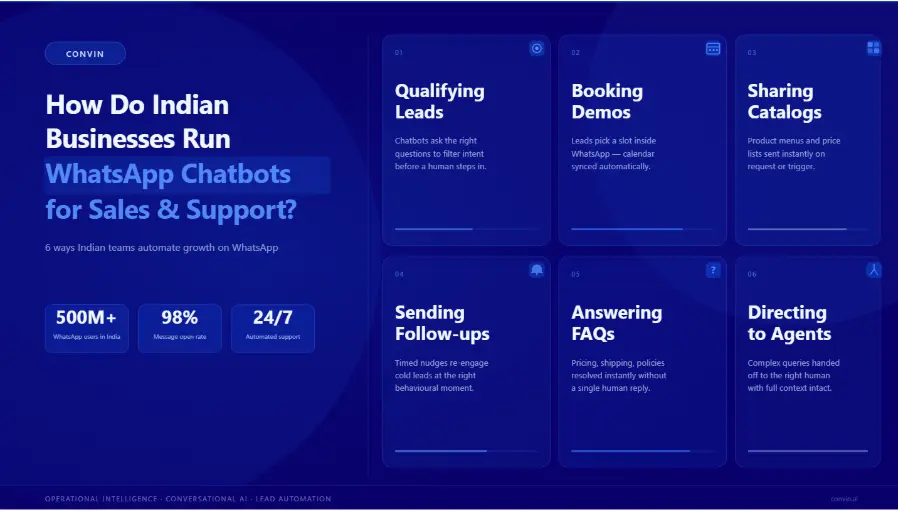
How do Indian businesses run WhatsApp chatbots for sales and support?
Most businesses in India no longer struggle with lead generation. Ads, websites, marketplaces, and referrals already bring consistent inquiries.
The real challenge is managing, nurturing, and converting those leads efficiently, especially when customers expect instant and personalized responses.
A WhatsApp chatbot for business helps automate this process by:
- qualifying leads,
- booking demos,
- sharing catalogs,
- sending follow-ups,
- answering FAQs,
- and routing conversations to the right teams.
For sales teams, this improves response speed and lead engagement at scale. For support teams, it simplifies ticket handling, updates, and post-purchase communication.
The biggest advantage comes when WhatsApp connects with omnichannel AI and CRM systems. Instead of isolated conversations, businesses gain shared customer context across sales and support journeys.
Platforms like Leads Loom help businesses centralize WhatsApp conversations and automate lead nurturing so no inquiry gets missed.
Most leads do not convert instantly. They need continuous follow-ups, relevant information, and timely engagement before making a decision.
Convert more leads with context-aware WhatsApp AI at Convin AI.
How a WhatsApp Chatbot Connects With Voice and Email in Omnichannel AI
A standalone WhatsApp chatbot can automate conversations. But modern customer journeys rarely stay inside one channel.
Customers may:
- start with a WhatsApp inquiry,
- switch to a support call during escalation,
- and expect updates through email afterward.
Without omnichannel AI, these interactions remain disconnected. Customers repeat information, agents lose context, and support experiences become fragmented.
An omnichannel AI platform solves this by creating a unified customer conversation layer across WhatsApp, voice, email, CRM systems, and support workflows.
Instead of treating every interaction separately, the system maintains a shared customer timeline where:
- previous conversations,
- call recordings,
- support tickets,
- purchase history,
- customer sentiment stays connected in real time.
For example, if a WhatsApp chatbot cannot resolve an issue, the system can automatically escalate the conversation to an AI voice agent or live support representative without losing context. Follow-up emails, CRM updates, and support notes are synchronized automatically.
This allows businesses to:
- reduce repeated verification,
- improve first-response resolution,
- personalize conversations,
- and maintain continuity across channels.
A modern omnichannel workflow typically combines:
- WhatsApp chatbots for instant engagement,
- AI voice agents for call automation,
- email workflows for follow-ups,
- and conversation intelligence for agent guidance and escalation tracking.
This is what transforms a WhatsApp chatbot from a simple automation tool into a connected customer intelligence system.
This blog is just the start.
Unlock the power of Convin’s AI with a live demo.

Where Standalone WhatsApp Chatbots Start Breaking
Most businesses initially deploy WhatsApp chatbots expecting end-to-end automation. The limitations become visible when conversations move beyond predefined flows.
Common Failures of Standalone WhatsApp Chatbots
A customer may discover your business on Instagram, continue the conversation on WhatsApp, call support later, and follow up through email. Without omnichannel AI, these interactions stay disconnected.
As a result, teams lose customer context, agents repeat questions, and customers experience fragmented support journeys.
This is why conversational AI platforms are evolving beyond standalone bots. Companies like Bland AI, Gong, and Observe.AI increasingly focus on conversation intelligence and unified customer insights rather than basic automation alone.
The competitive advantage today is not just automation, it is connected customer intelligence.
Eliminate fragmented conversations with omnichannel AI at Convin AI.
Omnichannel AI Changes the Role of WhatsApp Entirely
Many businesses think omnichannel AI simply means supporting multiple channels. In reality, it creates shared conversational memory across the customer journey.
Instead of treating interactions separately, omnichannel AI connects previous conversations, purchase history, unresolved issues, sentiment, and workflows in real time.
Without omnichannel AI, WhatsApp works as a standalone messaging channel.
With omnichannel AI, it becomes part of a connected customer intelligence system integrating chat, voice, CRM, routing, and analytics.
According to McKinsey & Company, businesses are increasingly adopting AI systems that combine automation with contextual customer understanding instead of relying on rigid scripted workflows.
As customer conversations grow across channels, fragmented automation leads to repeated verification, slower resolutions, and inconsistent experiences. Omnichannel AI solves this by coordinating interactions instead of automating messages in isolation.
Turn WhatsApp conversations into connected customer experiences.
The Future Is Not Chatbots. It Is Contextual Customer Intelligence.
The conversational AI industry is moving fast, and basic automation is no longer enough. Customers now expect businesses to remember them, anticipate their needs, and deliver consistent experiences across every channel. Most chatbot architectures simply weren't built for that.
The businesses pulling ahead are investing in connected AI ecosystems, not isolated tools. A WhatsApp chatbot for business is still a powerful starting point. But real competitive advantage comes from weaving it into a broader omnichannel intelligence layer that understands customers at every touchpoint, not just one.
FAQs
1. Can a WhatsApp chatbot support multilingual customer conversations?
Yes. Modern WhatsApp chatbots can support multiple Indian and global languages using NLP and AI translation capabilities for localized customer engagement.
2. Is coding required to deploy a WhatsApp chatbot for business?
Not always. Many platforms offer low-code or no-code builders that allow businesses to deploy chatbot workflows without heavy development effort.
3. Can WhatsApp chatbots integrate with payment systems?
Yes. Businesses can connect WhatsApp chatbots with payment gateways to enable invoice sharing, payment reminders, and transaction confirmations directly within chats.
4. How do businesses measure WhatsApp chatbot performance?
Common metrics include response time, lead conversion rate, customer satisfaction, resolution time, engagement rate, and escalation frequency.
5. Are WhatsApp chatbots suitable for small businesses?
Yes. Small businesses use WhatsApp chatbots to automate inquiries, manage leads, schedule appointments, and provide faster customer responses without expanding support teams.




.avif)