

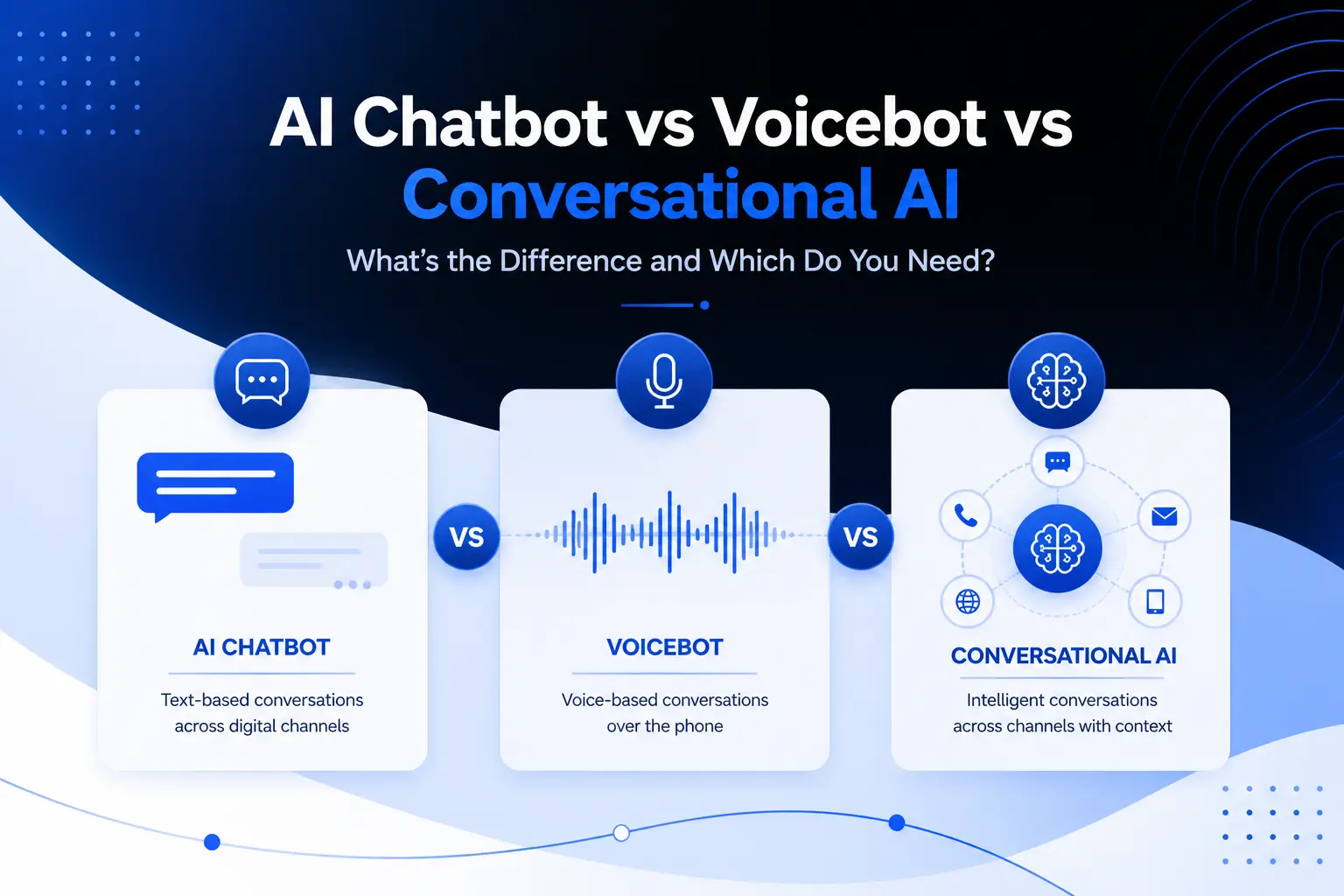
An AI chatbot is a text-based system designed to simulate human conversation through written interactions. You’ll typically find chatbots on websites, mobile apps, and messaging platforms like WhatsApp.
What makes modern chatbots powerful is their ability to go beyond scripted responses. Instead of just matching keywords, they use natural language processing to understand intent, so users can type naturally rather than follow rigid formats.
In a real-world scenario, imagine a customer visiting your website late at night. They want to know the status of their order. Instead of waiting for support hours, they simply type their query and receive an instant, accurate response. That’s where chatbots create immediate value.
Chatbots are especially effective in high-volume, repetitive environments answering FAQs, qualifying leads, or guiding users through simple workflows. However, they tend to struggle when conversations become complex, emotional, or require deeper context over time.
If you're exploring how chat-based automation fits into your workflow, platforms like Convin can give you a clearer picture of what your customers are actually asking and where a chatbot would make the most impact. Explore now!
A voicebot operates on the same principle as a chatbot, but instead of text, it communicates through spoken language. It allows users to talk naturally, while the system listens, processes, and responds in real time. Behind the scenes, voicebots combine speech recognition, natural language processing, and text-to-speech technologies. This makes them far more dynamic than traditional phone systems.
Think about calling a customer support line. Instead of navigating a long IVR menu, you simply say, “I want to check my account balance.” The system understands your request and responds instantly without requiring button presses.
Voicebots are particularly valuable in call center environments where handling large volumes efficiently is critical. They reduce wait times, improve accessibility, and allow customers to interact hands-free.
However, voicebots come with their own challenges. They need to handle accents, background noise, interruptions, and variations in speech, all of which make them more complex to implement than chatbots.
If your team handles a high volume of calls, analyzing those conversations is the first step before introducing automation. Tools like Convin help uncover repetitive call patterns, making it easier to decide where a voicebot can actually reduce load.
Convin helps identify calls best suited for voicebot automation.
Conversational AI is the intelligence layer that powers both chatbots and voicebots. It’s not limited to a single channel, instead, it connects conversations across multiple touchpoints and makes them feel continuous.
What sets conversational AI apart is its ability to understand context. It doesn’t just process a single query, it remembers past interactions, adapts responses, and creates a more personalized experience over time.
For example, a customer might start a conversation via chat, follow up through email, and later call support. Without conversational AI, they would have to repeat themselves at every step. With it, the system retains context and continues the conversation seamlessly.
This is where businesses move from basic automation to truly intelligent customer engagement. Conversational AI enables personalization, smarter routing, and deeper insights into customer behavior.
That said, it also requires more thoughtful implementation, integrating with CRMs, support systems, and data pipelines to deliver its full value. If you're thinking beyond single-channel automation, it's useful to understand how conversations flow across your entire customer journey.
See how Convin maps and analyzes interactions before full conversational AI setup.
This blog is just the start.
Unlock the power of Convin’s AI with a live demo.

While both serve a similar purpose automating conversations, their differences go beyond just text versus voice.
Chatbots are designed for environments where users prefer typing like browsing a website or sending a quick message. They are typically faster to deploy and easier to scale across digital channels.
Voicebots, on the other hand, are built for real-time spoken interactions. They’re ideal for call centers or scenarios where users need hands-free communication. However, they must handle the complexities of human speech, which adds another layer of technical difficulty.
Another key difference lies in user behavior. People tend to be more concise when typing but more conversational when speaking. This means voicebots often need to handle longer, less structured inputs.
In essence, chatbots and voicebots are not competing tools, they serve different contexts within the same customer journey.
Understanding how your customers prefer to interact- text or voice, comes from analyzing real interactions, not assumptions.
Convin helps uncover whether your customers prefer voice or chat interactions.
This is one of the most common misconceptions.
A voicebot is simply an interface, it enables voice-based interaction. Conversational AI, on the other hand, is the intelligence that makes those interactions meaningful.
Without conversational AI, a voicebot would behave like a traditional IVR system, limited, rule-based, and often frustrating. With conversational AI, it becomes capable of understanding intent, adapting responses, and managing context.
So while a voicebot can exist without conversational AI, it won’t deliver the kind of experience modern customers expect.
Think of conversational AI as the “brain,” and voicebots (or chatbots) as the “interfaces” through which that intelligence is delivered.
A quick way to validate this is by analyzing real conversations.
The right choice becomes clearer when you map your problem to the type of solution. Instead of thinking in terms of features, think in terms of where your conversations are breaking down.
Traditional IVR systems where users press numbers to navigate menus are quickly becoming outdated.
They are being replaced not by a single solution, but by a combination of technologies.
Voicebots are taking over the voice channel by enabling natural, speech-based interactions instead of rigid menu navigation. Conversational AI enhances this by making those interactions smarter and more context-aware. Meanwhile, chatbots handle similar queries across digital channels.
The key shift is from menu-based navigation to intent-based interaction.
Instead of pressing multiple buttons to reach the right option, users can simply say or type what they need and the system understands.
This shift dramatically improves user experience while reducing friction and handling time.
However, replacing IVR effectively requires more than just adding a voicebot. It involves understanding user intent patterns, redesigning conversation flows, and ensuring the system can handle real-world variability.
If you're considering moving away from IVR, the first step is to analyze how customers currently navigate your system. Convin can help uncover where users drop off or struggle so your transition to modern automation is grounded in real insights.
1. Can a chatbot and voicebot work together in the same system?
Yes, and in most mature setups, they should. A chatbot and voicebot can be connected through a shared conversational AI layer, allowing users to switch between chat and voice without losing context. This creates a more seamless experience, especially when customers move across channels during a single journey.
2. How long does it take to implement a chatbot or voicebot?
A basic chatbot can go live in a few weeks, especially for FAQs or lead capture. Voicebots typically take longer due to added complexity like speech recognition and call flow design. A full conversational AI platform may take a few months, depending on integrations, data readiness, and use cases.
3. Do these systems require constant training and updates?
Yes, but not in a manual, overwhelming way. Modern systems improve through usage data learning from real conversations, identifying missed intents, and refining responses. Regular optimization is still important, especially as customer queries evolve over time.
4. What kind of data do you need before implementing conversational AI?
You don’t need perfect data, but you do need conversation history, chat logs, call recordings, or support tickets. This helps identify common queries, intent patterns, and gaps. The more real interaction data you have, the more accurate and effective your system will be from the start.
5. How do you measure success after implementation?
Success isn’t just about automation rates. Key metrics include resolution time, containment rate (queries handled without human agents), customer satisfaction, and conversation quality. The goal is not just to reduce workload but to improve the overall customer experience.


.avif)